
Before you even think about how to create a book outline, let’s have a quick chat. What is this book really about? I mean, deep down in its soul. If you had to explain it in one single, powerful sentence, what would it be? This sentence is your North Star. It’s the guiding light that will keep every chapter, every story, and every piece of advice perfectly aligned.
Think of it as the anchor for your entire beautiful, messy, wonderful project.
Your Book Is a Legacy, Not a To-Do List
Let’s be honest. The thought of writing a book can feel absolutely massive. It’s less like a project and more like deciding to build a cathedral by hand, stone by stone. That sheer weight can be paralyzing. It can quickly turn a beautiful dream into just another dreadful item on your to-do list, stuck somewhere between “clean out the garage” and “finally organize the spice rack.”
But a book isn’t just another task to check off. It’s a piece of you. It’s the culmination of your wisdom, your funniest anecdotes, and your hardest-won lessons. It’s a direct conversation with future generations, a physical object that will sit on a shelf long after we’re all just digital memories. That’s both an incredible honor and, frankly, a little terrifying.
The pressure to “get it right” can stop you cold before you even type the first word. So, I’m giving you official permission to forget about the act of writing for a moment. Forget chapter titles, word counts, and grammar. Before we lay a single brick, let’s just stand back, admire the land, and dream about the home we’re going to build.
Find Your Book’s One True Purpose
Every truly great book, whether it’s a heartfelt memoir or a game-changing business guide, has a single, beating heart. It has one core message it wants to leave with the reader. Trying to write without knowing this message is like setting sail without a compass. You’ll put in a lot of effort, but you’ll just end up going in circles.
So, before we even whisper the word “outline,” let’s find your book’s North Star.
To get started, I want you to ask yourself one simple but profound question:
If my reader could only remember one single thing from my book a year from now, what would it be?
That’s it. Don’t overthink it. Is it a feeling of hope? A practical business strategy? The understanding that they are not alone in their struggles? This one sentence is your anchor. Write it down, stick it on your monitor, and let it guide every single decision you make from here on out.
To help you nail this down, I’ve put together a simple framework. Thinking through these questions will bring incredible clarity to your project’s mission.
Defining Your Book’s North Star
| Guiding Question | Example for a Business Book | Example for a Memoir |
|---|---|---|
| Who is this book for? | Aspiring entrepreneurs in the tech space. | My grandchildren and their children. |
| What do they need to hear? | That building a great company culture is more important than chasing venture capital. | The stories of how our family survived hardship with resilience and humor. |
| How will they feel after reading? | Empowered, focused, and inspired to lead with empathy. | Connected to their roots, proud of their heritage, and hopeful for the future. |
| What is the one takeaway? | True leadership is about serving your team, not just managing them. | Our family’s strength comes from the love we’ve shared through five generations of beautiful chaos. |
This exercise isn’t just about how to create a book outline; it’s the first step in creating a book with soul.
And speaking of soul, sometimes the best way to protect your vision is to bring in a partner. Hiring a professional ghostwriter doesn’t mean you’re not the author. It means you’re the visionary, the architect who brings in a master builder to ensure your legacy stands tall and proud. It’s a true collaboration that honors your story while saving you from the headache of mixing all that cement yourself. It’s easier, more fun, and you get to see your vision brought to life without the late-night panic.
Not sure whether you need a ghostwriter or an editor?
If you already have 30,000+ words drafted, an editor at $3,000–$12,000 will serve you better than a ghostwriter at $40,000. The quiz sorts this out in five questions — honestly, even when the answer is the smaller job.
Finding the Right Bones for Your Story
Alright, you’ve nailed down the heart of your book. You know why you’re writing it and who it’s for. Now for the part that can feel a bit like staring into a closet full of clothes with no idea what to wear: How do you actually structure this beautiful, important story of yours?
If you just try to cram everything in without a plan, your book will feel like a jumbled mess. But don’t worry. This isn’t about inventing some complicated literary contraption. It’s about choosing a simple, strong skeleton that will hold all your incredible stories together. Think of yourself as an architect, not the inventor of gravity. The principles are already there; you just have to pick the right one.
This might sound a little old-fashioned, but creating a book outline has been an essential step for writers for, well, centuries. Long before the printing press, scribes used outlines to organize manuscripts, and the practice only became more vital as books became widespread. It’s a time-tested method for wrestling big ideas into a coherent shape. You can even dive deeper into the history of outlining and see how authors have been using this tool for ages.
This little decision tree can help you visualize which structure might be the best fit, all based on your book’s core purpose.
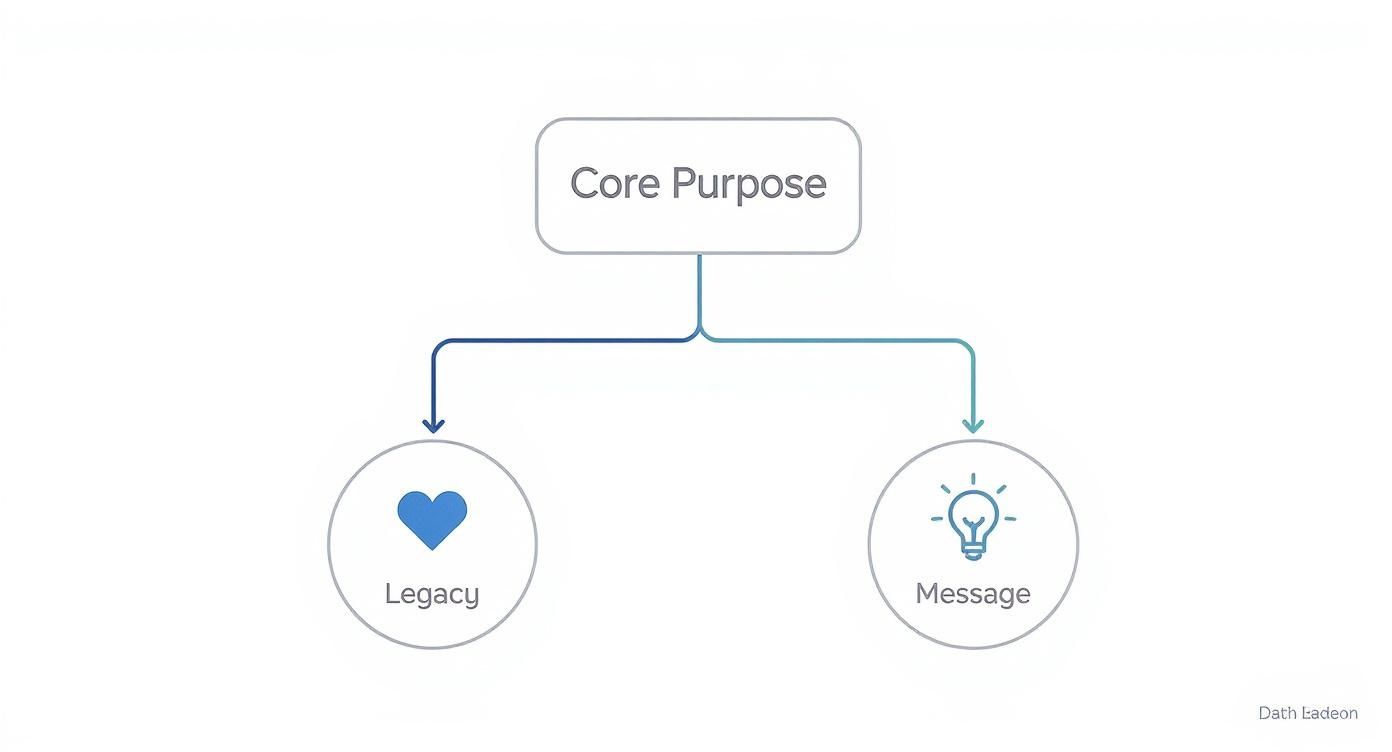
As you can see, the path you take depends entirely on whether you’re mainly sharing a life story or delivering a specific message. Let’s dig into the three most effective structures you can use.
The Chronological Path: From A to Z
This is the most straightforward and classic approach. You start at the beginning, and you end at the end. Simple. It’s the natural choice for most memoirs, family histories, and company origin stories. If you’re writing about your journey from a small-town kid to a successful CEO, this is your go-to.
- When it works best: For stories where the progression of time is central to the lesson. The whole point is the “how I got from there to here.”
- A real-world example: Think of a grandfather writing his life story for his family. He’d start with his childhood memories, move through his early career and marriage, and end with his reflections on family and legacy. Each chapter is another stepping stone in time.
This structure is comforting for readers because it’s so familiar. It lets them walk right alongside you on your journey.
The Thematic Approach: Grouping by Idea
Sometimes, a story isn’t about time; it’s about ideas. A thematic outline organizes your book into sections based on key concepts, lessons, or principles. This is an incredibly powerful way to structure business books, self-help guides, and leadership manifestos.
A thematic structure says, “It doesn’t matter when I learned these things; it matters that I’m sharing them with you now.” It’s all about delivering wisdom in the most impactful way possible.
Imagine a retired executive who wants to share her leadership philosophy. Instead of a chronological retelling of her career, she could organize her book around core themes:
- Chapter 1: The Power of Listening
- Chapter 2: Building Resilient Teams
- Chapter 3: Leading Through Crisis
Each chapter would pull stories and examples from different points in her career to illustrate that one central idea. It’s a brilliant way to demonstrate expertise and provide clear, actionable advice.
The Modular Design: Your “Greatest Hits” Album
The modular approach is a bit of a hybrid and offers fantastic flexibility. Think of your book as a collection of standalone essays or modules that all connect to a central idea but can be read in almost any order. This works beautifully for books of essays, devotionals, or legacy projects filled with short, digestible stories.
This structure is perfect if your stories don’t fit neatly into a single timeline or a rigid set of themes. It’s like creating a “greatest hits” album of your life’s wisdom. Each story or “track” stands on its own, but together, they create a powerful and cohesive experience for the reader. It’s less of a linear journey and more of a gallery tour of your most important moments.
Choosing your structure is a huge step. And if it feels overwhelming, remember you don’t have to go it alone. Bringing in a ghostwriter at this stage can be a game-changer. They are experts in story architecture and can help you see which “bones” will best support your legacy. It’s your vision, just with a master builder helping you make it unbreakable.
Building Your Chapter by Chapter Roadmap
Okay, deep breath. You’ve found your book’s soul, and you’ve picked a sturdy skeleton to hold it all together. Now for the really fun part, where your beautiful idea starts to look and feel like an actual, honest-to-goodness book.
This is where we build the chapter-by-chapter roadmap. And I promise, it’s way less scary than it sounds.
Forget everything you remember from high school English class about Roman numerals and endless sub-bullets. We’re not building a legal document; we’re storyboarding. We’ll keep it simple, creative, and maybe even use a sticky note or two. It’s time to take that big, beautiful structure and break it down into delightful, bite-sized chunks.
Each Chapter Is a Mini-Story
The secret to a great book outline is treating each chapter like its own self-contained story. Every single chapter needs a reason to exist. It needs a clear beginning, a compelling middle, and a satisfying end that makes the reader desperate to turn the page.
To get there, ask yourself two simple questions for every potential chapter:
- What is the one key takeaway for this chapter? Just like your book has a North Star, each chapter needs a guiding light. What is the single most important idea or feeling you want to leave with your reader?
- What story makes that point unforgettable? Facts tell, but stories sell. What anecdote, personal memory, or case study brings that key takeaway to life in a way your reader will never forget?
Thinking this way transforms the process from an overwhelming chore into a creative puzzle. You’re simply finding the right story to illustrate each powerful point. It’s less about brute-force writing and more about thoughtful, elegant design.
A Simple Template for Business Books
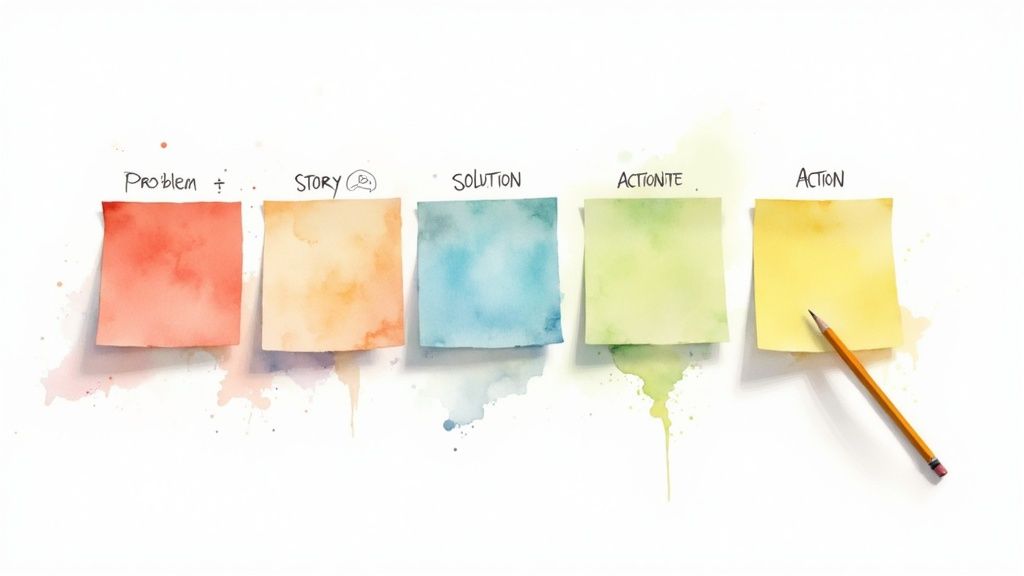
For those of you writing a business book, a leadership guide, or sharing your professional expertise, each chapter can follow a beautifully simple and effective pattern. This isn’t a rigid rule, but it’s a powerful starting point that ensures every chapter delivers real value.
Here’s a flow I’ve seen work wonders:
- The Problem: Start by introducing a common pain point your reader faces. What problem keeps them up at night?
- The Anecdote: Share a short, personal story of how you or a client faced this exact problem. Make it relatable.
- The Solution: Clearly explain the strategy, mindset shift, or tool you used to solve the problem. This is the “how-to” part.
- The Action Step: End with a clear, simple action the reader can take immediately. Give them a quick win.
This structure is a game-changer because it’s built around empathy and service. You’re not just lecturing; you’re guiding them from a shared struggle to a tangible solution. This is how you create a book that doesn’t just sit on a shelf but becomes a trusted companion.
An Emotional Arc for Memoirs
If you’re crafting a memoir or legacy book, the structure is more about emotional resonance than action steps. You’re inviting the reader into a specific moment in your life and helping them feel what you felt. Each chapter is a scene, a captured memory with its own emotional arc.
In a memoir, the goal of each chapter isn’t just to say what happened, but to reveal what it meant. You are guiding your reader to the heart of the lesson you learned.
Consider this framework for your memoir chapters:
- Setting the Scene: Paint a picture of the time and place. Who were you at that moment? What was the world like around you?
- The Turning Point: Describe the event, the conversation, the decision that changed everything. This is the moment of conflict or discovery.
- The Lesson Learned: Reflect on the aftermath. How did this turning point shape you? What wisdom did you gain that you can now offer the reader?
This approach ensures your stories aren’t just a random collection of memories. Instead, they become a connected series of profound lessons that build upon one another, creating a powerful and moving narrative.
To help you visualize this, I’ve put together a few fill-in-the-blank examples. These aren’t meant to be rigid formulas, but rather starting points to get your own creative ideas flowing.
Chapter Outline Template Examples
| Chapter Element | Business Book Example | Memoir Example |
|---|---|---|
| Chapter Title | Chapter 3: The Myth of the 24/7 Hustle | Chapter 3: The Summer I Worked the Line |
| Key Takeaway | True productivity comes from strategic rest, not burnout. | Hard, physical work taught me the value of my own two hands. |
| Opening Story | The story of when I hit rock bottom from exhaustion in my first startup. | Describe the sights, sounds, and smells of the factory floor at 18. |
| Main Points | 1. The science behind deep work. 2. How to implement the “90/20” focus rule. 3. Case study of a client who doubled revenue by working less. |
1. The grueling reality of the 12-hour shifts. 2. A memorable interaction with a coworker who became a mentor. 3. The moment I realized this wasn’t the life for me. |
| Closing Thought | A challenge to the reader to schedule their first “deep rest” block this week. | A reflection on how that summer’s discipline shaped my future work ethic. |
Playing with templates like these can make the whole process feel much more manageable. You’re just filling in the blanks for each chapter, one story at a time.
This chapter-mapping phase is where your book truly takes shape. It can also be the point where you realize having a co-pilot would make the journey a whole lot more fun. A good ghostwriter is a master of this process. They can help you mine your memories for the perfect stories and arrange them in a way that creates maximum impact. It’s still your roadmap, but they’re the seasoned guide who knows all the best routes.
Adding the Details Without the Drama
Your chapter-by-chapter roadmap is looking beautiful. It’s clean, organized, and probably hanging proudly on your wall or sitting as your desktop background. That’s a huge win.
But a book isn’t just a series of signposts; it’s the rich, vibrant country between them. It’s got texture, color, and depth. Now, we get to add the good stuff. The stories, memories, data, and hard-won wisdom that will make your book come alive. This is adding the meat to the bones, or maybe the tofu to the bones if that’s more your style.
This is often where the wheels can fall off. Suddenly, you’re staring at a lifetime of experiences, wondering which ones deserve a place in your legacy. How do you choose? Which stories pack the biggest punch? Which data points actually prove your argument? It can feel like trying to pack for a trip around the world using only a carry-on bag.
Let’s make this simple. We’ll add the details, but we’ll leave the drama behind.
Making Your Points Memorable
It’s not enough to just state a fact or share a lesson. You have to make it stick. The best way to do that is to wrap your ideas in stories, so they lodge themselves in your reader’s mind and heart.
A couple of simple, powerful techniques can help you do this beautifully.
First up is the Rule of Three. Our brains are wired to love patterns, and for whatever reason, three is the most powerful number in communication. When you’re making a point, try supporting it with three pieces of evidence. This could be three short stories, three eye-opening statistics, or three client testimonials. It feels complete, credible, and deeply satisfying to the reader.
Second is a little trick I lovingly call the Anecdote Sandwich. It’s a foolproof way to make any concept memorable.
- Top Bun: Kick things off with a personal, relatable story or anecdote that introduces a problem or idea.
- The Meat: Deliver the core lesson, the data, or the “how-to” advice. This is the main point you want your reader to walk away with.
- Bottom Bun: Circle back to the opening anecdote to show the resolution or reinforce the lesson you just taught.
This simple structure turns a dry explanation into an engaging mini-narrative that readers will actually remember.
Placing Your Stories for Maximum Impact
Not all stories are created equal. Some are funny little illustrations, and some are the earth-shattering moments that define a life. Your most powerful, emotional, and vulnerable stories are your crown jewels. Don’t just toss them in anywhere.
Think like a film director for a moment. Where will this scene have the most impact? Often, your most pivotal story belongs near the beginning to hook the reader and establish the stakes. Or, you might save it for the climax of the book, the moment of ultimate transformation.
Your most powerful stories are the emotional anchors of your book. Place them deliberately. Ask yourself, “What do I want my reader to feel right now?” and then place the story that will evoke that exact emotion.
This is a delicate art, and it’s one of the areas where a professional ghostwriter is worth their weight in gold. They are masters of narrative structure and can help you arrange your stories for a powerful emotional journey. It’s still your life and your lessons; they just know how to turn up the volume.
A Heart-to-Heart About Perfectionism
Okay, let’s talk. As you start adding these details, a sneaky little monster is going to creep in. Its name is Perfectionism.
It will whisper that your stories aren’t good enough, that you’ve left something important out, or that you need to rewrite that bullet point for the seventeenth time.
Please, I’m begging you, tell that monster to go take a hike.
Your outline is a living document, not a sacred text carved in stone. It’s a tool for creation, not a final exam you’re going to be graded on. Its entire purpose is to give you freedom and clarity, not to chain you to your first idea.
Give yourself permission for it to be messy. Give yourself permission to change your mind. The goal right now is forward momentum, not flawless execution. This process should feel energizing and creative, not draining and defeating.
Your story deserves to be told with joy, not anxiety. Keep moving.
The Secret Weapon: Your Ghostwriter-Ready Outline
Alright, you’ve wrestled that brilliant, sprawling idea out of your head and onto the page. You have a roadmap, a real, honest-to-goodness book outline. So, what’s next?
Let me let you in on a little secret used by some of the most successful people on the planet: they don’t do it alone. They hire a ghostwriter.
I can almost feel you hesitating. “Doesn’t that feel like cheating?” you might be thinking. Let me reframe that for you. If you were building your dream home, would you feel guilty for hiring an architect and a master builder? Of course not. You’re the visionary. You know what you want that home to feel like, the stories it will hold. The ghostwriter is simply the craftsperson who makes sure the walls are straight and the roof doesn’t leak.
It’s a powerful partnership. One that honors your story while saving you hundreds of hours staring at a blinking cursor. And your outline? It’s the single most important tool for making this collaboration work. Handing over a clear, thoughtful outline is like giving that master builder a perfect blueprint.
Creating the Ultimate Handoff Document
Think of your outline package as a “welcome kit” for your ghostwriter. The whole point is to get them inside your head so they can write in your voice. Your chapter map is the foundation, but to make it truly ghostwriter-proof, we need to add a few more ingredients.
Your handoff document should include:
- Your “North Star” Statement: Right at the top, remind them of the book’s core message. What’s the one thing you absolutely need readers to walk away with?
- Your Ideal Reader Profile: Who, specifically, are you writing for? “My grandson, Alex, who is 22 and just starting his career,” is a thousand times more helpful than “young professionals.” Give them a real person to picture.
- Your Voice and Tone: Are you witty and irreverent? Warm and wise? Direct and no-nonsense? Give them three to five adjectives that describe how you want the book to feel.
- A “Must-Have” Stories List: These are the non-negotiables. The anecdote about your first business failure, the hilarious tale of meeting your spouse. These are the heartbeats of your book, so make sure they’re flagged.
This extra layer of detail is what separates a good book from a great one. It eliminates the guesswork and empowers your writer to nail your voice from the very first page.
Don’t Forget the “Don’ts”
Just as important as what you want in the book is what you want to avoid. Your ghostwriter isn’t a mind reader, so be explicit about your boundaries and preferences. It’s a simple kindness that saves everyone a ton of time and revision headaches.
A great outline isn’t just a list of chapters. It’s a conversation starter. It’s the beginning of a creative partnership built on clarity, trust, and a shared vision for the incredible book you are about to create together.
This level of clarity is more critical than ever. The global book publishing market was valued at around $121.5 billion in 2023, and it’s only getting bigger. A well-prepared outline is your secret weapon to cut through all that noise and create a polished, market-ready manuscript faster. You can find more insights on the booming book publishing market on dataintelo.com.
Ultimately, preparing your outline for a professional is an act of profound self-respect. You’re acknowledging that your story is worthy of the best possible treatment. You bring the soul; they bring the sentence structure. Together, you’ll create a legacy that lasts forever.
Got Questions About Your Book Outline? Let’s Talk.
So, you’ve put in the work. You’ve brainstormed, figured out your “why,” explored different structures, and started mapping out your chapters. But even with a solid plan taking shape, it’s completely normal for a few questions to bubble up. In fact, it’s a great sign. It means you’re taking this seriously.
Feeling a bit wobbly or getting stuck is just part of the creative process. Everyone goes through it. Let’s tackle some of the most common questions we hear from authors. Think of this as grabbing a coffee with an old friend who’s been down this road before.
How Detailed Does My Outline Really Need to Be?
Ah, the big one. The honest-to-goodness answer? It needs to be as detailed as you need it to be to write with confidence. There’s no official Outline Police Force that’s going to show up at your door.
Some writers are “pantsers,” they thrive on discovering the story as they go. For them, a simple, one-page summary with chapter titles and a few key bullet points is all they need. It’s just enough of a guardrail to keep them on the road without stifling their creativity. That’s a perfectly valid approach.
However, for most of us, and especially if you plan on bringing in a ghostwriter, more detail is your absolute best friend.
Here’s a great rule of thumb to follow: Could someone else read this outline and understand the book’s core message, the emotional arc, and how one idea flows to the next? If the answer is yes, you’re in fantastic shape.
Your outline is a roadmap, not the finished highway. It’s meant to guide the journey, not document every single crack in the pavement. Aim for clarity, not perfection.
What if I Get Stuck or Want to Change Things Later?
First, take a breath. Getting stuck or changing your mind isn’t a sign of failure. It’s a sign you’re a creator. I can promise you, every author you’ve ever admired, from the big-name novelists to your favorite business gurus, has hit a wall, deleted a chapter, or had a brilliant new idea halfway through a draft. It’s not just normal; it’s a vital part of the process.
Your outline is a tool for freedom, not a prison. Its entire job is to make your life easier.
If a chapter suddenly feels flat, or you realize a much better way to connect two ideas, that’s a gift! Celebrate it. It is so much easier to rearrange a few bullet points in a document than it is to rewrite 10,000 painstakingly crafted words.
Think of your outline as being written in pencil, not permanent marker. Give yourself permission to let the project evolve. Your book will be infinitely richer for it.
Is It Cheating to Hire a Ghostwriter for My Outline?
Let’s put this idea to rest for good. No. Not even a little bit. In fact, collaborating with a ghostwriter on your outline is one of the smartest, most effective moves you can make to set your book up for success.
Think of it this way: would you say a visionary CEO is “cheating” if they hire an architect to design their new headquarters? Of course not. The CEO provides the vision, the purpose, and the “why.” The architect brings the expertise in structure, flow, and building materials to bring that vision to life.
A professional ghostwriter is a story architect. They know exactly how to pull your best stories out of you, see connections you might have missed, and organize your ideas for maximum impact. It is still 100% your vision, your voice, and your book. You’re simply bringing in a master builder to make sure the foundation is rock-solid. It’s not cheating; it’s strategy.
What Are the Best Tools for Making an Outline?
Honestly, the best tool is whichever one you’ll actually use. Don’t let the hunt for the “perfect” app become a clever form of procrastination. The real magic is in your ideas, not the software.
Here are a few solid options that just plain work:
- Google Docs or Microsoft Word: Can’t go wrong with the classics. They’re simple, accessible, and perfect for creating a straightforward outline with headings and bullets.
- Sticky Notes on a Wall: If you’re a visual thinker, this is for you. There’s nothing quite like physically moving your chapters and ideas around a room to see how they connect.
- Spreadsheets: Surprisingly powerful! A simple spreadsheet in Excel or Google Sheets is great for organizing chapters, key takeaways, and supporting stories in a clean grid format.
- Specialized Software: Tools like Scrivener or Trello are beloved by writers, but they do have a learning curve. Only go this route if you genuinely enjoy learning new tech.
Just pick one that feels right and get started. The real goal is to get those incredible ideas out of your head and onto the page.
At My Book Written, we believe bringing your book to life should be as rewarding as the story itself. Whether you’re just starting to organize your thoughts or you’re ready to find the perfect writing partner, our resources are designed to guide you with clarity and calm. Explore our guides and start your journey with confidence.
Writing something bigger than an assignment?
If this is research for a book you actually want to exist, the match quiz will tell you what it would cost and who could help.
Read next
What will your book cost?
Set the type, length and timeline. Get a real 2026 range in 30 seconds.
Open the calculator