
So, what in the world is a book outline template? It’s pretty simple. It is a structured guide that helps you organize all your brilliant ideas, plot points, and chapter summaries before you even think about writing the first draft. It’s the roadmap for your book, making sure your story flows logically from start to finish.
Think of it as the architectural blueprint for the beautiful house you are about to build. And let me tell you, it is an honor to build something that will last.
Conquering The Blinking Cursor Together
Let’s be real for a moment. The dream of writing a book is one of the most incredible things a person can have. It’s your chance to create something that lasts forever, a true piece of your legacy.

But the reality of it? Often, it’s just you, a quiet room, and a single, blinking cursor in a silent standoff. I swear you can hear it blinking sometimes. It’s in that deafening silence that so many amazing stories fade away.
Not yours, though. Not this time. We are going to get that story out of you and into the world.
Why Structure Is Your Best Friend
This is where a solid book outline template becomes your secret weapon. I once knew a wonderful gentleman who wanted to write his memoir. He decided to just “let it flow,” hoping inspiration would guide him. He ended up with 300 pages of charming but completely chaotic stories. I learned more about his cat, Bartholomew, than I did about the man himself. Bartholomew was a character, but he wasn’t the point.
The lesson was crystal clear. Structure does not stifle creativity; it builds a playground for it.
An outline isn’t a cage for your ideas. It’s a friendly map pointing the way to your own brilliance. It turns that daunting blank page into a welcoming invitation to finally begin your story.
Having a plan makes the entire process feel less like wrestling a bear and more like having a friendly chat over coffee. You know where you’re going, so you can relax and enjoy the journey of telling your tale.
You Are Not Alone On This Journey
The publishing world has changed dramatically. The number of self published books in the U.S. shot up by a mind boggling 1,233% between 2006 and 2023. More people than ever are sharing their stories, and you can, too. If you’re curious, you can find more details about this shift in the publishing world.
In fact, authors who use a book outline template report finishing their books 40-60% more often than those who do not. That’s a huge advantage, especially when you are trying to find the time and energy to get it all done.
Here’s what a good outline does for you:
- Beats Procrastination: It breaks a massive project down into small, manageable chunks. Instead of “write a book,” your task becomes “outline chapter three.” Much easier, right?
- Builds Confidence: Each section you fill out is a small victory that fuels your motivation to keep going. You can see your book taking shape.
- Ensures Cohesion: It makes sure your final book is a masterpiece, not a delightful mess like Bartholomew’s biography.
And remember, you do not have to do it all yourself. This is so important. Working with a professional ghostwriter can make this process genuinely fun and collaborative. They’re experts at helping you pull the stories out and fit them perfectly into your outline. It is still your vision, your voice, and your legacy, just with a helpful co pilot to navigate the tricky parts. It is easier, more fun, and you get a book you can be proud of. What’s not to love?
Not sure whether you need a ghostwriter or an editor?
If you already have 30,000+ words drafted, an editor at $3,000–$12,000 will serve you better than a ghostwriter at $40,000. The quiz sorts this out in five questions — honestly, even when the answer is the smaller job.
Choosing The Right Template For Your Story
Alright, let’s get down to it. You’re ready to build the house for your story, and now you need to pick the right blueprint. Just like you would not try to bake a cake in a wok, you should not try to force your story into the wrong structure. Choosing the right book outline template is all about finding one that feels like it was made just for your project.
It’s a powerful thing to create a book that will last forever, and my deepest desire is to make that journey as smooth and joyful as possible for you. Let’s walk through three distinct, easy to use templates I have developed for the kinds of stories people are most passionate about telling.
The Memoir Map For Your Life Story
Writing a memoir is a tricky business. It’s not just a timeline of everything that’s ever happened to you; it’s a focused journey with a theme, a lesson, or a feeling you want to leave with your reader. The Memoir Map is designed to help you navigate the beautiful, and sometimes foggy, landscape of your memories without getting lost.
This template helps you zero in on key moments, emotional turning points, and the central thread that ties your story together. Instead of trying to cram in every memory since kindergarten, this structure helps you cherry pick the moments that truly matter. For instance, my client who was a CEO wanted to write about her whole life. We ended up focusing just on the five years she spent launching her first company, because that was the story of transformation her readers needed to hear.
It prompts you to think about:
- The Catalyst: What event kicked your story into motion?
- The Core Conflict: What was the main struggle you faced, whether internal or external?
- The Transformation: How did you change from the person you were at the beginning to the person you were at the end?
This is the perfect template if you have ever thought, “I have so many stories, I do not know where to begin!” It gives you crucial anchor points to build around, turning a sea of memories into a clear, compelling narrative.
The Business Blueprint For Your Expertise
You are an expert in your field. You have years of hard won wisdom and game changing insights that could help thousands of people. The real challenge is getting all of that knowledge out of your head and into a book that builds your authority and genuinely serves your audience.
The Business Blueprint is structured to do exactly that. It’s less about a classic narrative arc and more about a logical, value packed progression of ideas. This template is all about organizing your expertise into a clear, actionable guide. Think of it like this: your reader has a problem, and your book is the friendly, step by step guide to the solution.
It’s built around a simple but incredibly effective framework:
- The Problem: Start by clearly defining the pain point your reader is experiencing.
- The Promise: Show them the better future that’s possible after reading your book.
- The Path: Lay out your step by step solution, with each chapter tackling a key part of the process.
This template is the fastest way to turn your ideas into a powerful tool that establishes you as a go to leader in your industry. It really works.
The Legacy Letter For Cherished Histories
Some books are not meant for the bestseller list. They’re for something infinitely more important: family. The Legacy Letter template is designed for creating a cherished family history, a collection of life lessons for your grandchildren, or a tribute to a loved one.
This is perhaps the most personal and heartfelt kind of book you can write. It’s not about plot twists or cliffhangers; it’s about preservation. The structure here is often thematic rather than strictly chronological. One client of mine organized her father’s life story not by date, but by his core values: integrity, humor, and family first. It was beautiful.
This template is your gentle guide to capturing the heart of a person or a family. It helps you organize stories around core values, funny inside jokes, treasured traditions, and the wisdom you want to pass down through generations.
Did you know that one of the most foundational storytelling frameworks, the Three Act Structure, has roots in ancient traditions? Industry data shows that 65-70% of successful novels still use some version of it. What’s more, manuscripts that follow a clear, proven framework see rejection rates from traditional publishers that are around 30% lower.
You can explore more about how structured outlines impact publishing success if you’re curious, but the takeaway is simple: structure helps create a story people connect with, even if that story is just for your family.
Which One Is Calling Your Name?
Still on the fence? Sometimes seeing it all laid out helps. This little chart should make it easier to see which template aligns best with your project’s goals.
Which Book Outline Template Is Right For You?
A quick comparison to help you choose the best starting point for your book project.
| Template Type | Best For | Key Focus | A Good Fit If… |
|---|---|---|---|
| The Memoir Map | Personal life stories, overcoming challenges, sharing a specific journey. | Narrative arc, emotional turning points, and personal growth. | You want to tell a compelling story about a specific period or theme in your life. |
| The Business Blueprint | Experts, entrepreneurs, coaches, and thought leaders. | Logical progression, actionable steps, and establishing authority. | Your goal is to teach a skill, share a methodology, or solve a specific problem for your reader. |
| The Legacy Letter | Family histories, tribute books, and passing down life lessons. | Thematic organization, emotional resonance, and preservation of memories. | The book is a personal gift for loved ones, meant to capture a person’s spirit or a family’s history. |
Ultimately, choosing the right book outline template is not about fitting your story into a box. It’s about finding the right container to hold its unique magic.
Take a moment and really think about the purpose of your book. Who is it for? What do you want them to feel when they finish the last page? The answer to those questions will point you toward the perfect starting place.
And remember, the outline is just the beginning. The next step is filling that structure with your voice. If that part feels daunting, that is where a ghostwriter can be your best friend. We are experts at listening to your stories and weaving them into the template, making the process not just easy, but genuinely joyful. It’s your vision, brought to life.
How To Fill Your Outline Using The Interview Method
Alright, you’ve done it. You have your shiny new book outline template, and it’s looking sharp. But… now what?
This is the moment where so many people get stuck. Staring at all those empty bullet points can feel just as intimidating as staring at a completely blank page.
Typing feels so different from talking, does it not? The second we sit down to write, our internal editor wakes up and starts judging every single word. But when we tell stories out loud, they just… flow.
That is why I want to share a technique we use with all our clients at My Book Written that completely changes the game. It’s called the interview method, and it’s designed to bypass that pesky inner critic entirely. We’re going to turn the daunting task of “writing” into a series of relaxed, casual conversations.
Talking Is The New Writing
The concept is beautifully simple. You grab your outline, find a comfortable chair, and have someone interview you about the topics you’ve laid out in each chapter.
This “interviewer” can be anyone, a trusted friend, a curious family member, or a professional ghostwriter. Their job is not to grill you; it is to listen and ask gentle questions that help you unpack your memories and ideas.
Suddenly, you’re not writing a book anymore. You are just sharing stories. You are just talking. All you need to do is hit “record” on your phone and let the magic happen.
This process works so well because it taps into the natural storyteller that lives inside all of us. No more wrestling with sentence structure or searching for the perfect word. You just speak from the heart, and the raw material for your book pours out effortlessly.
This simple process shows how a template guides you from a broad idea to a specific path for your book.
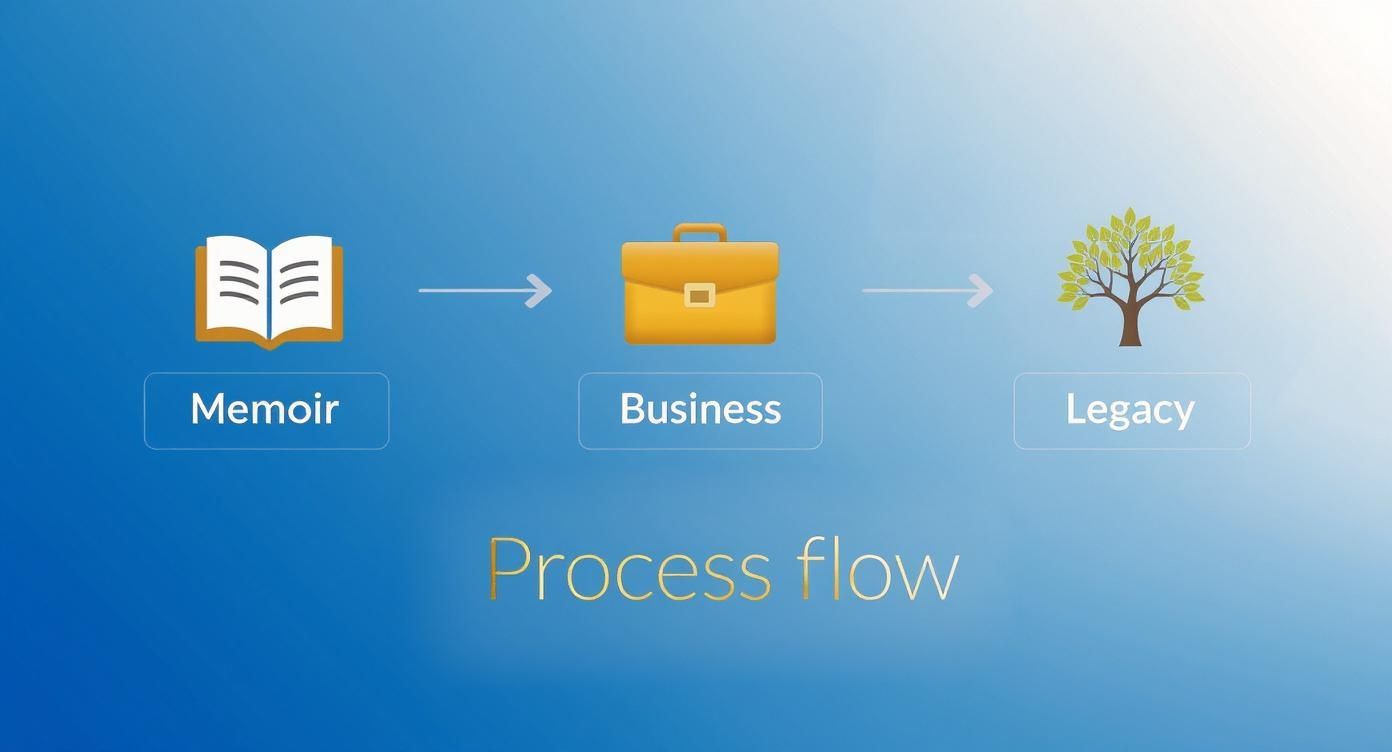
When you choose the right path first, the conversational journey of the interview method becomes much more focused and productive.
Spark Questions To Get You Started
To make this even easier, think of your interviewer’s questions as “sparks” designed to ignite your stories. You do not need a formal script. The real goal here is to start a natural conversation.
Here are a few sample spark questions I’ve used, tailored to each book outline template we discussed:
For The Memoir Map:
- Tell me about the first time you realized things were going to be different.
- What’s a story your family always tells about you from that time?
- Who was your biggest ally, and what did they teach you?
- Describe a moment you felt completely lost. What did you do next?
For The Business Blueprint:
- Can you walk me through the biggest mistake people make in this area?
- What was your “aha!” moment when you finally figured this out?
- If you were explaining this concept to a total beginner, where would you start?
- Tell me a story about a client who used your method and got amazing results.
For The Legacy Letter:
- What’s one piece of advice you wish you could have given your younger self?
- What was Grandpa’s funniest quirk that everyone remembers?
- Describe the feeling of our old family home during the holidays.
- What is the most important value you hope our family carries forward?
The interview method isn’t about getting perfect answers. It’s about unearthing the gold. The unpolished, authentic, and powerful stories are what will make your book unforgettable.
Honestly, working with a professional ghostwriter during this stage is a true joy. A great ghostwriter is an expert interviewer. They know precisely which threads to pull and what follow up questions to ask to uncover the deeper meaning hiding in your stories.
They create a safe, encouraging space where you can be yourself, knowing your spoken words will be skillfully transformed into a manuscript that honors your voice and vision. It’s the easiest, most fun, and most effective way I know to bring a book to life.
From Bullet Points to Book Chapters
Take a moment and look at what you’ve done. Your book outline template is not just a skeleton anymore; it is full. It’s packed with your notes, memories, and all those brilliant ideas you pulled from your interviews. This is a massive milestone. Seriously, feel proud of yourself. Now for the fun part: we get to start building.

This next phase is the bridge that takes us from a list of bullet points to the living, breathing body of your book. It’s where we turn those scattered gems of wisdom into a cohesive, compelling story. It sounds like a lot, but I promise it is more creative than daunting, and I will walk you through it.
Finding Your Themes
First things first, we need to do a little sorting. Think of it like panning for gold. You will go through all of your interview notes, the transcripts, audio files, everything, and start looking for the ideas that keep popping up. These are your themes.
Maybe you notice that you keep circling back to stories about resilience. Or perhaps five different anecdotes all touch on the importance of a key mentor in your life. These recurring patterns are the very soul of your book. They are the threads we will use to weave the entire narrative together.
Here’s a practical way to tackle this:
- Color code everything. Grab a few different highlighters and assign a color to each theme as it emerges. Go through your notes and mark up every story or point that fits a theme.
- Use sticky notes. If you prefer a more tactile approach, write a theme on a sticky note and slap it on the relevant page of your transcript.
- Tag your digital files. If you are working on a computer, use the comments or tagging feature in your document to label sections with themes like “Overcoming Fear” or “Early Career Mistakes.”
Suddenly, that mountain of information becomes a set of manageable, color coded piles. You’ll begin to see the book’s true structure emerge right from your own words.
Slotting Stories Into Chapters
With your themes identified, it is time to play matchmaker with your book outline. Let’s say your memoir outline has a chapter called “Finding My Footing.” You can now grab all the stories you highlighted in your “Early Career Mistakes” color and move them right into that chapter section.
This is where the magic really happens. That collection of ten different stories about bouncing back from setbacks can now be woven into a single, powerful chapter on overcoming adversity. Individual anecdotes transform into profound lessons, and scattered memories find their place in a bigger narrative arc.
It’s all about grouping related ideas so they can build on each other, creating chapters that flow beautifully and pack a real emotional punch.
You are not just filling in the blanks here. You are thoughtfully arranging your life’s key moments to tell a much bigger, more powerful story. This is where your wisdom truly takes shape.
This organizational work is precisely why using a detailed book outline is so powerful. A 2024 survey of 3,500 authors found that a staggering 73% of those who sell over 10,000 copies a year use them religiously. For nonfiction authors specifically, outlined books were finished 62% faster and earned higher quality ratings. If you want to learn more about how authors use outlines to achieve success, you’ll see just how critical this tool can be.
The Ghostwriter’s Superpower
I have to be honest, this stage is another one of those moments where having a professional ghostwriter on your team is a game changer. A skilled writer has an almost uncanny ability to see the connections in your stories. They can listen to everything you have shared and instantly spot the underlying themes you might miss simply because you are too close to the material.
They are masters of structure. It’s second nature for them to take your raw, brilliant material and arrange it into a narrative that flows like a river and keeps readers turning the pages. It takes all of that structural pressure off your shoulders.
Think of it this way: you have provided all the incredible, high quality ingredients. The ghostwriter is the master chef who knows exactly how to combine them into a Michelin star meal. It’s still your story, your flavor, and your vision, just presented in the most delicious way possible.
Common Mistakes to Avoid When Outlining
Writing a book is a huge undertaking. It is an incredible journey, but like any epic adventure, the path is full of a few traps and pitfalls. It is an honor to take on this kind of project, but let’s be real, it is also surprisingly easy to trip up right at the beginning.
So, let’s talk about the most common mistakes people make when using a book outline template. Think of this as your friendly guide to sidestepping the blunders that can stop a fantastic story before it even gets started. You will have your outline and be off to the races.
The “Kitchen Sink” Problem
First up is a classic I see all the time: trying to cram every single story, memory, and piece of advice you’ve ever had into one book. I call it the “kitchen sink” problem. It’s especially common with memoirs. One minute you are telling a powerful story about overcoming a business failure, and the next you’re on a long tangent about your third grade science fair project.
This impulse comes from a good place, the desire to share everything. But a book that tries to be about everything often ends up being about nothing at all. The focus gets lost.
The fix? I tell my clients to use the “Sequel Rule.” For every story you want to include, ask one simple question: “Does this directly serve the core message of this book?”
If the answer is no, do not just throw it away! Save it for the sequel. Giving yourself permission to write another book later is incredibly freeing. It helps you become ruthless in the best way possible, making sure every single page of this book is sharp, focused, and powerful.
Treating the Outline as Law
Next up is treating your outline like it is carved in stone. You spent all this time making a plan, and you are determined to stick to it, no matter what. But what happens when a more interesting, more powerful path reveals itself while you are writing?
Your outline is a map, not a straitjacket. Its whole purpose is to guide you, not to cage your creativity. The writing process itself is an act of discovery. You’ll unearth old memories, connect ideas in ways you never expected, and your story will start to take on a life of its own. That’s a good thing!
When you feel a pull in a new direction that makes your book stronger or more authentic, follow it. You can always go back and adjust the outline later. It’s a living document, meant to change and grow right alongside your story. Do not let your initial plan get in the way of your actual progress.
Getting Stuck in “Perfection Paralysis”
Finally, we have the sneakiest trap of them all: perfection paralysis. This is that endless loop of tweaking, refining, and reorganizing your outline until it’s “perfect,” which, of course, it never will be. Months can fly by while you are just shuffling bullet points around, all to avoid the scary (and wonderful) act of actually writing the book.
Your outline does not need to be perfect. It just needs to be good enough to get you going. Think of it as the scaffolding for a building, not the final, polished piece of architecture.
Here are a few tricks to break free:
- Give Yourself a Deadline: Set a firm, realistic deadline for finishing the outline. When that date arrives, you move on to Chapter One. No more excuses.
- The 80% Rule: Aim for an 80% perfect outline. That last 20%? You will only figure it out during the writing process anyway.
- Write One “Junk” Page: Just open a document and write. Let it be messy, imperfect, stream of consciousness. Sometimes, that one small act is all it takes to break the spell.
Navigating these challenges is all part of the process. If you are struggling, remember that a professional ghostwriter is like an expert guide for your journey. They have seen all these pitfalls before and know exactly how to steer you around them. They can help you decide which stories to save for the sequel, give you the confidence to follow a new narrative path, and give you that gentle nudge to start writing when you are stuck polishing the plan. It makes the whole process easier, more enjoyable, and helps you turn your vision into a finished book.
Your Book Outlining Questions Answered
Taking the leap to create a real, physical book is an amazing and worthwhile endeavor. Let us be real, though, it also kicks up a ton of questions. It is completely normal to feel a bit unsteady when you are trying to turn a brilliant concept into a workable plan.
So, let us tackle a few of the most common questions I hear. My genuine hope is to give you that shot of confidence you need to push forward.
How Detailed Should My Book Outline Be?
This is the big one, is it not? The best way I can describe it is like following a recipe. A simple list of ingredients is a start, but you will feel a whole lot better about what you’re cooking if you have clear, step by step instructions.
I always suggest starting with the major “tentpole” ideas for each chapter. Once you have those pillars in place, you can start layering in the smaller anecdotes, key takeaways, or specific notes that will bring those big ideas to life.
A great rule of thumb is to have at least 3 to 5 solid bullet points under each chapter heading. That gives you a fantastic roadmap without getting you stuck in perfection paralysis. Trust me, the more detail you can sketch out now, the smoother the actual writing process will be later.
What If My Story Changes While I Write?
That is not just okay, it is a great sign! It means the creative process is working exactly as it should. Your book outline is meant to be a map, not a straitjacket.
If you find a more compelling or scenic route while you are writing, by all means, take it. The outline’s only job is to give you a sense of direction, not to chain you to a specific path. Think of it as a living, breathing document.
When a new idea pops up that strengthens your book’s core message, just go back and adjust the map. This is also where a professional ghostwriter can be a lifesaver. They are absolute pros at weaving in these new discoveries while ensuring the book’s overall structure stays strong and coherent.
Is Using a Ghostwriter Cheating?
Okay, let us put this one to bed for good. Is a CEO “cheating” when they hire a top tier speechwriter to help them deliver a powerful message? Of course not. They’re simply partnering with an expert to make sure their important ideas connect with the audience.
Think of a ghostwriter as your professional partner, a skilled artisan who helps you shape and articulate your vision. The ideas, the stories, the hard won wisdom, the heart of the book… that is 100% yours.
They’re the craftsperson building the beautiful vessel to hold your message. It’s a powerful collaboration that honors your legacy and produces a polished, professional book you can be incredibly proud of. It lets you focus on your genius while they focus on theirs. It is not easier, it is smarter, and frankly, a lot more fun.
At My Book Written, we create the calm, focused space you need to transform your expertise into a finished manuscript. If you’re ready to organize your ideas and bring your story to life, we’re here to help. Explore our resources at https://mybookwritten.com and let’s start building your legacy together.
Writing something bigger than an assignment?
If this is research for a book you actually want to exist, the match quiz will tell you what it would cost and who could help.
Read next
What will your book cost?
Set the type, length and timeline. Get a real 2026 range in 30 seconds.
Open the calculator