
At its core, a man vs self conflict is the battle a person wages within their own mind. It’s that internal tug of war with your own fears, beliefs, and desires that makes a story, whether fiction or memoir, truly unforgettable. It's the secret ingredient that turns a good book into a great one.
The Toughest Battle Is Always With Yourself
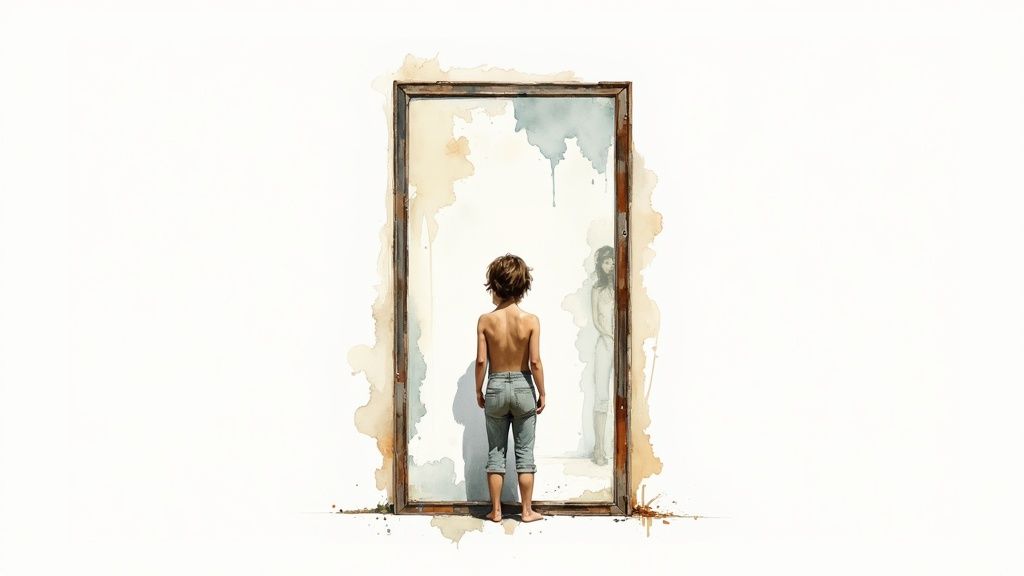
Let's be real for a moment. The idea of writing your life story can feel like trying to fold a fitted sheet. It’s awkward, confusing, and you’re pretty sure you’re doing it wrong. I get it. The biggest hurdle isn’t just finding the time to write; it’s wrestling with the story that's already living inside your head.
This is the very heart of man vs self conflict. Think of it as that debate club inside your mind where you’re the president, the treasurer, and the sole, very loud member of the opposition. It's an exhausting job, isn't it?
Understanding Your Inner Story
This internal battle is what elevates a memoir from a simple timeline of events to something much more profound. It transforms a dry recounting of "what happened" into a powerful exploration of "what it felt like." This is the secret sauce that makes a reader lean in and whisper, "I get it. I’ve been there."
The power of your story doesn’t come from a life free of struggle. It comes directly from those moments of deep internal conflict:
- Doubt vs. Courage: That nagging voice insisting you can't, pitted against the quiet whisper that says you must.
- Past vs. Future: The fight to let go of an old identity to make room for the person you’re becoming.
- Fear vs. Desire: Wanting something with every fiber of your being but being terrified of what it will take to get it.
Your internal struggles are not a weakness to be hidden. They are the very source of your story's power and the bridge that connects your experience to your reader's heart.
Thinking about these moments is tough. Getting them onto the page in a way that feels true is even tougher, which is why so many incredible stories remain untold. This is where partnering with a professional ghostwriter can be a complete game changer. They are skilled at helping you navigate this inner world, turning tangled feelings into a clear, compelling narrative.
It's still your story and your victory, you just have an experienced guide to help map the terrain. You get to be the hero, not the cartographer. And who doesn't want to be the hero of their own story?
Before we go deeper, here's a quick look at how these concepts fit together.
Quick Guide to Man vs Self Conflict
This table breaks down the essentials of internal conflict and shows why it's the engine of a powerful memoir.
| Core Concept | What It Looks Like in a Memoir | Why It Matters for Your Book |
|---|---|---|
| The battle is within. It’s a character wrestling with their own thoughts, fears, or moral compass. | A subject agonizing over a life-changing decision, fighting an addiction, or questioning their long-held beliefs. | It creates a deeply relatable and emotionally resonant story. Readers connect with vulnerability, not perfection. |
| It’s driven by a core contradiction. The character wants two opposing things at once. | Wanting to leave a toxic job for their passion project but being terrified of financial instability. | This tension is the "hook" that keeps pages turning. Readers need to know which side will win. |
| The resolution changes the character. Overcoming the internal struggle leads to growth. | The moment the subject finally forgives themselves, accepts a hard truth, or finds the courage to change their life. | This creates a satisfying character arc and delivers the book's core message or theme. |
Understanding this framework is the first step to finding the true heart of your story and sharing it with the world.
Not sure whether you need a ghostwriter or an editor?
If you already have 30,000+ words drafted, an editor at $3,000–$12,000 will serve you better than a ghostwriter at $40,000. The quiz sorts this out in five questions — honestly, even when the answer is the smaller job.
What Is Man Vs. Self Conflict, Really?
So, what does “man vs. self conflict” actually mean for you and your book? Let’s forget the dry, academic definitions for a minute. They’re about as helpful as a screen door on a submarine when you’re trying to write something from the heart.
Think of it as the war a person wages against their own shadow. It’s that invisible wrestling match happening inside someone’s head, a battle against their fears, doubts, past mistakes, or conflicting desires. It’s the fight no one else can see, but it’s often the most brutal one of all.
This isn't some abstract literary concept. It's a fundamental, and often exhausting, part of being human. We've all been there.
The Inner Tug of War
This internal struggle is the very thing that fuels personal growth and makes a character, or a real person in a memoir, deeply relatable. It’s the entrepreneur who just landed a massive deal but is secretly fighting a crippling case of imposter syndrome. It’s the new parent who loves their child more than anything but is wrestling with overwhelming guilt over a lost sense of self. It's the artist staring at a blank canvas, paralyzed by the fear that their best work is already behind them.
This psychological tug of war isn't just a feeling; it has a real, measurable impact on us. One fascinating study on self-control found that when people were asked to think about their unresolved personal conflicts, their ability to perform completely unrelated tasks afterward dropped significantly. It’s like our brain’s battery gets drained by these internal debates, leaving less power for everything else.
The man vs. self conflict is the story beneath the story. It’s the why behind the what. It's the difference between a book that simply lists events and a book that truly captures a soul.
It's Your Story’s Engine
Why is this so critical for your book? Because readers don’t connect with perfect people who have it all figured out. They connect with the struggle. They see themselves in the messy, complicated, internal battles because they’ve had them, too.
- It creates tension: When your protagonist is at war with themselves, the reader is on the edge of their seat, desperate to see which side wins. Will they find the courage? Will they make the right choice?
- It builds empathy: Vulnerability is the ultimate bridge between your story and the reader’s heart. By showing this internal fight, you invite the reader to come closer.
- It drives the narrative: The external journey is often just a reflection of the internal one. A person climbing a mountain might really be trying to conquer their own self doubt.
This is the conflict that makes a story breathe. But getting it onto the page is tough, which is why so many people get stuck. A ghostwriter can be your best ally here, acting as a kind of translator for your internal world. They are experts at finding the dramatic heartbeat in your personal struggles and turning it into a story that connects. You bring the raw, honest truth of your experience; they help you shape it into a masterpiece.
Finding The Internal Conflict in Your Own Story

Every truly unforgettable memoir is built around a powerful internal conflict. The thing is, trying to pinpoint the central conflict in your own life can feel like trying to find your keys in the dark. It’s messy, a little frustrating, and you’re not always sure what you’re even looking for.
This part of the writing journey is deeply personal, and it’s where the real heart of your book is hiding. You don’t need a life filled with international espionage or a pet tiger to have a story worth telling. You just need a human one.
Unearthing Your Central Struggle
Your internal conflict isn’t just a bad memory or a tough time. It’s the battleground inside you where one part of you had to change, give something up, or fight like heck to hold on to a core belief. It’s that crossroads moment that defined who you became next.
The classic man vs self conflict definition describes a character grappling with their own emotions, beliefs, or choices. This isn't just for fiction, it's profoundly real, shaping our identities and decisions every day. In fact, it's estimated that about 1 in 4 people globally will face a mental health challenge, which often involves these very kinds of intense internal battles. You can dive deeper into the psychology behind this on Fiveable.me.
So, how do you find this pivotal struggle in your own narrative? It often lives in the moments that still make your stomach do a little flip when you think about them.
Remember, your conflict isn't the event itself. It's the war you fought inside yourself because of the event. The real story is the internal shift, not just the external circumstances.
This can be the toughest part of the process, and it’s why so many people feel overwhelmed. A professional ghostwriter isn't just a typist; they’re an expert listener. They know how to help you sift through your memories to find that golden thread of conflict that will hold your entire book together. It transforms the experience from a painful interrogation into a heartfelt discovery.
Gentle Prompts to Find Your Conflict
Let's start digging, but gently. Grab a notebook, and don’t censor yourself, just let the memories flow. The goal here isn’t to write perfect prose; it’s to uncover the emotional truth.
1. The Fork in the Road
Think back to a time you faced a choice that truly terrified you. I don't mean deciding what to have for dinner, but a genuine crossroads where either path would change your life forever.
- What were the two paths?
- What part of you wanted one thing, and what part wanted the other?
- What were you most afraid of losing, no matter which choice you made?
2. The Mask You Wore
Was there a time in your life when you felt like a fraud? A period where the person everyone saw on the outside was a world away from the person you were on the inside.
- What was the mask you were wearing, and why did you feel you needed it?
- What was the internal truth you were hiding?
- What did you fear would happen if you finally took the mask off?
3. The Belief You Let Go Of
Think about a deeply held belief you had to release in order to move forward. This could be a belief about yourself, the world, or someone you loved.
- What was that belief, and where did it come from?
- What event or realization forced you to question it?
- What did it feel like to let it go? Was it painful, liberating, or a bit of both?
Answering these questions won't just give you a collection of memories; it will give you the emotional architecture of your story. You’ll start to see the themes of identity, morality, and transformation that form the bedrock of a book that lasts. This is your legacy, and finding this conflict is the first real step to honoring it.
Great Examples Of Man Vs Self in Books and Memoirs
Sometimes, the best way to really get a handle on a big idea is to see it in action. So let's take a little walk through the literary hall of fame and look at some brilliant examples of man vs self conflict. This isn't about copying them; it's about learning from the masters.
Think of it like learning to cook from a world class chef. You're not there to steal their signature dish. You're watching how they hold the knife, how they pair unexpected flavors, and how they turn simple ingredients into something unforgettable. That’s when you really get it.
Watching how great authors show, not just tell, their characters' inner turmoil is the key to unlocking your own story. By breaking down these examples, you’ll get a whole toolkit of techniques for dramatizing your own internal conflict and making it a living, breathing part of your narrative.
The Classic Case of Indecision
If man vs self conflict had a poster child, it would probably be Shakespeare's Hamlet. He's the original "it's complicated" character. After his father's ghost reveals he was murdered by his own brother, Claudius, Hamlet is tasked with a clear mission: get revenge. Simple enough, right? Not even close.
The entire play is basically one long, agonizing internal debate. Hamlet is trapped in a mental cage match with himself, and we have a front row seat.
- Duty vs. Doubt: He knows he should avenge his father, but he can't stop second guessing everything. Is the ghost even telling the truth? Is revenge the right path, morally speaking?
- Action vs. Inaction: He spends scene after scene thinking, planning, and philosophizing instead of actually doing anything. His famous "To be, or not to be" soliloquy is the ultimate expression of this internal war.
Everything Hamlet does, or more often, doesn't do, is a direct result of this crippling internal conflict. The story isn't just about a prince seeking revenge; it's about a man trying to reconcile his sense of duty with his own overwhelming doubt and moral confusion.
The most powerful stories show how a character's internal landscape directly shapes their external world. Hamlet’s indecision isn’t just a personality quirk; it’s the engine that drives the entire tragedy.
The Modern Memoirist's Journey
Let's jump forward a few hundred years to a more modern, and very real, example. In her incredible memoir, Wild, Cheryl Strayed gives us a raw, unflinching look at a battle with the self. After her mother's sudden death, her family falls apart, her marriage crumbles, and she spirals into self destructive behavior.
Her decision to hike more than a thousand miles of the Pacific Crest Trail is the external plot, but the real journey is the one happening inside her head. The trail is just the stage for her battle with herself.
- Grief vs. Survival: The physical pain of the hike, the blisters, the hunger, the exhaustion, becomes a perfect mirror for her emotional pain. Every agonizing step is a physical manifestation of her struggle to process her grief.
- Past Self vs. Future Self: Strayed is literally walking away from the person she was, a woman defined by loss and regret, hoping to find a stronger version of herself on the other side.
Her conflict is a war against her own despair, her haunting memories, and the deep seated fear that she might be broken beyond repair. To move forward, she has to first find a way to forgive herself.
Applying These Lessons to Your Story
Breaking down these examples shows us that the man vs self conflict definition is really about how we dramatize that inner struggle. Whether you're writing a tragic play or a modern memoir, the principles are the same. It’s all about finding the "why" behind your actions.
This can be the hardest part of telling your own story, and it's often where a professional ghostwriter can make all the difference. They are experts at spotting the dramatic arc in your life's events. They can help you connect the dots between your external journey and the internal one, making sure your story isn’t just a series of things that happened, but a powerful exploration of the human heart. It’s still your story, but they help you build the stage so your inner battle can truly shine.
How to Write About Your Negative Self Image

Let's get real for a moment. When we talk about ‘man vs. self’ conflict, it’s not always some grand, poetic struggle between duty and desire. Sometimes, the battle is much closer to the bone. It's the war we wage against a negative self image, that nagging inner critic who never shuts up, insisting you’re broken, unworthy, or defined by your worst mistakes.
This is an incredibly potent engine for a story, but it's a delicate one to handle. Nobody wants to read 200 pages of a hero wallowing in self loathing; that's just exhausting. But a story where someone fights, stumbles, and slowly begins to claw their way out of that pit? Now that is a story that will stick with a reader for a lifetime.
The Cycle of Self Sabotage
A deeply negative self identity can trap a person in a brutal cycle. When someone believes they don’t deserve good things, they often unconsciously sabotage opportunities for happiness or success. This "failure" then reinforces their negative self view, creating a self fulfilling prophecy that’s incredibly difficult to break.
This isn't just a feeling; it’s a well documented psychological pattern. As explored in research from outlets like Pollack Peacebuilding, a hostile internal view can stunt personal growth and perpetuate cycles of conflict by feeding on shame and guilt.
For your book to hit home, you need to show this cycle in action. Let the reader see the small, heartbreaking ways your subject pushes love away or misses a golden opportunity because, deep down, they just don't feel they've earned it.
A story that honestly portrays the battle against a negative self-image isn’t a story about weakness. It’s a profound story about courage, resilience, and the quiet, monumental effort it takes to believe you are worthy of your own life.
This is incredibly sensitive territory to navigate, especially if you’re the one who lived it. It’s tough to get the emotional distance needed to shape painful memories into a hopeful narrative. This is exactly where a ghostwriter can become your greatest ally. They can help you handle this theme with both raw honesty and deep compassion, ensuring the story inspires hope rather than just documenting pain.
Finding the Path to Hope
The real power of your story isn't in describing the darkness; it's in showing a path through it. The narrative arc has to show progress, even if it’s messy and full of setbacks.
Here are a few ways to structure that journey:
- Show the Cracks in the Armor: Introduce small moments where your subject starts to question their negative beliefs. Maybe a stranger’s unexpected kindness makes them pause, or they accomplish something minor that contradicts their "I always fail" script.
- Externalize the Inner Critic: Use dialogue or scenes where another character directly challenges the subject’s negative self talk. This gives the reader a voice of reason to root for and shows the internal battle playing out in the real world.
- Focus on Actions, Not Epiphanies: Healing from a negative self image rarely happens in a single "aha!" moment. Show it through small, consistent actions: actually going to that first therapy session, setting a boundary for the first time, or trying something new despite the paralyzing fear of failure.
This journey is the true heart of your book. It’s a testament to the immense strength it takes to rewrite the story you tell yourself, and that’s a victory worth sharing with the world.
Bringing Your Internal Conflict to Life With a Ghostwriter
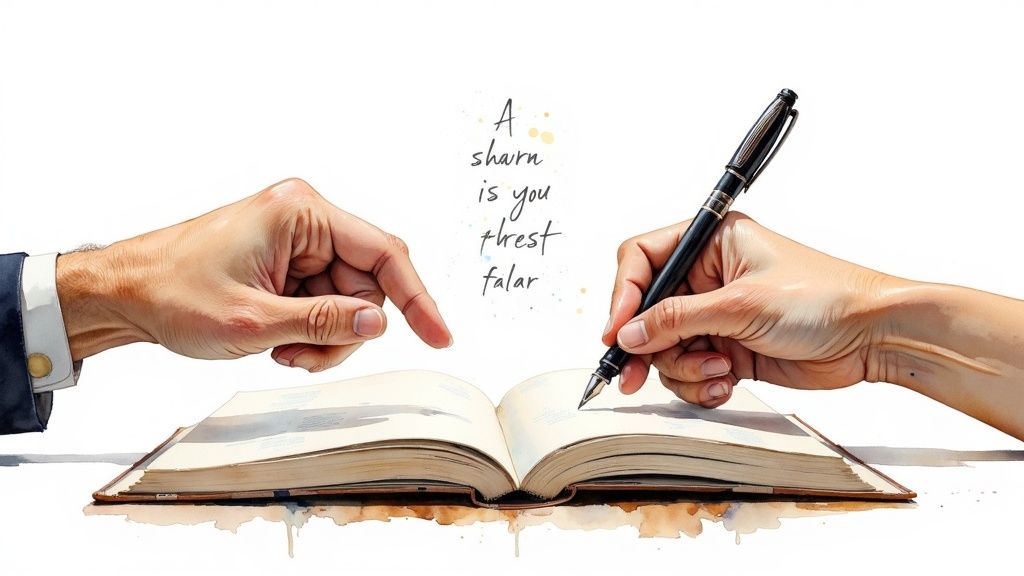
Okay, take a deep breath. You’ve done the emotional heavy lifting. You've sifted through your life, wrestled with your memories, and finally pinpointed the central internal conflict that gives your story its heartbeat. You can see it. You can feel it.
…Now what?
This is the moment that stops so many powerful stories right in their tracks: getting it all down on the page. It’s one thing to feel that internal tug of war; it’s a whole different ballgame to dramatize it in a way that’s compelling, honest, and truly connects with a reader.
This is where you might consider bringing in a professional. And I know what you’re thinking. A ghostwriter? Isn’t that… cheating?
Why a Ghostwriter Is Your Greatest Ally
Let’s just get this myth out of the way right now. A great ghostwriter doesn’t take over your story; they help you excavate it. They’re part therapist, part detective, and part master storyteller, all rolled into one. Think of them as your personal story guide.
Their entire job is to help you translate your inner world into powerful, readable scenes. They’re experts at asking the right questions, the ones you might not think to ask yourself, and at spotting the narrative threads that tie all your experiences together. They can take a jumble of memories and feelings and shape it into a real story with a beginning, middle, and end.
Honestly, writing a book about your own life is like trying to perform surgery on yourself. You're just too close to it all. A ghostwriter provides that crucial, gentle distance needed to see the whole picture clearly.
It’s Still Your Book, Your Victory
Let’s be crystal clear: working with a ghostwriter doesn't mean you're handing over your legacy. It means you’re honoring it enough to give it the professional craftsmanship it deserves.
Here’s how the partnership really works:
- You are the source of truth. You bring the memories, the emotions, the perspective, and the core message.
- They are the story architects. They take all your raw material and build a sturdy, compelling structure out of it.
- You have the final say. Every word, every chapter, every single comma has to get your stamp of approval. It’s your name on the cover, after all.
Teaming up with a ghostwriter lets you focus on what you do best: telling your truth. They handle the heavy lifting of story structure, pacing, and prose, ensuring your internal battle shines on every page.
This kind of collaboration is a game changer when you're tackling the man vs self conflict definition in your own life. It's incredibly difficult to write about your own vulnerabilities. A good ghostwriter creates a safe, judgment free space for you to explore those raw moments, helping you find the courage and clarity to share them.
Finding the Right Partner for Your Story
Choosing a ghostwriter is a deeply personal decision. You’re not just hiring someone to type for you; you’re trusting them with your life’s story. You need someone who not only has the writing chops but who also genuinely gets you and what you’re trying to say.
When you’re interviewing potential writers, ask them a few key questions:
- How do you approach turning our conversations and interviews into narrative scenes?
- Can you share an example of how you’ve helped another client dramatize their internal conflict?
- What’s your process for making sure my voice stays authentic throughout the entire book?
Hiring a pro isn't a shortcut; it's a smart, strategic move. It makes the journey of writing your book easier, more enjoyable, and far more likely to end with a finished product you are bursting with pride to share. Your story deserves to be told, and sometimes the best way to do that is to bring in a guide to help you tell it right.
Unpacking Your Internal Conflict: A Few Common Questions
Diving into the core of your own story is bound to bring up some questions. That’s perfectly normal. You're mapping out the most personal, human parts of your experience, and it’s easy to feel like you're in uncharted territory.
Here are a few of the questions we hear most often, along with some straight talking answers to help you navigate.
Can a Story Have More Than One Internal Conflict?
Oh, absolutely. In fact, it would be strange if it didn't. Life isn't that simple. Real people are messy and complex, and we’re almost always wrestling with more than one demon at a time. The subject of your memoir, for example, might be battling a paralyzing fear of failure while also struggling with a nagging sense that they don't deserve success in the first place.
The key is to pinpoint the primary internal conflict, the one that really drives the whole narrative. Think of it as the main event. All the other struggles can then weave in and out, adding incredible depth and texture that makes your story feel authentic and relatable. A skilled ghostwriter acts as a master weaver, helping you braid these different emotional threads into a rich tapestry, not a tangled mess.
How Do I Show Internal Conflict Without Just Telling the Reader?
This gets to the heart of powerful storytelling: "show, don't tell." It's the secret sauce that makes a story feel immersive and real, rather than like a dry report. Instead of writing, "She was torn between her career and her family," you have to bring that conflict to life through her choices and actions.
So, what does an internal war actually look like from the outside?
- Actions (or Inaction): Think about someone pacing their kitchen at 3 AM. Or starting to type a resignation email, only to delete it over and over. Maybe they drive all the way to a meeting and then just sit in the parking lot, unable to go inside.
- Body Language: Small physical tells can scream what the character is feeling. Show us clenched fists hidden in pockets, a foot that won't stop bouncing, or fingers that pick at a loose thread on a sweater.
- Dialogue: What a person avoids saying is often more revealing than what they actually say. Evasive answers, awkward silences, or abruptly changing the subject can signal a huge conflict raging just beneath the surface.
These tangible details let the reader feel the tension for themselves, which is a thousand times more effective than just being told it exists.
The most powerful internal conflicts are never explained to the reader; they are experienced through the character's every action, choice, and hesitation.
Does the Main Character Have to "Win" the Man vs Self Conflict?
Not in the classic, ride off into the sunset kind of way. A satisfying ending is about transformation, not necessarily a total, clean sweep victory. The real goal is progress, not perfection.
Maybe your subject doesn't magically cure their anxiety, but they learn the tools to manage it and stop it from running their life. Perhaps the guilt they carry isn't erased, but they finally reach a place of self forgiveness and acceptance. Sometimes, the most profound victory is simply achieving a new level of self awareness. That in itself is a monumental win.
The resolution just needs to feel earned and true to the journey. After all, your story is a testament to the struggle, not just the destination.
Bringing these deeply personal conflicts to the page is a brave and powerful act. At My Book Written, we believe your story deserves to be told with the care and expertise it requires. If you're ready to transform your inner journey into a book that will resonate with readers, we're here to help you find the perfect partner to guide you. Learn more about how to start your journey with us.
Writing something bigger than an assignment?
If this is research for a book you actually want to exist, the match quiz will tell you what it would cost and who could help.
Read next
What will your book cost?
Set the type, length and timeline. Get a real 2026 range in 30 seconds.
Open the calculator