

So, you want to create a book. A real, hold it in your hands, pass it down to your grandkids book. It’s a beautiful, honorable goal, a way to create something that will last forever. But let's be honest, staring at that blinking cursor can feel less like a noble quest and more like trying to build IKEA furniture with pages from the manual missing. You have the stories, the hard earned wisdom, and the life lessons, but how do you shape them into something that reads like a compelling narrative, not just a jumbled diary?
The secret is not magic. It is structure. Every great story you have ever loved, from a blockbuster film to your grandfather's captivating war stories, follows a pattern. These foundational structures are the blueprints for building a powerful book. They provide a map that guides both you and the reader from the first page to the last. While you could spend years becoming a narrative architect, it is often smarter, and way more fun, to bring in a professional builder. A ghostwriter can help you construct your legacy while you focus on the vision. They make the process easier, more fun, and ensure the final book is still 100% your vision.
In this guide, we are going to demystify the process. We will break down ten classic examples of narrative stories, showing you precisely how the professionals build engaging memoirs, business books, and legacy projects. Think of this as your personal tour of narrative architecture. We will explore the frameworks that give stories their power and provide actionable takeaways to help you finally get that book out of your head and onto the shelf.
1. The Hero's Journey: The Universal Blueprint for Your Transformation Story
If your life story feels like a Hollywood blockbuster waiting to happen, this is your script. The Hero’s Journey, a structure made famous by scholar Joseph Campbell, is the ultimate blueprint for stories of transformation. It’s one of the most powerful examples of narrative stories because it taps into a pattern we all recognize on a gut level.
The journey follows a protagonist (that’s you!) from their ordinary world, through a series of trials, to a triumphant return. It’s the framework for everything from business memoirs about overcoming impossible odds to personal stories of recovery and reinvention. Think of it as the emotional GPS for your book.
How It Works
The Hero's Journey guides the reader through your personal evolution in a way that feels both epic and deeply relatable. When you share your "call to adventure" (leaving that stable job to start a business) or the "dark cave" you had to face (a near bankruptcy), your readers see their own struggles reflected back. This makes your victory feel like theirs, too.
Take Phil Knight's memoir, Shoe Dog. He starts as a regular guy selling shoes from his trunk (the ordinary world). His call to adventure is the wild idea to import Japanese running shoes. He faces down betrayals, financial crises, and manufacturing nightmares (his trials and tribulations) before Nike becomes a global icon (his triumphant return).
Your Ghostwriting Game Plan
This structure is a ghostwriter's dream. It provides a clear, compelling roadmap to follow, ensuring your life's complexities are woven into a story that grips the reader. Honestly, it's so much easier to have a pro handle this.
- Map Your Milestones: Work with your writer to identify key moments that fit the Hero's Journey stages. What was your "call to adventure"? Who was your mentor? What was your ultimate test?
- Focus on the Transformation: Do not just list events. The magic is in showing how those events changed you. Let your ghostwriter pull out the emotional core of each challenge.
- Embrace the "All is Lost" Moment: Every great story has a low point. Be honest about your darkest hour. It is the moment that makes your eventual success so much sweeter and more inspiring for the reader.
Not sure whether you need a ghostwriter or an editor?
If you already have 30,000+ words drafted, an editor at $3,000–$12,000 will serve you better than a ghostwriter at $40,000. The quiz sorts this out in five questions — honestly, even when the answer is the smaller job.
2. The Three-Act Structure: The Timeless Formula for a Satisfying Story
If the Hero’s Journey feels a bit too epic, the Three Act Structure is its straightforward, no nonsense cousin. This is the bedrock of Western storytelling, providing a clear beginning, middle, and end that audiences have been trained to expect. It is one of the most classic examples of narrative stories for a reason: it just works.
This framework is perfect for a business book detailing a company's rise, a memoir about a specific chapter in your life, or a legacy project. It gives your story a satisfying rhythm: setting the stage, raising the stakes, and delivering a powerful conclusion.
How It Works
The Three Act Structure organizes your narrative into three distinct parts. Act 1 sets up your world and introduces the central conflict. Act 2 is the messy middle, where you face escalating challenges and complications. Act 3 brings the story to a climax and resolves the main conflict, showing what you learned along the way.
Consider Tara Westover’s memoir, Educated. Act 1 establishes her isolated life in a fundamentalist family with no formal schooling. The inciting incident is her decision to educate herself. Act 2 details her intense struggle to adapt to the outside world and academia, confronting her family’s abuse. Act 3 culminates in her earning a PhD from Cambridge, representing her final, hard won resolution and new identity.
Your Ghostwriting Game Plan
This structure provides a strong, intuitive backbone for your book, preventing it from wandering off into the weeds. A ghostwriter can use it to build narrative tension and ensure every part of your story serves a purpose.
- Define Your Turning Points: Work with your writer to pinpoint the key events that transition your story from one act to the next. What incident kicked off your main struggle? What was the midpoint where there was no turning back?
- Build the "Messy Middle": Act 2 is the longest and often the hardest part to write. Let your ghostwriter help you stack the challenges. Brainstorm all the obstacles you faced so they can be arranged to create rising tension, not just a list of bad things that happened.
- Stick the Landing: The resolution is crucial. It’s not just about what happened, but what it all meant. Your ghostwriter can help you articulate the core message or lesson from your experience, giving readers a satisfying takeaway.
3. The Monomyth / Quest Narrative: The Epic Road Trip of Your Life
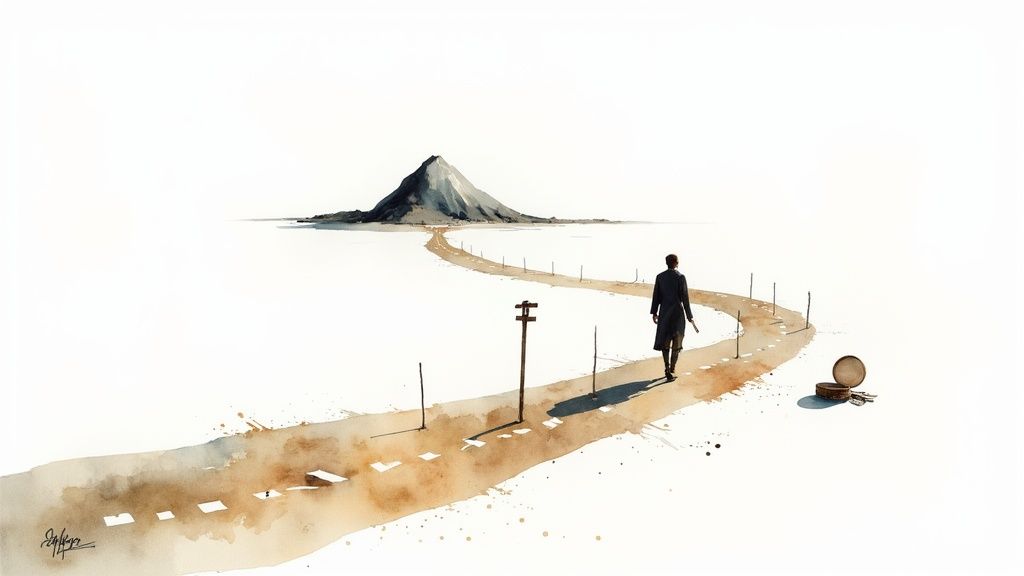
If your story is less about a single, dramatic transformation and more about a long, winding journey toward a goal, then you’ve found your narrative map. The Monomyth, or Quest Narrative, is one of the oldest examples of narrative stories, perfect for tales defined by travel, discovery, and a series of distinct challenges. It’s the ultimate road trip structure.
This narrative frames your story as a journey to a specific destination, whether it’s a physical place, a professional achievement, or a state of personal peace. Along the way, you encounter a series of distinct episodes, each teaching you something new and moving you one step closer to your final objective.
How It Works
The Quest Narrative is powerful because it mirrors the way we actually experience growth: one step at a time. Each obstacle overcome, each ally gained, and each lesson learned adds up to a compelling whole. It’s less about a single defining battle and more about the cumulative wisdom gained on the road.
Consider Cheryl Strayed’s memoir, Wild. Her quest is clear: hike the Pacific Crest Trail to process her grief and find herself again. Each leg of the journey presents new, episodic challenges: losing her boots, facing a blizzard, and meeting fellow hikers. Each one is a mini story that contributes to her overall emotional and physical journey from broken to whole.
Your Ghostwriting Game Plan
This structure is ideal for stories that span many years or locations, giving your ghostwriter a clear path to follow without getting lost in the details. It turns a sprawling history into a focused, forward moving adventure.
- Define the Destination: What is the ultimate goal of your story’s journey? Work with your writer to establish this destination early on, so every chapter feels like it’s building toward something meaningful.
- Structure by Waypoints: Break your life down into "stops" along the way. Each major project, job, relationship, or challenge can serve as a self contained chapter or episode that pushes the main story forward.
- Show the Cumulative Growth: The key is to show how the character at the end of the road is different from the one who started. Your ghostwriter can thread this internal journey through the external events, ensuring the reader sees not just what you did, but who you became.
4. The Flashback/Frame Narrative: Weaving Your Past into Your Present
Is your story one where the "why" is just as important as the "what"? The Flashback or Frame Narrative structure is perfect for authors whose past directly explains their present triumphs, beliefs, or business philosophy. It’s one of the most compelling examples of narrative stories because it builds suspense and deepens emotional impact by connecting then and now.
This structure tells two stories at once: the main narrative happening in the present, framed by crucial scenes from the past. It’s the ideal choice for a legacy book explaining how your grandfather’s resilience shaped the family business, or a memoir where a single past event became the catalyst for your life's work.

How It Works
A Frame Narrative creates intrigue by revealing information piece by piece. You present a current situation, then use a flashback to provide the backstory that gives it meaning. This "aha!" moment for the reader builds a powerful bond, as they connect the dots alongside you. It turns a simple timeline of events into a fascinating puzzle.
Look at the movie Slumdog Millionaire. The present day frame is Jamal on the verge of winning a game show. The flashbacks to his childhood in the slums of Mumbai explain exactly how he knows each seemingly impossible answer. His past is not just context; it is the entire engine of the present day story, creating a rich and emotionally satisfying narrative.
Your Ghostwriting Game Plan
This structure can get complicated, so it's a perfect place to lean on a ghostwriter's expertise. They can masterfully weave your timelines together without confusing the reader, ensuring each flashback lands with maximum impact. You don't want your book to be more confusing than a time traveler's family tree.
- Identify Your Anchor Points: Work with your writer to pinpoint the key present day events and the specific past memories that illuminate them. What current success is explained by an early failure?
- Create Clear Transitions: Your ghostwriter will know how to signal a shift in time, whether it's a chapter break or a simple phrase like "I remember when…" This keeps the reader grounded.
- Build to a Climax: The past and present storylines should converge. The final flashback should reveal a crucial piece of information that resolves the tension in the present narrative, creating a powerful and cohesive conclusion.
5. The Love Story / Romance Arc: Charting the Course of Human Connection
This narrative structure is about more than just "boy meets girl." The Love Story or Romance Arc is a powerful framework for exploring human connection, conflict, and growth through the lens of a developing relationship. It’s one of the most resonant examples of narrative stories because it taps into the universal desire for connection.
This arc traces the journey of two individuals as they move from strangers or antagonists to partners, navigating obstacles that threaten to keep them apart. It's the engine behind countless memoirs, legacy stories, and even business narratives where a key partnership was the catalyst for success.
How It Works
The Romance Arc creates emotional investment by making the reader root for the relationship itself. The central question is not just "what happens next?" but "will they or won't they?" This structure turns your story into an emotional rollercoaster, where every shared glance and overcome obstacle feels like a victory.
Think of Tara Westover’s memoir, Educated. While not a romance novel, a subtle love story arc with a fellow student named Drew provides a crucial emotional anchor. He represents a world of intellectual and emotional safety that stands in stark contrast to her violent, oppressive upbringing. Their connection helps illuminate her transformation and gives the reader a tangible symbol of the new life she is building.
Your Ghostwriting Game Plan
A skilled ghostwriter can use this structure to add depth and emotional stakes to your story, even if it is not a traditional romance. It’s about highlighting the relationships that defined your journey.
- Define the Core Conflict: What truly kept the central figures apart? Was it external pressure, like family disapproval, or internal struggles, like fear and self doubt? Work with your writer to make the obstacles meaningful.
- Show, Do not Just Tell, the Connection: Instead of saying "we fell in love," describe the moments that built the bond. Let your ghostwriter craft scenes that reveal the developing trust, shared humor, and growing affection.
- Focus on Mutual Growth: The most compelling love stories are about how two people change for the better because of each other. Pinpoint how the relationship spurred personal growth or provided the strength to overcome other challenges in your life.
6. The Revenge Narrative: Fueling Your Story with Unstoppable Motivation
If your story is driven by a deep injustice that needs to be set right, the Revenge Narrative is your framework. This structure creates a powerful, high stakes plot where a protagonist relentlessly pursues retribution. It’s one of the most gripping examples of narrative stories because it taps into a primal sense of justice and provides a clear, unstoppable motivation.
This is not just for action heroes. It can frame a business book about a hostile takeover, a memoir about reclaiming your name after a public betrayal, or a personal story about fighting back against a systemic wrong. It provides a clear engine for your plot: a wrong is committed, and the rest of the story is the determined quest to make things right.
How It Works
The Revenge Narrative creates immediate reader buy in. We understand the protagonist’s mission because we’ve all felt the sting of injustice. As you detail the initial wrong and the subsequent quest for vengeance, your readers become invested in your success. Every obstacle you overcome feels like a shared victory against the forces that wronged you.
Consider Alexandre Dumas's The Count of Monte Cristo. Edmond Dantès is a young, successful sailor who is wrongfully imprisoned (the inciting incident). He spends years plotting his escape and comeback, eventually returning as the wealthy and mysterious Count to systematically dismantle the lives of the men who betrayed him (the pursuit of revenge). The entire story is powered by that singular, burning goal.
Your Ghostwriting Game Plan
This structure gives your ghostwriter a powerful engine to drive your narrative forward, creating tension and a satisfying payoff. This is a tough one to do yourself without sounding bitter, so professional help is a great idea here.
- Define the Injustice Clearly: Work with your writer to establish the initial wrong in a way that is emotionally devastating. The reader needs to feel the weight of it to root for your revenge.
- Explore the Human Cost: A great revenge story is not just about winning. Let your ghostwriter help you explore the psychological toll. What did you sacrifice? How did the mission change you?
- Make the Payoff Worth It: The climax needs to be satisfying. Whether it's reclaiming your company, exposing a truth, or finding personal peace, the resolution must feel earned after a long, hard fight.
7. The Coming-of-Age / Bildungsroman: The Story of Your Becoming
If your story is about the messy, beautiful, and often awkward journey from who you were to who you are now, then the Coming of Age narrative is your stage. This classic structure, also known as a Bildungsroman, focuses on the growth of a protagonist from youth to adulthood. It’s one of the most resonant examples of narrative stories because it captures the universal experience of finding your place in the world.
This narrative chronicles the moral and psychological development that shapes a person. It’s perfect for memoirs that explore formative years, the loss of innocence, and the hard won wisdom that comes from experience. Your story becomes a mirror for anyone who has ever felt lost and eventually found their way.
How It Works
The Coming of Age story charts a path of internal transformation, where external events serve to trigger crucial moments of self discovery. When you describe the summer that changed everything or the mentor who saw potential in you, readers connect with those pivotal turning points in their own lives. Your personal growth becomes a universal lesson in resilience and identity.
Consider the film Boyhood by Richard Linklater. Filmed over 12 years with the same cast, it literally shows its protagonist growing up on screen. We see Mason navigate family turmoil, first love, and academic pressures. The narrative is not driven by a huge plot; it’s driven by the small, incremental moments of realization that collectively define his journey from a young boy to a college freshman.
Your Ghostwriting Game Plan
This structure helps your ghostwriter focus on the emotional arc of your maturation, turning memories into a cohesive story of becoming. It’s less about a single dramatic quest and more about the quiet evolution of your character.
- Identify Key Turning Points: Work with your writer to pinpoint the specific experiences that sparked significant growth. What event forced you to see the world differently? When did you first feel like an adult?
- Show, Do not Just Tell, Your Growth: Instead of saying you became more mature, describe the scene where you made a mature decision for the first time. Let your ghostwriter craft scenes that put the reader inside those moments of change.
- Lean into Awkwardness and Mistakes: The most relatable Coming of Age stories are honest about the stumbles along the way. Be candid about your failures and embarrassing moments; they are the foundation of authentic growth and make your story deeply human.
8. The Tragedy / Downfall Narrative: The Cautionary Tale Your Readers Can't Ignore
While most stories aim for a happy ending, some of the most impactful narratives explore the opposite. The Tragedy, or Downfall Narrative, charts a protagonist's descent from a high point of power, happiness, or respect into ruin. This is one of the more sobering examples of narrative stories, but its power lies in its raw honesty and profound lessons.
This structure is not about celebrating failure. It is about exploring the universal human experience of making mistakes and facing consequences. It works for legacy books that honestly grapple with a company's near collapse or memoirs that serve as powerful cautionary tales about addiction, hubris, or poor choices.
How It Works
A tragedy hooks readers by showing them a relatable protagonist with a single, significant character flaw. As the story unfolds, we watch this flaw lead them down a path where every choice makes their situation worse, creating a sense of gripping, unavoidable tension. The story becomes a powerful lesson in what not to do, making the final outcome resonate deeply.
Consider F. Scott Fitzgerald’s The Great Gatsby. Jay Gatsby begins as a figure of immense wealth and mystery, seemingly at the top of his world. But his fatal flaw, an obsessive and idealized love for Daisy Buchanan, drives every decision he makes. His pursuit ultimately leads to his isolation, disillusionment, and tragic death, a stark warning about the hollowness of the American Dream.
Your Ghostwriting Game Plan
This structure requires immense vulnerability, but a skilled ghostwriter can handle your story with the care it deserves, turning a difficult experience into a source of wisdom for others. Writing this alone can be incredibly painful, but sharing the load with a professional can be healing.
- Identify the Fatal Flaw: Be honest with your writer about the core vulnerability or mistake that set the downfall in motion. Was it pride? A blind spot? An addiction? This is the engine of your story.
- Show the Turning Points: Work with your writer to highlight moments where a different choice could have been made. These "what if" moments give the story its dramatic power and show that the outcome was not entirely inevitable.
- Find the Catharsis: A tragedy should not just be depressing. The goal is catharsis, a release of emotion that leads to insight. Your ghostwriter can help frame the ending to deliver a powerful, memorable lesson for the reader.
9. The Mystery / Detective Narrative: Building Suspense One Clue at a Time
If your story involves uncovering a hidden truth, solving a complex problem, or piecing together a forgotten history, this structure is your secret weapon. The Mystery or Detective Narrative is a plot driven framework that pulls readers forward by asking a central question. It’s one of the most engaging examples of narrative stories because it turns your reader into an active participant.
This structure is not just for whodunits. It’s perfect for a business book about cracking a market, a memoir about discovering a family secret, or a legacy project piecing together a company’s chaotic origins. You present a puzzle and then guide the reader through the clues, deductions, and dead ends on the way to the final revelation.

How It Works
A mystery narrative creates an information gap between what the protagonist knows and what the reader knows, generating intense curiosity. By revealing clues strategically, you control the pace and build suspense. The final answer must feel both surprising and inevitable, rewarding the reader for following the journey.
Think of Laura Hillenbrand's Seabiscuit: An American Legend. The central mystery is not a crime, but a question: how did this unlikely, undersized horse, with his down and out jockey and quiet trainer, become a symbol of hope for a nation? Hillenbrand masterfully reveals clues from the past, piecing together the characters' histories and the horse's own spirit to solve this historical puzzle.
Your Ghostwriting Game Plan
This structure is fantastic for turning a complex history or a challenging business problem into a page turner. Your ghostwriter can act as the lead detective, organizing your information into a compelling investigation for the reader.
- Define the Central Question: What is the core mystery your book will solve? Work with your writer to frame it as a clear, compelling question that hooks the reader from the start.
- Outline Your Clues: Map out the key pieces of information, events, and insights. Your ghostwriter will help you arrange them in an order that builds tension, introducing red herrings and breakthroughs along the way.
- Craft the "Aha!" Moment: The payoff is everything. Ensure the final reveal is satisfying and logically connects all the dots. This is where a professional writer is invaluable, making sure the solution lands with maximum impact.
10. The Fish-Out-of-Water / Culture Clash Narrative: Finding Your Story in a New World
If your story is about moving to a new country, switching careers into a completely alien industry, or just feeling like a stranger in a strange land, you have a classic narrative on your hands. The Fish Out of Water structure creates instant engagement by placing a relatable protagonist in an environment that is totally unfamiliar to them. This is one of the most compelling examples of narrative stories for exploring growth, adaptation, and what it means to belong.
This narrative is the engine behind countless comedies and dramas. It uses the contrast between the protagonist’s world and their new surroundings to generate conflict, humor, and profound personal discovery. Whether you are writing about leaving a small town for the big city or documenting your company’s bumpy expansion into a new international market, this structure highlights the universal human experience of trying to find your footing.
How It Works
The Fish Out of Water narrative builds a powerful connection with readers by making them feel the protagonist’s disorientation and eventual adaptation right alongside them. When you describe your hilarious misunderstandings at a foreign company’s headquarters or the awkwardness of navigating a new social circle, readers see their own moments of feeling out of place. This makes your eventual success, or your decision to embrace a new way of life, feel earned and deeply satisfying.
Consider the story of Sandra Bullock’s character in The Blind Side. She’s a wealthy, suburban mom (her ordinary world) who takes in a homeless, traumatized teenager from a vastly different background. The story’s heart comes from the clash of their two worlds. The humor and emotion are born from their attempts to understand each other’s lives, creating a narrative of mutual transformation.
Your Ghostwriting Game Plan
This structure gives your ghostwriter a fantastic source of natural conflict and character development. The "clash" itself does much of the heavy lifting, allowing your writer to focus on the emotional journey.
- Show, Do not Just Tell the Contrast: Instead of saying the new environment was "different," work with your writer to detail the specific sensory details, social rules, and communication styles that felt foreign. What surprised you the most?
- Embrace Your Vulnerability: The best Fish Out of Water stories hinge on the protagonist's willingness to learn and be humbled. Share the mistakes you made and the lessons you learned from the people in your new world.
- Find the Universal Truths: This story is not just about cultural differences. It's about finding common ground. Let your ghostwriter help you pinpoint the moments where you connected with others on a fundamental human level, despite your different backgrounds.
Comparison of 10 Narrative Story Types
| Narrative Structure | Implementation complexity 🔄 | Resource requirements ⚡ | Expected outcomes ⭐ | Ideal use cases 💡 | Key advantages 📊 |
|---|---|---|---|---|---|
| The Hero's Journey | Medium — multi-stage framework 🔄🔄 | Moderate — needs character development and scope ⚡⚡ | Strong transformation and emotional resonance ⭐⭐⭐ | Epics, mainstream films, character-driven adventures 💡 | Clear arc, universal appeal, satisfying payoff 📊 |
| The Three-Act Structure | Low–Medium — three clear beats 🔄🔄 | Low — efficient and familiar to industry ⚡ | Reliable pacing and narrative clarity ⭐⭐⭐ | Screenplays, commercial films, genre stories 💡 | Predictable structure for pacing and pitching 📊 |
| The Monomyth / Quest Narrative | Low–Medium — episodic progression 🔄🔄 | Moderate — varied settings and episodes ⚡⚡ | Sustained momentum and discovery ⭐⭐ | Fantasy, adventure, serialized content 💡 | Goal-driven plot; flexible episodes and subplots 📊 |
| Flashback / Frame Narrative | High — nonlinear timelines, careful signposting 🔄🔄🔄 | Moderate–High — editing and structural planning ⚡⚡⚡ | Heightened suspense and thematic depth ⭐⭐⭐ | Mysteries, literary fiction, stories revealing pasts 💡 | Gradual revelation; strong thematic resonance 📊 |
| The Love Story / Romance Arc | Low — focused on relationship arc 🔄 | Low–Moderate — chemistry and emotional beats ⚡⚡ | High audience investment and emotional payoff ⭐⭐⭐ | Romance genre, subplots in dramas/comedies 💡 | Universal emotional appeal; natural conflict generation 📊 |
| The Revenge Narrative | Medium — motive-driven escalation 🔄🔄 | Moderate — antagonist development and stakes ⚡⚡ | High tension and moral complexity ⭐⭐⭐ | Thrillers, dramas, action films centered on retribution 💡 | Clear motivation; intense cathartic payoff potential 📊 |
| Coming-of-Age / Bildungsroman | Medium — sustained internal arc 🔄🔄 | Low–Moderate — long-term character focus ⚡⚡ | Deep character growth and relatable themes ⭐⭐⭐ | YA, literary fiction, character-led films 💡 | Rich interiority; authentic maturation arc 📊 |
| The Tragedy / Downfall Narrative | Medium–High — must balance inevitability and agency 🔄🔄🔄 | Moderate — careful plotting and tone control ⚡⚡⚡ | Powerful emotional impact and catharsis ⭐⭐⭐ | Literary drama, serious films, stage tragedies 💡 | Thematic depth; moral and ethical exploration 📊 |
| The Mystery / Detective Narrative | High — precise plotting and clue management 🔄🔄🔄 | Moderate — research and tightly controlled reveals ⚡⚡ | High engagement and intellectual satisfaction ⭐⭐⭐ | Crime fiction, procedural TV, interactive mysteries 💡 | Encourages audience participation; suspense-driven pacing 📊 |
| Fish‑Out‑of‑Water / Culture Clash Narrative | Low–Medium — contrast-driven conflict 🔄🔄 | Low — relies on setting and characterization ⚡ | Comedy or empathy from contrast; social insight ⭐⭐ | Comedies, social satire, cross-cultural stories 💡 | Immediate conflict from contrast; opportunities for humor and learning 📊 |
Your Story Has a Shape. Let's Help You Find It.
We have journeyed through quite a few examples of narrative stories, from the epic quest of The Hero’s Journey to the intimate struggles of a Coming of Age tale. We have seen how business founders become unlikely heroes and how personal recovery mirrors the classic Three Act Structure. If there is one thing to take away from all this, it is that your story, your life, your business, already has a powerful structure embedded within it.
You do not need to invent a story from scratch. The raw material is already there, waiting in your memories, your company’s history, and your personal triumphs. The challenge is not a lack of a story. The real challenge is recognizing the powerful narrative that is already there and knowing how to chisel away the excess to reveal its beautiful, compelling shape.
The Real Work is Recognition, Not Invention
Think of yourself as a sculptor and your life as a block of marble. The masterpiece is already inside. The sculptor’s job is simply to remove the pieces that are not part of the statue. Similarly, your job is not to fabricate a dramatic arc but to identify the one that naturally fits your experiences.
Let's recap some of the key takeaways from our exploration:
- Structure is Your Friend: The narrative structures we discussed are not rigid cages. They are flexible blueprints that give your story shape, momentum, and emotional resonance. A Fish Out of Water arc can make a complex business pivot feel relatable and human.
- Voice is Everything: Your unique perspective, your humor, your vulnerability, that is what transforms a sequence of events into a story that connects with readers. It is the secret sauce that makes your story undeniably yours.
- Scenes Bring It to Life: People remember moments, not timelines. Learning to identify and build out key scenes, those pivotal turning points where everything changed, is what makes a book unforgettable.
The goal is not to force your life into a pre made box. Instead, it is to find the box that best fits your life. Was your startup’s journey a classic Revenge Narrative against the industry incumbents who said it could not be done? Is your personal memoir a Tragedy, a story of downfall with powerful lessons for others? Seeing these patterns helps you focus your message and create a narrative that flows.
You Don't Have to Be the Sculptor and the Marble
Recognizing your story’s shape is the first major step. The next is giving yourself permission to not do it all alone. Creating a book is a monumental act of love, legacy, and vulnerability. It is a project that deserves a dedicated team.
This is where the idea of "doing it all yourself" can become a trap. It is wonderful to have the vision, but trying to be the writer, editor, and project manager all at once can lead to burnout and a finished product that does not do your story justice.
Partnering with a professional ghostwriter is not cheating or giving up control. It is a strategic collaboration. It is like hiring a master architect to help you design and build the home you have always dreamed of. You provide the vision, the memories, the truth. They bring the craftsmanship, the structural expertise, and the objective perspective to make it stand strong.
A great ghostwriter is a story whisperer. They know these structures inside and out. They are experts at asking the right questions, the ones that unlock memories and details you might have overlooked. They take the immense pressure of writing off your shoulders, so you can focus on what matters most: sharing your truth.
Your story is waiting. It already has a shape. Now, let’s bring it into the world.
Ready to find the perfect collaborator to bring your book to life? At My Book Written, we connect aspiring authors with vetted, professional ghostwriters who specialize in turning real life experiences into unforgettable narrative stories. Find your perfect match and start your journey today at My Book Written.
Writing something bigger than an assignment?
If this is research for a book you actually want to exist, the match quiz will tell you what it would cost and who could help.
Read next
What will your book cost?
Set the type, length and timeline. Get a real 2026 range in 30 seconds.
Open the calculator