
So, you've written a book. First, let's just sit with that for a second. You created something out of thin air, a world of ideas and stories that didn't exist before you. That is an act of courage, a beautiful, slightly crazy thing to do. Before we even talk about editors, I just want to say: well done. Seriously.
Now, you have this manuscript, this thing you've poured your soul into. The idea of handing it over to a stranger feels… weird, right? Like letting someone read your diary. But a freelance book editor isn't a critic waiting to tear your work apart. Think of them as a book midwife. Their job is to help you deliver your story into the world, healthy, strong, and ready to meet its readers.
Your Book Is a Legacy—Let's Polish It Right
Writing a book is a monumental act. You've created something that will last forever, something that will sit on a shelf long after we're all gone. It's a piece of you, immortalized in ink. And that kind of legacy deserves to be treated with honor.
I get the fear. The thought of letting someone else touch your creation is terrifying. But here’s a secret: a great editor is not there to judge you. They are there to champion your story. They are your first true reader, your partner in crime, your co-conspirator in making this book the absolute best it can be.
Their one and only mission is to help your unique voice and story connect with readers in the most powerful way possible.
Why Your Story Deserves a Partner
Let’s be real for a second: you’re too close to your own manuscript. It's like trying to see your own haircut in the mirror. You know what you meant to say, so your brain helpfully fills in any gaps. You can no longer spot the plot holes for the prose. It’s totally normal. I once wrote a whole chapter where my main character had a dog, and then the dog just… vanished for the rest of the book. Never mentioned again. Poof. Gone. My editor kindly asked if the dog had been abducted by aliens.
This is where a freelance book editor becomes your hero. They bring that crucial fresh perspective. They see the magic you've woven into the pages and help you sweep away anything that might be hiding it. Their job is to elevate your vision, not erase it.
An editor’s purpose is to champion your story. They are there to find the magic you’ve woven into the pages and make sure every single reader can experience it just as you intended.
Sometimes, the best thing you can do to honor your creation is to bring in an expert. It isn't a sign of weakness; it’s a mark of true professionalism. Every single one of the greats, from Hemingway to Stephen King, relied on talented editors to get their work across the finish line.
Ghostwriters: A Different Kind of Partner
Now, if you're reading this and thinking, "Wow, this sounds like a lot of work on top of the work I already did," you're not wrong. Managing revisions, finding the right editor, and navigating feedback can feel like a whole separate job. And you just finished one!
This is where a professional ghostwriter can be an absolute godsend. Hiring a ghostwriter means you get an expert who not only helps shape the story but can also manage the whole editorial team for you. They handle the logistics, the back-and-forth, all the fiddly bits, so you can stay focused on the joy of creating. It’s your vision, brought to life without the headache. It’s easier, more fun, and you still get to hold your book at the end. Win-win.
Not sure whether you need a ghostwriter or an editor?
If you already have 30,000+ words drafted, an editor at $3,000–$12,000 will serve you better than a ghostwriter at $40,000. The quiz sorts this out in five questions — honestly, even when the answer is the smaller job.
Meet Your Editing Dream Team: Who Does What and When?
Feeling lost in a sea of editing jargon? You're not alone. The publishing world has a way of making things sound like a secret code. But finding the right help for your book is actually pretty straightforward once you know who's who.
I like to think of it like building a house. You've got the blueprint (your idea) and the raw materials (your words). You wouldn't hire an interior designer before the foundation is poured, right? The same logic applies here. Each editor has a specific job, and bringing them in at the right stage is crucial. Doing it out of order is like asking a safety inspector to check the wiring before the walls are even up. It's a frustrating waste of everyone's time and money.
So, let's meet the key players on your manuscript's construction crew.
The Architect: Developmental Editors
First up is the developmental editor, who is the architect of your book. They're not looking at a misplaced comma; they’re looking at the big-picture structural integrity. Is the foundation solid? Are the load-bearing walls in the right place? Is there a random staircase that leads to nowhere in Chapter 5?
A developmental editor dives deep into the core elements of your manuscript:
- Plot and Pacing: Does your story flow naturally, or does it drag in the middle and sprint at the end like it’s late for a train? They’ll help you get the rhythm just right.
- Character Arcs: Are your characters compelling? Do they change and grow in a way that feels real and satisfying? Or does your hero start out grumpy and end up… still grumpy?
- Overall Structure: Does the book’s organization make sense? For a business book, does each chapter build logically on the previous one? For a memoir, is the timeline clear and impactful?
You bring in a developmental editor when you have a finished first draft, but you suspect it's still a bit of a beautiful mess. This is the most intensive and often the most transformative stage of editing. It ensures your book's framework is strong enough to support the story you want to tell.
The Interior Designer: Line Editors
Once the architect gives the thumbs-up on your book's structure, it's time to bring in the line editor. Think of them as your interior designer. The house is built; now it's their job to make every single room beautiful and functional.
A line editor works their magic at the sentence level. They go through your manuscript line by line, focusing on how your words come together to create a specific style and feel. They make your sentences sing.
This isn't just about fixing what's "wrong." It's about elevating your prose, finding the perfect rhythm, and making sure your unique voice shines through on every page.
They'll smooth out clunky phrasing, trim repetitive words, and ensure your tone is consistent. A line edit is what turns a well-plotted manuscript into a book people can’t stop quoting. It’s what makes your writing sound like you, but on your best day.
The Final Inspectors: Copy Editors and Proofreaders
Okay, the house is built and beautifully designed. Before you hand over the keys to the reader, you need a final inspection. This is where copy editors and proofreaders come in. They are the grammar police, and thank goodness for them.
Your copy editor is the meticulous inspector with a clipboard and a magnifying glass. They hunt for any and all technical errors. They're checking for mistakes in:
- Grammar
- Spelling
- Punctuation
- Consistency (Wait, was her name Sarah or Sara? Did his eye color just change in Chapter 12?)
After the copy editor has marked up every fix, the proofreader does one last, final sweep. They are the absolute last line of defense against errors. They’re the ones who spot the single speck of dust on a perfectly clean window before the open house. They catch the sneaky typo that everyone else missed.
Following this order, developmental, line, then copy/proof, is the most efficient way to polish your manuscript. It saves you from spending money correcting typos in a paragraph that your developmental editor might tell you to cut anyway. And if juggling this team sounds overwhelming, a good ghostwriter can act as your project manager, handling the entire editing process so you can stay focused on the big picture. Trust me, it’s a beautiful thing.
Which Type of Freelance Book Editor Do You Need?
Still not sure where to start? Use this quick-glance guide to match your manuscript's current stage with the right editing professional.
| Editing Type | Best For Manuscript Stage | Primary Focus |
|---|---|---|
| Developmental Editing | You have a complete (but rough) first draft and need feedback on the big picture. | Plot, structure, character development, pacing, and overall concept. |
| Line Editing | Your story's structure is solid, but the writing needs polish and refinement. | Style, voice, flow, word choice, and sentence-level clarity. |
| Copy Editing | The manuscript is final in terms of content and style, ready for a technical review. | Grammar, spelling, punctuation, and consistency. |
| Proofreading | The manuscript has been copy edited and formatted; it's the very last check before publishing. | Catching any final, lingering typos or formatting errors. |
Ultimately, understanding these roles helps you invest your resources wisely, ensuring you hire the right expert at the perfect time.
What to Expect When You're Expecting Edits
So, you’ve found a few freelance book editors who seem promising. What happens next? Let’s pull back the curtain on the entire process, from that first "hello" email all the way to getting your polished manuscript back. It can feel like a mysterious dance, but I promise it's more like a friendly conversation over coffee, just with more tracked changes.
The whole thing kicks off with a simple inquiry. You'll reach out, tell them a little about your book, and see if they have the availability and interest. This is your chance to get a feel for their personality. A great editor will make you feel at ease, not intimidated.
The All-Important Sample Edit
Before you even think about signing a contract, you should always, always ask for a sample edit. This is non-negotiable. Any professional editor will gladly edit a small portion of your manuscript, usually around 1,000 words, so you can see their style and approach firsthand.
This isn't just about catching typos; it's about chemistry. Does their feedback resonate with you? Do they seem to get your voice? The sample edit is the best way to find out if you've found a true partner for your book. It’s like a first date. If they show up and spend the whole time talking about themselves, you know it's not a match.
After the sample, if you both feel it’s a good match, the editor will send over a formal proposal or quote. This document should clearly outline the scope of work, the timeline, and the total cost. No confusing jargon. This is also where you'll get the contract, which protects both you and the editor.
To help you visualize where an editor fits in, think about their role in stages, from architect to designer to final inspector.
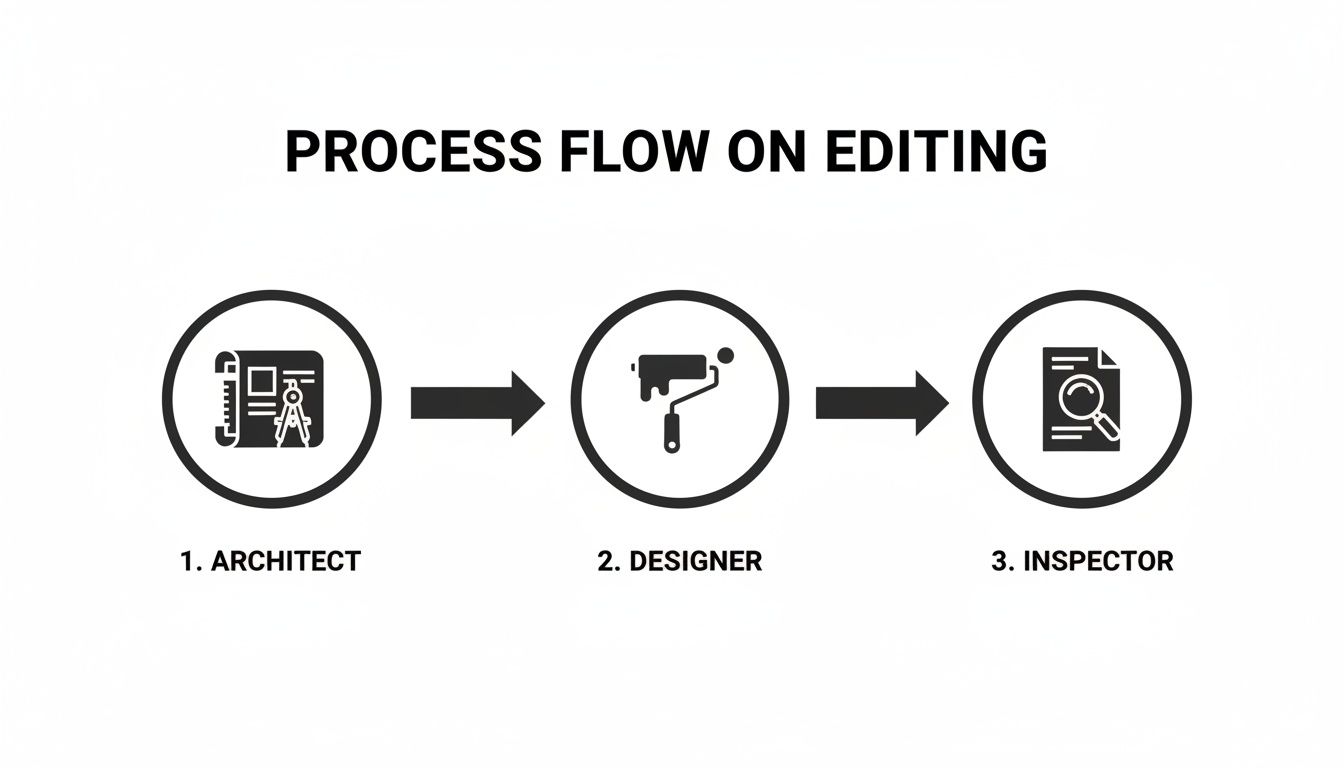
This shows how each editing phase builds on the last, making sure your book has a solid foundation before you start polishing the finer details.
What You Get Back in Return
The deliverables you receive will depend entirely on the type of editing you’ve signed up for. It’s definitely not a one-size-fits-all situation.
Here's a quick rundown of what you can generally expect:
- Developmental Edit: You’ll likely get your manuscript back with comments peppered throughout the margins, but the main event is the editorial letter. This is a detailed, multi-page document that gives you a big-picture analysis of your book's strengths and weaknesses, along with actionable advice on how to tackle revisions. It’s your roadmap.
- Line or Copy Edit: For these edits, you'll receive your manuscript with all changes tracked. You can then go through each suggestion and either accept or reject it. Most editors also send a "clean" version with all changes accepted for easier reading.
Think of the editing process not as a judgment on your writing, but as a collaboration to make your story the best it can be. It's a partnership built on a shared love for the book you're creating.
The number of freelance book editors is growing for a reason. Back in 2019, there were roughly 82,656 freelance writers and editors compared to just 48,544 working in-house, a trend that highlights the shift toward independent creative partnerships. You can dig into more insights about the freelance writing world to see how the industry is evolving.
It's a beautiful, messy, and ultimately rewarding process. And remember, if this all sounds like a headache you’d rather avoid, a ghostwriter can manage the entire thing for you. They’ll find the right team and handle all the back-and-forth, letting you stay focused on the heart of your story.
How Much Do Freelance Book Editors Cost?
Alright, let’s talk about the elephant in the room, the one with a price tag dangling from its ear. Money.
Budgeting for a professional edit can feel daunting, but it’s one of the most critical investments you’ll make in your book’s future. Think of it less as a cost and more as tuition for your book’s success. It's the difference between a homemade cake and a professionally decorated one. Both might be delicious, but only one looks like it belongs in a bakery window.
Skipping this step to save a few bucks is one of the most common regrets I see from first-time authors. It almost always leads to painful revisions down the line and a handful of those dreaded one-star reviews that mention "too many typos." Paying for a quality editor is an act of respect, for your story and for your future readers.
The rise of self-publishing has fueled the demand for skilled freelance book editors. Typical editing fees can range from $1,000 to $5,000 per book, which just goes to show how vital this partnership is. You can learn more about current self-publishing trends on Spines.com.
Understanding the Common Pricing Models
When you start getting quotes, you'll notice that editors don't all charge the same way. It's not a conspiracy, I promise. It's just that different projects require different approaches.
You'll generally run into three main pricing structures:
- Per-Word Rate: This is extremely common, especially for line editing and copyediting. Rates can be anywhere from $0.02 to $0.06 per word. It’s clean, simple, and easy to calculate.
- Hourly Rate: Some editors, particularly for heavy-duty developmental work, charge by the hour. This can range from $50 to $150+ per hour. They're not just editing; they're strategizing, analyzing, and providing deep structural feedback.
- Flat Project Fee: My personal favorite. A flat fee gives you a clear, upfront cost for the entire project. No surprises. Wonderful when you're managing a budget.
What You Should Expect to Pay
Let's get down to some real-world numbers. Why is a deep structural edit so much more of an investment than a final proofread? It all comes down to the time, skill, and creative energy required. One is brain surgery; the other is a final polish.
Here are some realistic ballpark ranges for a standard 80,000-word manuscript:
| Type of Editing | Typical Price Range | What You're Paying For |
|---|---|---|
| Developmental Editing | $4,000 – $8,000+ | The editor's deep expertise in story structure, character arcs, and pacing. This is the most intensive and collaborative work. |
| Line Editing | $2,500 – $5,000 | A meticulous, line-by-line focus on style, voice, and flow. This is where your prose really gets its sparkle. |
| Copyediting | $1,600 – $3,200 | A technical review focused on grammar, punctuation, and consistency. It’s a crucial step for looking professional. |
| Proofreading | $800 – $1,600 | The final safety net to catch any lingering typos and formatting errors before you hit "publish." |
Remember, these are investments, not just expenses. A great editor doesn't just fix your mistakes; they elevate your story and give you the confidence to share it with the world.
If you’re looking at those numbers and feeling a bit overwhelmed, take a deep breath. I get it. This is why a professional ghostwriter is such a fantastic option. They can oversee the entire editing process, build it into their fee, and make sure your vision is brought to life beautifully without the administrative headache. Your story is worth it.
How to Find and Vet Your Perfect Editor
Finding the right editor is a lot like dating. You’re looking for that special someone who just gets you and your vision, who laughs at your jokes (even the bad ones), and who sees the brilliant potential hiding in your beautiful, messy first draft. This isn't just about hiring someone with a good grasp of grammar; it's about finding a creative partner. You wouldn’t hire a plumber to fix your roof, right? It’s about finding the right fit.
So, where do you even start looking for these literary soulmates? A quick Google search can feel like shouting into the void. To find truly talented freelance book editors, you need to know where they hang out.
Where the Best Editors Are Hiding
You'll need to look beyond the first page of search results. The most dedicated professionals are usually found in specific communities and directories where their skills and experience have already been vetted.
Here are a few treasure maps to get you started:
- Professional Organizations: Groups like the Editorial Freelancers Association (EFA) or ACES The Society for Editing have searchable member directories. These are the real pros.
- Reputable Freelance Marketplaces: Platforms like Reedsy are built specifically for the publishing world. It's a fantastic place to browse portfolios, read reviews, and see an editor's past work.
- Ask for Referrals: Do you know other authors? Ask them who they’ve loved working with. A personal recommendation is often worth its weight in gold.
This search is so important because while editing is a highly skilled profession, the field isn't exactly booming. The median annual wage for editors hovers around $75,260, and projected job growth is a mere 1%. This means the best editors are often in high demand, so starting your search in the right places gives you a huge advantage. You can dig into more editor employment stats from the Bureau of Labor Statistics if you're curious.
Asking the Right Questions
Once you have a shortlist of promising candidates, it’s time for the "first date," otherwise known as the interview. Your goal here isn't just to check their technical skills but to gauge their passion. Anyone can say they're good with grammar; you want someone who is genuinely excited about your story.
Forget the boring, generic questions. Try these instead:
- After reading my sample pages, what excited you most about this project? This gets straight to the heart of it. Did they connect with your work?
- What do you see as the biggest opportunity in this manuscript? A great editor doesn't just spot problems; they see potential. Their answer will give you a glimpse into their vision for your book.
- How would you describe your communication style during an edit? You need to know if they're a "rip the Band-Aid off" type or more of a gentle guide. Find someone whose style meshes with your own.
Think of this interview as a vibe check. You're about to trust this person with your creative baby. Make sure you feel a genuine connection and a sense of trust.
Red Flags to Watch For
Just like in dating, there are some definite red flags. A bad partnership can do more harm than good, so keep your eyes peeled.
Be wary of an editor who:
- Guarantees a Bestseller: Nobody can promise this. It’s a huge red flag. Run.
- Refuses a Sample Edit: A confident, skilled editor will always be willing to do a short sample. It’s how you both see if you're a good fit.
- Has Poor Communication: If they’re slow to respond or write unclear emails from the start, imagine what it will be like once they have your full manuscript.
- Doesn't Respect Your Voice: If their sample edit feels like they're trying to rewrite your book in their own style, they aren't the right partner. The goal is to elevate your voice, not replace it.
Choosing an editor is a deeply personal decision. Take your time, trust your gut, and find someone who will champion your story as fiercely as you do. And hey, if this whole matchmaking process sounds exhausting, a ghostwriter can play Cupid for you, finding and managing the perfect editorial team so you can focus on the romance of creation.
So, What's Next on Your Path to a Polished Manuscript?
Alright, take a deep breath. We've just covered a lot of ground. If you’re feeling a surge of "I can do this!" energy, that's fantastic. Let's put that momentum to good use with a few simple, practical steps you can take right now.
Writing a book is a total marathon, and you're nearing the final, triumphant leg of the race. It's time to get your manuscript ready for the professional partnership it deserves. Don't worry, I won't overwhelm you with a massive to-do list.
First, Get Your Own House in Order
Before you start sending your manuscript out to freelance book editors, it’s a good idea to do a little tidying up yourself. This isn't about making it perfect, that's what the editor is for! It's about respecting your own work and the editor's time.
Here’s a quick checklist to get you started:
- Read your book out loud. I know, it feels silly, but it’s the best way to catch clunky sentences. If you stumble over your own words, a reader definitely will.
- Get clear on your goals. Jot down a one-page summary of what you hope this book will achieve. Who is your ideal reader? What’s the single most important message? Having this vision nailed down helps an editor serve your story.
- Figure out your budget. Look back at the price ranges we discussed and be honest about what you can comfortably invest. Knowing your numbers upfront makes the whole process way less stressful.
A great editor does so much more than fix commas; they become a champion for your vision. Getting prepared is the first step in building a powerful, collaborative partnership.
This preparation phase is about more than just checking boxes. It's an act of empowerment. Every little bit you do to organize your thoughts and polish your pages is an investment in your own legacy. It's you, telling yourself that this story truly matters.
And please, remember this: if looking at this list still feels like being asked to climb a mountain, that’s completely okay. That’s precisely why professional ghostwriters exist. They can handle every single one of these steps for you, managing the entire process so you can focus on the creative journey. Your job is to have the vision; their job is to bring it to life, headache-free.
Frequently Asked Questions
You’ve got questions, and that’s a great sign. It means you’re taking this seriously. Let's tackle a few of the most common head-scratchers we hear from authors just like you.
Can I Just Hire One Editor for Everything?
Ah, the dream of the "one-stop-shop." It's tempting, isn't it? While some incredibly versatile freelance book editors can wear multiple hats, it's a bit like asking your general contractor to also do the fine woodworking. They're related, but they require completely different skills.
A developmental editor is looking at the blueprint of your story. A proofreader has a magnifying glass out, hunting for a single misplaced period. Using specialists for each phase gives you an expert with fresh eyes at every critical point, which is usually the best recipe for a truly polished book.
What if I Disagree with My Editor’s Changes?
First off, congratulations, you're a real author! This is a completely normal part of the process. It's crucial to remember that their feedback is a suggestion, not a command. Your name is going on the cover, and the final say is always, always yours.
The trick is to approach disagreements with curiosity, not defensiveness. Instead of thinking, "They're wrong," try asking, "Why did they suggest this?" More often than not, a comment you disagree with is flagging a deeper issue. Maybe they suggested cutting a scene you love because the pacing felt sluggish. The solution might not be to cut the scene, but to tighten the writing.
A great editorial relationship isn't about blind agreement. It's a collaborative dance built on mutual respect for the story. You bring the vision, they bring the expertise, and together you find the best way forward.
How Long Does Book Editing Take?
This is the ultimate "how long is a piece of string?" question, but we can give you a solid ballpark. A final proofread on a pretty clean 60,000-word manuscript might only take about a week.
On the other hand, a deep developmental edit on a 100,000-word epic could easily take four to eight weeks, and that's just the editor's part! Always ask for a projected timeline in the proposal. Building in buffer time is one of the kindest things you can do for yourself and your book's launch date.
And if managing all these moving parts sounds like a full-time job you didn't sign up for, that’s where a ghostwriter can step in as your project manager. They handle the entire process so you can stay in your creative zone. It’s a beautiful, sanity-saving option.
Navigating the world of freelance book editors can feel complex, but you don't have to do it alone. At My Book Written, we provide the resources to help you organize your ideas and find the perfect creative partner to bring your story to life.
Learn how to blueprint your book and hire with confidence at https://mybookwritten.com.
Ready to talk to an actual writer?
Five questions and we come back with two or three ghostwriters who fit your book, your budget and your timeline. Free, and no writer gets your details until you say so.
Read next
What will your book cost?
Set the type, length and timeline. Get a real 2026 range in 30 seconds.
Open the calculator