
That book idea living on your laptop? Let’s be honest. It doesn’t belong there.
You picture it on a shelf at Barnes & Noble, you imagine the feel of its cover, you see someone else’s life being changed by the words inside. That dream is more than just a dream; it’s an honor. Creating something that will outlast you is one of the most incredible things a person can do. It's a piece of you that becomes permanent.
But the path from that blinking cursor to a printed, bound book can feel impossibly confusing, like you’ve been handed a map written in a language you don’t speak. It’s enough to make anyone feel stuck before they even start. I’ve been there, and I get it. It's a whole world of weird rules and unspoken expectations.
Your Book Belongs On A Bookshelf, Not A Hard Drive
The good news is that getting published isn’t some secret club you have to be "lucky" to get into. It’s a process. And like any process, it can be learned, strategized, and executed. This isn't about hoping a blog post goes viral; it's about smart, deliberate preparation to make your book undeniable.
Your only job as a traditionally published author is to write the best bloody book you can. And hit your editorial deadlines. And be pleasant and courteous to work with. Once you’ve done all those things, your job is over. It’s THEIR job to sell the book.
The whole journey really boils down to three key phases.
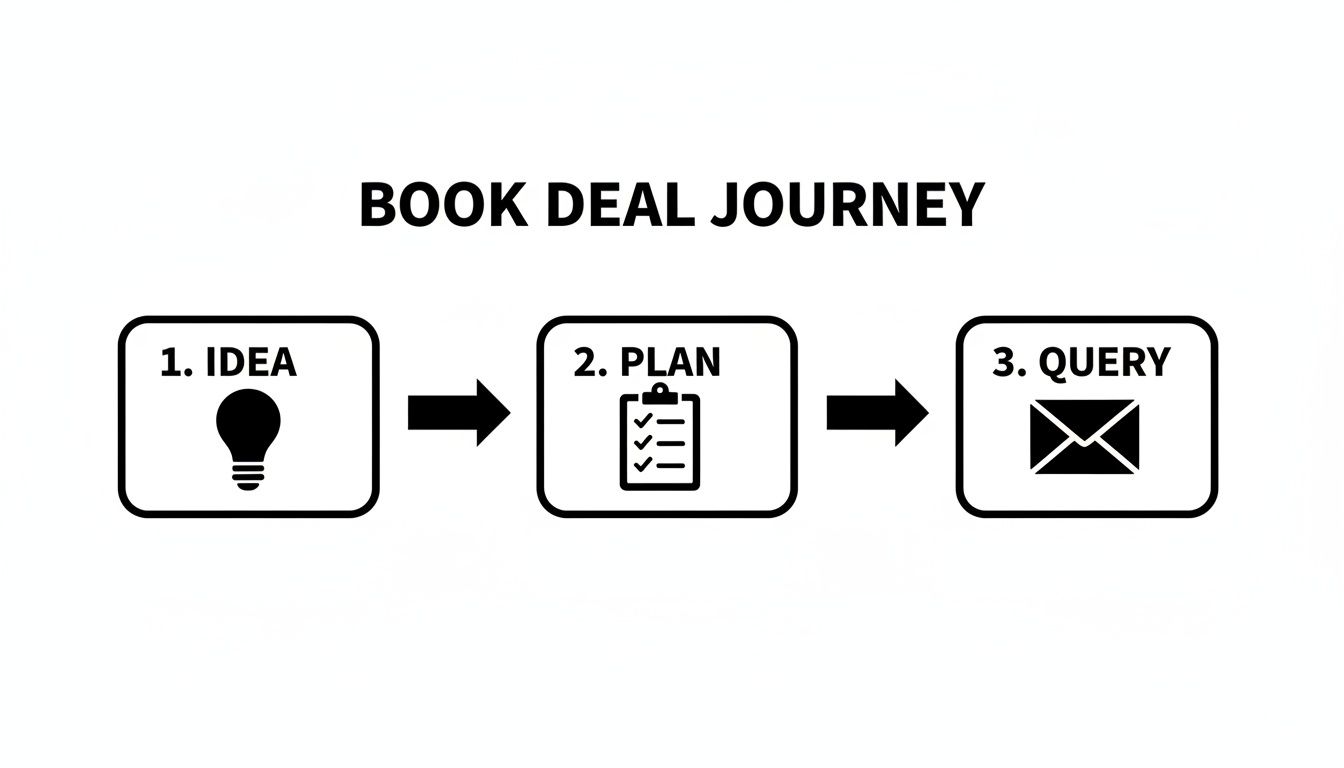
This simple breakdown shows that a fantastic idea is just the starting line. The real work, the part that gets you a deal, happens when you plan your approach and query the right people. That’s how you turn a creative spark into a business case that a publisher simply can't ignore.
The Core Ingredients for a Book Deal
Here's a quick look at the essential elements you need to get a publisher's attention. Think of this as your recipe for a book deal cake. Leave one ingredient out, and the whole thing falls flat.
| Key Component | Why It's a Must Have | Your First Actionable Step |
|---|---|---|
| A Compelling Book Proposal | This is your business plan. It sells the publisher not just on the book, but on you as a marketable author. | Outline your chapter summaries and start researching 5 to 10 comparable (but not identical) books in your genre. |
| A Strong Author Platform | Publishers are investing in a business, and your platform proves there's a built in audience ready to buy your book. | Identify your primary social media channel and commit to posting valuable content for your target reader 3 times a week. |
| A Literary Agent | Agents are your key to the castle. Major publishing houses rarely look at unsolicited manuscripts. | Start researching agents who represent authors in your genre using tools like Publishers Marketplace. |
Getting these three pieces right is non negotiable in today's market. Each one builds on the other to create a submission package that screams "sure bet."
Understanding The Modern Publishing Landscape
Let’s talk numbers for a second, because it’s important to walk into this with open eyes. The odds can feel steep. Industry insiders estimate that traditional publishers wade through over 1 million query letters and submissions every year, but ultimately sign deals with fewer than 1 to 2% of them. You can learn more about the current state of book sales to see why editors have to be so incredibly selective.
This isn’t to scare you; it’s to focus you. When you know what you’re up against, you can be more strategic.
For example, authors with an established platform, even a modest following of 10,000+ engaged fans, see their chances of getting a deal jump dramatically. That’s a tangible advantage.
Trying to manage all of this on your own can feel like a full time job on top of your actual full time job. It’s a massive undertaking. This is where the idea of collaboration can be a game changer. Partnering with a professional ghostwriter isn’t just about getting the words down; it’s about having an experienced guide who already knows the map by heart.
It turns a solitary struggle into a shared, exciting adventure, all while ensuring your unique voice and vision remain the star of the show. Your story is worth that investment.
Not sure whether you need a ghostwriter or an editor?
If you already have 30,000+ words drafted, an editor at $3,000–$12,000 will serve you better than a ghostwriter at $40,000. The quiz sorts this out in five questions — honestly, even when the answer is the smaller job.
Build Your Author Platform Without Selling Your Soul
Alright, let's talk about the dreaded "author platform."
Just hearing that phrase can make any writer cringe. It sounds so corporate and sterile, like something you'd discuss in a boardroom, not a cozy writing nook. I get it. The idea that you have to become some kind of "influencer" just to get your book out into the world feels… well, kind of gross.
But what if we looked at it differently? What if building a platform isn't about hawking a product but about finding your people? The ones who will geek out with you over that obscure historical detail you spent three weeks researching. The ones who will cheer you on when you share a messy, vulnerable snippet from your writing process.
Publishers aren't just buying a manuscript. They're investing in you, the person behind the words. They want to see that there's already a small, dedicated group of people excited about what you have to say.

Find Your Digital Campfire
You don't need a million followers. You absolutely do not need to do viral TikTok dances (unless that's your jam, in which case, go for it). You just need to build a genuine connection with a small but mighty community. This isn't about shouting "PREORDER MY BOOK!" into the digital void.
It's about starting conversations.
Think of it like hosting a dinner party. You wouldn't stand on a chair and yell at your guests to buy your Tupperware. You'd chat, share stories, and make them feel welcome. Your online space should feel the same.
Here are a few authentic ways to get started:
- Start a Niche Newsletter: Don’t just send updates. Write it like a personal letter to a good friend. Share behind the scenes glimpses, talk about the books you’re loving, or offer a unique insight related to your topic. Make it the one email people actually look forward to opening.
- Pick ONE Social Media Playground: You don’t have to be everywhere. Find out where your ideal readers hang out and choose the platform you genuinely enjoy using. If you're a visual person, try Instagram. If you love witty banter, Twitter might be your spot.
- Share Your Process, Not Just the Product: People love seeing how the sausage is made. Post a picture of your chaotic desk, share a paragraph you're struggling with, or talk about a surprising discovery from your research. It’s real, and it’s relatable.
The whole point is to find a sustainable, non cringey way to connect. If you try to force a persona that isn't you, you'll burn out fast. The goal is connection, not performance.
Building a platform isn't about marketing; it's about making friends who happen to be readers. It’s about creating a space where people feel seen and understood, long before you ever ask them to buy a thing.
Platform Building When You're Crunched for Time
Let's be real: building a community takes time, and you're already trying to write a whole book. It’s a lot to juggle. The thought of doing it all yourself can be completely overwhelming. It's like being asked to build the car while you're driving it.
This is where having a partner can be a lifesaver.
When you collaborate with a professional ghostwriter, you're not just getting a writing expert; you're getting a strategic partner who understands the publishing industry inside and out. They can help you brainstorm platform ideas that feel authentic to you and even manage the content creation so you can stay focused on your core message. It frees up your mental energy to do what you do best: be the visionary.
One powerful space to start is LinkedIn, especially for non fiction authors. You can find excellent resources and tools to help, like these efficient LinkedIn post strategies for authors.
Ultimately, your platform is simply proof that your message resonates. It's the tangible evidence an agent or publisher needs to see that there's a real, human hunger for the story only you can tell. And that, my friend, is a beautiful thing.
Craft a Proposal That Makes Agents Stop Scrolling
Let's be real for a second. The book proposal is where your beautiful, world changing idea has to put on a business suit and prove it can make money.
It’s where the dream meets the spreadsheet.
This might sound a little soulless, but it’s the single most important document you will create on your path to getting a book deal. Honestly.
For a nonfiction book, the proposal is the entire pitch. You aren’t selling a finished manuscript; you’re selling the promise of a brilliant one. For fiction writers, your full manuscript is king, of course, but the query letter and synopsis are your proposal’s close cousins. They do the exact same thing: make an agent stop scrolling through their inbox and say, "Okay, I need to read this now."
It’s your audition, your sales pitch, and your business plan all rolled into one. No pressure, right? Don't worry, we're going to break this beast down piece by piece.
The Anatomy of an Unforgettable Proposal
Think of your proposal like a movie trailer. It needs to introduce the hero (your core idea), show off the most exciting scenes (your best stories and arguments), and leave the audience desperate to see the full film. It’s not just about what your book is, but why it needs to exist right now, and for whom.
Here are the non negotiable parts of a proposal that will make an agent’s job easy, and that’s exactly what you want to do:
- The Overview: This is your opening. You need a killer hook in the very first sentence that grabs their attention and clearly states the book's central premise and why it's a must have.
- Target Audience: Be specific. "Everyone" is not an audience. Is your book for burnt out millennial managers? First time parents desperately trying to sleep train? The more precise you are, the more real the audience feels.
- Competitive Analysis: This is where you prove you’ve done your homework. You'll list 5 to 7 recent, successful books in your category, briefly explain what they do well, and then, this is the crucial part, clearly state how your book is different, better, and fills a gap they left behind.
- Author Bio & Platform: We’ve already covered this, but here’s where you put it all on paper. This section proves you are the absolute perfect person to write this book and that you already have an audience waiting to buy it.
- Marketing & Promotion Plan: This shows you’re a partner, not just a writer. Talk about your newsletter, speaking gigs, podcast connections, or any other tangible ways you’ll help move copies off the shelves.
- Chapter Summaries: This is the heart of the proposal. You'll write a juicy, compelling paragraph or two for each chapter that outlines its core message. Make them so tantalizing that the agent feels like they have to know what happens next.
- Sample Chapters: Finally, the proof. You include one or two of your strongest chapters to show you can actually deliver on your promises. The writing has to sing.
This feels like a monumental task because, well, it is. I've seen brilliant experts with world changing ideas get completely stuck right here. The creative, free flowing energy that sparks a book idea is often the polar opposite of the structured, strategic thinking a proposal demands.
A great idea gets an agent's attention. A great proposal gets you a book deal. It’s the bridge between your passion project and a publisher’s business decision.
The Query Letter: A Quick Before and After
Let's look at a real world example for a fiction query. An aspiring fantasy author sent out 50 queries with a letter that started like this:
BEFORE:
"Elara is a young sorceress in the kingdom of Aerthos. When a dark plague sweeps the land, she discovers she holds the key to a forgotten magic that can save her people. She must journey to the Shadow Mountains to find the Sunstone before the evil Lord Malakor can use it to plunge the world into eternal darkness."
It's… fine. But it’s generic. It sounds like a dozen other fantasy books I’ve seen. After 50 rejections, the author got some tough feedback and rewrote it.
AFTER:
"Elara wasn’t born with magic; she stole it. In a kingdom where magic is a birthright of the elite, her thievery is a death sentence. But when the royal mages’ ‘cure’ for a flesh eating plague only makes it spread faster, Elara’s stolen power is the only thing keeping her slum neighborhood alive. To find a real cure, she must hunt down the Sunstone, a relic the royals claim is a myth, even if it means facing the one man who knows her secret: the ruthless Lord Malakor, her own father."
See the difference? We immediately get stakes, deep conflict, and a unique hook. The second version landed seven full manuscript requests from the next 10 queries sent. That’s the power of a well crafted pitch.
This entire process, from outlining chapter summaries to nailing that killer hook, can be draining. If you find yourself staring at a blank page, paralyzed by the sheer scope of it all, please know you’re not alone.
This is often where bringing in a professional ghostwriter can be a game changer. They don’t just write; they are expert proposal crafters. They know exactly how to frame your genius in a way the industry understands and gets excited about. It frees you up to stay in your visionary role while they handle the architecture.
Find and Woo the Perfect Literary Agent
Alright, you’ve poured your heart and soul into a polished, powerful proposal. Now comes the moment that feels a bit like sending your kid off to college. You have to release it into the wild. It can be absolutely terrifying. I get it.
But let's reframe this. You're not just blindly launching your life's work into the void. You're executing a well planned, strategic mission to find the perfect co pilot for your author journey.
Finding the right literary agent is a lot like dating. You aren't just looking for anyone to say yes. You’re searching for that one special person who reads your proposal, feels that spark of excitement, and understands your vision so completely that they’re ready to champion it in the publishing world. This person will be your partner, your advocate, and your fiercest defender.

Building Your Agent Wish List
So, where do these magical agent beings hang out? The absolute worst thing you can do is blast your proposal to every agent with an email address. That’s the publishing equivalent of shouting, "Will someone please go out with me?" in a crowded mall. It’s not a great look.
Instead, you need to become a detective. Your mission is to build a highly targeted list of dream agents who are actively searching for a book exactly like yours. This is all about quality, not quantity.
Here are the essential tools for your investigation:
- QueryTracker: This is an incredible database of agents, their specific submission guidelines, and the genres they represent. It's an indispensable resource for organizing your search and tracking every query you send.
- Publishers Marketplace: Think of this as the industry’s private bulletin board. You can see who just sold what, which agents are making big moves, and get a feel for the major players in your niche.
- #MSWL on X (formerly Twitter): This hashtag stands for "Manuscript Wish List." Agents use it to post exactly what they're hoping to find in their inbox. If an agent tweets, "#MSWL a nonfiction book about the secret history of garden gnomes," and that’s your book, you've just found a red hot lead.
Your goal here is to create a "dream list" of 15 to 20 agents who feel like a perfect match. Dig into their client lists. Read interviews they've given. Try to get a genuine sense of their personality and professional style.
The Art of the Personalized Query
Once you have your highly curated list, it's time to write your query letters. Please, I am begging you, do not start your email with "Dear Agent." It is the single fastest way to get your email dragged into the trash folder. It screams, "I am mass mailing this to 200 people and couldn't be bothered to learn your name."
Personalization is everything. Your query needs to prove you’ve done your homework.
A query letter is your first impression, your handshake, and your audition all in one. Make it count by proving you chose this specific agent for a reason.
Here’s a simple, effective structure for a query that gets results:
- The Personalized Opener: Start strong. "I'm seeking representation for my 80,000 word historical novel, and I'm querying you specifically because of your incredible work with Author X and your stated interest in stories about forgotten women in science."
- The Killer Hook: This is the "after" version of the pitch we worked on earlier. Just two or three powerful sentences that lay out the core concept and stakes of your book.
- The Mini Synopsis: A short, punchy paragraph that gives a little more detail about the book's narrative or argument.
- Your Bio: Briefly explain why you are the perfect person to write this book and mention key elements of your platform.
This focused approach is about making a genuine connection. It shows respect for the agent's time and instantly sets you apart from the crowd.
Brace Yourself for Rejection
Okay, take a deep breath. We need to talk about rejection. You are going to get rejected. Probably a lot. It’s not an "if," it's a "when." Every single author you admire has a digital folder bursting with rejection letters. It’s a rite of passage. It doesn't mean your book is bad; it just means it wasn't the right fit for that specific person at that specific time.
The numbers can feel daunting. Agents are the gatekeepers to roughly 90% of traditional book deals. Personalizing your query boosts your typical response rate from a measly 1% for generic blasts to a much more respectable 10%. On average, an author will send between 50 and 100 queries over 12 to 18 months before landing representation. You can find more insights on the current publishing market on publishers.org.
This whole process can feel like a full time job. And honestly, it is.
If this sounds absolutely exhausting, that's because it can be. This is another area where partnering with a professional ghostwriter can be a game changing shortcut. Many established writers already have trusted relationships with agents. They can make warm introductions, bypassing the dreaded slush pile entirely and getting your proposal directly in front of the right people. It turns a frustrating waiting game into a focused, professional partnership.
Navigating "The Call" and Your First Book Deal
It finally happened. After all the querying and waiting, your phone rings. An agent loves your book and wants to talk.
First things first: do a victory dance. Seriously. Let out a whoop. This is a massive milestone on a very long road, and you absolutely need to savor it.
Okay, back with us? Good. Because after the initial high wears off, a healthy dose of, "Oh wow, what now?" is probably kicking in. This is the moment your dream gets real, and it's totally normal to feel a little wobbly.
That first call is more than just a formality, it’s an interview. But here's the secret: you’re interviewing them just as much as they're interviewing you. You’re not just looking for representation; you're looking for a career partner who will be in your corner for the long haul.
Questions to Ask a Potential Agent
Before you say yes to anything, you have to be sure this is the right fit. This is your story, your baby. You wouldn't hand it over to just any babysitter, right? You need to show up prepared with thoughtful questions that get to the heart of their vision and working style.
Here are a few essential questions to get the ball rolling:
- What's your editorial vision for the book? This is the big one. Do their ideas excite you? Do they get what you were trying to do? Their answer will tell you if you're on the same page creatively.
- Who do you see as the ideal editor or publisher for this? This reveals their strategic thinking. Are they mentioning imprints or specific editors who publish books you already admire? It shows they know the market for your work.
- How do you typically communicate with your clients? Find out if they're a once a month email person or a jump on a call person. Knowing this upfront can save you a world of frustration later on.
- What's the plan if we don't sell the book in the first round? Life happens. You want an agent with grit and a Plan B. Their answer here tells you a lot about their tenacity and commitment.
Ultimately, this call is all about connection. You should walk away feeling energized and understood, not like you're just another manuscript on their pile.
Decoding Publishing Lingo
Once an offer from a publisher lands, you'll suddenly find yourself swimming in a sea of industry jargon. It can feel like everyone is speaking another language, but don't panic. It's not as complex as it sounds, and knowing these terms will make you feel much more confident.
Advance: This is the money a publisher pays you upfront. It's an "advance" against your future royalties. The good news? You don't have to pay it back. The catch? You won't earn any more money until your book has sold enough copies to "earn out" this initial amount.
Royalties: This is the percentage you earn from each book sale after your advance has been earned out. For a debut author, hardcover royalties often start around 10% and can climb based on hitting certain sales milestones.
Subsidiary Rights: Think of these as all the other ways your book can make money beyond the physical copy: audiobooks, foreign translations, movie rights, you name it. Your agent's job is to negotiate who controls these rights and what your cut will be.
Getting a handle on these terms is your first step toward a fair deal. And when it comes to the contract itself, the details are everything. Once you have an offer on the table, mastering powerful contract negotiation strategies becomes critical to lock in the best possible terms.
What to Expect From Your First Book Deal
So, what does a "normal" deal for a first time author even look like? The honest answer is that it varies wildly. Debut advances can range from a modest $5,000 to well over six figures for a book that sparks a bidding war. The key is to ground yourself in realistic expectations.
This is where your agent truly earns their commission. They'll handle the back and forth with the publisher, but you are always the final decision maker.
A First Timer's Guide to Book Deal Terms
Here's a look at standard industry figures for advances and royalties to help you understand what's on the table.
| Contract Term | Typical Range for a Debut Author | What This Actually Means For You |
|---|---|---|
| Advance | $5,000 to $50,000+ | A modest advance is common. A six figure deal is the exception, not the rule. |
| Hardcover Royalty | 10% of list price, escalating to 12.5% and 15% | Your percentage increases after you sell a certain number of copies (e.g., 5,000 and 10,000). |
| Trade Paperback Royalty | 7.5% to 8% of list price | These are slightly lower than hardcover rates and may also have escalation clauses. |
| Ebook Royalty | 25% of net receipts | This is 25% of what the publisher actually receives from retailers like Amazon, not the cover price. |
Note: These are industry averages and can vary significantly based on the publisher, genre, and market demand for your book.
The entire process, from that first thrilling call to signing on the dotted line, is an absolute whirlwind. It’s the culmination of so much hard work. It's okay to feel overwhelmed, but never forget: you earned this.
This is your vision, your story, becoming a real, tangible thing that will one day live on a bookshelf. And that is a truly beautiful thing.
Common Questions on the Path to Publication
The journey to getting a book deal can feel like you're trying to assemble furniture with instructions written in ancient runes. It’s twisty, confusing, and full of moments where you just want to sit on the floor and question all your life choices.
You are not alone in this. Let's tackle some of the most common questions we hear from brilliant people who are standing right where you are now, holding a beautiful idea and wondering which way is up.
How Long Does This Whole Thing Actually Take?
Let me put it this way: publishing moves at the speed of a sleepy glacier. From the moment you type "The End" on a polished manuscript to the day you sign a contract, the timeline can easily stretch from one to three years. I know, I know. Take a deep breath.
First, you might spend anywhere from six to eighteen months just finding the right agent. Once you sign with them, they'll likely have brilliant ideas for revisions, which could take another two to six months. Then, your agent sends your book out to publishers, a process called "going on submission," which can take another six to twelve agonizing months.
It’s a marathon of patience, not a sprint. The secret is to learn to celebrate the tiny victories along the way, like getting a rejection letter that's personalized. Yes, I'm serious. A personalized "no" means you were taken seriously, and that's a win.
Do I Really Need a Social Media Following?
This is the big one, isn't it? For nonfiction, the answer is a pretty firm "yes." When you're writing a book based on your expertise, publishers need to see that you already have an audience of people who consider you an expert. Your platform is the proof.
For fiction, a jaw dropping, unforgettable story is still the most important thing. A masterpiece can and does still break through on its own merit.
However, having an engaged following is a massive bonus. It reduces the publisher's risk. My best advice? Don't build an audience to get a book deal. Build an audience because you genuinely love connecting with people who are into the same weird, wonderful stuff you are. A book deal might just be a happy side effect of finding your people.
What If I Have a Great Book Idea but Hate Writing?
Welcome to the club! I've talked to countless CEOs, chefs, therapists, and adventurers who have a life changing book inside them but would rather do literally anything else than write 80,000 words. The very thought of it is exhausting.
This is exactly why ghostwriters exist.
Hiring a professional writer isn't cheating; it's a brilliant collaboration. It’s like hiring an architect to build your dream house. You provide the vision, the stories, and the soul. They handle the blueprints and the construction.
The finished book is 100% yours, but you get to skip the parts that make you want to throw your laptop out a window. It’s the smartest, most effective shortcut to creating a fantastic, professionally written book that captures your voice perfectly.
Can I Just Send My Manuscript to a Publisher?
In the world of traditional publishing, that’s almost always a hard no. The vast majority of major publishers, like the "Big Five" and all their various imprints, have a strict policy against accepting unsolicited manuscripts.
Think of it this way: agents are the bouncers at the publishing industry's most exclusive club. Their job is to act as a filter, finding the absolute best projects from the millions submitted each year and presenting them to editors.
Sending your manuscript directly is like trying to sneak past the velvet rope. It will almost certainly be sent back unread or deleted without a second glance. The road to a major publisher goes directly through an agent's inbox.
Crafting a book is a legacy project, an act of generosity for the future. Whether you write every word yourself or partner with an expert to bring your vision to life, the journey is profound. At My Book Written, we provide the resources to help you organize your thoughts and prepare for that partnership, ensuring your story is told with the care it deserves. Find the clarity you need at https://mybookwritten.com.
Writing something bigger than an assignment?
If this is research for a book you actually want to exist, the match quiz will tell you what it would cost and who could help.
Read next
What will your book cost?
Set the type, length and timeline. Get a real 2026 range in 30 seconds.
Open the calculator