
Let's be honest for a moment. The idea of writing a family history book feels grand and important. It is a beautiful way to honor the people who made you who you are. But the reality of starting is often… well, a bit much.
It usually looks like shoeboxes filled with brittle, curled up photos, letters written in elegant but impossible to decipher cursive, and a tangle of stories in your head that don't have a clear beginning or end. It's a beautiful mess, but it's still a mess. I get it. I’ve been there, sitting on the floor surrounded by papers, wondering if I should just build a fort out of them instead.
Turning that beautiful chaos into a real, hold it in your hands book can feel like trying to solve a jigsaw puzzle without the box top. This is precisely where a family history book template becomes your secret weapon. It provides the structure, the roadmap, so you can stop wrestling with formatting and start focusing on what truly matters: the heart of your family's legacy.
Your Secret Weapon Against Creative Chaos
Think of a template as the scaffolding for a building. You're still the architect of the story. You get to choose the memories, the photos, and the funny little anecdotes that make your family unique. The template simply holds everything together so you can build something magnificent without the foundation falling apart. It turns a daunting chore into a joyful act of creation.
And you're not alone in wanting to create something tangible like this. The genealogy market is exploding and is expected to be worth over $10 billion by 2031. The growing demand for tools like printed books and templates shows just how deeply people want to hold their history in their hands.
Of course, before you even think about placing those precious photos into a template, you'll want to make sure they're properly cared for. Before turning those dusty photo piles into a polished family story, it's crucial to consult tips on how to preserve old photographs to ensure your memories are safeguarded for the book and for years to come.
Here’s a final, comforting thought: you don't have to do it all by yourself. Once you've gathered your stories and filled your template, a professional ghostwriter can step in to elevate your work. They can polish the writing and perfect the layout, making sure your family's story is told with the grace and skill it deserves. It’s still your vision, just with a little expert help to get it across the finish line. Honestly, it's a game changer.
Choosing Your Perfect Family History Book Template
Not all templates are created equal, and that’s putting it mildly. Some are simple Word documents you can fill in over a cup of tea. Others are complex design files that look like they require a pilot’s license just to open. So how do you pick the right family history book template without pulling your hair out?
This is your friendly guide to finding a template that fits you, not the other way around. Let’s figure out what you actually need based on your tech skills (no judgment here!), the feeling of your family’s story, and what you want the final book to look like.
What Kind of Story Are You Telling?
First, think about the end goal. Are you aiming for a classic, text heavy memoir filled with detailed stories of your ancestors? Or do you envision a modern, photo rich coffee table book where the pictures do most of the talking?
- For Text Focused Books: Simple, elegant templates in Word or Google Docs often work best. They keep the focus on the narrative without a lot of distracting bells and whistles.
- For Photo Heavy Books: Look for templates on platforms like Canva or even Adobe InDesign that offer creative layouts for images, captions, and timelines.
I once spent an entire week wrestling with an over the top, complicated template. My goal was a simple story, but the tool was built for a graphic designer. It was a digital tug of war, and the template was winning. The lesson? Simpler is almost always better. It should empower your storytelling, not complicate it.
Find Your Tech Savvy Sweet Spot
When choosing your perfect family history book template, it helps to see what the pros use. Reviewing some of the best book layout templates can help you visualize what's possible and find a design that feels both professional and personal.
This is especially true now that personalization is so popular. People are happy to invest in products they can customize, a trend proven by the personalized children’s book market, which was valued at over USD 661.49 million. This shows that buyers will pay for templates that let them create something truly unique, a feeling that applies perfectly to family history projects.
If the technical side of things feels daunting, this quick decision tree can help you decide whether a template or a professional is the right path for you.
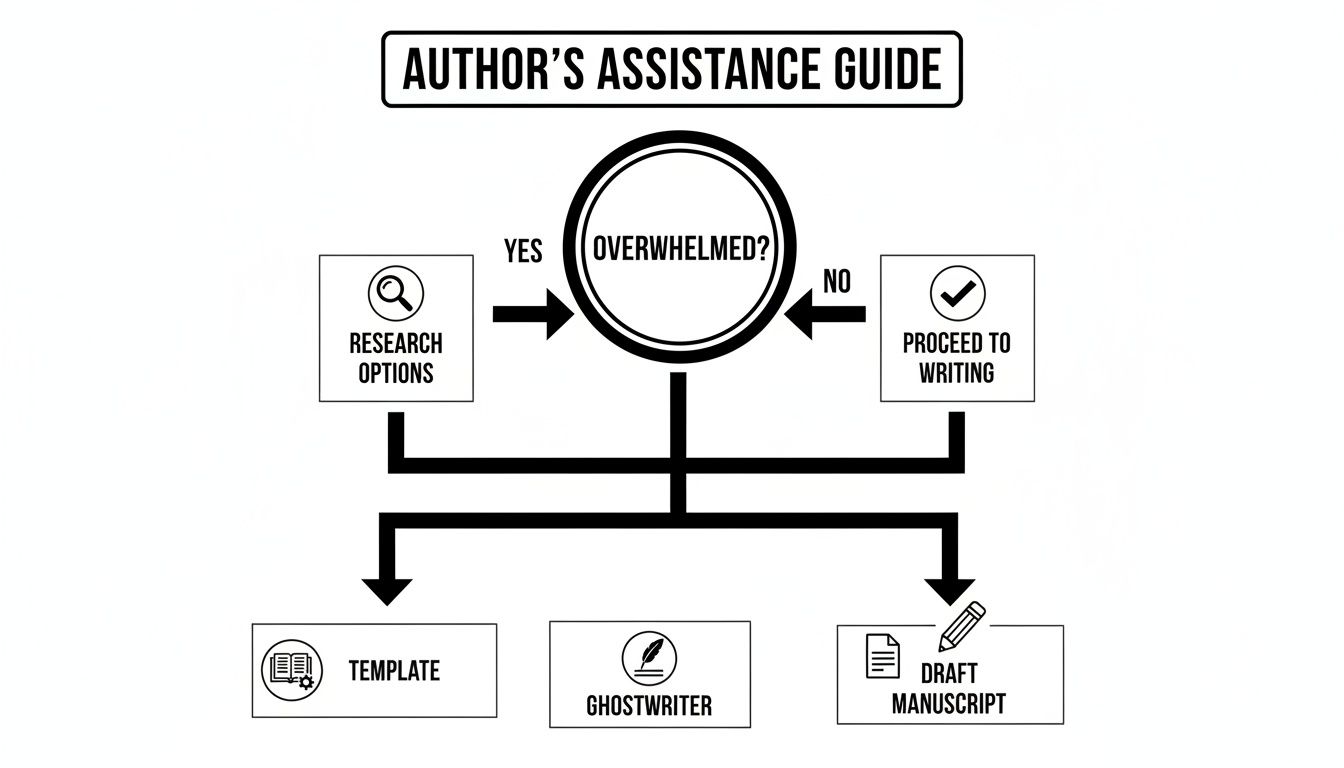
This guide shows that if you're feeling overwhelmed, leaning on a ghostwriter is a fantastic option to bring your vision to life without the technical stress.
The most important thing is to choose a tool that makes you feel excited to work on your project. If opening the file fills you with dread, it's the wrong one. Your family's story deserves to be told with joy, not frustration.
To make this a bit easier, here’s a quick breakdown of the common template types to help you decide which lane you’re in.
Template Type Comparison
| Template Type | Best For | Pros | Cons |
|---|---|---|---|
| Word/Google Docs | Writers focused on storytelling and simple layouts. | Easy to use; widely accessible; great for text heavy books. | Limited design flexibility; can look generic without effort. |
| Canva | Beginners who want a visually appealing, photo rich book. | Drag and drop interface; thousands of pre made layouts. | Can be tricky for long form text; printing quality can vary. |
| Adobe InDesign | Those with graphic design experience or a desire to learn. | Professional grade results; total creative control over every detail. | Steep learning curve; requires a paid subscription. |
Choosing the right format from the get go saves a ton of headaches later. Be honest about your skills and the time you're willing to invest in learning a new program.
Ultimately, remember that you don't have to do it all yourself. Many people choose a simple template to gather their stories and then hand it all over to a professional ghostwriter. They take your heartfelt work and handle the tricky design parts, turning your content into a polished, beautiful book. It's the best of both worlds: your stories, their expertise.
Not sure whether you need a ghostwriter or an editor?
If you already have 30,000+ words drafted, an editor at $3,000–$12,000 will serve you better than a ghostwriter at $40,000. The quiz sorts this out in five questions — honestly, even when the answer is the smaller job.
How to Structure Your Family’s Narrative
So, you've found the perfect family history book template and you're ready to dive in. But then it hits you. The big, scary question: how on earth do you organize a lifetime of stories? It's the kind of overwhelming thought that makes you want to gently close your laptop and surrender to a night of mindless television.
Don't worry. We’ve all been there. Staring at a mountain of memories and feeling like a traffic cop at a twelve way intersection is completely normal. The secret? There’s no single “right” way to structure your book. The best structure is simply the one that makes this beautiful project feel manageable and, dare I say it, fun.
The Good Old Chronological Approach
This is the classic for a reason. Starting at the beginning and moving forward in time is logical and easy for readers to follow. It’s like watching a movie of your family’s life unfold, one generation at a time, and it's a fantastic way to show how events in one era shaped the next.
For instance, you might kick things off with your great great grandparents arriving from the old country. From there, you could move through each decade, capturing the births, marriages, and major milestones that followed. It creates a very clear path from “then” to “now.” It's a structure that makes sense, and when you're wading through a sea of dates, "making sense" is a real gift.
Spotlighting Your Family All Stars
Another wonderful method is what I call the “Ancestor Spotlight.” Instead of a single, sweeping timeline, each chapter is dedicated to one key person or couple. This approach lets you really dig into their individual stories, personalities, and quirks. It’s a beautiful way to honor the people who anchor your family tree.
Think about dedicating chapters to folks like:
- Grandma Jean: The family matriarch whose recipes are legendary.
- Uncle Robert: The war hero with incredible stories of bravery.
- Great Aunt Millie: The artist who traveled the world and sent postcards from every port.
This structure essentially turns your book into a collection of compelling mini biographies. It feels personal and intimate, allowing each person’s unique spirit to shine. And let’s be honest, some ancestors are just more dramatic than others and deserve their own stage.
The goal isn't to create a perfect, exhaustive record. It’s to capture the feeling of your family. It's to tell the stories that make you smile, laugh, or feel a deep sense of connection to those who came before.
Telling a Story Through Themes
Sometimes, the best stories aren't told in a straight line at all. A thematic structure connects memories across different generations by focusing on shared experiences. This can be an incredibly powerful and emotional way to show the threads that bind your family together. It’s less about dates and more about heart.
You could build chapters around big ideas like:
- Our Family’s Journey to America: A chapter combining every immigration story you've collected.
- Holiday Traditions Through the Years: From Grandpa’s caroling to your modern day potluck.
- The Family Business: Charting the rise (and maybe fall) of a shared enterprise.
This approach does a brilliant job of highlighting your family’s unique values and culture. If any of this still feels overwhelming, remember that hiring a ghostwriter can be a huge relief. You provide the beautiful, messy details from your template, and they help you weave them into the perfect narrative. It’s your story, just with a professional helping you build the house.
Filling the Pages With Memories and Moments
This is it. This is where your book gets its heartbeat. You've got a beautiful family history book template all picked out, but now the blank pages are staring back, waiting for you to fill them with the good stuff. So, how do you actually jog those memories and get your relatives to share the stories that go beyond just dates on a census record?
It's a delicate art, kind of like trying to catch a firefly without squashing it. You can't just ask, "So, what was your life like?" and expect a novel in return. You have to become a gentle detective of the heart, asking just the right questions to unlock specific, vivid memories.
The real magic is always in the details. Instead of asking about "the old days" in general, you want to get specific and emotional. The goal is to paint a picture with words, and that all starts by asking the right kinds of questions.
Gentle Questions to Unlock Great Stories
Think less like a reporter and more like a curious grandchild sitting at the kitchen table. Warm, open ended questions are your best friends here. Over the years, I’ve found that questions tied to the senses, feelings, or particular places work absolute wonders.
Give a few of these a try:
- What's a piece of advice your father gave you that you still think about today?
- Can you describe the kitchen where you grew up? What did it smell like on a Saturday morning?
- What was the silliest thing you and your siblings ever got in trouble for?
- Tell me about a time you felt incredibly proud of your family.
See how these don't have a simple "yes" or "no" answer? They're an open invitation to tell a story. You will be absolutely amazed at what a simple question about a kitchen can unearth about family dynamics, love, and tradition.
Your family book isn't just a collection of facts; it's a museum of feelings. The stories you gather are the exhibits, each one telling a small part of a much bigger, more beautiful story of who you are and where you come from.
From Dusty Photos to Polished Pages
Beyond the interviews, you probably have a treasure trove of physical artifacts. We're talking old photos, letters, and recipes scribbled on napkins. Giving these items a home in your book is what transforms it into a true family heirloom. There's a reason the global books market was estimated at around USD 150.99 billion; people still crave tangible keepsakes, which is exactly what you're creating. If you want to dive deeper, Grand View Research has some great insights on the enduring power of print.
When it comes to photos, scanning them is your best option. A flatbed scanner is great, but honestly, many modern phone scanning apps do a fantastic job. The key is to find good, even lighting without any glare. Once you have the digital copies, weave those images right into your narrative with captions that add a bit of color. Instead of just "Grandma, 1952," try something like, "Grandma Mae, winning the county fair pie contest in 1952. She always said the secret was a little bit of cinnamon."
I know this whole process can feel a bit overwhelming. If you find yourself drowning in anecdotes and aren't sure how to stitch them all together, this is the perfect time to call in a professional. A ghostwriter can take all the memories and photos you've gathered and weave them into a seamless, beautiful narrative. It’s still your family’s story, just with an expert helping you tell it.
Preparing Your Project for a Professional Touch
You’ve done it. You poured your heart, your weekends, and probably way too much coffee into this project. Your family history book template is brimming with memories, photos, and stories that have been waiting generations to be told. So, what’s next?
How do you get this labor of love across the finish line and into a real, physical book you can hold in your hands? For so many people, this final step, navigating the technical maze of book design, formatting, and printing, can be a frustrating hurdle that drains all the joy out of the process.
This is the perfect moment to take a deep breath and pass the baton. Handing your work over to a professional ghostwriter or book designer isn't cheating. It’s honoring your incredible effort by giving it the polished, professional finish it deserves. They’re the experts who can take your amazing raw material and shape it into the family heirloom you’ve been dreaming of.
The Handoff Checklist That Saves Time and Sanity
To make this transition as smooth as possible, you need a clear plan. Just dumping a jumble of files on a professional is like handing a chef a random bag of groceries and saying, "Make dinner." A little organization goes a long, long way and will absolutely save you time and money.
Giving your ghostwriter or designer everything they need upfront is the key to a seamless collaboration. I've put together a checklist to help you bundle up your project perfectly, ensuring they have all the puzzle pieces from day one.
Ghostwriter Handoff Checklist
| Item | What to Include | Why It's Important |
|---|---|---|
| Completed Manuscript | The full document in its original, editable format (e.g., Word, Google Docs). | This is the core content. An editable file allows them to get straight to work without retyping anything. |
| High Resolution Images | A separate folder (e.g., via Dropbox, Google Drive) with all original, high quality photo files. | Embedding images in a Word doc degrades their quality. Separate, high res files are crucial for crisp, clear printing. |
| Photo Placement Guide | A list or notes within the manuscript indicating where each photo should go (e.g., "Insert Grandma Mae 1952.jpg here"). | This prevents confusion and endless back and forth emails, ensuring the right memory is paired with the right story. |
| A Vision Statement | A brief paragraph or two explaining your vision. What should the book feel like? Is it warm and folksy or more formal and historical? | This provides creative direction and ensures the final book's tone and style align with your expectations. |
| Key Family Details | A simple list of names, key dates, and relationships that might be confusing. | This acts as a quick reference guide, helping the writer avoid mistakes with names or family connections. |
| Font & Style Preferences | Any specific fonts, colors, or design examples you love. | Providing inspiration helps the designer nail the aesthetic you're aiming for much faster. |
A little bit of prep work here really pays off. It sets a professional tone for your partnership and helps the expert you hired spend their time on design and editing, not on detective work.
Photo organization, in particular, is a secret superpower. Trust me on this. Naming your files something clear, like ‘Grandma Mae Wedding 1952.jpg’ instead of ‘IMG_5821.jpg’, is a game changer for your designer and helps prevent mix ups. It’s a small detail that saves a ton of headaches.
Thinking about working with a professional can feel like a huge step, but it’s actually the kindest thing you can do for your project. You did the beautiful, difficult work of gathering the stories. Now let someone else handle the technical stuff so you can just sit back and enjoy the result.
This final step is about collaboration, not surrendering control. A good professional will work with you to ensure the finished book is a perfect tribute to your family and a testament to all your hard work. You’ve earned it.
Your Top Questions About Making a Family History Book
As you get started on this adventure, you're bound to have a few questions pop up. It happens to everyone! Don't worry, it's completely normal. It just means you care about getting this right. Here are a few of the most common things people wonder about.
How Do I Handle Sensitive or Painful Family Stories?
This is such an important and thoughtful question. The truth is, every family tree has a few complicated branches. My best advice is to approach these stories with empathy and respect.
You don't have to air all the dirty laundry. Instead of just focusing on the hardship, you could frame these moments as stories of resilience or lessons learned. It’s also perfectly okay to leave out certain details that might cause pain to living relatives. You could even create two versions: a private one for immediate family and a more general one for wider sharing. The goal is to honor the full, complex experience of your ancestors, struggles and all, with compassion.
What if I Have Gaps in My Family Research?
Welcome to the club! I've never seen a family history project that didn't have at least a few question marks or dead ends. Almost everyone has a mysterious great aunt or a branch of the family that just seems to disappear.
Don't let missing information stop you. In fact, you can embrace the gaps and make them part of the story. Acknowledge them directly in your writing. For instance, you could say something like, "Where great uncle Thomas went after 1930 remains a family mystery, but we like to imagine he went off in search of adventure." It makes the whole thing feel more authentic and human.
Your family history book doesn’t have to be perfect to be priceless. It’s a snapshot of what you know right now. Think of it as an act of love, a collection of memories, and a starting point for the next generation of storytellers.
Will Hiring a Ghostwriter Make It Feel Less Like My Book?
Not in the slightest! That’s a common fear, but it's really a misconception. Think of a ghostwriter as your professional partner, not someone who takes over. The stories, the photos, the memories, the heart of the project, that’s all you. You are the author.
A ghostwriter is just the expert who knows how to structure the narrative, polish the prose, and handle all the technical bits and pieces that go into creating a beautiful, professional book. It's a collaboration that lets you focus on the fun part (sharing memories from your family history book template) while they do the heavy lifting. The result is a polished heirloom you'll be even more proud to share, with a lot less stress along the way.
At My Book Written, we know your story is precious. We’ve got resources and guides to help you sort through your materials and turn a lifetime of memories into a clear, compelling manuscript. When you’re ready to transform your filled out template into a timeless family heirloom, explore our guides to see how partnering with the right professional can bring your vision to life.
Capture the story while you still can
Legacy books are the most time-sensitive projects there are. Five questions and we shortlist writers who specialise in family history, at your budget.
Read next
What will your book cost?
Set the type, length and timeline. Get a real 2026 range in 30 seconds.
Open the calculator