
Of course you can pay someone to write your book. In fact, it's one of the smartest and most honorable moves that busy leaders, experts, and people with incredible stories make. It’s a respected practice for creating a lasting legacy, your mark on the world, without getting totally swallowed by the monumental task of writing a manuscript from scratch.
Your Book Idea Deserves to Be Real

Let's get real for a second. That idea swirling in your head, the one that keeps you up at night, it feels important because it is important. It's the story you just know the world needs to hear, the expertise that could change careers, or the family history that deserves to be held in your grandchildren's hands. It is a piece of you that deserves to last forever.
But the thought of actually sitting down and writing it? Yikes. It can feel like trying to climb Mount Everest in flip flops. It’s a massive, intimidating journey filled with self doubt, endless hours, and the tyranny of that blinking cursor. It’s enough to make anyone say, "maybe next year."
Why Going It Alone Isn't Always Noble
A lot of folks get hung up on the idea that they have to write their own book for it to be truly "theirs." I get it, I really do. But that noble thought is exactly why millions of incredible books never see the light of day. They just remain ghosts of ideas, trapped in notebooks and late night thoughts.
Hiring a professional writer, often called a ghostwriter, isn't cheating. It’s a beautiful collaboration. Think of it like this: a film director has a powerful vision, but they hire a world class cinematographer to bring it to life on screen. You are the director of your book. Your vision, your voice, and your stories are the heart of the project. A professional just helps you make the movie.
Hiring a ghostwriter is about honoring your idea enough to give it the professional craftsmanship it needs to become a physical, tangible book. It’s your story, simply told with an expert's help.
A ghostwriter is the skilled artisan who handles the heavy lifting. They’re the ones who build the structure, find the perfect words, and transform your brilliant, and maybe a little scattered, thoughts into a polished, compelling manuscript. This frees you up to do what you do best: be the visionary.
From Your Head to Their Hands
The process is far more personal and collaborative than most people imagine. It’s a true partnership built on trust and a shared goal. A friend of mine, a CEO, described it like this: "I talked for hours about my life, my mistakes, my wins. My ghostwriter listened and handed me back my own soul, but organized."
- You bring the soul: Your unique experiences, insights, and personality are the essential raw materials.
- They bring the skill: They know exactly how to structure a narrative, craft sentences that sing, and organize chapters for maximum impact.
- Together, you create the book: The final product is a perfect fusion of your brilliant ideas and their expert execution.
Ultimately, deciding to pay someone to write your book is an investment in your legacy. Entrepreneurs especially can find huge value in this, and it helps to understand why publish a book in the first place. It's time to get that masterpiece out of your head and into the world, where it belongs.
Not sure whether you need a ghostwriter or an editor?
If you already have 30,000+ words drafted, an editor at $3,000–$12,000 will serve you better than a ghostwriter at $40,000. The quiz sorts this out in five questions — honestly, even when the answer is the smaller job.
Finding the Right Kind of Writing Partner

When you decide to pay someone to write your book, you're not just hiring a typist. You're bringing on a creative partner, a strategist, and the architect of your big idea. This is a huge decision, and like casting the lead in a movie, you need the perfect fit for the part. You wouldn't cast a comedian in a serious drama, right? Same thing here.
Let's be honest, the term "writer" is incredibly broad. It's like saying you need an "athlete." Are you looking for a marathon runner or a powerlifter? The skill sets are worlds apart. Let's break down the main types of writing collaborators you'll come across.
The Seasoned Ghostwriter
Think of a ghostwriter as the master builder of your book. These are professionals who live and breathe long form narrative. They’re not just skilled with words; they are story engineers who understand plot arcs, chapter pacing, and how to create a manuscript that pulls a reader from the first page to the last. They know how to make your story a real page turner.
They excel at listening, drawing your stories out through interviews, and then weaving them into a cohesive book that sounds just like you, only better. A great ghostwriter disappears, leaving your voice front and center. They’re the go to choice for memoirs, sweeping business books, and any project that relies on deep storytelling.
The Niche Subject Matter Expert
Sometimes, you don't just need a writer; you need a writer who already speaks your highly specialized language. This is where the niche expert shines. Imagine you’re a biotech founder writing about CRISPR technology. Hiring a writer with a Ph.D. in molecular biology will save you hundreds of hours of trying to explain the basics. It's a total game changer.
These writers are invaluable for highly technical, academic, or industry specific books. They bring more than just writing chops; they bring deep domain knowledge. You’re getting a collaborator who can challenge your ideas, add valuable insights, and ensure every detail is spot on for a sophisticated audience.
The Versatile Freelance Writer
Freelance writers are the chameleons of the writing world. Many are fantastic generalists who can pivot between all sorts of projects, from straightforward how to guides and ebooks to company histories. They’re typically pros at research and can get up to speed on a new topic with impressive speed. Think of them as the Swiss Army knives of the writing community.
If your book is more direct, less narrative driven, and focused on clear communication, a talented freelancer can be a fantastic and budget friendly choice. They’re usually masters of hitting deadlines and translating complex ideas into plain, accessible language.
The goal isn't finding the "best" writer, but the "right" writer for your specific project. A brilliant novelist might be a terrible choice for a technical manual, and vice versa. Matching the skill set to the soul of your book is everything.
To help you visualize the differences and start thinking about your own needs, here’s a quick rundown of your options.
Choosing Your Writing Partner
| Writer Type | Best For | Typical Price Range | Key Benefit |
|---|---|---|---|
| Seasoned Ghostwriter | Memoirs, novels, thought leadership, and complex narratives. | $30,000 – $150,000+ | Expert storytelling and the ability to perfectly capture your unique voice. |
| Niche Subject Matter Expert | Technical guides, academic books, and industry-specific content. | $20,000 – $100,000+ | Deep domain knowledge that adds authority, accuracy, and nuance. |
| Versatile Freelancer | Ebooks, how-to guides, and more straightforward projects. | $5,000 – $40,000 | Flexibility, efficiency, and often a more accessible price point. |
Picking your partner is the first major step in making your book a reality, so don't rush it. Think carefully about what your manuscript truly needs. Is it a master storyteller, a technical translator, or an efficient wordsmith? Getting this one decision right sets the entire project up for success.
Where to Find Your Perfect Ghostwriter

Alright, you’re ready to find your creative partner. This is the fun part, the casting call for your book's co star. But where do the real pros actually hang out? You can skip the random classifieds; finding the right person when you decide to pay someone to write my book means going where the talent is already vetted and visible.
Think of this as your treasure map. There are a few key places where you can find experienced, professional writers who are serious about their craft. This isn't just about finding a writer; it’s about finding your writer.
Curated Platforms and Professional Marketplaces
Your first stop should be the platforms specifically designed to connect authors with publishing professionals. Honestly, they take a lot of the initial guesswork out of the process, which is a huge relief when you're just starting.
-
Curated Platforms (like Reedsy): These are the VIP lounges of the writing world. The writers on these sites have been heavily vetted, meaning they have a proven track record of successful book projects. It’s a fantastic place to find top tier talent without sifting through thousands of unqualified applicants.
-
Professional Marketplaces (like Upwork): Think of these as bustling, high end markets. While they’re more open, they have robust review systems and portfolios that let you see a writer's entire history. You can find incredible specialists here, from memoirists to business book experts, often with more varied price points.
The industry is growing, and fast. The global ghostwriting services market was valued at $3.3 billion in 2024 and is projected to hit $6.2 billion by 2032. This boom shows just how many people recognize the power of a book, and if you're curious, you can explore more insights about this surging demand.
Ghostwriting Agencies
If you prefer a more hands off, managed experience, then a ghostwriting agency might be your perfect match. Agencies are like the producers of your book project. They handle all the matchmaking for you, pairing you with a writer from their stable who fits your specific needs and personality. A friend of mine went this route and said it was like having a book concierge. So fancy!
An agency essentially acts as a project manager, handling contracts, payments, and deadlines. This provides a layer of security and accountability that many first time authors find incredibly comforting. It’s a great option if you value structure and want a whole team behind your book.
Think of your project brief as a dating profile for your book. Be honest, be specific, and let your personality shine through. You’re not just hiring a skill set; you're attracting a partner who genuinely gets excited about your vision.
Crafting a Project Brief That Attracts the Best
No matter where you search, a clear, compelling project brief is your secret weapon. This is your chance to get the right people truly excited about your idea. Vague requests like "Need a writer for my book" will get you a flood of generic, copy paste proposals. You want better than that.
Instead, get specific. Your brief should be a mini trailer for your book.
A good brief should include:
- A "Logline": A one sentence hook that grabs attention. For example, "A memoir about leaving a corporate career at 40 to open a sustainable dog bakery in rural Vermont."
- The "Why": Why does this book need to exist? "I want to inspire others to follow their unconventional dreams and show that it's never too late for a second act."
- Your Target Audience: Who are you writing for? Be specific. "Fellow career changers, animal lovers, and anyone feeling stuck in a rut."
- Your Ideal Collaboration Style: How do you see this partnership working? "I'm looking for a collaborative partner for weekly interviews who can help me find the emotional core of my stories."
Try to avoid saying things like, "Looking for the cheapest writer" or "Must be done in two weeks." That’s like putting "Must love my mess" on your dating profile. You’ll attract the wrong crowd. Be clear, be passionate, and you’ll find a writer who can’t wait to help you tell your story.
How to Vet Your Ghostwriting Candidates
Alright, let's take a deep breath. By now, your inbox is probably buzzing with proposals from hopeful writers. It’s both thrilling and a little terrifying, like you’re a casting director for the most important role in your life. Now comes the hard part: how do you separate the real pros from the candidates who mean well but are completely wrong for your project?
This is where the real work begins. Finding the right partner when you decide to pay someone to write your book isn't about finding the most decorated resume. It’s about finding the person who just gets you and your vision. It's about finding your book's other parent.
Let's walk through how to hire with total confidence.
The Art of the Interview
First things first, forget the generic, checkbox style questions. "Have you written a book before?" is a starting point, not the main event. Your goal here is to really understand their process, see their personality, and most importantly, gauge how well they listen.
You aren't just hiring a typist; you're bringing on a creative partner who will be living inside your head for months.
Here are a few questions I’ve found to be incredibly revealing:
- "Tell me about a time a project went sideways. What happened, and how did you get it back on track?" This one is gold. It reveals their problem solving skills, their honesty, and how they handle pressure when things inevitably don't go according to plan.
- "How do you like to receive feedback, especially when it's critical?" Some writers want blunt, direct notes. Others thrive on a more collaborative, gentle approach. There isn't a right answer here, except for the one that perfectly aligns with your own communication style.
- "Based on what I've shared so far, what do you find most compelling about my story?" This is a listening test, plain and simple. Do they just parrot facts back at you, or have they already started connecting the emotional dots? You want someone who is already captivated by your idea.
These kinds of questions open the door to a real conversation, moving you beyond a stuffy interview and into a genuine connection.
Beyond the Portfolio: A Look at Voice Versatility
Every single applicant will send you a portfolio. It's your job to look past the shiny book covers and read with a specific goal in mind. You're not just looking for "good writing." You're looking for vocal range.
Think of it like a talented actor who only ever plays the same grumpy detective. He’s great at it, but can he pull off a romantic lead? A historical figure? You need a writer who is a vocal chameleon. A real Meryl Streep of the writing world.
As you review their samples, ask yourself:
- Does the memoir they wrote for a tech CEO sound completely different from the self help book they penned for a therapist?
- Can you hear a distinct, unique personality shining through in each piece?
- Do they show a clear ability to adapt their style to the subject matter and the original author's intent?
If all their samples sound suspiciously like they were written by the same person, that’s a red flag. It means they have a strong authorial voice of their own, which is great for them, but it might end up overpowering yours. You want a writer who can disappear, leaving only your voice on the page.
The single best way to know if a writer can capture your voice is to have them actually try. A paid sample is not an expense; it's the cheapest insurance policy you can buy for your book project.
The Litmus Test: A Paid Sample Chapter
This is my single biggest piece of advice, and honestly, it should be non negotiable. Before you even think about signing a five or six figure contract, you must commission a paid sample chapter. And yes, it absolutely has to be paid. Any true professional will expect to be compensated for their time and creative energy.
This small step isn't just about seeing if they can write well. It's about test driving the entire collaborative experience on a small, manageable scale.
Give them the raw material for one chapter, maybe an interview recording, a brain dump of notes, or a rough outline. Then, sit back and see what they create.
Did they nail your tone? Did they find the emotional heart of the story? And just as importantly, how did they handle your feedback and revision requests?
This low risk test tells you everything you need to know. It’s the ultimate test drive before you buy the car. If the sample chapter feels off, you can walk away with minimal loss. But if they nail it? You get to move forward with the incredible confidence that you’ve found your perfect match.
Talking Money: Ghostwriting Costs and Contracts
Alright, let's get into the part that makes most people a little nervous: the money. Talking about the cost to pay someone to write your book can feel a bit like buying a car. You know there’s a huge price range, but you’re not sure what’s fair.
Don’t sweat it. This isn't just an expense; it's an investment. You're investing in creating a tangible piece of your legacy, a book that solidifies your expertise and tells a story that only you can. When you see it that way, the budget becomes less about cost and more about value.
How Ghostwriters Actually Price Their Work
Professional writers don't just pick a number out of a hat. Their pricing is a direct reflection of the project's scope, complexity, and the level of research and interviewing required. Once you understand their models, you can budget with way more confidence.
Here are the most common ways they structure their fees:
- Flat Project Fee: This is the gold standard for full book projects. You agree on one fixed price for the entire manuscript, from the initial outlines to the final, polished draft. It’s clean, simple, and means no surprise invoices.
- Per-Word Rate: You'll sometimes see this for shorter form content like blogs or articles. A writer might charge something like $0.50 to $2.00+ per word. It’s less ideal for a full length book because the final word count can be a moving target.
- Hourly Rate: This is pretty rare for writing an entire book but might pop up for services like coaching, developmental editing, or crafting a book proposal. It’s not great for a full manuscript because it creates a lot of uncertainty for your budget.
Think of it like this: a flat project fee is like getting a fixed quote from a contractor to build your dream kitchen. You know the total cost upfront. An hourly rate is like paying that contractor's crew by the hour. You’ll be anxiously watching the clock, and the final bill is anyone’s guess.
So, What's the Bottom Line?
Let's talk real numbers. The cost to hire a ghostwriter varies wildly because you’re paying for a unique blend of skill, experience, and the writer's proven ability to capture someone else's voice.
A newer writer building their portfolio might quote $5,000 to $15,000 for a straightforward project. A seasoned professional ghostwriter with a track record of high quality books will typically fall in the $40,000 to $75,000 range. For the elite level writers who work with A list celebrities and Fortune 500 CEOs? You’re easily looking at $100,000 and up.
A word of caution: going for the cheapest option can be a spectacular backfire. I’ve seen authors hire a low cost writer who disappears, misses deadlines, or delivers a manuscript so messy it has to be completely rewritten by a professional. You end up paying twice and losing a year. It's the ultimate "you get what you pay for" scenario. Don't let your book become a cautionary tale.
The Contract: Protecting You and Your Big Idea
This part is non negotiable. Any ghostwriter worth their salt will insist on a comprehensive contract before a single word is written. This document is your roadmap and your protection.
The single most important element in that contract is the "work for hire" clause. This is the legal magic that ensures you, the author, own 100% of the rights, the copyright, and all intellectual property for the book. The ghostwriter is a hired pen; their name doesn't go on the cover, and they have no claim to your work once they’ve been paid. Your story remains your story. Period.
While the median salary for a staff writer in the U.S. hovers around $67,120, a great ghostwriter operates on a completely different level. They are highly skilled specialists running a business, and their project fees reflect that deep expertise. You can learn more about the ghostwriting profession to get a better sense of how the industry really works.
Kicking Off the Project: How to Work with Your Ghostwriter
You did it. You found your creative partner, signed on the dotted line, and you’re ready to go. Congratulations! This is the moment the real adventure begins. Getting this far is a huge accomplishment, but now it’s time to really dig in and make the magic happen.
This phase is less about project management spreadsheets and more about building a creative partnership that feels productive, fun, and totally in sync. The best books come from a collaboration where the author feels heard and the writer feels empowered. The goal? A manuscript that sounds completely and utterly like you.
The Brain Dump and Beyond
The process almost always starts with a series of conversations, what I lovingly call the “brain dump.” This is where you pour out your stories, ideas, and expertise. Don’t even think about being polished. It’s your writer’s job to catch all those threads and start weaving them into a coherent narrative.
After those initial interviews, the process usually flows something like this:
- The Outline: Your writer will put together a detailed, chapter by chapter blueprint. This is your first real chance to see the book's structure and make sure it lines up with your vision.
- First Drafts: They'll start delivering chapters, one by one or in small batches. Your job is to read them and give honest, clear feedback. Does the voice sound right? Are the stories landing the way you want them to?
- Revisions: Here comes the back and forth dance of refining the manuscript until every sentence sings. Trust me, good writers live for good feedback. It’s how we get the book from good to great.
To make this process even smoother, many professionals now use AI-powered content creation tools to help organize research and streamline early drafting stages, which can be a huge time saver for both of you.
How to Give Feedback Without Being a Jerk
Giving feedback can feel awkward, but it's absolutely essential. I’ve found the best way to do it is with a "compliment sandwich." It's delicious and effective.
Start with what you love, provide the constructive critique, and end with another positive. For example, “The opening story is brilliant! I think we lost a bit of my voice in the third paragraph, though. Can we try rephrasing it to sound more like X? But you nailed the conclusion, it’s perfect.”
This approach keeps morale high and makes sure the writer is excited, not defensive, about making changes.
You are the keeper of the vision. The writer is the keeper of the craft. Your job is to provide the 'what' and 'why,' and their job is to figure out the 'how.' It’s a partnership built on mutual respect for each other’s roles.
Remember, when you pay someone to write your book, you’re paying for their professional skill in bringing your ideas to life. A clear and respectful process is key.
This infographic shows the simple, secure flow from kicking off the project to getting full ownership of your work.
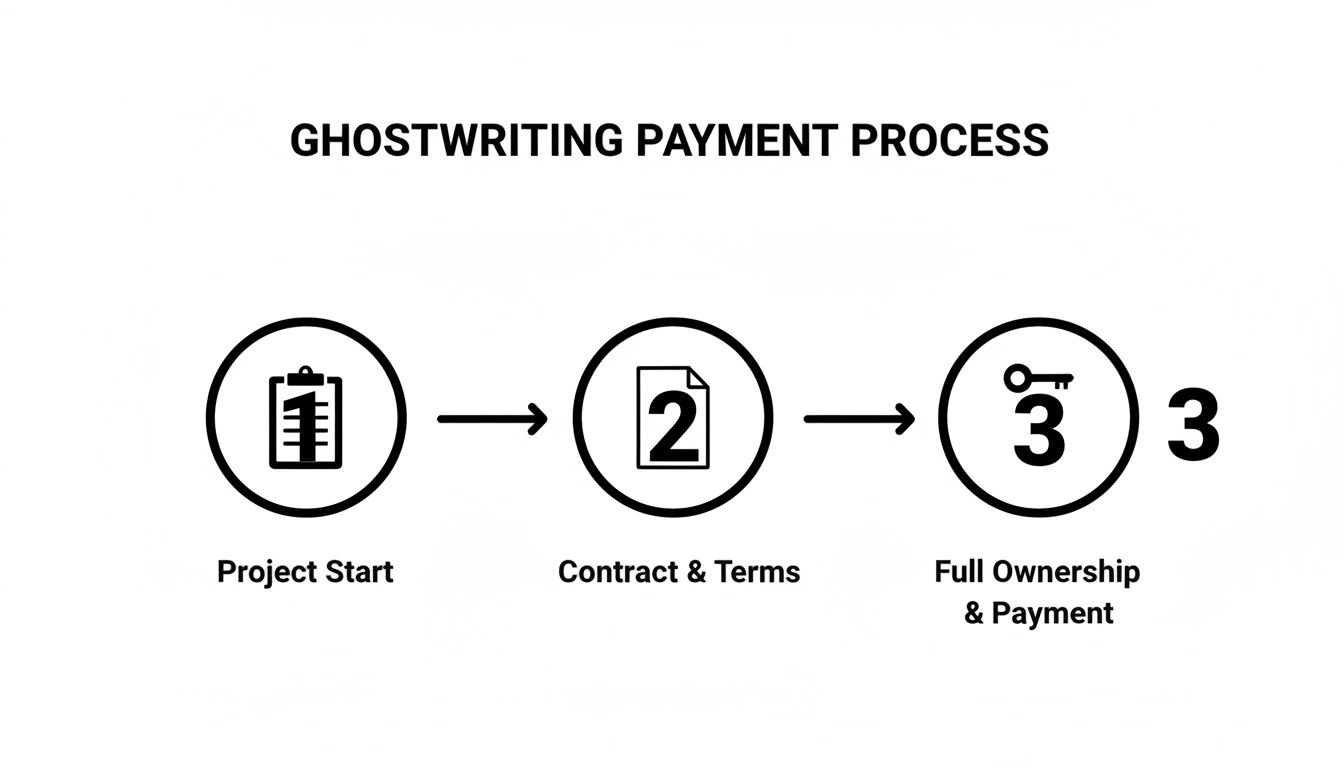
As you can see, the contract is the central pillar here. It ensures your IP is protected and the final key to ownership is legally and officially yours.
Common Questions About Hiring a Ghostwriter
Even when you’re fired up and ready to pay someone to write your book, some nagging questions might start to creep in. That’s perfectly normal. This is a huge, personal undertaking, and it’s smart to get some clarity before diving in. Let's tackle some of the most common worries I hear all the time.
A big one is always about credit. "Will people know I didn't write it myself?" The short answer? Not unless you tell them.
A ghostwriter's entire job is to be invisible. The contract legally establishes you as the sole author, and any true professional will guard that confidentiality with their life. It's your story and your name on the cover, period. They are quite literally a ghost, and they like it that way.
Then there's the AI question, which is a very real concern these days. We're seeing a split in the industry. Some services are using AI to cut corners and lower costs, but this has actually made authentic, human only ghostwriting even more valuable. Many publishers are now specifically requiring AI free content, cementing the human touch as the gold standard for a timeless book. You can read more about where the industry is heading to see how this is shaking out.
But Will It Really Sound Like Me?
This is the million dollar question, isn't it? The fear that the final book will sound like a complete stranger wrote it.
A skilled ghostwriter is a master listener. They don't just hear your words; they pick up on your rhythm, your sense of humor, and your unique perspective. Think of them as vocal chameleons.
Their goal isn't to invent a voice for you. It's to find, capture, and elevate the voice that’s already there. It's more like a translation process than an act of creation.
Through in depth interviews and close collaboration, they get a feel for your essence. When you read the final manuscript, it should feel so authentically you that you forget someone else was even involved in typing the words. It will feel like you're reading your own thoughts, just more eloquent.
At My Book Written, our goal is to give you the tools and confidence to find that perfect writing partner for your journey. Ready to take the next step with your story? Explore our guides at mybookwritten.com and let's get started.
Find out what your book would actually cost
Set the type, length, research depth and timeline. You get a real 2026 range built from 240+ quotes — not the number an agency wants you anchored to.
Read next
What will your book cost?
Set the type, length and timeline. Get a real 2026 range in 30 seconds.
Open the calculator