
Writing a memoir isn't about cataloging every single thing that's ever happened to you. That's called an autobiography, and unless you've discovered a new planet or invented toast, it can be a bit of a snooze. A memoir is about finding the one central truth from a specific slice of your life and wrapping a compelling story around it. The real work is moving from a state of total overwhelm to one of sharp focus, nailing down that core message, and then creating a solid blueprint to bring your narrative to life.
Your Story Is a Book Waiting to Be Written
That idea you keep coming back to, the one about turning your life's lessons into a real, hold in your hands book, is more than just a fleeting thought. It's a story that deserves to be told. It’s a legacy that deserves to last forever. I get it. It feels like a beautiful, honorable, and completely terrifying thing to do.
But let’s be real. The path from a lifetime of memories to a finished manuscript can feel like trying to untangle a massive knot of Christmas lights in a dark room. Frustrating, right?
You've got a pile of notes, a flood of experiences, and a powerful desire to do your story justice. This isn't just about stringing words together. It's about honoring your journey, your struggles, and your victories. It’s an act of creation, and it’s a profound honor to undertake.
This simple flow shows how we get from a jumble of ideas to a finished book.
As you can see, before a single word of the book is written, you need to get into the right headspace and find that clear, heartfelt theme to build everything on.
Shifting From Overwhelm to Action
The biggest hurdle for most people isn't a lack of stories. It’s the feeling of being completely swamped by them. We’re going to help you shift your mindset from, "How can I possibly do this?" to, "What's the one truth I absolutely need to share?" That single question becomes the heartbeat of your memoir.
And let's get one thing straight right now: you don’t have to do this alone. In fact, most people find the sheer weight of writing, structuring, and polishing a manuscript to be too much to handle on their own. It’s a beast.
The most beautiful memoirs are collaborations. You bring the life, the voice, and the soul. A professional brings the craft to make it sing. It’s your story, perfectly told.
Partnering with a professional ghostwriter is like hiring an architect to build your dream home. You provide the vision, and they draw up the blueprints and handle the construction. It’s still your house, your vision, just brought beautifully to life without you having to learn how to pour concrete. It's an easier, more enjoyable process, and it ensures your legacy is captured with the professional polish it deserves. For writers looking for more tools to help them along the way, platforms like Authoredup offer some excellent resources.
Not sure whether you need a ghostwriter or an editor?
If you already have 30,000+ words drafted, an editor at $3,000–$12,000 will serve you better than a ghostwriter at $40,000. The quiz sorts this out in five questions — honestly, even when the answer is the smaller job.
Find Your North Star: Your Why and Your Who
Before you even think about chapter one, let's take a deep breath and get crystal clear on two things that will change everything. First, why are you writing this book? And second, who are you writing it for? I know this sounds a bit like homework, but trust me, these aren't just philosophical questions. They are the bedrock, the foundation, the North Star for every single decision you'll make from here on out.
Your answers are the filter through which every story, every memory, and every word must pass. Getting this right is the difference between a random collection of memories and a memoir that truly moves people. It’s what gives your story its soul.

Uncovering Your “Why”
Your “why” is your book's purpose. It’s the deep down reason you're willing to put in the hours, dig through the tough stuff, and create this permanent record of your life. When you feel stuck or overwhelmed (and you will, we all do), your “why” is the thing that pulls you back to the keyboard.
So let's get practical. Is this book…
- A legacy for your grandchildren? You'll probably want a warm, conversational tone filled with family history and hard earned life lessons.
- A guide for entrepreneurs? Your focus will need to be on the failures, the pivots, and the specific wisdom you gained from your business journey.
- A story of healing for others? This demands gut wrenching vulnerability, total honesty, and a sharp focus on the emotional truth of your experience.
I once worked with a retiring CEO who wanted to write a book about his company. On the surface, he thought it was a straightforward business history. But when we really dug into his "why," we realized what he actually wanted was to inspire the next generation of employees with the scrappy, never say die culture of the early days.
That single clarification changed everything. We threw out the boring corporate milestones and focused instead on the hilarious, heartfelt stories of near bankruptcy and late night breakthroughs. That's the stuff people actually want to read.
To find your “why,” ask yourself this: If a reader could only remember one single thing from your book a year after reading it, what would you want that to be? Write that sentence down. That’s your core message.
This isn’t about ego. It’s about service. You’re writing to give something valuable to someone else. Honing in on your “why” is the first, most critical step in figuring out how to write a memoir that truly connects.
Painting a Picture of Your “Who”
Okay, now let's talk about your reader, your "who." I don't mean a vague demographic like "women over 40." I mean one specific person. Give them a name, a job, a problem they're facing that your story can help with. Imagine you're sitting across from them at a coffee shop, telling them just what they need to hear.
This exercise isn’t silly; it’s an incredibly powerful tool. When you write for everyone, you end up writing for no one. But when you write for one person, your voice becomes intimate, authentic, and magnetic.
This is also an area where a skilled ghostwriter can be your secret weapon. Part of their magic is helping you find this exact clarity. They are experts at asking the kinds of probing questions that reveal the true heart of your story and the ideal person who needs to hear it. It’s a clarifying, often emotional, and deeply rewarding process that makes the entire project feel less like work and more like a focused mission.
Your "why" is your motivation. Your "who" is your audience. Nailing these two down is like getting a map and a compass before you head into the wilderness. Now you have a direction, a purpose, and a destination. Everything from here on out just got a whole lot easier.
How to Structure Your Memoir for Impact
Let's clear up a common misconception right away. A memoir is not a diary. It’s not a chronological data dump of your entire life, starting from your first breath and ending with what you had for breakfast yesterday.
That’s an autobiography, and frankly, unless you’re a former president or have lived an exceptionally public life, it's probably not the book you're hoping to create.
A memoir is a story, plain and simple. It has a beginning, a middle, and an end, all built around a specific theme, a slice of your life, or a pivotal transformation. It’s about finding the meaning in the mess. Your memories are the raw ingredients; the structure is the recipe that turns them into a masterpiece people can't put down.

Finding the Right Framework for Your Story
After you've figured out why you’re writing this book and who you're writing it for, choosing your structure is the single most important decision you'll make. It’s the skeleton that holds everything together.
Your structure dictates which stories you'll tell and, just as importantly, which ones you'll bravely leave on the cutting room floor. Getting this right is what separates a compelling, professional feeling book from a collection of rambling anecdotes.
Here’s a look at a few common structures I see work brilliantly.
Choosing Your Memoir Structure
This table offers a quick comparison of common memoir structures to help you decide which best fits your personal story and goals.
| Structure Type | Best For | Example Scenario |
|---|---|---|
| Chronological (A to B) | Coming of age stories, overcoming a specific illness or challenge, or tracing the path of a business from startup to success. | A founder tells the story of their company, starting with the garage idea and moving sequentially through funding rounds, product launches, and eventual acquisition. |
| Thematic (All About B) | Thought leadership or legacy books where the focus is on lessons learned rather than a strict timeline. | A seasoned CEO organizes her memoir into chapters like "On Failure," "Finding Mentors," and "Leading Through Crisis," pulling stories from various decades to illustrate her points. |
| Framed Narrative (The Bookend) | Dramatic or transformative stories that have a clear "before and after" and benefit from building immediate intrigue. | A memoir opens with the author standing on a mountain peak, then flashes back to the debilitating accident that nearly paralyzed them, telling the story of their recovery before returning to the summit. |
Choosing a structure isn't about boxing yourself in. It’s about being intentional. It gives your story shape and power, ensuring your reader follows the emotional journey you want them to experience.
The Secret Sauce: A Simple Story Arc
No matter which structure you choose, your story still needs a clear narrative arc. Think of it like a satisfying three act play. This isn't just fluffy creative advice; it’s a critical element that makes a book commercially viable.
Publishers are actively looking for memoirs, with some reports showing an 85% increase in deals over the last decade. But they receive thousands of queries from first time writers every year. A book with a tight, well defined architecture immediately stands out.
Successful manuscripts tend to follow a clear pattern: around 20-30% setup, 50-60% rising conflict and transformation, and a final 20% for resolution and reflection. For a deeper dive, you can learn more about publishing trends and why this structure is so crucial.
A memoir without a clear structure is like a beautiful house with no foundation. It may look nice at first, but it will eventually fall apart, leaving the reader confused and unsatisfied.
A simple blueprint can make all the difference:
-
Act 1: The Setup (about 25% of your book): This is where you paint the "before" picture. Who were you? What was your world like? You establish the status quo before everything changed.
-
Act 2: The Confrontation (about 50%): Here comes the inciting incident, the challenge, the messy middle. This is the heart of your story where you face obstacles, learn tough lessons, and begin your transformation.
-
Act 3: The Resolution (about 25%): This is the "after." How did the journey change you? What wisdom did you gain? You resolve the main conflict and reflect on the story's deeper meaning for the reader.
This three act framework is your best friend. It keeps you from wandering off on tangents and ensures your story has momentum from beginning to end.
And if this all feels a bit daunting, remember, this is precisely where a professional ghostwriter shines. They are masters of structure, able to see the powerful arc hidden in your memories and build a narrative that will stand the test of time. It's a partnership that turns a good idea into a great book.
Gather Your Memories Without Drowning in Them
Alright, let's talk about the treasure hunt. This is where you become a detective in your own life, digging through the past to find the golden nuggets that will form the heart of your book. Your memories are scattered everywhere: in dusty photo albums, old journals, forgotten email threads, and most importantly, in the minds of the people you’ve shared your life with.
I’m not going to lie, this phase can feel chaotic. It's like trying to put together a thousand piece puzzle without the box top. But we can make this manageable, even fun. I promise.
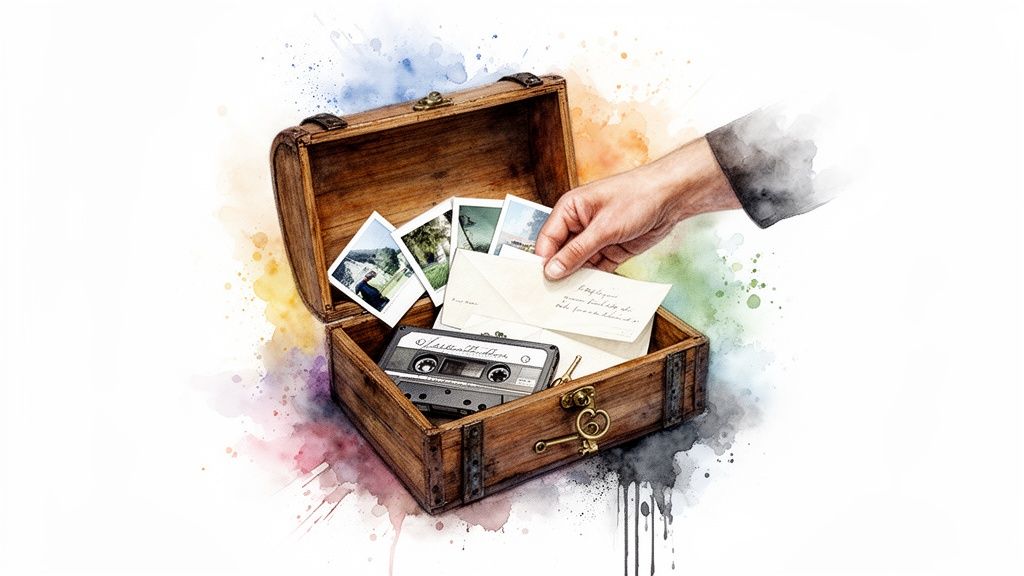
Here's the single most important rule right now: your goal is to collect, not to write. Don't censor yourself. Don't worry about prose. Just gather the raw materials.
Think of yourself as a chef prepping ingredients before you even think about turning on the stove. This prep work is the greatest gift you can give your future self, and it will save you hundreds of hours of frustration down the road.
Creating Your Memory Map
Instead of trying to remember your entire life at once (a task guaranteed to induce a nap), let’s get tactical. We need a system to coax these stories out of hiding without getting overwhelmed.
Here are a few low stress methods that really work:
- Map a "Memory Timeline": Grab a large sheet of paper or open a spreadsheet. Plot out the major life events from the period your memoir covers. Just use bullet points: "Graduated college," "Moved to Chicago," "First business failure," "Met Sarah." This timeline becomes your visual guide.
- Interview Your Supporting Cast: Your story doesn't exist in a vacuum. Talk to family, old friends, or former colleagues. Go in with specific questions like, "What do you remember most about that trip to Italy?" or "What was your first impression of me?" Use a voice recorder (with their permission!) so you can be present in the conversation.
- Use Sensory Prompts: Memories are deeply tied to our senses. Put on an old album from your college days. Cook a meal that reminds you of your grandmother. Visit a place from your childhood. It’s wild what forgotten moments come flooding back.
This is exactly where having a ghostwriter as a partner becomes a game changer. They aren't just writers; they are expert interviewers. They know how to ask the right questions to pull out the details you've long forgotten, helping you see the connections and patterns in your own life. It turns a solo archeological dig into an exciting, guided expedition.
Organizing Your Golden Nuggets
As you collect these memories, you need a place to put them. Don’t just dump everything into one giant folder labeled "Memoir Stuff." That way lies madness.
Instead, create thematic digital folders based on the key themes or chapters you’re starting to see emerge. For instance, your folders might be named:
- Lessons from Mom
- The Scrappy Startup Years
- Travel Disasters and Triumphs
- Learning to Let Go
Just drop your notes, scanned photos, and interview transcripts into the relevant folders. This simple act of organization transforms a chaotic pile of memories into a structured archive, ready for you when it's time to start outlining and writing.
Your story has value, not just as a personal legacy but as a contribution to a larger conversation. The current market is hungry for authentic voices, and getting your story into the world is more possible now than ever.
In fact, biographies and memoirs are seeing a huge surge in popularity, with significant year over year sales increases. Readers are craving unique perspectives. Whether your story is about entrepreneurial grit or intergenerational wisdom, there's an audience waiting for it. You can explore the data and discover more insights about these book market trends to see just how much demand there is for real, compelling stories like yours.
Why a Ghostwriter Is Your Secret Weapon
Let's talk about the ultimate secret weapon for actually finishing your book: not doing it alone. You are the visionary, the keeper of the story, the heart and soul of this entire project. Think of a professional ghostwriter as the skilled architect who brings that vision to life on the page.
And let’s clear the air on something right now. This isn't cheating. It’s a collaboration. In fact, it’s the single smartest way to ensure your story is told with the craft, structure, and emotional power it truly deserves. It’s about honoring your legacy by giving it the professional polish to last forever.
Moving From Visionary to Author
You wouldn't build a house without an architect or perform surgery on yourself. So why would you take on the monumental task of writing, structuring, and editing a book without an expert guide?
A great ghostwriter doesn't just take dictation. They become your partner, your strategist, and your confidant. They interview you, dig deep into your memories, and help you find the emotional core of your story, that universal theme that will hook readers and not let them go.
They handle the heavy lifting of the craft, so you can focus on what only you can do: telling the story. It makes the whole process more fun, more focused, and infinitely less stressful. Honestly, it’s the best way to get it done.
Finding the Right Partner for Your Story
Of course, finding the right person can feel a bit like online dating. You’re looking for chemistry, trust, and a shared vision. This is a huge decision, and you need to feel completely comfortable trusting this person with your most personal experiences.
When you start your search, don't just get hung up on their previous topics. Look for their ability to capture someone else's voice. A great ghostwriter is a chameleon; they can adapt their writing style to sound exactly like you.
Here’s what to look for when you're vetting candidates:
- A Strong Portfolio: Do their samples feel authentic and varied? Can you hear a distinct personality in each one? That’s the mark of a true pro.
- A Clear Process: They should be able to walk you through a structured plan for interviews, drafting, and revisions with complete confidence. No hand waving.
- Deep Listening Skills: During your first calls, are they asking thoughtful, probing questions? Or are they doing all the talking? You want a partner who is genuinely curious about you and your story.
This partnership is critical because the memoir market is booming. To stand out, your book needs to be exceptional. With the rise of audiobooks, a sector projected to become a multi billion dollar industry, the structure is more important than ever. When vetting ghostwriters, ask them how they pace chapters for listeners. Shorter, punchier chapters can seriously boost engagement in an audio format. You can discover more insights on personal stories for 2025 and see why this kind of professional guidance is so valuable.
Choosing a ghostwriter isn't about hiring a typist. It's about choosing a creative partner to embark on one of the most meaningful journeys of your life. It’s about finding someone you trust to hold your story with as much care as you do.
Key Questions to Ask a Potential Ghostwriter
Once you've narrowed down your list, it's time for the interview. This is your chance to see if you "click." Being prepared with the right questions will tell you everything you need to know.
Here's a checklist to get you started:
- "How do you capture a client's unique voice?" This is the million dollar question. Look for answers about their interview process, how they listen for speech patterns, and their use of transcripts.
- "Can you walk me through your revision process?" You need to know you'll have plenty of opportunities for feedback and that the process is collaborative, not confrontational.
- "How do you handle sensitive or difficult memories?" A great ghostwriter is also an empathetic listener who can create a safe space for you to share your toughest stories.
- "What does the contract look like?" They should be transparent about fees, timelines, ownership of the work (it should always be 100% yours), and confidentiality.
Finding your ghostwriter is the final, crucial step in making your book a reality. It's the decision that turns a wonderful idea into a beautifully written, professionally crafted memoir you will be proud to share with the world. You’ve held onto this story for long enough. It's time to let an expert help you set it free.
Your Memoir Writing Questions Answered
We get it. Starting this journey can feel a lot like packing for a trip to a country you’ve never visited. You know it’s going to be amazing, but you probably have a million questions about what to expect. That’s completely normal.
Here are a few of the most common questions we hear, answered with the kind of straightforward, real world advice you deserve. Think of this as your friendly FAQ for the soul.
How Do I Handle Sensitive Stories About Other People?
This is, without a doubt, one of the trickiest and most heartfelt concerns that comes up. You need to tell your truth, but you don't want to cause unnecessary pain or, let's be honest, get an awkward phone call from Aunt Carol after the book comes out.
The golden rule here is to write your truth from your perspective. This isn't just a clever turn of phrase; it's a powerful narrative tool that keeps you honest and safe. Focus on how you felt and what you experienced, rather than making accusations.
For example, "He was a terrible business partner" is an accusation. But "When the company failed, I felt a profound sense of betrayal and disappointment" is your unimpeachable emotional truth. It keeps the story centered on you, right where it belongs.
In some cases, a little creative camouflage is your best friend. Changing names, locations, and other identifying details can give you the freedom to tell the story you need to tell while protecting the privacy of others. If the story involves significant trauma or potential legal issues, it’s always a wise move to consult with a sensitivity reader or even a lawyer.
A good ghostwriter is also a master at navigating these emotional minefields with grace. They can help you find the words that are both true to your experience and kind to the people in it.
What Is the Difference Between a Memoir and an Autobiography?
I love this question because the answer unlocks so much clarity. It's really the difference between a sprawling forest and a single, beautiful tree.
Think of it this way:
- An autobiography is the entire forest of your life, told chronologically from birth right up to the present. It’s comprehensive, fact driven, and covers what happened.
- A memoir is a walk through a specific, meaningful part of that forest. It focuses on a particular theme, time period, or transformation in your life. It explores what it meant.
A famous chef’s autobiography would cover their entire career, from culinary school to their Michelin stars. But their memoir might focus only on the chaotic, brilliant, and terrifying year they spent opening their very first restaurant. See the difference? The memoir has a tight focus and a clear emotional arc.
Unless you’re a world leader or a rock star, most people should write a memoir. It's more focused, more powerful, and frankly, much more interesting for the reader.
How Long Should My Memoir Be?
The question of length can feel like a mystery, but there's a pretty reliable sweet spot in the publishing world. For a standard memoir, you should be aiming for somewhere between 60,000 and 80,000 words.
That word count usually translates to about 250 to 300 pages in a finished book. If it’s much shorter, readers might feel like the story is incomplete. Go much longer, and you risk losing their attention, unless your life story involves, say, discovering a new planet or something equally dramatic.
Your best friend in hitting this target is that chapter blueprint we talked about earlier. It’s your roadmap, making sure every chapter serves the central theme and moves the story forward. It's the secret to keeping your manuscript tight, compelling, and free of fluff. As you navigate this journey, you might encounter moments where the words just won't come. Understanding how to overcome writer's block can be a huge help in keeping the momentum going.
A memoir’s length isn’t about hitting a magic number. It’s about telling your story completely, with richness and depth, and then having the wisdom to stop when it’s done.
Is It Still My Book If a Ghostwriter Writes It?
Let me shout this from the rooftops: Absolutely, 100%, without a shadow of a doubt, YES.
Think about it this way: when you hire an architect to design your dream home, is it their house or yours? It’s yours, of course. You provided the vision, the needs, the style, the soul. The architect just brought the technical skill to make it a reality.
A ghostwriter is your story’s architect.
You are the source of the vision, the memories, the voice, the wisdom. Your ghostwriter provides the professional craft to structure it, write it beautifully, and make it unforgettable. They are expert interviewers and storytellers whose entire job is to capture your unique perspective so perfectly that the words on the page sound exactly like you.
The final book is in your name, the copyright is yours, and the intellectual property is yours. It is your story, your ideas, and your legacy. Hiring a ghostwriter is simply the smartest, most effective way to ensure your story gets the expert execution it deserves. It’s an act of honoring your life by giving it the best possible voice.
At My Book Written, we provide the resources and clarity you need to finally get your story out of your head and onto the page. Whether you're just starting to organize your thoughts or looking for the perfect professional partner, we're here to guide you. Start your journey with confidence at https://mybookwritten.com.
Thinking about getting help with your memoir?
Tell us where you are and we will shortlist memoir specialists who work at your budget — plus an honest read on whether you need a writer or just an editor.
Read next
What will your book cost?
Set the type, length and timeline. Get a real 2026 range in 30 seconds.
Open the calculator