
So, you’ve got this brilliant idea for a book. The one that’s been bouncing around in your head for months, maybe even years. You know it has the power to help people, maybe even shift how your entire industry thinks. It deserves to be a real, physical thing people can hold, not just a fleeting thought.
There's a certain weight and permanence to a book. It’s a beautiful way to crystallize your life's work, a real honor.
But let me give you some tough love, from one creator to another: most experts with incredible ideas jump the gun. They get so revved up about the writing part that they just start typing, and what they end up with is a hundred pages of disconnected thoughts. It’s a classic case of what I call "manuscript-us interruptus," and it's the fastest way to a project that never sees the light of day.
The real work of writing a book doesn’t start with a blinking cursor. It starts with a plan. You have to build the foundation before you even think about laying the first brick.
Who Is This Book Really For?
This is the first, and honestly, the most critical question you have to answer: who are you writing for? And please, for the love of all things literary, don't give me a generic answer like "entrepreneurs" or "business leaders." That’s as helpful as saying you want to date "a human."
We need to get painfully specific here.
Think of one single person. Give them a name, a job, a problem that keeps them staring at the ceiling at 3 AM.
- Are you writing for Sarah, the startup founder who’s brilliant at product but can’t crack lead generation to save her life?
- Is it for David, a mid-level manager who feels completely invisible and desperately wants to lead with more impact?
- Or maybe it’s for Maria, a seasoned CEO who’s terrified her company culture is turning toxic and doesn't know how to fix it?
When you have a crystal-clear picture of that one person, your book becomes a direct conversation with them. The moment you try to write for everyone, you connect with no one.
Your book isn't a megaphone to shout everything you know. It's a quiet, generous guide to lead one specific person from their nagging problem to your brilliant solution. In this story, your reader is the hero, not you.
What's the Big Promise You're Making?
Once you know exactly who you're talking to, you have to define the core promise of your book. What's the transformation they'll experience after reading the final page? What will they be able to do that they couldn't do before?
This promise acts as a filter for everything you include. Every story, every piece of data, every chapter has to serve this one big idea.
I had a client once who said he wanted to write a book about "sales." Way too broad. So we dug in. I found out his real genius was in helping introverted tech founders sell without feeling like they were becoming slick, pushy salespeople.
His promise wasn't "learn to sell." It was "close your first six-figure deal without sacrificing your integrity." See the difference? One is a topic; the other is a transformation.
Getting this level of clarity isn't easy. It forces you to be honest and trim away ideas that, while interesting, don't serve the core promise. But it's the secret to writing a book that actually makes a difference. If you're struggling here, it’s often a sign that bringing in a collaborator, like a ghostwriter, could be a game changer. They're masters at finding that single golden thread in a mountain of your expertise.
Map Your Book Chapter by Chapter
Alright, you've locked in your foundation: you know exactly who you're writing for and the big promise you’re making to them. Now for the part everyone wants to skip, but which separates the finished books from the abandoned drafts. It's time to map out your chapters.
Seriously, think of yourself as an architect, not just a writer. You wouldn't build a house without a blueprint, right? Your book is a permanent structure for your ideas. It deserves that same level of care and planning.
This is the exact spot where so many fantastic book ideas fizzle out. We get lost in a sea of ideas because we don't have a map to follow. It’s no surprise that industry data shows a staggering 80% of business professionals ditch their manuscripts because their ideas are too disorganized. They burn hundreds of hours on drafts that go nowhere. You can get a sense of how planning impacts the wider publishing world from this Mordor Intelligence report.
From Messy Ideas to a Clear Path
Don't worry, outlining doesn’t have to feel like a dreaded homework assignment. It’s more like solving a puzzle, your puzzle. The whole point is to create a logical flow that guides your reader on a satisfying journey, moving them from the problem that has them stuck to the solution you’re offering.
There are a few great ways to tackle this, so don't feel stuck with that old-school Roman numeral format from high school (unless you love it, of course).
- The Sticky Note Method: This is my personal favorite for visual thinkers. Grab a pack of Post-its and find a big, empty wall. Each note represents a single idea, a key story, or a chapter concept. You can physically move the pieces around until the flow just feels right.
- Mind Mapping: Start with your book's core idea in the center of a page. From there, branch out with your main themes (these will likely become your chapters) and then add smaller branches for the sub-points within them. It's a fantastic way to see how all your ideas connect.
- The Interview Trick: Feeling totally stuck? Ask a friend or colleague to "interview" you about your book. Just hit record and have a conversation. The questions they ask and the way you naturally explain your concepts will often reveal the perfect chapter structure. This is a little-known secret that professional ghostwriters use all the time.
Ultimately, your goal is to move the reader from their starting point to their destination, with each chapter serving a clear purpose along the way. A simple process flow can help you visualize this core plan.
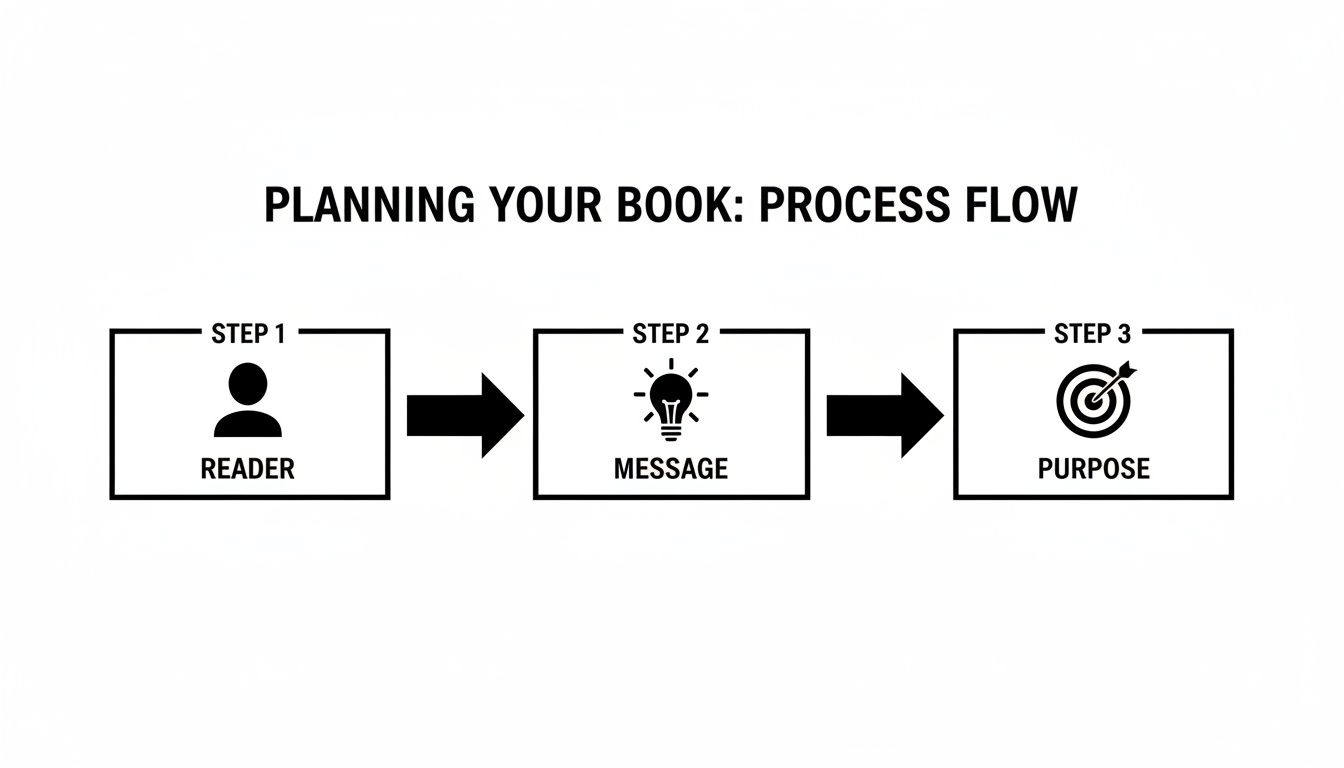
This visual is a great reminder that every part of your plan, reader, message, and purpose, needs to be in perfect alignment.
A Simple Structure You Can Steal
I once worked with a CEO who had written his entire company history in chronological order. While factually accurate, it was an absolute snoozefest. We completely reframed the book around his most powerful leadership lessons, using the history as supporting examples. It became an instant must-read in his industry.
That’s what good structure does.
To get you started, here’s a simple but incredibly effective framework I call the “Problem, Promise, Path” model. It works for just about any business or non-fiction book you can imagine.
The 'Problem, Promise, Path' Book Structure
This simple three-act structure helps map your business book's core message and chapter flow.
| Phase | What It Does | Example Chapters |
|---|---|---|
| The Problem (Act 1) | Hooks the reader by articulating their specific pain point and showing you understand their world. | 1. Why Your Marketing Feels Stuck 2. The Hidden Costs of 'Good Enough' 3. The Myth of the Overnight Success |
| The Promise (Act 2) | Presents your unique solution or framework as the answer. This is where you build authority and trust. | 4. Introducing the 'Momentum' Framework 5. Case Study: How Company X Tripled Leads 6. The Three Pillars of Sustainable Growth |
| The Path (Act 3) | Provides actionable steps, tools, and a clear roadmap for the reader to implement your solution. | 7. Your First 90-Day Action Plan 8. Tools to Automate Your Success 9. Building a Team That Buys In 10. Your Legacy Beyond the Book |
Once you’ve finished mapping everything out, that terrifying blank page won't be staring back at you anymore. Instead, you'll have a clear, chapter-by-chapter roadmap that makes the actual writing feel like you're just filling in the blanks. It’s the single best thing you can do to honor your idea and ensure it becomes the incredible book it deserves to be.
Not sure whether you need a ghostwriter or an editor?
If you already have 30,000+ words drafted, an editor at $3,000–$12,000 will serve you better than a ghostwriter at $40,000. The quiz sorts this out in five questions — honestly, even when the answer is the smaller job.
Find Your Voice and Get the Words Written
Alright, let's get down to it. You’ve got a solid plan and a beautiful, chapter-by-chapter map. Now for the part that can feel both thrilling and terrifying: getting the words down on the page.
It’s one thing to have a head full of great ideas; it’s a whole other beast to turn them into thousands of words that feel alive and authentic.
The biggest question I hear at this stage is always, "How do I make the book actually sound like me?" It’s a genuine fear that the final product will come out sounding stiff, corporate, or like a textbook. Let me put that fear to rest right now.
Your unique voice, your personality, your stories, and yes, even your little quirks, those are your greatest assets. They are what will make your book connect with readers on a human level. Don't try to sound like some generic "author." Just be you.
Embrace the Messy First Draft
The fastest way to kill your creative flow is to try and write and edit at the same time. The pressure to get every sentence perfect on the first go is paralyzing. It’s the infamous "blank page syndrome" that stops so many brilliant books before they even start.
Your only goal for the first draft is to get words on the page. That's it.
Give yourself permission to write a messy, clunky, imperfect first draft. I call it the "crappy first draft" philosophy. Just get the ideas out of your head and into a document without judgment. You can, and will, make it all pretty later. To make sure you see this through, it's vital to learn how to stay consistent and build habits that stick.
When the Blank Page Fights Back
Let’s be brutally honest. You're running a business. You have a team to lead, clients to serve, and a bottom line to manage. Finding uninterrupted blocks of time to write can feel like a complete fantasy.
This is where so many amazing book ideas go to die a slow, quiet death in a forgotten Google Doc.
The demand for business books is huge; in the US alone, business and professional development titles make up a 25-30% slice of the market. Yet, finishing is the real challenge. Statistics show that a staggering 95% of first-time authors take over 18 months to complete their book, with only 20% finishing without professional help.
So, what if you didn't have to face that blinking cursor alone?
A book is a permanent legacy. The method you use to create it is temporary. What matters is that your wisdom, your voice, and your story get shared with the world.
The Smartest Shortcut: A Ghostwriter
For countless leaders, collaborating with a professional ghostwriter is the most efficient and, frankly, most enjoyable path to a finished book. If you've been staring at a blank page for weeks, it might be the best decision you ever make for your project.
A great ghostwriter does so much more than just type for you. They are expert interviewers, storytellers, and architects of ideas.
- They interview you: Through a series of conversations, they skillfully pull the genius right out of your head.
- They capture your voice: They study how you speak, the metaphors you use, and your unique cadence to ensure the book sounds exactly like you.
- They structure your ideas: They take all your knowledge and shape it into a compelling narrative that keeps readers hooked from page one.
The final book is 100% your vision, your ideas, and your voice, brought to life without the solitary grind. It’s an incredibly smart way to create a legacy piece without sacrificing your business in the process.
The Not So Glamorous World of Editing
So, you’ve got a first draft. Seriously, take a moment and celebrate. Pop the champagne! You’ve accomplished something most people only ever talk about.
Now, take a deep breath, because this is where the real work begins.
This is the phase that separates a good book from a truly great one. It’s also, if I’m being completely honest, the part where a lot of authors want to throw their laptops out the nearest window. Editing can feel brutal. It's like being told your newborn baby is perfect… except it needs a new nose.

Why You Can’t Edit Your Own Book
Let’s get one thing straight: you are far too close to your own writing to edit it effectively. Your brain knows what you meant to say, so it automatically fills in the gaps, skips over typos, and glides right past clunky phrasing. You won’t even notice it happening.
I once worked with a brilliant CEO who was so immersed in his company's culture that he didn't realize he'd used the word 'synergy' 87 times in his manuscript. Eighty. Seven. He needed an outsider's perspective to see the forest for the synergetic trees.
This is exactly why fresh eyes are non-negotiable. Whether you hire a professional editor or enlist a few trusted, eagle-eyed colleagues, you absolutely need someone else to read your work. Getting a handle on the process, especially understanding the difference between revising and editing, is crucial before you even think about finalizing that draft.
The Three Layers of Editing
To keep from feeling completely overwhelmed, let's break editing down into three distinct stages. Trust me, trying to do all of these at once is a surefire recipe for madness.
- Developmental Editing: This is all about the big picture. Does the book's structure actually work? Is your core argument clear and compelling from chapter one all the way to the end? Think of this editor as an architect checking the blueprints and foundation of your house to make sure it won't collapse.
- Line Editing: Now we're zooming in to the sentence level. A line editor is focused on the rhythm, flow, and voice of your writing. They’ll challenge you on whether your sentences are punchy and clear, if your tone is consistent, and if your message is really landing with the impact you intended.
- Copyediting: This is the final, meticulous polish. The copyeditor is your friendly neighborhood grammar cop, hunting down typos, punctuation errors, and tiny inconsistencies with ruthless efficiency. Their job is to make sure your manuscript is clean, professional, and ready for your readers.
Think of it this way: A developmental editor ensures you wrote the right book. A line editor ensures you wrote the book well. A copyeditor ensures you wrote it correctly. You truly need all three.
How to Handle Feedback Without Crying
Getting a document back covered in red ink can feel intensely personal. It’s a delicate dance between protecting your core message and being genuinely open to making it better.
When that marked-up manuscript lands in your inbox, just breathe. Remind yourself that the feedback isn't a critique of you. It's about making the book better for your reader.
If this whole process sounds like something you'd rather avoid, that’s completely normal. This is another area where working with a professional ghostwriter can be a massive relief. They manage the entire editing workflow, acting as a buffer between you and the sea of red ink. Their job is to thoughtfully integrate feedback while fiercely protecting your unique voice and vision, making the whole journey a lot more fun and less of a grind.
Choose Your Path to Publishing and Launch
You did it. You wrestled your ideas, stories, and expertise onto the page and polished them until they gleam. Your manuscript is a real, beautiful, finished thing.
Now… how in the world do you get it into the hands of the people it was meant to help?
Welcome to the wild, wonderful, and sometimes confusing world of publishing. It’s not the finish line you might think it is; it’s the starting block for your book’s life out in the world. Making sense of it all can feel like trying to read a map in a foreign language, but I promise, it's manageable once you understand the main roads.
The Three Roads to Published Author-ity
Alright, let's break down the three main paths you can take. There isn’t a single "best" choice here, only the one that’s best for you and what you want this book to achieve.
-
Traditional Publishing: This is the classic path you see in movies. You write a killer book proposal, land a literary agent, and that agent sells your book to a major publishing house like Penguin Random House. They pay you an advance and handle all the editing, design, and distribution, and you get a small percentage of sales as royalties.
-
Self-Publishing: This is the indie route where you are the CEO of your own book. You’re in complete control of everything from the cover design to the marketing plan. You also keep 100% of the creative control and a much, much larger slice of the profits. You can hire top-notch professionals for each step (editing, design, formatting) and publish directly on platforms like Amazon KDP.
-
Hybrid Publishing: Think of this as a middle ground. A hybrid publisher operates like a traditional one in terms of quality and distribution, but you pay them a fee to produce your book. It’s a partnership where you invest in their expertise to bring a high-quality product to market faster than the traditional route, all while getting professional support.
The Honest Truth About Your Options
Let's get real about the pros and cons because they’re significant.
Traditional publishing offers prestige and the power of a big marketing machine, but it’s incredibly slow and competitive. Landing a deal can take years, and the odds are long. I've known brilliant authors who spent two years just getting an agent, let alone a book deal.
Self-publishing gives you speed, total freedom, and higher royalties. But all that freedom means you're also the project manager, marketer, and publicist. You have to wear a lot of hats, and if you’re not prepared to actively market your book, it might just sit quietly on the virtual shelf.
The global book publishing industry is a massive field, with revenue expected to hit $126.8 billion by the end of 2025. Non-fiction, where our business books live, makes up about 40% of that market.
Interestingly, since 2019, the number of self-published business books has surged by 52%. That tells you just how many experts are choosing to take control of their own destiny. You can explore more industry trends at IBISWorld.
Publishing Is Not the Same as Launching
This is a critical distinction that trips up so many first-time authors. Hitting "publish" on Amazon is not a book launch. Not even close.
A launch is a coordinated event designed to build buzz and create a moment. It's the grand opening for your book.
A great book launch turns your book from an item for sale into an event people want to be a part of. It’s the difference between opening a store and just hoping people wander in, versus throwing a massive party with a line around the block.
Your launch plan is a whole separate project that might include:
- Assembling a "launch team" of friends, colleagues, and superfans to help spread the word.
- Lining up a tour of guest appearances on podcasts in your niche.
- Running a strategic price promotion in the first week to drive early sales.
- Leveraging your email list and social media channels with a planned content calendar.
No matter which publishing path you choose, the energy you bring to the launch will make a huge difference in your book's long-term success. It’s your chance to give your creation the powerful start it deserves.
A Few Lingering Questions…
Writing a business book is a rollercoaster. One minute you’re on a creative high, the next you’re staring at a blank page wondering if you’ve completely lost your mind. It’s a beautiful, messy, incredible process.
As you’ve gone from a spark of an idea to a full-blown manuscript plan, I bet a few nagging questions have popped up.
Don't worry, you're in good company. Every author I've ever worked with, from first-timers to seasoned pros, hits these same mental roadblocks. So, let's pull back the curtain and tackle the common uncertainties I hear from authors just like you.
"So, How Long Should My Business Book Actually Be?"
Everyone asks this, but there’s no single magic number. In the real world, most business books land somewhere between 40,000 and 60,000 words. That translates to a physical book of about 150 to 250 pages.
If it's much shorter, it can feel more like a beefed-up pamphlet than a book. Go much longer, and you risk losing your reader, who is likely a very busy professional.
My best advice? Stop obsessing over the word count. Instead, focus on one thing: delivering on the promise you made in your introduction. A tight, value-packed 45,000-word book that solves a reader's problem is infinitely better than a rambling, 70,000-word book filled with fluff just to hit a page count. Get to the point. Your reader will love you for it.
"Do I Really Need a Huge Social Media Following to Get Published?"
Ah, the "platform" question. It’s a big one. The short answer is that a following definitely helps, but it is not a dealbreaker, especially if you decide to self-publish.
Let’s be honest: for a traditional publisher, your existing platform carries a lot of weight. They're making a bet on you, and they want to see a built-in audience ready to buy your book. But here’s the inside scoop: a small, hyper-engaged audience in a specific niche can be way more powerful than a massive, generic following.
If your platform feels small right now, don't let that stop you. Just start building it thoughtfully.
- Share your best ideas in a weekly newsletter.
- Get active and connect with peers on LinkedIn.
- Pitch yourself as a guest on podcasts your ideal reader listens to.
The key is showing that you have a real way to connect with the very people your book is for. And remember, the book itself becomes a massive tool for building that platform.
"What’s the Real Difference Between a Ghostwriter and an Editor?"
This is a fantastic and incredibly important question. People confuse these roles all the time, but they are completely different and serve unique purposes.
Think of it like building a house.
A ghostwriter is your architect and general contractor. You are the visionary. You provide the land (your expertise), the vision (your core message), and the unique stories. The ghostwriter then draws up the blueprints and builds the entire house from the ground up, making sure it perfectly reflects your style and ideas.
An editor is your home inspector and interior designer. They come in after the house has been built to make it perfect.
- A developmental editor checks the foundation and overall structure.
- A line editor polishes the interior, ensuring every room flows beautifully.
- A copyeditor walks through with a white glove, fixing any tiny imperfections before you open the doors.
You might hire a ghostwriter to build the initial manuscript, and then both of you will work with an editor to turn it into a masterpiece.
The ghostwriter builds the structure of your story. The editor makes sure that structure is flawless and ready for the world to see. One creates, the other refines.
"Okay, Be Straight With Me: How Much Does a Ghostwriter Cost?"
This is the big one, and the honest-to-goodness answer is: it varies. A lot. The cost of hiring a professional ghostwriter depends on their experience, their specific process, and the scope of your book.
Top-tier ghostwriters who work with celebrities and major CEOs can command fees well into the six figures. But for a high-quality, professional ghostwriter for a standard business book, you're typically looking at a range of $25,000 to $75,000.
Yes, it’s a significant investment, but you’re investing in your legacy. When you're exploring your options, please don't just shop based on price. Ask to see their portfolio. Talk to their past clients.
Most importantly, make sure you genuinely connect with them. You’ll be spending a lot of time sharing your most personal stories and ideas with this person. A great personality fit is absolutely crucial to bringing your vision to life in a way that feels joyful and authentic. It’s your book, your voice, and your honor to create it. Finding the right partner makes all the difference in the world.
Bringing a book into the world is a profound act of generosity. If you're ready to turn your expertise into a lasting legacy but need a guide to help you through the process, My Book Written provides the resources to help you plan, structure, and partner with the right professional. Explore our guides and start your journey today.
Get matched with a business book specialist
Business books need research, interviews and fact-checking, not just writing. We match you with people who have actually done it.
Read next
What will your book cost?
Set the type, length and timeline. Get a real 2026 range in 30 seconds.
Open the calculatorKeep reading
Business & Thought Leadership
11 guides in this section, free to read.
Browse the section