
Before you write a single word of your memoir, the most important thing is to truly believe your story is worth telling. It is. The journey ahead involves finding the central thread of your life, mapping out the moments that define it, and then diving into the real work, getting those memories onto the page, whether you go it alone or bring in a pro.
Your Story Deserves to Be Told
So, you’re thinking about writing a memoir. Welcome. Let’s just get this out of the way: that feeling you have, the one that’s equal parts thrilling and terrifying, is completely normal. It’s a calling, an undeniable pull to capture the essence of your life and turn it into something tangible, something that lasts forever.
But man, it can also feel overwhelming. Staring at that blank page can feel like trying to map the entire world from memory. Where on earth do you begin?
This guide is here to be your co-pilot. We get it. We know the path is full of emotional landmines, crippling self-doubt, and the relentless taunt of a blinking cursor. We're here to help you create something beautiful, a physical book that honors your journey.

Why Your Memoir Matters More Than You Think
You know that little voice in your head whispering, "Who would want to read my story?" It’s a terrible roommate, and it’s time to serve it an eviction notice. Your story is inherently unique because you are. Your victories, your heartbreaks, your quirky family traditions, they’re all part of a narrative that only you could write.
A memoir isn't reserved for celebrities or people who've climbed Everest. It's for anyone who has lived, learned, and gained a perspective worth sharing.
Your book could be so many things:
- A priceless legacy for your family, answering questions your grandkids haven't even thought to ask yet.
- A beacon of hope and understanding for someone walking a path you've already traveled.
- A powerful tool for you to process and finally make sense of your own journey.
The act of writing your story is an act of honoring your own existence. It declares that your experiences mattered, your voice is important, and your legacy deserves to be preserved in something more permanent than a fading memory.
Of course, getting from idea to finished book can happen in a couple of different ways. For some, the solitary challenge of writing every word themselves is a deeply personal and rewarding marathon. They thrive on that intimate connection with the page.
For others, partnering with a professional is the smarter, more fun, and frankly, easier path. Working with a ghostwriter isn't cheating; it's a strategic collaboration. Think of it as hiring an expert architect to help you build the monument to your life, ensuring every brick is laid perfectly while you provide the vision. It's still your vision, brought to beautiful reality.
This decision is one of the first you'll make. Here's a quick look at the two main paths for creating your memoir, helping you see which approach fits your life and goals.
Your Memoir Writing Path DIY vs Professional Partnership
| Aspect | DIY (Do-It-Yourself) | Partnering with a Ghostwriter |
|---|---|---|
| Time Commitment | High. Requires hundreds of hours for writing, editing, and revision. | Low. You provide the stories; the ghostwriter handles the heavy lifting of writing. |
| Writing Skill | You need to be a strong, disciplined writer or willing to learn extensively. | No writing skill required. Your ability to tell your story is what matters. |
| Objectivity | Challenging. It's hard to be objective about your own life experiences. | A huge benefit. A professional can spot the universal themes and structure the narrative for impact. |
| Project Management | You're responsible for everything: setting deadlines, outlining, and staying motivated. | The ghostwriter or firm manages the entire process, keeping the project on track. |
| Financial Cost | Lower upfront cost, but your time has value. Potential costs for editors, coaches, etc. | Higher initial investment. You're paying for expertise, speed, and a polished final product. |
Ultimately, whether you decide to write it all yourself or bring in an expert partner like the storytellers at Opus Eternal, the goal is the same. You're the author of your life. Let's get that story told.
Not sure whether you need a ghostwriter or an editor?
If you already have 30,000+ words drafted, an editor at $3,000–$12,000 will serve you better than a ghostwriter at $40,000. The quiz sorts this out in five questions — honestly, even when the answer is the smaller job.
Finding the Heart of Your Story
So, you’ve decided to write a memoir. Let's tackle the first big, scary question: What is this thing actually about?
Most people fall into the trap of thinking they need to start with "I was born on a Tuesday…" and document every single thing that's ever happened to them. Please, for the love of your future readers, don't do this. That’s an autobiography, and unless you're a former president or a rock star, it's a recipe for a very expensive doorstop.
A great memoir isn't just a chronological list of events. It’s a story with a heartbeat. It zeros in on a specific period of your life where everything changed, or it explores a central theme that runs through your experiences. It's not the entire, sprawling map of your existence, it’s a deep dive into one fascinating corner of it.
Think of your life as a massive library. Your memoir isn't the whole library. It’s one single, powerful book you pull from the shelf. Our job is to find that book.
Uncovering Your Central Theme
How do we find that golden thread? It's usually hiding in plain sight, woven into the patterns of your life. We just need to know how to look for it. We're not writing a diary entry; we're crafting a compelling narrative.
Let’s try a little exercise I call "memory spelunking." Grab a notebook, don't overthink it, and just jot down whatever comes to mind for these prompts:
- The Highs and Lows: List 3 of your proudest moments and 3 of your most gut-wrenching lows. Is there a common thread connecting them?
- The Turning Points: Pinpoint 3 moments where your life took a sharp, unexpected turn. Think of these as the "before and after" photos of your journey.
- The Recurring Lessons: What’s a lesson life seems determined to teach you, over and over again? (Mine is apparently "don't put metal in the microwave." It's a work in progress.)
- The Defining Relationships: Who are the 3 people who have most profoundly shaped the person you are today, for better or worse?
Now, take a step back and look at what you’ve written. Do you see a pattern emerging? Maybe all your turning points involve taking a massive risk. Perhaps your highs and lows are all tied to a quest for belonging or a fight for independence. This is the raw material, the very heart of your memoir.
The most powerful memoirs aren't about extraordinary events; they are about the extraordinary emotions and insights found within ordinary lives. Your story’s power isn't in what happened, but in what it meant to you.
Once you have a sense of your theme, you can start framing it as a central question. A story about leaving a soul-crushing corporate job to open a bakery isn't just about flour and sugar. The real question might be, "Can you find true fulfillment by abandoning the life you were told you should want?"
This focus becomes your North Star. It guides every decision, helping you figure out which memories belong in the book and which, while meaningful, are detours from the main story. To make that story resonate, it helps to use effective storytelling techniques that bring your experiences off the page and into the reader's imagination.
The Ghostwriter's Secret Weapon
Honestly, this discovery process can be incredibly difficult to do alone. We're often too close to our own lives to see the narrative arc clearly. It's like trying to read the label from inside the bottle.
This is where a good ghostwriter is worth their weight in gold. A great ghostwriter is part-therapist, part-detective. They listen to your jumble of memories and have an uncanny knack for spotting the glimmer of the real story buried underneath.
They ask the questions you haven't thought to ask yourself and help connect dots you didn't even know existed. It’s an incredible relief to have a skilled partner whose entire job is to help you make sense of it all. They don't just write down your words; they help you find your story's soul.
Creating Your Memoir's Blueprint
Okay, you’ve done the hard soul work. You found the beating heart of your story, and that’s a massive win. But now comes the part that can feel just as intimidating: How on earth do you take a whole lifetime of memories and shape them into something that reads like a story, not just a chaotic diary entry?
This is what I call the blueprint phase. We're not writing chapters yet. We’re just drawing the map. Forget about crafting perfect sentences for now. Right now, our job is to be the architect, not the interior designer.
The goal here is to take that overwhelming mountain of memories and build a manageable, even exciting, structure. This isn’t about some rigid, soul-crushing outline. It's about creating a flexible guide that gives you the confidence to write freely. Think of it less like trying to build a skyscraper all by yourself and more like assembling a really cool LEGO set with a great set of instructions.
The Memory Island Technique
Let’s start with a wonderfully simple but powerful method I call the "Memory Island" technique.
Imagine your life is a vast ocean. Instead of trying to chart the entire thing at once, we're just going to identify the most important islands, the key moments that are absolutely non-negotiable for your memoir.
These are the scenes that really bring your theme to life. They’re the pillars that will hold up the entire structure of your book.
Grab a piece of paper (or open a new doc) and list 10 to 15 of these Memory Islands. Don't even think about chronological order yet. Just get them down.
What does a Memory Island look like? It could be:
- The afternoon you left your hometown with nothing but a suitcase and a wild idea.
- That one conversation with your grandmother that changed how you saw everything.
- The gut-wrenching moment you realized a dream you’d held for years was actually over.
- The hilarious, disastrous first date with the person you ended up marrying.
These islands are your story's bedrock. They represent the core events and the personal transformation you want to explore. This concept map gives you a good visual of how all these pieces connect.
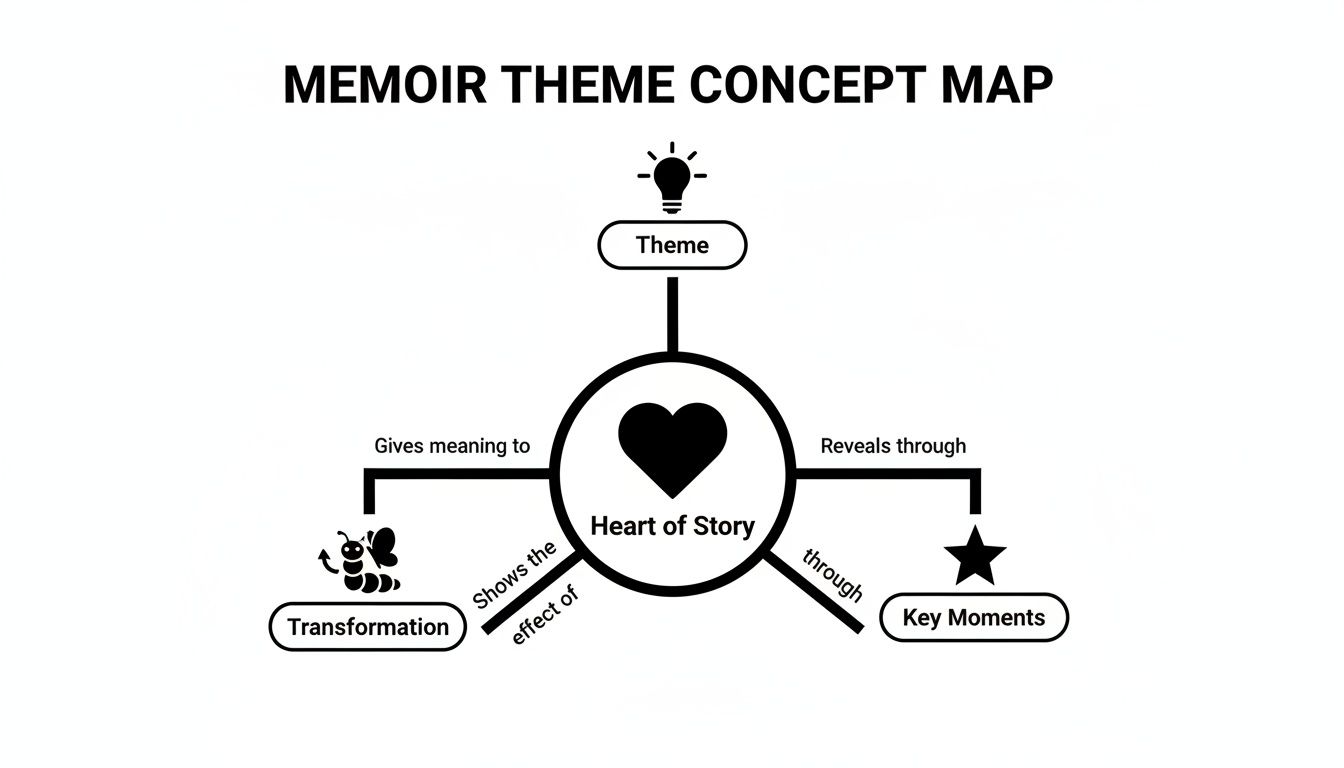
As you can see, the heart of your story is where your theme, your key moments, and your transformation all intersect.
Building Bridges Between Your Islands
Once you’ve got your islands jotted down, you can start playing with the order. You might go for a classic chronological timeline, or you could get creative and start near the end, weaving in flashbacks. There are no hard-and-fast rules, only what best serves the story you need to tell.
Now for the magic. The empty space between those islands is where the rest of your narrative lives. These are the "narrative bridges" that connect your key scenes, giving the reader context, your own reflections, and the momentum to keep turning the page.
For instance, if one island is "The big fight with my father" and the next one is "Moving across the country," the bridge is the story of what happened in between. Maybe it’s a chapter about the quiet, lonely nights spent making that monumental decision. That’s the connective tissue that turns a list of events into a compelling journey.
A great memoir structure isn't just about what happened; it's about why it happened and how it felt. The bridges you build are just as important as the islands they connect, providing the emotional depth and narrative flow that keeps a reader hooked.
Your Three-Act Structure, Simplified
Don't let this scare you, but even the most creative memoirs tend to follow a classic three-act pattern. It's actually incredibly intuitive.
- The Beginning (The Setup): This is where you introduce your world as it was. You establish your starting point, bring in the key people, and present the central conflict or question that drives your story.
- The Middle (The Mess): Life is messy, and so is the middle of a good book. This is the part where you face challenges, make mistakes, and navigate the fallout. Most of your Memory Islands will probably live here.
- The End (The Resolution): This isn't always a "happily ever after" finale. It's about showing how you’ve changed. You resolve the memoir’s central question and reflect on what you learned, demonstrating your transformation.
This blueprinting process can feel a little clunky and unnatural, I get it. It’s tough to be objective about your own life.
This is another spot where working with a professional can be a game-changer. An experienced ghostwriter, for example, has a knack for seeing the inherent structure in someone’s life story. They can listen to your islands and instantly see the most powerful way to build the bridges, ensuring your blueprint is solid and emotionally resonant. It takes the pressure off of you, letting you focus on what you do best: remembering.
Getting the Words on the Page Without the Struggle
Okay, deep breath. We've found the heart of your story and we've built a beautiful blueprint. Now for the part that sends most aspiring authors running for the hills: actually writing the darn thing. This is where the ink is supposed to meet the page, but often, it's where life, self-doubt, and that evil, blinking cursor conspire to stop you dead in your tracks.
Let’s be brutally honest for a second. This is the hardest part. The initial rush of excitement fades, and the day-to-day reality of sitting down to write your memoir settles in. It can be a lonely, emotional, and sometimes deeply frustrating process. Countless incredible stories fizzle out right here, lost to the sheer chaos of everyday life.
But not yours. Not this time. We’re going to tackle this together.
Ditch the Marathon Mindset, Embrace the Sprint
Most people have this idea that they need to carve out huge, uninterrupted four-hour blocks of time to write. If you have that luxury, fantastic. For the other 99% of us juggling jobs, kids, pets, and a million other things, that’s just a recipe for failure.
Instead, let’s try something a little different. Think of it as writing in sprints, not a marathon. The idea is simple: short, focused bursts.
- Set a timer for 20 minutes. That's it. One single, manageable 20-minute sprint.
- Pick one "Memory Island." Don't try to write the whole book or even a whole chapter. Just focus on one specific scene or memory from your blueprint.
- Write with abandon. Seriously. Don't edit. Don't worry about perfect sentences or finding the right word. Just get the raw memory down on the page. You can, and will, clean it up later.
You would be absolutely shocked at how much you can accomplish in just 20 minutes a day. It feels manageable, it builds momentum, and it keeps that nasty inner critic from having enough time to sabotage your efforts. Suddenly, the monumental task of "writing a book" becomes the simple act of "writing for a few minutes."
What if You Just Feel Stuck?
Some days, the words just won't come. You'll sit there, staring at the screen, feeling like a total fraud. Welcome to the club. Every single writer on this planet has been there. When you’re writing a memoir, this feeling is often amplified because you're wrestling with real, complicated emotions from your past.
The blinking cursor isn't your enemy. Your real enemy is the unrealistic expectation that every writing session will be a magical, effortless flow of perfect prose. Some days it’s a grind, and that’s okay. The goal is progress, not perfection.
This struggle is where good old-fashioned discipline becomes your best friend. To truly push through these moments, you might want to explore these 10 actionable self-discipline techniques that can help you keep going when motivation decides to take a vacation. It's all about building habits that carry you through the tough days.
When to Call in a Partner
Let’s have a heart-to-heart. What if you try the sprints, you build your discipline, and you still find that the hours just aren't there? What if you discover that translating your vibrant, three-dimensional memories into compelling prose is just way harder than you ever imagined?
This is not a sign of failure. It's a sign of wisdom.
Recognizing you need help is one of the smartest moves you can make on this journey. This is the exact moment when partnering with a ghostwriter can turn a stalled project into a finished masterpiece. It’s not giving up; it’s bringing in an expert to help you cross the finish line.
A service like Opus Eternal specializes in this very thing. They can take your blueprint, your voice, and your memories, and then do the heavy lifting of the actual writing. Their expert ghostwriting is remarkably fast and efficient, making it an accessible premium option to get your book done right. It’s your vision brought to life, without all the struggle.
Polishing Your Draft Until It Shines
So, you did it. You wrestled your memories onto the page, and now you’re staring at a finished first draft. Before you do anything else, take a moment and celebrate. I’m serious. That’s a monumental achievement most people only ever dream of.
Now for the next, equally important step: put it away.
No, really. Tuck that manuscript into a drawer, save the file in a folder you won't touch, and walk away for at least a few weeks, a month is even better. Right now, you’re too close to the words, too invested in the struggle of getting them down. You need some distance to see what you’ve really created. It’s like trying to see your entire reflection when your nose is pressed against the mirror.
This next phase is all about revision. As Ernest Hemingway famously said, "The only kind of writing is rewriting."

Reading Your Work with Fresh Eyes
Once your manuscript has had a nice little vacation, it's time to read it again. But this time, you’re not reading it as the writer; you’re reading it as a tough but fair critic. If you can, print it out. You'd be amazed how many new things you'll spot on a physical page that you skimmed right over on the screen.
For this first pass, you’re hunting for big-picture issues, not typos. Don’t get hung up on awkward sentences just yet. Instead, keep these questions in mind:
- Does the story flow well? Are there any jarring transitions or moments where the pacing just feels off?
- Is my voice consistent? Does it sound like me from the first page to the last?
- What’s the emotional heartbeat? Does the emotional journey I planned actually land for the reader, or is it just in my head?
- Are there any glaring holes? Are there gaps in the story that will leave a reader confused?
This is the part where you have to be brave and, as the saying goes, "kill your darlings." Remember that beautifully crafted paragraph you spent three hours perfecting? If it doesn’t actually move the story forward or serve your central theme, it needs to go. It’s painful, but it's what separates a good story from a truly unforgettable one.
Revision isn't just about fixing mistakes. It's about discovering your book's true potential. You aren’t just cleaning up a draft; you're a sculptor, chipping away everything that isn’t the masterpiece inside.
Why This Is the Perfect Time to Call for Backup
Let’s be real for a second. Being truly objective about your own life story is next to impossible. You remember all the inside jokes, the sensory details that never made it to the page, and the context behind every scene. That’s precisely why bringing in a professional at this stage is often the single best investment you can make when you write your own memoir book.
A professional editor or a ghostwriter brings a priceless gift to the table: fresh, expert eyes. They can spot the plot holes you’re blind to and see the powerful narrative threads you didn’t even realize you’d woven.
Think of it this way: you’ve built a solid, beautiful house. Now it’s time to bring in the interior designer. They won't tear down your walls; they’ll help you rearrange the furniture, find the perfect paint colors, and add those finishing touches that make the entire space sing. They elevate your vision.
Working with a pro isn't a sign of failure. It's an act of profound respect for your own story, ensuring it shines as brightly as it deserves to.
Bringing Your Book into the World
You did it. The manuscript is polished, the memories are on the page, and your story is finally told. Seriously, take a moment to let that sink in. This is a massive accomplishment.
But after the champagne pops, a new, slightly scary question usually appears: Now what? How do you get this document out of your computer and into the hands of a real, live reader?
Welcome to the publishing world. It can feel like a labyrinth from the outside, but it really boils down to two main roads you can travel. Let’s break them down so you can choose the right path for your incredible story.
The Two Roads to Publication
Think of your finished manuscript as a classic car you’ve spent years restoring. Now you have to decide: do you want to drive it yourself, or do you want to hand the keys to a professional driver who knows all the best routes and shortcuts?
-
Traditional Publishing: This is the classic, old-school route. You find a literary agent who falls in love with your memoir, and they pitch it to big publishing houses (think Penguin Random House or HarperCollins). If a publisher makes an offer, they’ll pay you an advance and take care of everything else, editing, cover design, printing, and distribution. It carries a lot of prestige, but be prepared for a long, slow journey that’s often paved with rejection letters.
-
Self-Publishing (Indie Publishing): On this path, you’re in the driver's seat. You’re the boss. You hire your own dream team of editors and designers and use platforms like Amazon's Kindle Direct Publishing (KDP) or IngramSpark to print and distribute your book worldwide. The upside is huge: you keep a much higher slice of the royalties and maintain 100% creative control. The trade-off? You’re also responsible for the upfront costs and all the marketing.
Which Path Is Right for Your Memoir?
Deciding between these two isn't about which one is "better," but which one is a better fit for you and what you want for your book.
The traditional path is a fantastic choice if your main goal is to see your book in major bookstores and get the validation that comes from a legacy publisher believing in your work. It's a tough door to get open, but the rewards can be incredible if you do.
That said, the self-publishing boom has completely changed the game, especially for memoirists. A huge number of authors now proudly identify as self-published. You can dig into some fascinating statistics on this author-led shift to see just how many writers are taking control. This path gives you speed, total control, and a direct line to your readers, perfect if you want to get your story into the hands of your family, community, or a niche audience without waiting years.
The most important thing is getting to hold your finished book. Whether a big-name publisher or you yourself made it happen, the accomplishment is exactly the same. You’ve created a legacy.
What If This All Sounds Utterly Exhausting?
I hear you. After pouring your heart and soul onto the page, the thought of wrestling with agent queries, ISBNs, and print formatting can feel like being asked to run another marathon right after crossing the finish line.
This is another moment where a great ghostwriting partner can be an absolute lifesaver.
At Opus Eternal, we believe our job isn’t done when the last word is written. A true partner can help you navigate the publishing maze by connecting you with trusted editors, phenomenal cover designers, and expert formatters. We can help you craft a query letter that gets an agent’s attention or get your accounts set up for self-publishing. It turns a confusing, overwhelming process into a clear, manageable checklist, so you can focus on the pure joy of finally sharing your story.
Your Memoir Writing Questions Answered
The decision to write a memoir is huge, and it naturally comes with a whole lot of questions. It's completely normal to feel a bit overwhelmed. Let's walk through some of the most common concerns I hear from writers, so you can push forward with more confidence.
How Do I Write About People Without Causing Drama?
This is the big one, isn't it? The question that keeps so many would-be memoirists up at night. The most important thing to hold onto is this: you are telling your story from your perspective. This isn't about reporting a court transcript; it's about sharing your emotional truth.
A common and effective strategy is to simply change names and blur identifying details. You can even create composite characters, blending a few people into one, to protect privacy while keeping the story's emotional core intact. Sometimes, a frank, open conversation with the person you're writing about can clear the air. But ultimately, you have a right to your own memories and experiences.
This is where an experienced ghostwriter can be a lifesaver. They are masters at navigating these sensitive situations, helping you find the words to tell your truth with care and skill, minimizing the potential for fallout.
How Much Does It Cost to Hire a Ghostwriter?
The cost of hiring a ghostwriter has always been a bit of a mystery, with prices all over the map. You'll see figures from a few thousand dollars to well into the six figures for well-known collaborators. It can feel intimidating and, honestly, out of reach for many people with a powerful story to share.
But that landscape is starting to change. While the top-tier, big-name ghostwriters will always command a premium, more accessible options are popping up. Companies like Opus Eternal were founded specifically to bridge this gap, offering that high-end, professional partnership at a much more manageable price point. It’s making expert help a real possibility for more authors than ever before.
What if My Life Isn't "Exciting" Enough?
Let me debunk this myth for you right now: your life is absolutely interesting enough for a memoir. A powerful memoir isn't defined by blockbuster events like wrestling crocodiles or climbing Everest (though if you've done either, we definitely need that book!).
The memoirs that stick with us are about human connection. They're about the universal truths we discover in deeply personal journeys, overcoming a private struggle, learning a difficult lesson, finding unexpected joy after heartbreak. It’s the emotional resonance of your story, not the adrenaline factor, that will forge a lasting bond with your readers.
Ready to finally turn your life story into a beautiful book you can hold in your hands? The team at My Book Written provides the expert guidance and resources you need to navigate every step of the process with confidence. Explore how we can help you create your legacy today.
Thinking about getting help with your memoir?
Tell us where you are and we will shortlist memoir specialists who work at your budget — plus an honest read on whether you need a writer or just an editor.
Read next
What will your book cost?
Set the type, length and timeline. Get a real 2026 range in 30 seconds.
Open the calculator