
Hiring a writer for your book is about finding a creative partner, someone who can take that brilliant, beautiful idea swirling around in your head and turn it into a real, hold-it-in-your-hands manuscript. It's a collaboration that lets you be the visionary while an expert handles the heavy lifting of structure, prose, and all those pesky commas.
Frankly, it's the fastest and most fun way to bring your story to life.
Giving Your Story The Voice It Deserves
That idea has been rattling around in your head for years, hasn't it? I know the feeling. Maybe it's a story that wakes you up at night, the business wisdom you know could shake up an industry, or a family history that feels too important to lose.
This is not just about "writing a book." It is about building a legacy. It is about creating a physical piece of you that will exist long after you are gone. That's a beautiful, honorable thing. But for most people, the journey from idea to bookshelf feels like trying to climb Everest in flip flops. The sheer scale of the project, the nagging self doubt, the endless hours staring at that blinking cursor… it is enough to make anyone put their dream back on the shelf.
Think of this guide as your sherpa. I am here to help you navigate the process of finding the right professional to join you on this expedition.
A Partnership, Not A Shortcut
Let's get one thing straight right away. Hiring a ghostwriter is not cheating. It is a smart collaboration.
Think of it like hiring an architect to build your dream home. You have the vision, the memories, and the non negotiables. They have the blueprints, the tools, and the know how to build a structure that will stand the test of time. It's still your house, your design, your dream.
Your story is the soul of the project. A great writer simply provides the skilled hands to give it a body. It's a powerful alliance that honors your vision by ensuring it's presented in the most compelling way possible.
The goal is to get your story told, beautifully and authentically, without the years of struggle that so many aspiring authors face on their own.
Still on the fence? Let's break down how this partnership stacks up against going it alone.
Hiring a Ghostwriter The Smart Path to Your Book
Here is a quick look at the benefits of partnering with a professional writer versus going it alone.
| Challenge Area | The DIY Struggle | The Ghostwriter Advantage |
|---|---|---|
| Time Commitment | 1,000+ hours of writing, editing, and research. Life gets in the way. | Your book gets written while you focus on your career, family, and life. |
| Writing Skill | You might be an expert in your field, but are you an expert storyteller? | They are masters of narrative structure, pacing, and prose. Their job is to make you sound like you, but better. |
| Objectivity | It is hard to "kill your darlings" and see your own work with fresh eyes. | An outside perspective helps refine your message and spot plot holes you are too close to see. |
| Industry Knowledge | Navigating publishing standards, formatting, and agent queries is a full time job. | They know what agents and publishers are looking for and how to position your book. |
| Motivation | The "lonely writer" trope is real. It is easy to lose steam or give up. | A partner keeps the project on track, provides encouragement, and ensures you finish. It is just more fun. |
Working with a writer is not just about saving time; it is about elevating your final product from "good" to "unforgettable." It is about creating something you are immensely proud of.
Now, let's get that masterpiece out of your head and into the world.
Not sure whether you need a ghostwriter or an editor?
If you already have 30,000+ words drafted, an editor at $3,000–$12,000 will serve you better than a ghostwriter at $40,000. The quiz sorts this out in five questions — honestly, even when the answer is the smaller job.
Preparing Your Project Before You Hire a Writer
I get it. You are eager to find the perfect writer and get this book out of your head and into the world. But before you even think about posting a job ad, we need to talk about the most crucial step. Getting your own house in order.
Trust me on this one. Walking into a conversation with a potential writer with a clear, thought out plan is like bringing a detailed map on a treasure hunt. It instantly elevates you from just another client to a dream partner every top tier ghostwriter wants to work with.
You would not hire a contractor to build your dream home by just saying, "Make it nice!" right? Of course not. You would have sketches, ideas, maybe even a Pinterest board full of specific doorknobs you love. Your book is no different. The more clarity you bring to the table now, the faster, cheaper, and more authentic the final manuscript will be.

This prep work is not about writing the book yourself. It is about creating the blueprint so your writer can build it to your exact specifications, with all its unique quirks and charms intact.
Laying the Foundation: Your Book's Blueprint
Let's start with the absolute basics. You need a simple document that acts as your project's North Star. Before looking for a writer, spend some real time developing a comprehensive creative brief that lays out your vision and needs.
This does not need to be a literary masterpiece. It just needs to be honest. Here is what to include:
- Your Core Message: If a reader remembers only one thing from your book, what is it? Try to nail this down in one or two powerful sentences. For example, "Even in the darkest moments, one act of kindness can change everything."
- The Target Audience: Who, specifically, are you writing for? "Everyone" is not an audience. Is it for young entrepreneurs battling burnout? New parents navigating the beautiful chaos of their first year? Your grandkids who never heard your grandfather's war stories? Get specific. Picture them in your mind.
- A Simple Outline: Do not let this scare you! We are not talking about a rigid, Roman numeraled monster. A simple bulleted list of key events for a memoir, major concepts for a business book, or the main lessons for a self help guide is perfect. Think of it as a list of scenes in a movie.
This initial effort is what translates that swirling cloud of ideas in your head into something tangible. A great writer can work with a feeling, but they can build a masterpiece from a plan.
Gathering Your Raw Materials
Every book is built from something. Your memories, scribbled notes, old journals, interviews, and research are the timber and stone your writer will use. Your job right now is to gather it all in one place.
Set up a digital folder, a simple Google Drive or Dropbox folder is perfect, and just start dumping things in. Do not stress about organization just yet. The goal is to create a treasure chest for your writer to explore.
The best collaborations I have ever had were with authors who did the emotional and logistical work of collecting their story's artifacts first. It shows a deep commitment to the project and lets me dive right into their world.
Consider adding things like:
- Scanned photos that trigger key memories.
- Voice memos where you just talk, unscripted, about an event or idea.
- Links to articles or books that have a tone or style you admire.
- A list of people who the writer should interview to get the full story.
This is not busywork. The very act of gathering is an act of discovery. It will clarify your own thinking and ensure that when you finally bring a writer on board, they have everything they need to capture the true soul of your story. You are not just hiring help; you are inviting a creative partner into a well prepared workshop, ready to build something that lasts.
Where to Find the Best Writers for Your Book
Alright, let's go treasure hunting. You have got your idea mapped out, your materials are gathered, and now it’s time to find the person who can weave it all together. The search can feel like trying to find a specific needle in a giant stack of other, slightly different needles, but I promise, your writer is out there. They are probably sipping coffee right now, waiting for a story just like yours to land in their inbox.
First thing to remember. There is no single "best" place to hire a book writer. The perfect person for a deeply personal memoir about overcoming adversity likely is not the same writer you would tap for a punchy business book on disruptive tech. The goal is not to find the most acclaimed writer on the planet; it is to find the right collaborator for you and your project.
Let's explore the main hunting grounds, each with its own quirks and advantages.
The Curated Approach: Agencies and Premium Platforms
Think of these as the boutique shops of the writing world. Ghostwriting agencies and high end platforms do a lot of the initial heavy lifting for you. They have already vetted their writers, checked their backgrounds, and are ready to match you with a few candidates who they believe fit your project's tone and subject matter.
This route is fantastic if you are short on time and really value that pre vetted seal of approval. The downside? It almost always comes with a premium price tag, as the agency takes a cut for their matchmaking and project management. For many people, though, that peace of mind is worth every penny.
Diving Into Freelance Marketplaces
Welcome to the grand bazaar. Platforms like Upwork are massive, sprawling marketplaces where you can find writers of every imaginable skill level, specialty, and price point. This is where you can uncover some incredible, undiscovered talent, if you are willing to put in the work to find them.
The key here is that you are the one doing the vetting. You will need a sharp eye, a crystal clear project brief, and a solid plan for interviewing candidates. The sheer volume of applicants can be overwhelming, and it is easy to get bogged down by low quality, copy paste proposals.
My best advice for marketplaces? Ignore the race to the bottom on price. Your life's story or your business legacy is not the place to bargain hunt. Focus instead on the quality of a writer's proposal, the depth of their portfolio, and their communication style from the very first message.
Look for the writers who ask thoughtful questions and show a genuine interest in your story. They are the ones who stand out, not the ones with the lowest bid.
The Power of the Personal Connection
Often, the most incredible collaborations come from a source you already know and trust. This is the "word of mouth" method, and it’s pure gold.
- Referrals: Ask other authors, business leaders in your circle, or even just well connected friends. A personal recommendation from someone who has already been through the process is invaluable. They can tell you not just about the quality of the writing, but what it was really like to work with that person day to day.
- Professional Organizations: Groups like the Association of Ghostwriters are filled with seasoned professionals who take their craft seriously. Browsing their member directories can connect you with writers who are established, vetted experts in the field.
This path requires a bit more networking, but it frequently leads to writers who are not only skilled but also deeply professional and reliable. Finding the right partner is a journey, but with this map, you are well equipped to navigate the terrain and find the perfect collaborator to bring your book to life.
How To Vet A Writer And Avoid Costly Mismatches
Okay, let's talk about the most important part of this whole journey. Take a deep breath. You are not just hiring some freelancer; you are picking the person you will trust with your big idea, your legacy, your story. It’s a huge leap of faith, and it’s totally normal to feel a bit nervous about getting it right.
A slick portfolio and a charming email are a good start, but they do not give you the full picture. The real magic happens when you find someone who not only writes well but also truly gets you. This is about finding a partner, and putting in the effort now will save you a world of headaches, time, and money later on.
Decoding the Portfolio
Every writer is going to send you their samples. Your job is to read them like a detective hunting for clues, not just as a casual reader. Do not just ask, "Is this good writing?" That is table stakes.
Instead, you need to look for stylistic range. A great ghostwriter is a chameleon. Can they actually capture different voices? Read a sample from a CEO's business book and then pivot to a heartfelt memoir. If they sound like they were written by the same person, that is a problem. The mark of a real pro is when they can completely adopt the author's unique voice.
Here is what to look for beyond just pretty sentences:
- Emotional Range: Can they handle humor, vulnerability, and authority with equal skill?
- Structural Sense: Does the writing have a logical flow? Is the pacing on point, or does it drag?
- Authenticity: Does the voice feel genuine, or does it come across as a generic, "writerly" voice?
Asking Questions That Truly Matter
The interview is where you go beyond the page and get a feel for the person you will be working with so closely. Please, I am begging you, do not just ask, "Have you written a book like this before?" We need to dig a lot deeper to find out who they are as a creative partner.
Think of it less like a stuffy job interview and more like a first date for a massive creative project. You are looking for chemistry.
This decision tree can help you visualize your search before you even start vetting.
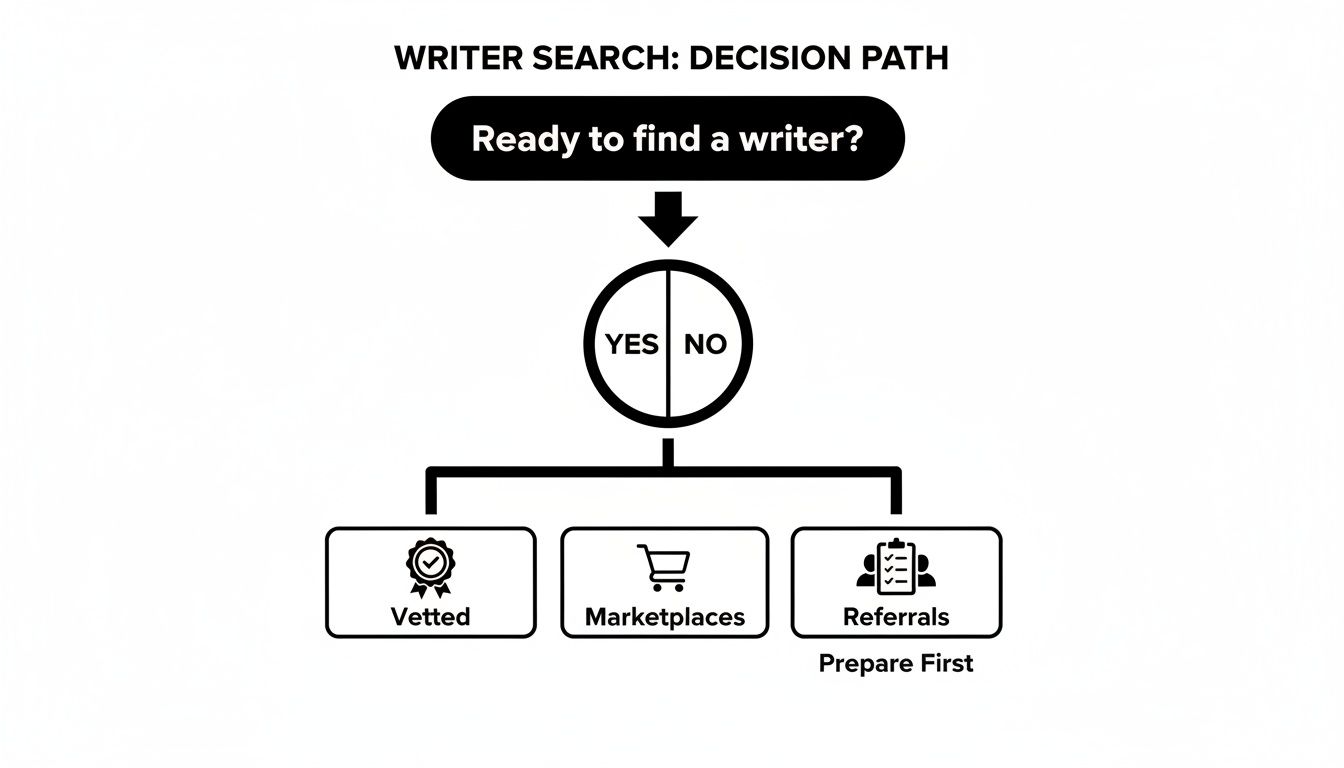
As you can see, no matter where you find your candidates, a thorough vetting process is always the next critical step.
Try asking a few of these to get a real conversation started:
- "Tell me about a difficult collaboration you have had. What was the challenge, and how did you get through it?" This tells you volumes about their problem solving skills and emotional intelligence.
- "Based on what I have sent you, what’s your initial gut reaction? How might you start organizing this into a book?" This gives you a peek into their creative process and whether their instincts align with yours.
- "How do you handle feedback, especially if an author wants to take a chapter in a completely different direction?" Their answer reveals everything about their ego and flexibility.
Pay very close attention to whether they listen more than they talk. A great ghostwriter is an expert listener. If they are constantly cutting you off to boast about their own achievements, that’s a massive red flag.
Checking References and Spotting Red Flags
Never, ever skip the reference check. A portfolio shows you their highlight reel, but a reference tells you what it was really like to work with them day in and day out. Ask their former clients about their communication, their ability to hit deadlines, and how they responded to feedback.
To screen candidates effectively, you might also consider tools like a Language Proficiency Checker for Writers to add an objective layer of assessment to your process. It’s just another way to build confidence in your decision.
Finally, trust your gut. Your intuition has served you well to this point, and it’s a powerful tool when you hire writers for book projects.
Be wary of anyone who:
- Promises you a bestseller: Nobody can guarantee this. It is a dishonest sales tactic.
- Does not ask you many questions: A lack of curiosity about you and your story is a dealbreaker.
- Has a vague or confusing contract: True professionals value clear agreements.
- Pressures you for a fast decision: A real partner will respect your need to find the perfect fit.
Finding the right writer is a mix of careful evaluation and gut feelings. Take your time with it. This is the person who will help bring your story to life, and that is a decision worth getting right.
Talking Money and Paperwork: Ghostwriting Costs and Contracts
Alright, let's get into the two things that tend to make aspiring authors a little squeamish. Money and contracts. I get it. But honestly, getting these two elements buttoned up from the start is the single best thing you can do to protect your vision, your budget, and your relationship with your writer.
Think of it this way. A solid contract is not about mistrust. It is about clarity. It’s like setting the ground rules before a big game so everyone knows how to play and win together. It lays the foundation for a professional, respectful partnership, which is exactly what you need to create something amazing.
When you first dip your toes into the world of ghostwriting, the pricing can feel like a total black box. But it does not have to be. Let's pull back the curtain.
How Ghostwriting Fees Actually Work
First things first, let's get rid of the idea of a one size fits all price tag. The cost to bring your book to life really boils down to three key factors. The project's complexity (is it a 150 page memoir or a 300 page business book with heavy research?), the writer's track record, and how they structure their fees.
You will typically run into a few common pricing models:
- Flat Project Fee: This is the gold standard for full length books, and for good reason. You agree on a single, all in price for the entire project. This gives you total budget certainty, and everyone knows exactly what is being delivered for the fee. It’s clean and straightforward.
- Per Word Rate: Some writers prefer to charge by the word. This can work for shorter form content or if the final length is a bit up in the air, but it can make budgeting a real headache. I generally advise authors to push for a flat fee for a full manuscript.
- Hourly Rate: You will see this more for consulting, book coaching, or heavy editing, but it is pretty rare for writing an entire book from scratch. It’s just too hard to predict the hours required, which creates uncertainty for both sides.
The Big Question: What Should You Expect to Pay?
So, what is the magic number? The ghostwriting landscape has matured a lot over the past decade. While you can always find someone on a freelance marketplace willing to write a book for a few thousand dollars, you are taking a massive gamble. A true professional who can nail your voice, structure a compelling narrative, and deliver a manuscript ready for publishing will command a professional fee.
Today, most experienced ghostwriters charge between $30,000 and $95,000 for a standard full length book. I have found that the sweet spot for a highly skilled, reliable pro often lands around the $50,000 mark. For a deep dive into industry pricing trends, the 2025 ghostwriting industry report on AssociationOfGhostwriters.org is a fantastic resource.
This fee is not just for typing words. You are investing in a writer's skill, their time, and the incredible creative energy it takes to live inside your story and do it justice. It is an investment in the professional execution of your legacy.
Your Contract: The Non-Negotiables
Now for the paperwork. Any writer worth their salt will insist on a contract, and you should, too. This document is the constitution for your project. Do not skim it.
Here is a checklist of the absolute must haves in any agreement you sign:
- The Scope of Work: Get painfully specific here. What are the exact deliverables? Does the fee include research, interview transcriptions, outlining, writing, and a set number of revisions? Do not leave room for assumptions.
- Copyright Ownership: This is critical. The contract must state, without a shred of ambiguity, that you are the sole author and own 100% of the copyright and all related rights. The ghostwriter is performing a work for hire service. Their name should not appear on the book unless you have specifically negotiated a co author or "with" credit.
- A Rock Solid Confidentiality Clause: Your ideas, research, and personal stories are yours alone. A strong non disclosure agreement (NDA) or confidentiality clause is non negotiable. It ensures your writer cannot share any of your proprietary information.
- A Clear Payment Schedule: You should never pay the full fee upfront. A standard professional practice is to tie payments to milestones. For example, an initial deposit to kick things off (25-50% is common), with further payments due upon delivery of the detailed outline, the first half of the manuscript, and the final draft.
- An "In Case of Emergency" Termination Clause: What happens if things just do not work out? A good contract outlines how either party can walk away, what happens to the payments already made, and who owns the work completed to that point.
Signing a clear, comprehensive contract is the moment your book idea graduates from a dream to a real deal professional project. It’s a powerful act that honors both your vision and your writer’s craft. Get this right, and you are building your book on a foundation of solid rock.
The Collaborative Dance: How To Work With Your Writer
You did it. You found your writer, signed on the dotted line, and took a massive leap of faith. Take a moment and celebrate that. Seriously. You have just turned a dream that lived in your head into a real, honest to goodness project.
Now, the real magic begins. This is where your vision and their craft come together to create something brand new. This process is not about handing over your notes and waiting for a finished book to appear. It is a partnership, a creative dance, and your active participation is what will make the final product truly sing with your unique voice.

It’s completely normal to feel a little jittery at this stage. You are entrusting someone with your most precious stories. But a good process, built on trust and clear communication, makes all the difference.
Kicking Things Off: The Brain Dump
The first phase is often the most intense and, frankly, the most fun. It’s all about the "brain dump." Your writer will likely schedule a series of long conversations with you. Their job is to become a temporary expert on you and your story.
Be prepared to talk. A lot. This is your chance to share everything. The big moments, the tiny details you think no one would care about, the raw emotions, the hard won lessons. Do not censor yourself. The more you give your writer, the richer the material they have to work with.
- Be Open and Honest: This is a judgment free zone. Your writer needs the real story, not the polished dinner party version.
- Trust Their Questions: A great ghostwriter is an expert interviewer. They will ask questions that make you think about your own life in new ways. Go with it.
- Have Your Notes Ready: Remember all that prep work you did? Now is the time to hand over that treasure chest of notes, journals, and materials.
The Art of Constructive Feedback
After the interviews, your writer will disappear for a bit and come back with something tangible, usually a detailed outline or the first few chapters. Seeing your story on the page for the first time is a wild, emotional experience.
Your role now shifts to that of a reviewer. Giving feedback can feel awkward, but it’s essential. Your writer wants your input. They need to know if they have truly captured your voice.
Remember, you are the ultimate authority on your own story. Do not be afraid to say, "That is not quite how it felt," or "Can we try a different tone here?" A professional writer will never be offended by clear, specific feedback; they will be grateful for it.
When reviewing drafts, try to be specific. Instead of saying "I do not like this," try "The tone here feels a little too formal for me. Can we make it sound more like how I’d tell this story over coffee?" This gives your writer a clear direction to work with.
This collaborative spirit is becoming more important than ever. The entire ghostwriting industry is experiencing a fundamental realignment away from old school publishing houses and toward hybrid and independent paths. This means even brilliantly written books with great author platforms face a tough road securing traditional deals, a shift that was very apparent at recent industry gatherings.
To get a better sense of these industry changes, you can explore insights from the 2025 Gathering of the Ghosts on ASJA.org. A great writer helps you create a book that is ready for this new reality.
Starting from a Half-Finished Draft?
What if you are not starting from scratch? Many people come to a writer with a half finished manuscript or a collection of scattered notes that feels impossible to tame. If this is you, please know you are not alone!
For projects like these, working with a team that specializes in bringing ideas across the finish line can be a game changer. The goal is to make the process enjoyable and inspiring, turning your existing material into the polished, complete book you always dreamed of.
Ultimately, this dance between your story and their craft is what will create a book that exceeds your wildest expectations.
Common Questions About Hiring A Book Writer
Still have a few questions? You are not alone. It’s a huge, beautiful, and deeply personal step to entrust your story to someone else. Let’s tackle some of the most common things we hear from authors who are ready to find the right writer for their book.
Is It Wrong To Use A Ghostwriter?
Absolutely not! Thinking it is "cheating" is like saying a film director is wrong for hiring a cinematographer or actors. The director has the vision, the soul of the project, and they bring in specialists to help bring that vision to life.
A ghostwriter is your creative partner. They are the skilled craftsperson who helps translate your voice, your memories, and your wisdom onto the page. At the end of the day, it is your story, your ideas, and your name on the cover. Period.
Who Owns The Copyright To The Book?
You do. 100%. This is a non negotiable, bright red line in any professional ghostwriting contract. The agreement has to state, in no uncertain terms, that you are the sole author and the exclusive owner of all rights.
The writer is paid for their service. Their name will not appear anywhere on the book unless you have both agreed to a different arrangement, like a co author or "with" credit.
Your complete ownership of the final manuscript is the bedrock of a professional ghostwriting relationship. A legitimate writer will insist on this clarity just as much as you should.
How Much Input Do I Have In The Process?
As much as you want! This is your book, your legacy. The whole process is a partnership built around your story. You will be deeply involved from the start, sharing your memories in interviews, helping shape the outline, and reviewing every single draft to give feedback.
A great ghostwriter actually wants your input. They need it to make sure the book's voice, tone, and message are authentically, undeniably yours. You and your writer will figure out the level of collaboration that feels right for you.
Ready to finally get that book out of your head and into the world? The resources at My Book Written are designed to give you the clarity and confidence to start your journey. Explore our guides at https://mybookwritten.com.
Ready to talk to an actual writer?
Five questions and we come back with two or three ghostwriters who fit your book, your budget and your timeline. Free, and no writer gets your details until you say so.
Read next
What will your book cost?
Set the type, length and timeline. Get a real 2026 range in 30 seconds.
Open the calculator