
Getting professional memoir writing assistance is your secret weapon for turning a lifetime of memories into a real, physical book. It can be a guide to help you write it, or a pro who writes it for you. Either way, the goal is simple: getting the right support to transform your memories into a lasting legacy and preserve your unique story for generations to come.
The Beautiful Challenge of Writing Your Life Story

Let’s be honest, the thought of writing your life story is both thrilling and completely terrifying. It's this huge, deeply personal project, swirling with every emotion you can think of. You have a whole life's worth of moments, big and small, and you feel this deep pull to get it all down on paper, to create something that will last forever.
This feeling isn’t just a random idea; it’s a profound human need. It’s the desire to share who you are, to connect with the people you love, and to leave a piece of yourself behind. It’s a genuine act of love for your family and a gift to your future self.
But then, reality crashes the party. A little voice in your head starts whispering doubts. "Is my story even interesting?" "Where on earth do I start?" "I'm not a writer!" Suddenly, this beautiful dream feels less like a heartfelt project and more like trying to climb Mount Everest in flip-flops.
You Are Not Alone in This Feeling
If you’re feeling that way, here’s a little secret: almost everyone does. The fear that your life isn’t "exciting" enough for a book is one of the biggest hurdles people face. But a great memoir isn’t about crazy, movie plot twists. It’s about the human experience, your human experience.
Think about it. The smell of your grandmother’s kitchen, the feeling of your first big success, the quiet lessons learned from a painful failure… these are the moments that truly matter. They are the universal threads that connect us all. Your story is worthy simply because it’s yours.
And you're part of a massive movement. The desire to capture life stories has never been stronger. The memoir and biography market has exploded; one study found that sales in just three memoir categories grew by over 400 percent in only four years.
More recently, the number of memoir book deals increased by 85 percent compared to a decade ago. Best of all, nearly a quarter of memoirs sold in a single year were by unknown authors. This proves that a powerful, authentic story is what truly matters, not a famous name. You can learn more about the rise of memoir writing and its trends to see just how popular this path has become.
Why It’s Okay to Ask for Help
This journey is an emotional rollercoaster. You’re not just writing; you're revisiting joyous highs and digging into painful lows. It takes vulnerability, a huge time commitment, and a skill set that, let's be real, most of us don't use every day. That's why seeking memoir writing assistance isn't a sign of weakness. It's a sign of wisdom.
You wouldn’t try to build your own house without an architect, right? This is the same idea. Bringing in a professional, like a ghostwriter, doesn’t mean you’re giving up control. It means you’re giving your story the best possible chance to come to life beautifully.
A ghostwriter is your creative partner and skilled artisan. You bring the heart, the memories, and the voice. They bring the structure, the storytelling craft, and the expertise to build a book that honors your legacy. It’s still your vision, just brought to reality with a lot less stress and a lot more fun.
This isn’t about being "good enough" to write a book on your own. It's about honoring your story enough to give it the professional touch it deserves.
Not sure whether you need a ghostwriter or an editor?
If you already have 30,000+ words drafted, an editor at $3,000–$12,000 will serve you better than a ghostwriter at $40,000. The quiz sorts this out in five questions — honestly, even when the answer is the smaller job.
How to Gather Your Memories and Materials
Before a single word of your memoir hits the page, and long before you even dream of an outline, you have to collect the building blocks. It’s time to become the lead detective of your own life. I know that sounds like a big job, but think of it less like a stuffy research project and more like a treasure hunt through your past.
This first stage is all about making a glorious, creative mess. Seriously. We are not aiming for a perfect, chronological timeline right now. The real goal is to surround yourself with the raw materials of your life, the tangible pieces that hold the emotional weight of your experiences. Let's make this a joyful trip, not a stressful chore.
Becoming Your Own Life's Archivist
So, where does this grand excavation begin? You start by looking for the things that spark a feeling. A memory isn’t just a dry fact; it’s a full-on sensory experience, and these everyday items are the keys to unlocking those doors.
A faded concert ticket stub isn’t just a piece of paper. It’s the thumping bass, the sticky floor under your shoes, and the feeling of singing at the top of your lungs with a thousand strangers. A simple receipt from a long-ago dinner can bring back the entire conversation, the taste of the wine, and the exact look on your friend’s face.
Your story lives in the details. Don’t dismiss the small stuff. A forgotten postcard, a silly home video, or even an old school report card can unleash a flood of memories you thought were long gone.
As you get into this, a little organization can keep the glorious mess from turning into a total catastrophe. It might be helpful to explore some planning apps to organize your life to keep track of your story threads as they emerge.
The Memory Hunter’s Checklist
To get you started, here’s a quick list of things to hunt for. Don't feel pressured to find every single item; just use this as a guide to kick off your detective work.
- Photographs and Photo Albums: These are the obvious starting point, but I encourage you to look deeper. Who isn't in the photo? What was happening just outside the frame? The story is often in the margins.
- Journals and Diaries: This is pure gold. Please don't cringe at your younger self, embrace it! Those raw, unfiltered thoughts are the authentic voice we're trying to capture.
- Letters, Emails, and Postcards: Old correspondence captures relationships in motion. Reading old letters can feel like you’re eavesdropping on your own past, revealing dynamics you’d completely forgotten.
- Home Videos and Audio Recordings: There's nothing quite like hearing the actual voices of loved ones or seeing them in motion to bring a scene roaring back to life.
Talking to Your Supporting Characters
One of the richest, and often most surprising, sources of material is other people. It’s time to gently interview your family and friends. Schedule a coffee or a call and just ask them to share their memories of certain events or time periods. You will be absolutely amazed at what they remember that you've forgotten.
Just a heads-up: everyone’s memory is its own little movie, with its own director and script. Your sister might remember that family vacation completely differently than you do. That’s not just okay; it's fantastic! These differing perspectives add richness and depth to your story. This isn't about proving who is right; it's about collecting all the colors to paint a more complete picture.
This gathering phase is truly the heart of your memoir writing assistance journey. If you put in the work now, everything that follows becomes easier, richer, and far more authentic. And if it all feels too big, remember that a good ghostwriter is an expert at this kind of detective work, helping you sift through the clues to find the heart of the story.
Finding the Right Partner for Your Story
Choosing someone to help write your life story is a massive decision. It’s a bit like finding a therapist, a business partner, and a trusted friend all rolled into one highly skilled person. This isn't just about hiring a typist; it's about entrusting your most precious memories to someone who can honor them.
The whole idea can feel overwhelming, I get it. But I promise, the search for that perfect creative match is an exciting part of the journey. Let’s break it down and figure out who you really need in your corner.
Coach, Collaborator, or Ghostwriter: What's the Difference?
The world of memoir writing assistance isn't one size fits all. The right kind of help depends entirely on how involved you want to be in the actual writing process.
Think of it this way:
- A Writing Coach is your personal trainer for the book. They’ll give you a solid plan, cheer you on, and spot you when you're lifting the heavy emotional stuff. But at the end of the day, you're the one doing all the writing.
- A Collaborative Writer is your co-pilot. You're both in the cockpit, making decisions and shaping the story together. Your name often appears alongside theirs on the cover.
- A Ghostwriter is your architect and master builder. You share the vision for your life's "house," describing every room and memory you want inside. They draw up the blueprints and build it from the ground up, making sure every detail is perfect while making it sound exactly like you.
Honestly? Most people find the ghostwriter route to be the most rewarding. It frees you up to focus on the joy of remembering and storytelling, without getting bogged down by the technical nuts and bolts of structuring a book. It's often less stressful, more fun, and the final product is still 100% your vision and your story, brought to life.
Where to Find Your Writing Partner
Okay, so you've decided you want some help. Fantastic! But where do you actually find these talented wordsmiths? They aren’t exactly hanging out at the local coffee shop with a sign that says, “Will Write for Lattes.”
Your search can start in a few key places:
- Professional Organizations: Groups like the Association of Ghostwriters are a goldmine. They have directories full of vetted professionals who take their craft seriously.
- Referrals: Know anyone who has written a book? Ask them! A personal recommendation from someone you trust is often the most reliable way to find a great fit.
- Reputable Agencies: Companies that specialize in ghostwriting have already done the hard work of finding and vetting talent. This can save you a ton of time and anxiety.
As you start thinking about the stories you want to tell, this flowchart can help you organize how you'll gather those precious memories to share with your chosen partner.
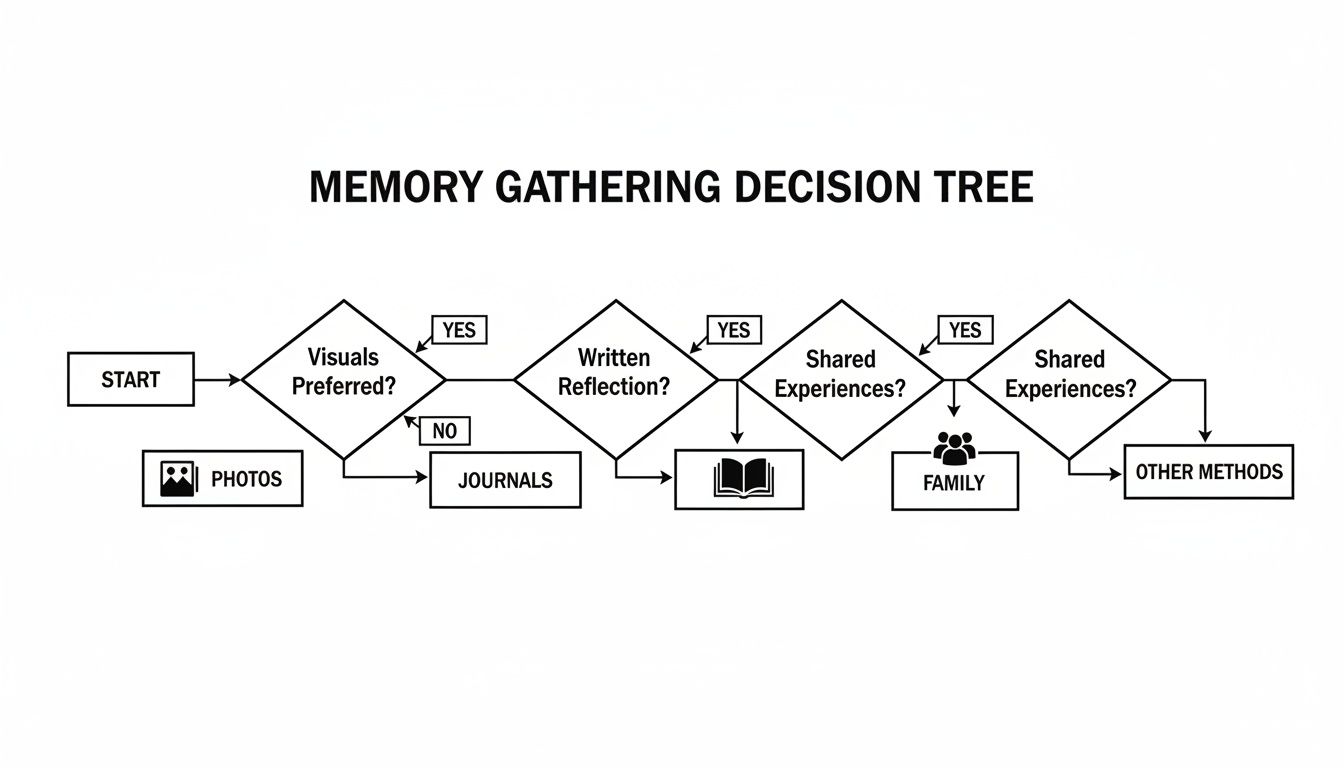
This just shows how different threads, photos, old journals, family interviews, can all be woven together to create a rich, detailed story.
How to Vet and Interview Candidates
Once you have a shortlist of potential writers, it's time to do a little detective work. This is less about their resume and more about their soul. You’re looking for genuine chemistry, not just a list of credentials.
Start by digging into their portfolio. Do they have direct experience with memoirs or autobiographies? More importantly, do you like their writing? Read some samples out loud. Does the rhythm feel natural? Does the voice feel authentic?
A ghostwriter's most important skill isn't just writing well; it's writing well in your voice. They need to be a chameleon, able to capture your unique cadence, your humor, and your distinct way of seeing the world.
When you get on the phone or a video call, it's time to ask some targeted questions. You're not just hiring a writer; you're inviting someone deep into your life.
This checklist can help guide your conversations and make sure you cover all the important bases.
Key Questions to Ask a Potential Ghostwriter
Use this checklist during your interviews to find the perfect fit for your legacy project.
| Question Category | Sample Questions | What You Are Listening For |
|---|---|---|
| Experience & Style | – "Can you walk me through your process for capturing someone's voice?" – "Which of your past memoir projects are you most proud of, and why?" |
Confidence in their process. An ability to adapt, not just apply a formula. A passion for personal stories. |
| Collaboration & Process | – "How do you handle disagreements if our creative visions differ?" – "What does your typical revision process look like?" |
A collaborative spirit, not a rigid ego. Flexibility and a clear, client-focused system for feedback. |
| Logistics & Contract | – "What is your fee structure? Are there any additional costs?" – "What happens if we fall behind on our timeline?" |
Transparency about costs and timelines. A professional approach to the business side of the project. |
Finding the right person takes a little time, but it’s the single most important investment you'll make in this process. You're not just hiring a writer; you're choosing the custodian of your legacy. Choose wisely, and the journey will be one of the most fulfilling of your life.
What to Expect When You’re Expecting a Book
So, you did it. You took the leap, interviewed some amazing people, and found the perfect creative partner to help bring your life story into the world. You’ve chosen your writer. Now what?
If you’re feeling a mix of pure excitement and a little bit of "oh my goodness, what happens now?", that’s completely normal. Welcome to the beautiful, weird, and wonderful process of expecting a book.
Let’s pull back the curtain on what this collaborative journey really looks like. It’s a structured process, for sure, but it’s also a deeply human one. Think of it less like a business transaction and more like a creative dance. You lead with your memories, your writer follows with their craft, and together you create something new.
The First Trimester: Getting the Story Straight
The entire project almost always kicks off with a series of deep dive interviews. This is where you and your writer really get to know each other. They’ll ask you tons of questions, and not just about the big, life changing events. They’ll dig for the tiny, sensory details that make a memory come alive. What did the air smell like on that day? What song was playing on the radio?
These conversations are the bedrock of the entire book. Your writer isn’t just gathering facts; they're absorbing your voice, your sense of humor, your unique way of seeing the world. It can feel a little like therapy sometimes, and that’s perfectly okay. It’s a safe space to be vulnerable.
From these talks, your writer will start piecing together an outline. This isn’t some boring list of bullet points. It’s the architectural blueprint for your memoir, mapping out the narrative arc, the emotional journey your reader is about to go on. It’s all about figuring out where your story really begins and ends, which isn't always chronological. We’re not writing a history textbook; we’re telling a story that sizzles.
The Second Trimester: Words on the Page
Once you’ve both agreed on the blueprint, the real magic begins: the writing. Your ghostwriter will take all those hours of interviews and start weaving them into chapters.
And then comes a moment that’s both thrilling and a little bit strange. You’ll get that first batch of pages and read your own life story, told in your voice, but written by someone else.
Take a deep breath. It’s a surreal experience! Your first instinct might be to notice what’s not there or what’s slightly different from how you remember it. That’s a totally normal part of the process.
Giving feedback is a skill, but it’s one you can master quickly. The key is to be honest and specific. Instead of just saying, "I don't like this," try something like, "This part feels a bit formal. I'd probably say it more like this…" Your writer wants your feedback! They need it to perfectly calibrate the voice and get it just right.
The goal isn't for the writer to guess everything perfectly on the first try. The goal is to collaborate, revise, and shape the manuscript together until every single sentence feels authentically, undeniably you. It’s a partnership, not a mind reading act.
The Third Trimester: Polishing and Perfecting
The rest of the project settles into a comfortable rhythm of drafting and revising. You’ll share memories, they’ll write, you’ll review, and together you’ll polish each chapter until it shines.
This is also where the legal stuff becomes super important. A solid contract protects both of you by clearly outlining timelines, payment schedules, and how many rounds of revision are included. It’s the boring but essential part that allows the creative magic to happen without any misunderstandings down the road.
If managing all of this feels like a lot, you're not alone. Many people want the beautiful final book without the logistical headache. For those who want expert memoir writing assistance without all the back and forth, services like Opus Eternal have emerged. They offer remarkably fast and efficient ghostwriting, providing an accessible alternative that is often less than half the cost of traditional options, without compromising on the premium quality your story deserves.
This screenshot from their website shows how they present a clear, straightforward path to getting your book done.
This clean layout emphasizes speed and quality, showing that getting professional help can be a smooth and manageable experience.
Finally, remember that this is more than just a project; it's an investment in your legacy. The self publishing revolution has completely changed the game. The Alliance of Independent Authors found that over 60 percent of memoir writers choose to self publish, and in a recent survey, 77 percent of indie authors identified as self published.
Financially, 56 percent earned over $100 a month from their writing, with an impressive 8 percent reporting earnings over $10,000 monthly. Discover more insights about these personal story statistics for 2025 and see how a professionally written book can become a source of both pride and potential revenue.
Whether you're aiming for a bestseller or a treasured family heirloom, the process is a powerful collaboration that turns a lifetime of memories into something real, something tangible, something that will last forever.
From Manuscript to Family Masterpiece
You did it. The manuscript is finished. Take a moment to let that sink in. Pop some champagne, do a happy dance, whatever your celebration looks like. This is a monumental achievement. But once the dust settles, a new question usually pops up: “So… now what?”
That final step can feel just as daunting as the first one. You’ve poured your soul into this story, but where is it headed? Is it destined for the bestseller list, or is its real home on the family coffee table, a treasure for generations to come?
There’s no wrong answer. The journey doesn't stop at 'The End'; you’re just starting your story's next chapter.
Defining Your Book’s Destiny
First things first: you need to decide what you truly want for your book. This one decision will guide everything that follows.
- The Family Heirloom: Is your goal to create a beautiful, professionally bound book to pass down to your children and grandchildren? Here, commercial success doesn't matter. The emotional connection is everything.
- The Published Author: Do you dream of seeing your story on bookstore shelves? Your aim is to reach a wider audience, maybe even landing a traditional publishing deal or successfully self publishing.
Neither path is better, but they are very different roads. A family heirloom project is all about gorgeous design and high quality printing to create a priceless artifact. A commercial project, on the other hand, is about marketability and building an audience.
Honoring your story means choosing the path that feels right for you. Whether your audience is your family of five or a crowd of five million, what truly matters is getting your story into the hands of the people you want to reach.
After pouring your heart out, the next thrill is often seeing your manuscript become a real, physical book. If you're ready to see your work in print, learning the nuts and bolts of printing a book from your Word manuscript is a great next step.
Navigating the Publishing World
If you're leaning toward the commercial route, it helps to understand today's publishing landscape. The memoir market is alive and well, but it's also very specific. Publishers are looking for personal stories that tap into a universal theme or a larger cultural conversation.
They want to know not just what happened to you, but why your experience will resonate with everyone else. For instance, the young adult memoir category has seen a massive 26% jump in sales over the last five years, proving there's a real hunger for authentic coming of age stories. For authors who don't already have a massive following, professional memoir writing assistance is often the key to shaping a story that truly stands out.
Don't Forget the Audiobook Boom
Your story’s life isn't limited to the printed page. We are in the golden age of audio. The global audiobook market is on track to hit $19.7 billion by 2028. Turning your memoir into an audiobook is another incredibly powerful way to connect with people.
Just imagine your great grandchildren listening to your life story in your own voice, or in the warm tones of a professional narrator. It’s an intimate and lasting way to preserve your legacy. Whether your goal is a bestseller or a beloved family heirloom, you have more options than ever to share your story with the world.
Your Questions About Memoir Writing, Answered
It’s completely normal to have a million questions when you start thinking about writing your life story. It’s a huge undertaking, filled with emotion and big decisions. Let's walk through some of the most common things people wonder about when they consider getting a helping hand.
"If Someone Else Writes It, Is It Still My Book?"
This is the big one, isn't it? It’s the question I hear more than any other, and it comes from such an important place: the desire to keep your story authentic. The answer is simple: Yes, it is absolutely, 100% your book.
Think of your ghostwriter not as the author, but as a master sculptor. You are the marble, filled with all the stories, memories, and emotions. The writer is the one with the chisel and hammer, skillfully chipping away to reveal the beautiful statue that was already there. They provide the craft, but the voice, the heart, and the soul of the book? That’s all you.
"But What If My Life Isn't Interesting Enough?"
Let me share a secret from my years of experience: nearly every single person who sits down to write a memoir has this exact same fear. That little voice of doubt is persistent, but it's almost always wrong. A compelling memoir isn't about having climbed Mount Everest or brokered a peace treaty.
The most powerful stories are about the universal human threads that connect us all: love, loss, resilience, family, and the messy, beautiful journey of finding our place in the world. Your story is fascinating because it's your human story. A professional partner can help you spot the incredible narrative arcs you might have missed and weave them into a tale that will resonate deeply, especially with the people you love most.
The real magic of a memoir isn’t found in extraordinary events, but in finding the extraordinary meaning within a life fully lived. Your life is filled with that meaning. Our job is to find it together.
"Okay, So How Much Is This Going to Cost?"
Now for the practical side of things. The cost of memoir assistance can vary quite a bit, depending entirely on the level of support you need. A writing coach you meet with a few times a month will be a different investment than a ghostwriter who dedicates themselves to your project full time, from the first interview to the final polished manuscript.
As a general benchmark, a comprehensive ghostwriting project is a significant investment. With most reputable writers or agencies, you can expect a range from $25,000 to well over $100,000. That number reflects the hundreds of hours of interviewing, researching, writing, and revising that go into creating a truly exceptional book.
It's helpful to reframe it, though. You're not just buying a typed document. You’re investing in the careful preservation of your legacy, creating a timeless family heirloom that will be passed down and cherished for generations. The value of that is, frankly, priceless.
"And How Long Will This Whole Process Take?"
Patience is a key ingredient in writing a great book! There's no single timeline, but a good rule of thumb for a full length memoir is anywhere from nine months to a year and a half.
That might sound like a long time, but a life story is something that deserves to be handled with care, not rushed. The journey typically involves:
- Deep Dive Interviews: Weeks or even months of rich, in depth conversations to gather your stories.
- Drafting the Manuscript: The core writing phase where your memories start to take shape on the page.
- Revisions & Feedback: A collaborative dance of reading, tweaking, and refining to get every detail perfect.
- Polishing & Proofreading: The final, meticulous steps to make your manuscript shine.
Trying to speed through it is like rushing through a once in a lifetime vacation. You’ll miss all the best parts. The goal is to create something that truly honors your life, and that level of quality takes time, attention, and a whole lot of heart.
At My Book Written, we believe every story deserves to be told with dignity and skill. We provide the resources and guidance you need to confidently turn your vision into a beautiful, tangible book that will last forever. Start your journey with us today.
Thinking about getting help with your memoir?
Tell us where you are and we will shortlist memoir specialists who work at your budget — plus an honest read on whether you need a writer or just an editor.
Read next
What will your book cost?
Set the type, length and timeline. Get a real 2026 range in 30 seconds.
Open the calculator