
Let's be honest. That incredible book idea has been living in your head for ages, hasn't it? Rent-free, I might add.
Maybe it’s a game-changing business book, a memoir preserving your family's legacy, or a novel that you just know needs to be told. It’s the kind of idea that could build your brand, change lives, or simply become a beautiful heirloom for generations to come. A real legacy.
But then, reality hits. Hard. Between running a business, raising a family, and just trying to remember what day it is, the dream of actually writing that book feels a million miles away. The blank page starts looking less like an opportunity and more like a bully, just staring at you.
If that sounds familiar, you're not alone. I've talked with countless founders, experts, and grandparents with lifetimes of wisdom who felt the exact same way. They had brilliant ideas but no clear path to get them down on paper. The sheer thought of structuring chapters, finding the right words, and writing tens of thousands of them felt completely paralyzing.
The Hard Truth About Writing a Book
Here's a little secret from someone in the trenches: writing a good book is incredibly hard. It's so much more than just having a great idea. It demands discipline, a very specific skillset, and a huge amount of time you probably don't have. This is precisely why so many amazing stories remain untold, locked away in someone’s mind.
The good news? You don't have to go it alone. In fact, many of the most successful people in the world don’t. They use a powerful tool to get their ideas out of their heads and into readers' hands: book writing services.
Hiring a professional, like a ghostwriter, isn't cheating. It’s a smart, strategic partnership. It’s about honoring your vision enough to give it the professional craftsmanship it deserves. It’s still your story, your voice, and your expertise. You’re just bringing in a specialist to do the heavy lifting of the actual writing. It’s like having a personal chef for your thoughts.
Think of it like hiring an architect to build your dream home. You provide the vision, the style, and the purpose; they handle the complex work of turning that vision into a solid, beautiful structure.
You are the visionary. The author. The creator. A ghostwriter is simply the skilled artisan who helps you build the final masterpiece, ensuring every word reflects your original intent.
This approach is becoming more popular every single day. The global self-publishing market has absolutely exploded, hitting $1.85 billion and projected to climb to an incredible $6.16 billion by 2033. This massive growth proves there's a huge movement of people just like you taking control of their stories and bypassing the old-school gatekeepers.
When it comes to bringing your book to life, the entire point is creating engaging content that genuinely connects with your readers. A professional writer’s job is to make sure that connection happens on every single page.
This guide will walk you through exactly how to find that perfect partner to finally make your book a reality. It's time to get that story out of your head and into the world where it belongs.
Alright, you've made the decision to bring in a professional to help with your book. That’s a massive step, and a smart one. But as soon as you start looking, you're hit with a barrage of confusing terms: ghostwriter, co-writer, book doctor… what’s the difference?
It can feel a little overwhelming, but don't worry. Think of it less like hiring a contractor and more like casting the perfect creative partner for your project. Let's break down who does what so you can find the right fit for your book.
Decoding Your Book Writing Service Options
Choosing the right professional is all about matching their specific skillset to what you actually need. You wouldn't hire a plumber to fix your roof, right? Same principle applies here.
The Ghostwriter: Your Voice, Their Words
This is easily the most common arrangement in the world of book writing services, and for a good reason. A ghostwriter is a professional you hire to write your book for you, based entirely on your ideas, stories, and expertise. Your name is the one on the cover, and you get 100% of the credit. It is your book, period.
I’ve heard the question a thousand times: "Isn't that cheating?" Not in the slightest.
Think of a brilliant entrepreneur who has a game-changing business methodology but simply doesn't have the 80 hours a week it takes to wrestle a manuscript into shape. A great ghostwriter acts as a skilled interpreter, translating those brilliant ideas into a polished, compelling book that readers can't put down. It's a collaboration of vision and craft.
A great ghostwriter doesn’t invent your voice; they find it. They're expert listeners who absorb your stories, your passion, and your unique perspective, then channel it all onto the page. It's your soul, just with their syntax.
This decision tree gives you a quick visual on how to think about your own book-writing journey and where you might need help.
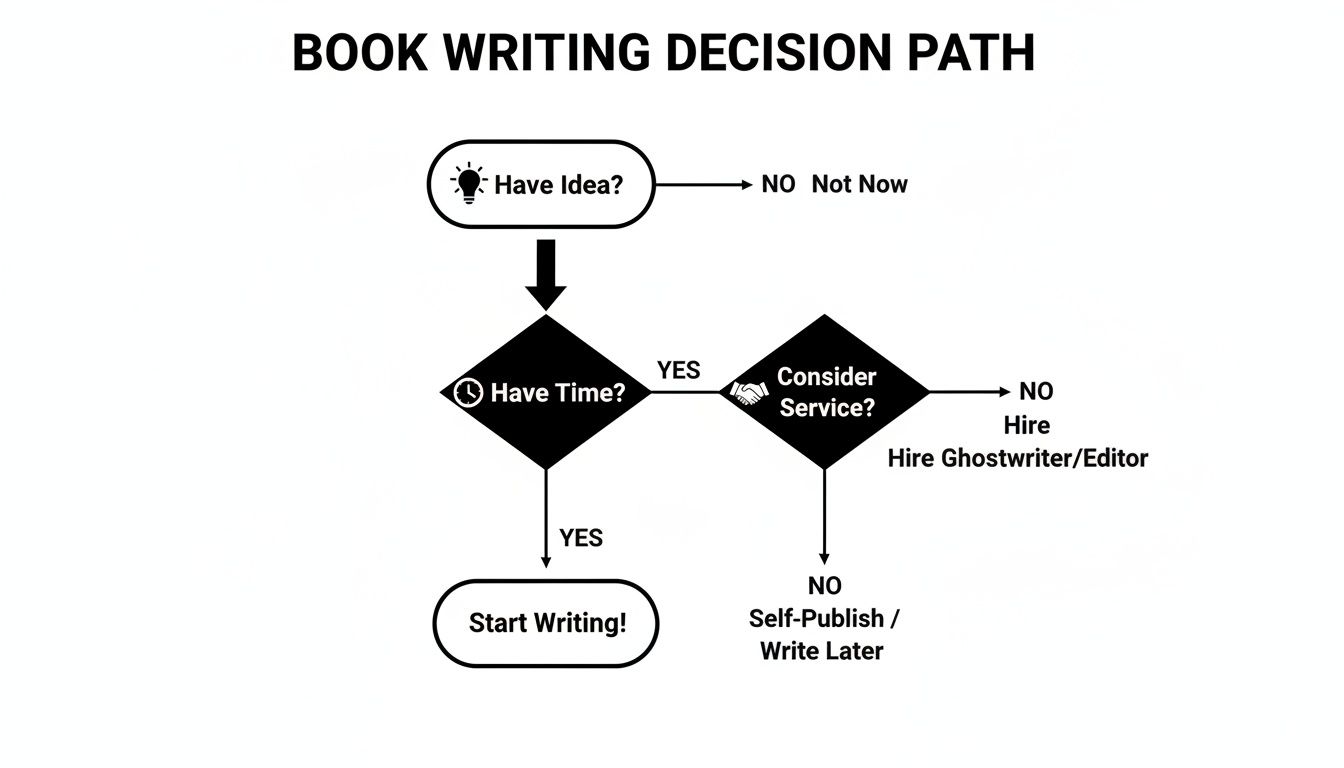
As you can see, the path from idea to finished book often comes down to one crucial resource: time. This is where a professional service can make all the difference.
The Co-Writer: Sharing the Spotlight
A co-writer (or co-author) is a different kind of partnership. In this setup, the writer shares public credit with you. Their name appears right on the cover, usually with a line like, "with [Writer's Name]."
This is a fantastic option when the writer brings their own significant expertise or a well-known name that adds credibility and marketability to the project. For instance, a famous actor might team up with a seasoned journalist for their memoir. Both names on the cover add to the book's appeal and sales potential. It's a true, publicly acknowledged partnership.
The Book Doctor & The Editor: Your Manuscript's Specialists
What if you've already done the heavy lifting and have a completed first draft? First of all, celebrate that! It's a huge accomplishment. But maybe you're stuck. The manuscript feels clunky, the pacing is off, or it just doesn't have that spark you envisioned. This is when you call in the specialists.
-
A Book Doctor: This pro performs major surgery on your manuscript. They aren't just fixing typos; they're restructuring chapters, rewriting sections for clarity and impact, and plugging major plot holes or logical gaps. A book doctor is your go-to when your book has "good bones" but needs a serious overhaul to get it into fighting shape.
-
An Editor: Think of an editor as more of a personal trainer for your manuscript. They focus on refining what's already there. A developmental editor will look at the big-picture elements like structure and flow, while a copyeditor hones in on the sentence-level details, grammar, punctuation, and style.
For example, a first-time novelist who has a great story but struggles with pacing would bring in a developmental editor. A business leader who has all the facts down but needs a final professional polish would hire a copyeditor. It's all about diagnosing the problem and finding the right expert to solve it.
To make it even clearer, here’s a quick comparison to help you figure out which service might be the best creative partner for you.
Which Book Writing Service Is Right For You?
| Service Type | Best For You If… | You Provide | They Deliver |
|---|---|---|---|
| Ghostwriter | You have the ideas and expertise but lack the time or writing skills to produce a full manuscript. | Your ideas, stories, notes, interview time, and expertise. | A complete, publish-ready manuscript written in your voice. |
| Co-Writer | You want a true partner whose name and expertise will add value and credibility to the project. | Your contribution to the content and a collaborative spirit. | A co-authored manuscript where you share credit and workload. |
| Book Doctor | You have a finished draft, but it has significant structural, pacing, or clarity issues. | Your completed (but messy) manuscript. | A heavily revised and restructured manuscript that is ready for editing. |
| Editor | Your manuscript is structurally sound, but you need help refining the prose, flow, and mechanics. | A solid, complete manuscript. | A professionally polished manuscript (developmental, line, or copy edit). |
Ultimately, the goal is to find someone who not only has the right skills but also understands your vision. This table should give you a solid starting point for figuring out who that person is.
Finding Your Perfect Writing Partner
Alright, let's get into the matchmaking. I'm not talking about romance, but something just as intimate: finding the person you’re going to trust with your story. Choosing the right writer can feel a lot like dating, but instead of an awkward dinner, you’re creating a piece of your legacy together. It's a big deal.
So, where do you even start? It’s not like there’s a secret handshake or a writer’s speakeasy (though that would be cool). The good news is that talented professionals are everywhere, but you have to know where to look and, more importantly, what to look for.

This isn't about hiring someone to type for you. You're searching for a true partner who can get inside your head, understand your message, and channel your voice onto the page. Let’s break down how to find that person without pulling your hair out.
Where to Look for Your Ghostwriter
You can't hire a great writer if you can't find one. Fortunately, the best ones tend to cluster in a few key places. Casting a wide net is fine, but fishing in the right ponds is a whole lot more effective.
Here are a few of my go-to starting points:
- Professional Organizations: Groups like the Nonfiction Authors Association or the Association of Ghostwriters are absolute gold mines. These aren't just random directories; they're vetted communities of serious professionals who live and breathe this work.
- Reputable Agencies: Established agencies that specialize in connecting authors with writers can be a huge help. They do a lot of the initial legwork and screening, which can save you a ton of time and energy.
- Referrals: Never, ever underestimate the power of a warm introduction. Ask other entrepreneurs, mentors, or colleagues who’ve published books. A personal recommendation is often the most reliable sign of a great working relationship.
How to Evaluate Portfolios and Samples
Once you’ve got a shortlist, it's time to do your homework. This is where you get a real feel for their skills and style. Don't just skim their samples, read them with a critical eye.
You're not just checking for good grammar. You're listening for a voice that clicks with you. Does their writing feel authentic? Can they spin a compelling story, whether it's about a complex business strategy or a personal journey? Look for versatility. A writer who can adapt their style to different clients is a writer who can adapt to you.
Think of a writer’s portfolio as their audition reel. You’re the casting director. Are you looking for a sharp, witty voice for your business book or a warm, reflective tone for your memoir? The proof is in their past projects.
When a writer sends you a custom sample based on your idea, pay close attention. Did they just rephrase your notes, or did they truly capture the feeling behind your words? This sample is a direct preview of your collaboration. It should make you feel excited and, most importantly, understood.
Spotting Red Flags Before It’s Too Late
Just as important as knowing what to look for is knowing what to run from. A bad partnership can burn through your time, money, and enthusiasm. Always trust your gut, and keep an eye out for these tell-tale warning signs.
The biggest red flag for me? A writer who isn’t curious. If they don’t ask you a mountain of questions about your story, your vision, and your "why," they aren't truly invested. They're seeing a project, not a person with a story to tell. You want someone who is genuinely fascinated by what you have to say.
Other potential red flags to watch for:
- A "One-Size-Fits-All" Process: If their approach sounds rigid and they seem unwilling to adapt to your specific needs, that’s a problem. Every book is unique.
- Poor Communication: Slow response times or vague answers during these initial chats are a preview of what's to come. You need a responsive partner.
- No References: Any professional worth their salt will have past clients who are happy to vouch for them. If they can't or won't provide references, consider it a deal-breaker.
Checking references is non-negotiable. It’s the single best way to find out what it’s really like to work with someone. Ask their past clients about the writer's process, communication style, and whether they delivered on their promises. This small bit of due diligence can save you from a world of headaches down the road. Finding the right partner through book writing services is what makes this journey not just successful, but truly enjoyable.
Not sure whether you need a ghostwriter or an editor?
If you already have 30,000+ words drafted, an editor at $3,000–$12,000 will serve you better than a ghostwriter at $40,000. The quiz sorts this out in five questions — honestly, even when the answer is the smaller job.
Understanding the Cost of Writing a Book
Let's get right to it and talk about the elephant in the room. The one wearing a tuxedo made of hundred-dollar bills. Yes, I’m talking about money.
When you first start looking into book writing services, the cost can feel like a huge, mysterious cloud. I want to pull back that curtain and give you some real, honest numbers so you can plan with confidence instead of anxiety.
Investing in a professional writer is exactly that, an investment. It's not just paying for words on a page. You're investing in deep expertise, saving hundreds of your own hours, and making sure the final book is something that truly honors your story.
So, what does that investment actually look like?
Cracking the Code on Pricing Models
There isn't a single price tag for writing a book, simply because every project is wonderfully unique. Instead, you'll find that professional writers use a few common pricing structures. Getting a handle on these will help you compare apples to apples when you start getting quotes.
Here are the most common models you’ll run into:
- Flat Project Fee: This is the most popular model, and frankly, it's the best for everyone involved. You and the writer agree on one single, all-inclusive price for the entire manuscript, from the first interview to the final polished draft. This gives you budget certainty and lets the writer focus on quality, not the clock.
- Per-Word Rate: Some writers charge by the word. For instance, a writer might charge $1.00 per word for a 50,000-word manuscript, totaling $50,000. It’s a straightforward model, but it can sometimes create a weird incentive to add fluff, the last thing your book needs.
- Hourly Rate: This is far more common for book doctors or editors who are sharpening an existing manuscript. For a full ghostwriting project, it's less than ideal. The hours can be unpredictable and hard to track, which can lead to some serious sticker shock down the road.
Think of it this way: a flat fee is like buying a ticket for a cruise. You know the full cost upfront for the entire journey. A per-word or hourly rate is more like taking a taxi in a new city, the meter is always running, and you're never quite sure what the final fare will be.
What’s a Realistic Price Range?
Alright, let's get down to brass tacks. A full, professionally ghostwritten book is a significant undertaking. For a standard nonfiction book (think 40,000 to 60,000 words), you can expect to invest anywhere from $25,000 on the lower end to well over $100,000 for a top-tier writer with a stellar track record.
Why such a massive range? It really boils down to a few key factors:
- The writer’s experience and portfolio. A seasoned ghostwriter with a string of bestselling books will naturally command a higher fee than someone just starting out.
- The complexity of your subject. A deeply technical business book that requires extensive research is a heavier lift (and thus more expensive) than a straightforward personal memoir based on your interviews.
- The amount of research required. If the writer needs to interview dozens of people or sift through archives, that extra time will be factored into the cost.
- Your timeline. Need a book finished in three months? A rush fee is pretty standard for that kind of sprint.
This isn't a niche service anymore; it's a booming industry. The digital publishing market, which is deeply connected to these services, is projected to grow from $52.61 billion to $58.73 billion next year alone. You can find more details on these publishing market trends that show just how much opportunity there is for your book.
The Value Behind the Price Tag
So, what are you actually getting for your money? It’s so much more than just a document full of words. Your investment typically covers a comprehensive, collaborative process.
Here’s what’s usually included:
- Dozens of hours of in-depth interviews to capture your voice, stories, and expertise.
- Thorough research to support your ideas and add powerful depth to the narrative.
- A detailed book outline or blueprint for you to approve before the real writing begins.
- Professional drafting of every single chapter.
- Multiple rounds of revisions based on your direct feedback.
- A dedicated creative partner who is 100% committed to bringing your vision to life.
Hiring a ghostwriter is a powerful shortcut to creating a timeless asset. You get to skip the frustration of the blank page and the years it can take to master the craft of writing. Instead, you end up with a beautiful, professionally crafted book that is still completely, authentically yours. That’s a return on investment that truly lasts a lifetime.
Setting Your Project Up For Success
Let’s get into the nitty-gritty: the contract. I know, it sounds about as exciting as watching paint dry, but this single document can make or break your entire project. A solid agreement isn’t just a legal formality; it’s the blueprint for a great working relationship.
Think of it as the roadmap you both agree on before the journey begins. It clears up any confusion, prevents those awkward money conversations down the line, and makes sure you and your writer are driving toward the same destination, your finished book.

This document is your best friend in this process. It protects your ideas, your investment, and ultimately, your peace of mind.
Key Clauses That Must Be In Your Agreement
Any professional writer or editor will provide a clear, comprehensive agreement. While they all look a bit different, a few clauses are absolutely non-negotiable. Don’t even think about signing until you’ve confirmed these are included.
- 100% Ownership and Copyright: This is the big one. The contract must state, without any ambiguity, that you are the sole author and owner of all rights to the work. The writer is being paid for a service; once that service is complete, they have zero claim to your book. It’s your name, your story, your legacy.
- A Rock-Solid Confidentiality Clause: You're about to pour out your life’s work, trade secrets, or deeply personal stories. A non-disclosure agreement (NDA) clause ensures everything you share stays between you and the writer. It's the "cone of silence" for your project.
- A Clear Payment Schedule: Surprises are great for birthdays, not for invoices. The agreement should spell out the total project fee and the payment milestones. These are usually tied to specific deliverables, like a payment to start, another upon outline approval, one after the first half is drafted, and the final payment on completion.
- Defined Revision Rounds: How many times can you ask for changes? This needs to be defined. The contract should specify exactly how many rounds of revisions are included in the price. This keeps the project on track and prevents it from getting stuck in an endless loop of tweaks.
Getting these terms right is foundational. Before a single word is written, having a clear plan is essential. This same principle applies to many creative endeavors, such as creating an effective content strategy where a solid framework is the key to success.
Mapping Out a Realistic Timeline
"So, when will my book be done?" It's always one of the first questions, and for good reason. While every project is unique, a standard ghostwriting process for a full-length book typically takes anywhere from six to twelve months. It’s a marathon, not a sprint.
Here’s what a timeline for a 50,000-word business book might look like:
- Months 1–2: Discovery and Outlining. This is the deep-dive phase. You'll spend a significant amount of time in interviews, sharing your knowledge and stories. From there, the writer crafts a detailed, chapter-by-chapter outline for you to review and approve.
- Months 3–6: The First Draft. Now the magic happens. The writer gets to work, transforming your ideas into prose. They'll likely deliver chapters in batches so you can give feedback as the manuscript takes shape.
- Months 7–8: Revisions and Polish. With the full first draft in hand, you’ll work with the writer to refine, polish, and perfect the manuscript based on your feedback. This is where the book truly comes to life.
A timeline isn't just a schedule; it’s a promise. It’s the shared understanding that turns a huge, intimidating goal into a series of manageable, exciting steps toward a finished book.
To navigate this journey, you need a partner who can help you rise above the noise. The US book industry is massive, with projected revenues of $24.77 billion next year, but a sobering reality is that only 0.01% of books sell over 100,000 copies. Professional guidance, built on the foundation of a solid agreement, can be the key differentiator for your success.
Your Finished Book Is Ready for the World
You did it. Let that sink in for a second. That manuscript is done.
The idea that was once just a flicker in your mind is now a real, tangible thing. It has a voice, a structure, and a story ready to be told. Seriously, take a moment and celebrate this. Finishing a book is a monumental achievement, and you've earned this win.
This isn't just the end of a project; it's the beginning of a whole new chapter for you. Think back to where you started, that initial spark of an idea, the moments of doubt, and the bursts of inspiration along the way. You had the vision to start and the wisdom to find the right partner to help you see it through to the end.
Your Story Lasts Forever
Whether you've just finished a game-changing business book or a deeply personal family memoir, you've created something that will endure. It's a bridge from your mind to the minds of countless readers you haven't even met yet.
That’s the real magic of a book, isn't it? It’s a piece of you that lives on, timeless and independent. Your expertise, your experiences, and your unique perspective are now ready to make their mark.
You honored your idea by giving it the professional craftsmanship it deserved. You didn't just write a book; you created a timeless asset. And you did it the smart way, by building a team.
Choosing to work with professional book writing services was never a shortcut. It was a strategic decision to make sure the final product was every bit as polished and powerful as the vision you held in your head.
You've created something incredible. Now, it's time to share it. The world is waiting.
Your Top Questions, Answered
If you’re thinking about hiring a professional writer, you’ve probably got a few questions running through your mind. It's a big decision! Let's clear up some of the most common ones I hear from authors just starting out.
"If a Ghostwriter Writes It, Is It Still My Book?"
Yes. 100% yes. Let’s get this out of the way, because it's the biggest question of all.
A professional ghostwriter is a skilled artisan hired to build your house, not their own. You're the architect. You provide the blueprint, the vision, and all the core ideas. They just bring the tools and the expertise to put it all together.
Your contract should explicitly state that you own 100% of the copyright and all intellectual property. That's non-negotiable. It's your name on the cover because, from concept to conclusion, it is your book.
"How Much of My Time Will This Take?"
You're in the driver's seat, so you can decide how hands-on you want to be. The process usually starts with a series of in-depth interviews where the writer absorbs your knowledge, your stories, and your voice. Think of it as a "brain dump."
After that, your main job is to review the chapters as they come in and give your feedback. While you can be as involved as you like, the more accessible you are for quick check-ins and reviews, the faster and smoother everything goes. A good writer will create a communication rhythm that works for your schedule.
"Will They Help Me Get It Published?"
Sometimes, but that's usually a different service. Most high-quality ghostwriters, book doctors, and editors are laser-focused on one thing: delivering an outstanding, submission-ready manuscript. They perfect the book itself.
The good news? These professionals are deeply embedded in the publishing world. They almost always have a trusted network of literary agents, publishers, and self-publishing experts they can connect you with. Just be sure to ask about their network when you're interviewing them.
Ready to turn your book idea into a reality? The team at My Book Written offers expert guidance and resources to help you organize your thoughts and prepare for the writing journey. Learn more and get started at My Book Written.
Ready to talk to an actual writer?
Five questions and we come back with two or three ghostwriters who fit your book, your budget and your timeline. Free, and no writer gets your details until you say so.
Read next
What will your book cost?
Set the type, length and timeline. Get a real 2026 range in 30 seconds.
Open the calculator