
A ghostwriter for a book is the secret weapon behind countless bestsellers. They’re a professional writer you bring on board to take your brilliant ideas, your hard won expertise, and your life stories and shape them into a finished book. Think of them as a creative partner who captures your voice and vision, but does all the heavy lifting of the actual writing. You bring the soul, they bring the ink.
Why Your Amazing Book Idea Is Still a Blank Page
Let's be real. You have a fantastic book idea percolating. It might be your life story, a groundbreaking business strategy, or a personal journey that could inspire thousands. The concept is crystal clear in your head, but the moment you sit down to write, it all falls apart. It feels like trying to build a rocket ship with nothing but a screwdriver and a prayer.
That blinking cursor on a blank page is one of the most intimidating things on the planet, isn't it? It just sits there, judging you. You're not alone. The monumental task of structuring chapters, organizing a lifetime of thoughts, and wrestling with words stops so many brilliant ideas from ever seeing the light of day. It’s a creative mountain, and most of us don't have the gear to climb it alone.

From "I Should Write a Book" to "I Wrote a Book"
This is where the lightbulb goes on. The realization that you don’t have to do this by yourself. Hiring a ghostwriter for a book isn’t admitting defeat; it’s making a strategic move to actually get it done. They're part project manager, part expert wordsmith, and part story therapist, all rolled into one. They handle the how so you can stay focused on the what.
Your story is still yours. Your ideas are still revolutionary. A ghostwriter is the skilled collaborator who helps you build the vessel to carry them out into the world. It’s your vision, brought to life through their expertise. And it's way more fun.
There’s a reason this partnership model is blowing up. The global market for ghostwriting services was pegged at around $4.28 billion in 2025, with North America making up a whopping 47.86% of that. This boom is fueled by the very things you're probably facing: not enough time and the sheer mental exhaustion of creating a book from scratch. You can discover more insights about this growing market and see why so many people are turning to the pros.
You Are the Architect, They Are the Builder
Think about it this way: you’re designing your dream home. You know exactly where the sunny breakfast nook should go, what the kitchen should feel like, and the perfect shade of blue for the front door. You have the vision. But are you going to mix the concrete and wire the electrical panel yourself? Probably not. You'd call a pro so the house doesn't fall down.
A ghostwriter plays the role of the master builder for your book.
- They handle the technical stuff: Things like narrative structure, pacing, and crafting compelling prose.
- They ensure it's built to last: They know how to create a professional, engaging manuscript that agents and readers will love.
- They follow your blueprint: The final product is a perfect reflection of your personality, your message, and your voice.
This collaboration is your ticket to finally turning that nagging, brilliant idea into a real thing. A physical book you can hold in your hands and proudly say, “I wrote this.”
Hiring a Ghostwriter vs Writing It Yourself
Still on the fence? Let's be honest about the two paths. One involves a lot of fun conversations and seeing your book come to life. The other involves a lot of coffee, frustration, and maybe a few tears.
| Factor | Hiring a Ghostwriter | Writing It Yourself |
|---|---|---|
| Time Commitment | Low to moderate. Focus on fun interviews and reviews, not daily writing. | Extremely high. Can take hundreds or thousands of hours. So many hours. |
| Required Skillset | Your expertise on the topic. No professional writing skills needed. | Strong writing, editing, storytelling, and project management skills. |
| Speed to Market | Fast. A professional can produce a manuscript in 4 to 9 months. | Slow. Often takes years, if it gets finished at all. |
| Objectivity | High. An outsider's perspective helps clarify and strengthen the message. | Low. It's really hard to be objective about your own work and stories. |
| Financial Cost | Significant upfront investment. | Low to none, but the "opportunity cost" of your time is very high. |
| Creative Control | High. You are the final decision maker on all content and voice. | Absolute. Every single word and comma is yours to decide. |
Ultimately, choosing to hire a ghostwriter is an investment in efficiency, expertise, and, most importantly, completion. It honors your idea by giving it the professional craftsmanship it needs to come to life. And it lets you skip the hard parts and get right to the glory.
Not sure whether you need a ghostwriter or an editor?
If you already have 30,000+ words drafted, an editor at $3,000–$12,000 will serve you better than a ghostwriter at $40,000. The quiz sorts this out in five questions — honestly, even when the answer is the smaller job.
Finding Your Perfect Writing Partner
Alright, let's get into the nitty gritty of finding "the one." I’m not talking about romance; I’m talking about the person you’re about to entrust with your ideas, your stories, and your legacy. Hiring a ghostwriter for a book can feel a bit like online dating. If you just jump in blindly, you’re bound to go on a few bad dates.
You need someone who has the writing chops, of course, but just as importantly, you need someone who genuinely connects with your vision. They have to get you. This isn't about hiring someone to type for you. It's about finding a creative partner who can help bring your story to life in a way that truly lasts. A book is forever, after all.
So, where do you begin the search for this literary soulmate? The world of ghostwriters is much bigger than you might think, and the best ones are rarely found through a simple Google search.
Beyond the Usual Suspects
You could easily lose days scrolling through massive freelance platforms like Upwork or Fiverr, and you might even get lucky. But here’s a little secret: the most sought after ghostwriters aren't just sitting around waiting for a project to fall into their lap. They're actively writing, and you often have to find them where they live and work.
I once worked with a client who found his perfect ghostwriter through his accountant. No joke. The accountant had another client, a retired CEO, who had just published a brilliant memoir and couldn't stop raving about the writer who helped him. One warm introduction later, a fantastic partnership was born.
This just goes to show you the surprising power of your own network.
- Your Professional Circle: Start with the people you trust. Talk to your lawyer, your business coach, your colleagues. Who do they know? The best referrals often come from professionals who understand quality and have high standards.
- Literary Agents and Editors: Even if you plan to self publish, people in the traditional publishing world are an incredible resource. They can often point you toward talented writers they’ve worked with.
- Industry Specific Groups: Writing a book on tech startups? Ask around in a founder's group on LinkedIn. A memoir about your career as a chef? Connect with culinary communities. Great writers often specialize, and you’ll find them in their niche.
The goal here is to find someone whose work you can see and whose reputation you can verify. A warm referral from a trusted source is worth its weight in gold because it comes with a built in layer of trust and vetting.
How to Read a Portfolio Like an Expert
Once you have a shortlist of potential writers, it's time to dig into their work. A portfolio isn't just a collection of writing samples; it's a window into a writer's process and adaptability. You’re not just checking for good grammar, you’re looking for a chameleon.
A truly great ghostwriter for a book is a master of voice. As you review their samples, ask yourself these questions:
- Does each piece sound completely distinct from the others?
- Can you feel the personality of the original author shining through, not the ghostwriter?
- Do they demonstrate versatility across different tones, styles, and topics?
For example, you might see a portfolio with a deeply emotional memoir, a sharp and witty business guide, and a heartfelt family history. That’s a fantastic sign. It shows they are skilled at listening and adapting, which is the absolute core of great ghostwriting.
And don't just glance at the testimonials, read them closely. Do past clients specifically mention how the writer captured their voice perfectly? Do they talk about how easy and collaborative the process felt? Those are the subtle clues that tell you you’ve found someone who isn't just a writer, but a true partner. Remember, this isn't about finding a good writer; it's about finding your writer.
How to Vet a Ghostwriter Like a Pro
Alright, you've done the searching, and now you have a shortlist of potential ghostwriters. Their websites look sharp, their headshots are friendly, and you're staring at a folder full of writing samples. It can feel a little intimidating, like you’re suddenly supposed to be a literary critic.
Let me put your mind at ease. You absolutely do not need an English degree to spot the right talent.
Vetting a ghostwriter for a book isn't about finding a "perfect" writer; it's about finding the right writer for you and your specific story. This is all about connection and adaptability, not just flawless grammar.
Let's walk through how to do this, step by step, no jargon allowed. We'll look at their past work and then talk about how to have a conversation that reveals everything you truly need to know.
Reading Between the Lines of a Portfolio
When a ghostwriter sends over their portfolio, your first instinct might be to hunt for typos. And while basic competence is a must, that’s not the main event. A truly gifted ghostwriter is a master of disguise, a vocal chameleon.
What you're really looking for is proof that they can slip into someone else’s skin and write with that person’s unique rhythm, humor, and heart.
As you go through their samples, here’s what you should be looking for:
- Vocal Variety: Does a business book from a CEO sound completely different from a heartfelt memoir by a grandmother? If all their samples have the same “writerly” feel, that’s a red flag. It means they might impose their own voice on your story instead of capturing yours.
- Storytelling Flair: Even in a dry, technical business book, is there a compelling story? Can they take a complex idea and make it genuinely engaging and easy to follow? Great ghostwriters are, first and foremost, brilliant storytellers.
- Emotional Honesty: When you read their memoirs or personal stories, do you feel something? A top tier ghostwriter can tap into the emotional core of a story without it ever feeling cheesy or forced.
I once had a client who wanted to write a book about his grandfather, a salty, hilarious, no nonsense kind of guy. We looked at one writer whose portfolio included a very academic history book and a light, funny parenting guide. The fact that he could nail both of those wildly different voices told us he was a pro at listening and adapting. He got the job.
Asking the Right Questions in the Interview
The portfolio gets them in the door, but the interview is where you find out if you can actually build a book with this person. Think of this conversation less as an interrogation and more like a first date for your project. You're checking the chemistry.
Remember, a great ghostwriter is a world class listener. Pay close attention to how they engage with you. Are they asking sharp, insightful questions about your story? Or are they just waiting for their turn to talk about their process? Their curiosity about your project is one of the biggest green flags you can get.
The best ghostwriters fall in love with your story a little bit. Their job is not just to write it down, but to become its champion, its shepherd, and its most passionate advocate, second only to you.
The interview is your chance to go beyond "what's your rate?" and ask questions that truly reveal a writer's process, personality, and if they're the right fit for your book.
Key Interview Questions for a Ghostwriter
Go beyond 'what's your rate' with questions that reveal a writer's process, personality, and suitability for your project.
| Question to Ask | What You Are Really Learning |
|---|---|
| "Can you walk me through your typical process with an author?" | This uncovers their organizational skills. You'll learn about their interview style, how they handle revisions, and their methods for keeping the project on track. |
| "How do you approach capturing someone's unique voice?" | A great answer will go beyond "I'm a good listener." They should mention specific techniques, like studying interview transcripts or analyzing your existing writing. |
| "Have you ever had a project where the author's vision was unclear at first? How did you handle that?" | This question tests their problem solving skills and their ability to be a strategic partner, not just a hired typist. It shows you if they can help bring clarity to your ideas. |
| "What part of my book idea excites you the most?" | This is the passion check. You want someone who is genuinely intrigued by your story and sees its potential. Their enthusiasm (or lack thereof) will tell you a lot. |
Choosing your ghostwriter for a book is one of the most critical decisions you’ll make on this journey. It's a huge act of trust. By reviewing their work with an eye for voice and asking questions that reveal their collaborative spirit, you can find a partner who will not only write your book but will honor your story every step of the way.
How Much Does a Ghostwriter Actually Cost?
Alright, let's tackle the question you’ve probably been Googling since the idea of hiring a ghostwriter first popped into your head. What's the real cost? It can feel like a big, opaque number, but let's break it down so it makes sense.
Talking about money can feel a little awkward, but it's one of the most important parts of this process. Remember, you aren't just paying for someone to type for you. You're investing in a professional partner, a strategist, interviewer, and storyteller who can take the brilliant ideas in your head and shape them into a compelling book. You're buying your time back and getting a masterpiece in return.
What Really Goes Into the Price?
A ghostwriter’s fee isn't just a number they pull out of thin air. It’s a carefully calculated figure based on several key factors. Think of it less like buying a product off a shelf and more like commissioning a custom piece of art.
Here’s what a professional ghostwriter is considering when they send you a proposal:
- Experience Level: A writer just starting out is going to charge a lot less than a veteran with a shelf full of successfully published books. You're paying for their track record and the peace of mind that comes with knowing they can handle a project of this scale.
- Genre and Complexity: A straightforward business book built from a series of interviews is a completely different animal than, say, a deeply personal memoir that requires navigating sensitive topics and weaving together multiple timelines. The more research and heavy lifting involved, the higher the fee.
- The Length of Your Book: This one’s pretty straightforward. A 90,000 word manuscript is a much bigger undertaking than a 40,000 word one, and the price will reflect that.
- Your Timeline: Need the book finished in four months to hit a specific launch date? You can expect to pay a premium for that rush. A more standard timeline of nine to twelve months will usually come with a standard rate.
A great ghostwriter is an investment, not an expense. The right partner saves you hundreds of hours of frustration and ensures your story is told with the skill and heart it deserves. That value is hard to put a price on.
The Most Common Pricing Models
In my experience, ghostwriters tend to use one of three pricing structures. No single method is "best," it really just comes down to what works for the writer and the project.
- Per Project Fee: This is, by far, the most common model, and frankly, it’s the one I recommend for authors. You agree on a single, fixed price for the entire project. This is great because it gives you total budget certainty right from the start. No surprises.
- Per Word Rate: Some writers prefer to charge by the word (for example, $1 per word). This can work, but it creates a bit of a moving target. The final cost isn't truly known until the manuscript is complete, which can be stressful for budgeting.
- Hourly Rate: You'll rarely see this for a full ghostwriting project, but it might pop up for related services like book coaching or developmental editing. It’s not ideal for writing an entire book, as it’s nearly impossible to accurately predict the total number of hours required.
So, What's a Realistic Budget?
Let's get down to the actual numbers. The ghostwriting world has matured a lot in recent years. According to the Association of Ghostwriters, by 2025, rates have solidified into much clearer tiers. For a full length book, most top tier professionals now charge somewhere in the $30,000 to $95,000 range, with the sweet spot often landing around $50,000. And yes, six figure deals are becoming more common, especially for high profile clients or books with strong commercial potential. You can dive into the specifics by checking out the full industry report here.
I know that can sound like a huge number, and it is a significant investment. But think about what it represents. Spread over the 6 to 12 months of the project, you’re collaborating with a dedicated expert to create a piece of your legacy. It’s about weighing the cost against the incredible value of finally seeing your story come to life, exactly as you envisioned it.
Your Collaborative Journey From Idea to Manuscript
Alright, you did it. You found your writer, signed the contract, and now the real adventure begins. So, what actually happens now? This is where the partnership truly comes to life and the magic starts to take shape.
Getting started with a ghostwriter for a book isn't about handing over a perfect outline and walking away. It’s quite the opposite, actually. The first phase is what I call the "brain dump," and a great ghostwriter will make this feel less like an interrogation and more like the most fascinating conversation you’ve ever had.
This is your time to share everything. The messy half thoughts, the funny anecdotes you've told a thousand times, the painful lessons learned, and the big ideas scribbled on sticky notes. A skilled writer is a master interviewer. They know precisely how to ask the right questions to pull the gold out of you, organize it, and see the structure of a book even when you can’t.
From Casual Chats to Concrete Chapters
This initial download of information is the bedrock for the entire project. Your writer will take all those conversations, notes, and recordings and begin to build the blueprint for your book. But this isn't a one and done deal; it's an ongoing, collaborative dance.
Most ghostwriting projects fall into a steady, predictable rhythm. This structure is designed to keep the momentum going without ever feeling overwhelming. A typical workflow usually looks something like this:
- Weekly Interviews: You’ll likely schedule regular calls, usually for an hour or two each week. During these sessions, your writer will dive deep into specific topics. One week might be about your childhood, the next about a pivotal business failure.
- Chapter Deliveries: After a few interviews, your writer will go off and weave your stories into the first draft of a chapter. This is the incredible moment you get to see your own ideas transformed into a compelling narrative.
- Review and Feedback Cycles: You’ll get the chapter, read it over, and provide your thoughts. This is a critical part of the process, as it’s where you fine tune the manuscript to ensure the voice and tone feel exactly right.
This iterative process is what makes the book undeniably yours. It’s a constant loop of you sharing, them writing, and you refining. It's your story, your expertise, and your voice, all shaped and polished by a professional hand.
Giving Feedback Without Feeling Awkward
Let's be honest: providing feedback to a professional writer can feel strange at first. You might worry about hurting their feelings or not knowing the "right" literary terms. Forget all that. Your only job is to be honest.
The best feedback is simple and comes from the gut.
Saying things like, "This part doesn't quite sound like me," or "I feel like we're missing the humor in this story," is pure gold for a ghostwriter. They want that input! It helps them zero in on your unique voice and perspective.
A professional ghostwriter has zero ego when it comes to your project. Their entire goal is to make the manuscript sound like you, not them. Your honest, direct feedback is the most valuable tool they have.
Remember, this collaboration is built on trust and open communication. It’s perfectly okay to disagree or ask for a complete rewrite of a section. A true pro will welcome the challenge, seeing it as another opportunity to get your book exactly right. Think of them as a sculptor and your feedback as the chisel. You're working together to reveal the masterpiece that's already there.
The infographic below shows the common payment structures that underpin this collaborative process.
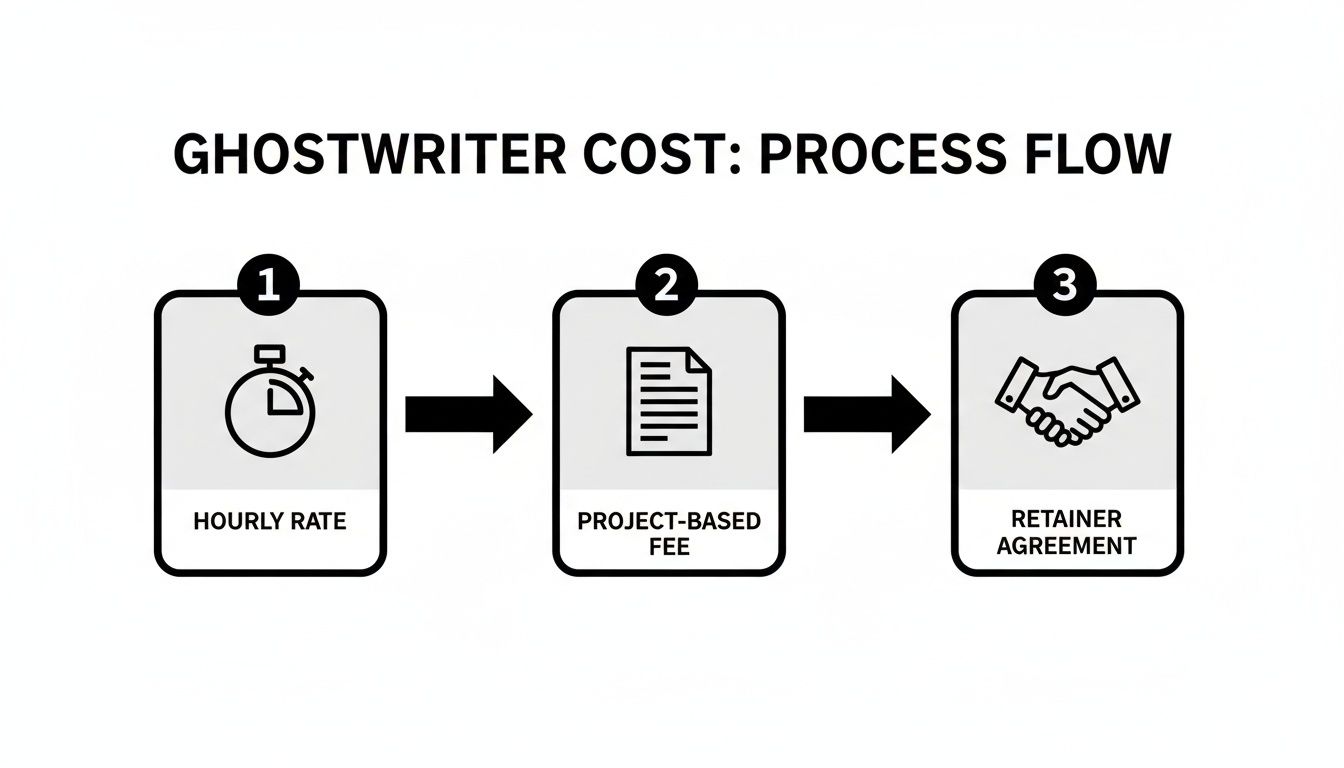
As the flow shows, while hourly and retainer models have their place, the project based fee offers the most predictable and common path for a book length collaboration.
This journey from an idea to a finished manuscript is one of the most rewarding experiences you can have. It takes your internal world and makes it real, tangible, and permanent. With the right ghostwriter for a book as your partner, the process isn't just manageable; it's genuinely enjoyable. You get to do the best part, telling your stories, while they handle the heavy lifting of crafting the perfect sentences. It’s the ultimate creative two step.
Keeping Your Voice and Owning Your Story
Let’s talk about the elephant in the room. It’s the one fear I hear from almost every client, usually in a hushed, nervous tone: "But will it still sound like me?"
The answer is a huge, resounding YES. A great ghostwriter’s main job isn't just to write well; it's to write well as you.
Think of them less as a writer and more as a method actor for your voice. They aren't there to deliver their own monologue. They’re there to study you, inhabit your perspective, and deliver your lines with your exact quirks, timing, and passion. Your story is the star of the show. They’re the supporting actor helping you win the Oscar.
How They Bottle Your Magic
So, how do they actually pull this off? It’s part art, part science, and it all starts with some serious deep listening. A skilled ghostwriter will immerse themselves in your world.
Here’s how they do it:
- They study how you talk: They’ll pour over recordings of your interviews, picking up on the specific words you use, your natural rhythm, and the way you emphasize certain points.
- They read what you write: Got old blog posts, emails, or social media updates? They'll read them all to get a feel for your written cadence.
- They constantly check in: They’ll ask questions like, "Does this feel right?" or "Is this how you'd phrase it?" to make sure the tone is spot on.
The better you understand your own style, the easier it is to guide them. Spending some time thinking about how to find your writing voice will pay huge dividends in this process.
Your Story, Your Copyright
Now for the legal stuff. This isn't a gray area; it's completely black and white.
When you hire a ghostwriter for a book, any standard, professional contract will state that you own 100% of the copyright. Full stop.
The "ghost" in ghostwriter is there for a reason. They are contractually invisible. The finished book, the ideas within it, and all the credit belong entirely to you. Your legacy is legally and creatively yours, forever.
This professional standard is a huge reason the industry is thriving. The ghostwriting market is expected to grow from $5 billion to nearly $8 billion by 2030 as more experts and storytellers realize they can bring their ideas to life with a pro partner. Ultimately, the words are your property, just as if you’d typed every single one yourself.
Answering Your Lingering Questions
We've walked through the entire process, but I know there are probably a few questions still rattling around in your head. It's completely normal. Think of this as our fireside chat before you take the final leap. After all, you’re not just writing a book; you’re building a piece of your legacy.
So, How Long Does This Whole Thing Take?
This is the million dollar question, isn't it? While every project has its own rhythm, you can generally expect a standard non fiction book (think 50,000 to 70,000 words) to take somewhere between 6 to 12 months from start to finish.
That timeline gives everyone enough breathing room. It allows for in depth interviews, thoughtful writing, and a revision process that doesn't feel rushed. It's the sweet spot between getting it done efficiently and not letting the project drag on forever.
Will the Ghostwriter Get Credit on My Book?
Nope! This is one of the biggest myths out there. The "ghost" in ghostwriter is literal, they are professionally invisible.
A standard ghostwriting contract is ironclad on this point: you are the author. You get 100% of the credit, you own the copyright, and their name won't appear on the cover. The only exception is if you both agree to a special arrangement, like a "with" or "and" credit, but that’s a conversation you’d have upfront.
What Do I Need to Have Ready to Start?
Honestly? You can start with just an idea. That’s it. A skilled ghostwriter for a book is a master at drawing the book out of you through a series of focused, insightful interviews.
You don't need a polished outline or a half finished manuscript. Your experiences, your knowledge, and your willingness to share are the only true prerequisites.
That said, if you do have existing material, bring it to the table! Things like old blog posts, presentation decks, personal journals, or even a collection of voice memos can be gold. It gives your writer a head start on understanding your voice and your message, but it's absolutely not a requirement to get started.
At My Book Written, we’re firm believers that everyone has a story worth telling. Our goal is to give you the resources and confidence to start your ghostwriting journey, whether you have a fully formed idea or just the first spark. We're here to help you build the foundation for your legacy. Start your book journey with us.
Ready to talk to an actual writer?
Five questions and we come back with two or three ghostwriters who fit your book, your budget and your timeline. Free, and no writer gets your details until you say so.
Read next
What will your book cost?
Set the type, length and timeline. Get a real 2026 range in 30 seconds.
Open the calculator