
That brilliant book idea, the one that keeps you up at night? It’s more than just a passing thought. It’s a legacy, a business lesson, or a memoir just waiting to be told. Finding the right book writers for hire is the first real step to bringing that story to life.
Your Story Deserves a Voice—Let's Go Find It
That idea rattling around in your head isn't just an idea. It's a real, tangible thing that deserves to exist on paper, something people can hold in their hands for generations to come.
But let’s be honest. The path from a spark of an idea to a finished book can feel like trying to build a ship in a bottle. In the dark. While juggling. If you've ever felt that way, you're definitely not alone.
This guide is your friendly co-captain. We’re going to skip the confusing jargon and get straight to the practical, actionable advice you need.

Why Partnering with a Writer Is an Act of Creation
Hiring a professional book writer isn’t about surrendering your vision or admitting defeat. It's about finding a skilled partner who can translate your brilliance into beautiful prose. It's a collaboration, not a cop-out.
Think of it this way:
- You are the architect. You have the blueprint, the vision, and the soul of the project.
- The writer is the master builder. They have the tools, the techniques, and the hard-won experience to construct the masterpiece you’ve designed.
So many people get stuck thinking they have to do it all themselves, that the struggle is part of the art. I say, let’s make it easier, and a lot more fun. Why go it alone when you can have a pro in your corner, turning the grunt work into a genuinely joyful process?
The real honor is in creating something that will last forever. How you get there is just part of the story. Your story is what matters most, and bringing it to life is a beautiful, worthy goal.
The process should feel exciting, not exhausting. You bring the heart, the memories, and the expertise. A ghostwriter brings the structure, the polish, and the quiet dedication to get it done. Together, you create something that is 100% yours.
I’ve navigated these waters many times, and I promise, getting that book out of your head and into the world is one of the most rewarding things you will ever do. Let’s get started.
Not sure whether you need a ghostwriter or an editor?
If you already have 30,000+ words drafted, an editor at $3,000–$12,000 will serve you better than a ghostwriter at $40,000. The quiz sorts this out in five questions — honestly, even when the answer is the smaller job.
Where to Find Professional Book Writers for Hire
So, you’ve decided to find a partner to bring your book to life. That’s a huge step! But now you’re staring at your screen, and the sheer number of options feels overwhelming. It’s like trying to find one specific fish in the entire ocean. Where do you even begin to cast your net?
Don't worry. The waters aren't as murky as they seem. There are some fantastic fishing spots where the pros gather, and I’m going to show you exactly where to find them. Finding great book writers for hire is less about luck and more about knowing where to look.
The Premium Agency Experience
Imagine having a dedicated project manager who handles every single detail, from scheduling interviews to managing deadlines. That’s what you get when you work with a high-end ghostwriting agency. These are the full-service firms that offer a curated, managed, and almost entirely hands-off process.
This is the perfect route if you’re a busy executive or an entrepreneur who needs a polished book without getting bogged down in the day-to-day grind of writing it. You bring the idea and the expertise; they handle the rest.
- What you get: A full team, dedicated project management, and a writer who has been hand-picked and thoroughly vetted for your specific project.
- Best for: Memoirs, high-stakes business books, and legacy projects where a premium, guided experience is non-negotiable.
- Keep in mind: This is the most expensive option, but you’re paying for peace of mind and an impeccably smooth workflow.
Agencies are fantastic because they take all the guesswork out of the equation. You aren't just hiring a writer; you're hiring an entire system built to produce a book. It’s the white-glove service for your legacy.
Curated Freelance Platforms: The Sweet Spot
Next up, we have specialized freelance platforms. Don’t confuse these with the chaotic, free-for-all marketplaces out there. Platforms like Reedsy, Upwork’s "Project Catalog," or Gotham Ghostwriters have done a lot of the initial vetting for you.
They’re a wonderful middle ground. You get access to a huge pool of professional book writers, but with quality controls, portfolios, and client reviews to help you make an informed choice. It’s the difference between shopping at a boutique market and a massive superstore; the quality is just consistently higher.
Finding a writer is a bit like dating. You need to find someone whose style you love, whose personality clicks with yours, and who is genuinely excited about your story. These platforms are some of the best matchmakers in the business.
As you browse these sites, zero in on profiles that specialize in your genre. A brilliant sci-fi writer probably isn't the best fit for your family memoir, and that’s okay. The goal is to find the person whose skills are a perfect match for your project.
The Untapped Power of Your Own Network
Finally, never underestimate the power of a simple referral. You would be absolutely shocked by how many brilliant writers are found through a conversation at a conference or a quick post on LinkedIn. The best people are often busy with projects, not marketing themselves.
Your own professional and personal network is a goldmine waiting to be tapped.
- Start on LinkedIn: Use the search bar for terms like "ghostwriter," "book writer," or "memoirist." Check to see who you’re connected to through second or third-degree connections. A warm introduction from a mutual contact is pure gold.
- Ask your colleagues: Have you worked with a marketing consultant who raved about their content writer? Does your lawyer know someone who specializes in business books? People in your professional circle often have connections to top-tier creative talent.
- Tap into industry groups: If you’re part of an entrepreneurs' organization or a professional association, ask for recommendations. These groups are fantastic for finding book writers for hire who already understand the nuances of your specific field.
The beauty of a referral is the built-in trust. When someone you respect vouches for a writer, you’re already starting the relationship from a place of confidence. It’s a beautifully simple, and profoundly effective, way to find your perfect writing partner.
How to Spot a Talented Writer in the Wild
Alright, you've waded through the internet and have a shortlist of potential writers. High five! Now comes the fun part, the real detective work. How do you separate the true wordsmiths from those who just have a slick website?
This is all about the art of evaluation. It’s a bit like being a talent scout. You have to look past the headshot and see if they can actually play the game. Anyone can say they're a great writer, but the proof is in the portfolio. Let’s Sherlock Holmes our way through this.
The Portfolio Is Your Crystal Ball
A writer's portfolio isn't just a collection of past work; it’s a direct window into what they can do. It shows you their style, their range, and most importantly, their ability to bring a story to life. Don't just skim the samples, really dig in.
Here's what to look for:
- Genre Consistency: Do they have real experience in your genre? A fantastic business book writer might struggle to capture the delicate emotional nuances of a family memoir. Look for samples that feel similar in tone and scope to your own project.
- Voice and Adaptability: A great ghostwriter is a chameleon. Can they adapt their voice to match different clients? If every sample sounds exactly the same, it might mean they have one default style they impose on everyone. You want your book to sound like you, not them.
- Structural Integrity: Does the writing flow well? Look for a clear beginning, middle, and end. Even in a short sample, you should feel a sense of purpose and direction. Good writing isn't just pretty sentences; it's solid architecture.
When you're evaluating writers, pay close attention to their ability to craft compelling and persuasive content. This is crucial whether they're writing a gripping memoir or a convincing business book, and you can learn more about it in this helpful persuasive writing guide.
Testimonials Are More Than Just Praise
Next up, check out their testimonials and references. A talented writer will leave a trail of happy, successful clients in their wake. Think of these as character witnesses for their professionalism and skill.
But not all testimonials are created equal. Vague praise like "They were great to work with!" is nice, but it doesn’t tell you much. You're looking for specifics.
"A great writer doesn’t just deliver a manuscript; they deliver a partnership. They listen, they challenge you in the best way, and they care about your story as if it were their own. Their past clients will tell you that."
Look for testimonials that mention the writer’s process, their ability to capture the client's voice, or their knack for making a complex topic easy to understand. Those details are pure gold. If you're feeling good about a candidate, don't be shy about asking for one or two references you can speak with directly. It’s a standard professional practice.
Their Online Presence Is Their Digital Handshake
Finally, take a peek at their online presence. Does their LinkedIn profile reflect the expertise they claim? Is their blog well-written and insightful? A writer’s own public-facing content is a direct reflection of their standards.
If their own website copy is sloppy or uninspired, that’s a major red flag. They should be their own best case study. After all, if they can't tell their own story well, how can you trust them to tell yours?
This isn’t about being nosy; it’s about doing your due diligence. You're looking for a partner to entrust with your legacy, your life's work. It's an act of courage to share your story, and you deserve a collaborator who honors that trust with proven skill and genuine passion. This deep dive is how you find them.
The Money Talk: Pricing, Contracts, and Expectations
Okay, let's pull up a chair and talk about the elephant in the room. You know, the one jingling its pockets and looking a bit awkward. Money.
Discussing the cost of hiring a book writer can feel like trying to solve a riddle, but I promise it's more straightforward than it seems. You’re not just buying words on a page; you're investing in a partner who will help you build something permanent, something that carries your voice long after you’ve left the room.
It’s an act of profound trust, and getting a handle on the financial side of that partnership is crucial. This is all about making you feel confident and prepared. No mystery, no jargon, just a clear-eyed look at what to expect so you can have honest conversations from day one.
Cracking the Code on Ghostwriting Fees
When you start searching for book writers for hire, you'll quickly see that their pricing isn't one-size-fits-all. That's actually a good thing! It means you can find a model that works for your specific project and budget.
Let’s break down the common ways writers structure their fees:
- Per-Project Fee: This is the industry standard and, honestly, the best for both sides. The writer quotes a flat fee for the entire book, which gives you total budget certainty. You both know exactly what’s expected from start to finish without any surprises.
- Per-Word Rate: Some writers charge by the word. This can work for shorter projects but gets tricky for a full-length book where the final word count might fluctuate. It’s a bit like paying for gas by the drop instead of by the gallon.
- Hourly Rate: This is less common for writing an entire book but often used for consulting, editing, or book coaching. It’s great for undefined tasks but can lead to budget blowouts if the scope isn't managed with an iron fist.
For a full manuscript, the per-project model almost always offers the most peace of mind. You’re not watching the clock or counting every single word; you’re focused on creating something incredible.
Think of your contract as the blueprint for your partnership. It’s not about mistrust; it’s about clarity. A great contract protects both you and the writer, ensuring everyone is on the same page before a single word is written.
Pricing in this industry tells a story about a writer's experience and demand. In 2025, fees for book projects can span a massive range, from a few thousand dollars on the low end to over $500,000 for A-list talent.
However, the sweet spot for most seasoned, professional ghostwriters often clusters around $50,000, with many top-tier writers falling in the $30,000 to $95,000 range based on their track record and the project's complexity. Six-figure deals are also becoming more common, especially for high-profile memoirs or complex business books. You can dig deeper into these industry trends in the latest report from the Association of Ghostwriters.
When you're ready to talk numbers, it helps to have a general idea of what different projects might cost. The final quote will always depend on the writer's experience and the scope of your book, but this table gives you a solid starting point.
| Typical Ghostwriting Project Costs |
|---|
| A breakdown of common project types and their estimated cost ranges with professional writers. |
| Project Type |
| Business Book / Thought Leadership |
| Memoir / Legacy Project |
| How-To / Self-Help Book |
| Typical Page/Word Count |
| 150-250 pages (40,000-60,000 words) |
| 200-300 pages (50,000-80,000 words) |
| 150-200 pages (35,000-50,000 words) |
| Estimated Professional Fee Range |
| $40,000 – $120,000+ |
| $45,000 – $150,000+ |
| $35,000 – $85,000+ |
Remember, these are ballpark figures. A writer who needs to conduct extensive interviews or deep-dive research will naturally command a higher fee than one working from existing materials.
Your Contract: The Non-Negotiables
A handshake is lovely, but a contract is essential. This is your roadmap for the entire project, and any professional writer worth their salt will insist on one. It’s what protects your vision, your investment, and your story.
After doing your homework on a writer's portfolio and experience, the contract is where you formalize that partnership.
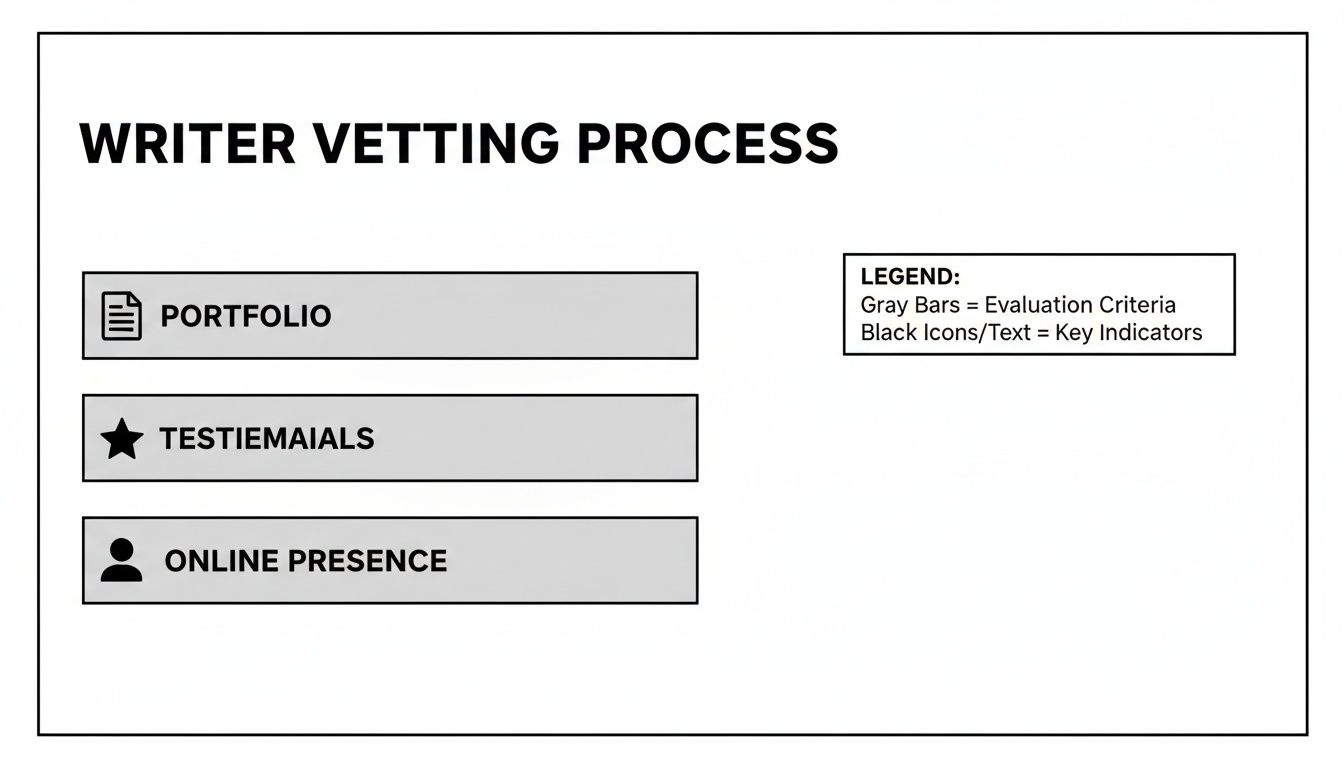
This diagram shows the journey from initial vetting to a solid agreement. The contract is the final, crucial step in that process.
Here are the absolute must-haves in any ghostwriting agreement:
- A Crystal-Clear Scope of Work: The contract must define exactly what the writer will deliver. This includes the estimated word count, the number of interview hours, the extent of research, and the final format of the manuscript.
- The Payment Schedule: Payments are almost always tied to project milestones. A typical structure is a deposit upfront (usually 25-50%), with further payments due after the outline is approved, at the manuscript's halfway point, and upon final completion.
- Revision Rounds: How many chances do you get to provide feedback and request changes? The contract should specify the number of revision rounds included in the fee. This prevents "scope creep" and keeps the project moving forward efficiently.
- Copyright and Ownership: This is the big one. The contract must state, unequivocally, that you own 100% of the rights to the finished book. Your name goes on the cover, and you own the copyright, period.
- A Rock-Solid Confidentiality Clause: Your story is yours alone. A non-disclosure agreement (NDA) or a confidentiality clause within the contract ensures your ideas, interviews, and manuscript drafts remain completely private.
Talking about money and contracts doesn’t have to be intimidating. In fact, it's a sign of a professional, respectful partnership. It's how you build a solid foundation for the incredible, creative work you’re about to do together.
The Interview Questions That Reveal Everything
You’ve sifted through portfolios and now you’re ready to actually talk to your top candidates. This is a huge step! But this conversation is about so much more than just their writing chops. It's about chemistry.
Think of it like finding a dance partner for a really, really long waltz. You need someone who can follow your lead, but who also knows the steps so well they can guide you when you stumble. This interview is your chance to see if you can be vulnerable with this person, if you can trust them with the raw, messy, beautiful truth of your story.
Questions That Go Beyond the Resume
Look, anyone can give you a polished, rehearsed answer to, "So, what's your process?" That’s not what we’re after here. We need to understand their character, how they solve problems, and frankly, their heart. These questions are designed to gently peel back the professional veneer and see the real person you’ll be partnering with.
Here are a few of my favorites to get you started:
- "Walk me through a time a project went off the rails. What happened, and how did you help get it back on course?" This question is pure gold. It reveals their honesty, their accountability, and how they handle pressure when things inevitably get a little messy.
- "How do you approach capturing someone else’s voice without letting your own style take over?" This gets to the very soul of ghostwriting. A great answer will involve deep listening, asking probing questions, and studying your unique way of speaking. They should be a chameleon, not a painter who only uses one color.
- "Imagine I’m struggling to explain a core concept for my book. How would you help me articulate it?" This shows you their skills as a collaborator and a coach. The best book writers for hire are also expert interviewers who can gently pull the story out of you when you get stuck.
These aren't gotcha questions. They're invitations to share a real story, and their answers will tell you everything you need to know about their work ethic and character.
Red Flags to Watch For
Just as important as asking the right questions is knowing how to spot the warning signs. Your gut feeling is your most powerful tool here. If something feels off, it probably is.
Be wary of a writer who:
- Shows a lack of curiosity. If they aren't asking you a ton of questions about your story, your goals, and your "why," they aren't truly invested in your vision. They should be genuinely fascinated by you.
- Gives vague, generic answers. If you ask about their process and they just say, "I do research and then I write," that’s a big red flag. A pro will talk about detailed outlines, interview transcripts, and specific revision workflows.
- Uses high-pressure sales tactics. This is a creative partnership, not a timeshare presentation. You should feel supported and respected, never rushed into making a decision.
A great interview should feel less like a job screening and more like the first chapter of a wonderful conversation. It’s a dance of mutual discovery where you both get to decide if you’re the right fit for this incredibly personal journey.
Choosing a writer is an act of trust. You are handing them your memories, your life's work, your legacy. The person who earns that trust won't just be a great writer; they'll be a great partner. Take your time, listen closely, and choose the person who makes you feel seen, heard, and genuinely excited to begin.
Bringing Your Book to Life: The Writing Process
You did it. You found your writer, the contract is signed, and you’re ready to roll. Take a second to really let that sink in, it’s a massive step! So… what happens now? This is where the real work, and the real fun, begins. It's the collaborative dance of turning all those amazing ideas in your head into a finished manuscript.
Think of this partnership as a journey, not just a transaction. It’s a process built on trust, open communication, and a shared vision for your story. Let’s walk through what the workflow typically looks like so you can feel confident and prepared for this next phase.
The Deep-Dive Interviews
The first part of the process is always the most personal. Your writer’s main job right now is to become an expert on you, your story, your voice, and your unique way of looking at the world. This happens through a series of "deep-dive" interviews, which usually feel more like guided conversations than a formal Q&A.
This is your time to share memories, unpack business lessons, or trace the family history you hold so dear. A truly great writer will ask questions you've never even thought to ask yourself, gently digging to find the heart of your message. Don't be surprised if these chats feel a bit like therapy; honestly, that’s a good sign you’re getting to the important stuff.
The goal of these interviews isn't just to gather facts; it's to capture the feeling behind them. Your writer is listening for your rhythm, your humor, and the unique way you see the world.
Building the Blueprint: The Outline
After absorbing your story, your writer will get to work on a detailed outline. I can't stress this enough: do not underestimate the importance of this step. The outline is the architectural blueprint for your entire book. It’s where you map out the structure, the flow, and the emotional arc before a single chapter is written.
Your involvement here is absolutely critical. This is your chance to make sure the foundation is solid.
- Review it carefully: Does the chapter-by-chapter progression make sense?
- Look for gaps: Is there a crucial piece of the story missing?
- Confirm the tone: Does the summary for each chapter capture the right feeling?
Nailing the outline saves everyone countless hours of revision down the road. It’s the ultimate "measure twice, cut once" moment in book writing. If you're curious to learn more about the mechanics behind storytelling, you can find some great insights into the craft of writing that can help you give even better feedback.
The Chapter-by-Chapter Journey
Once you’ve approved the outline, the writing begins in earnest. Most professional book writers for hire work chapter by chapter. They'll write a draft, send it to you for review, incorporate your feedback, and only then move on to the next one. This back-and-forth keeps the project on track and ensures the book never strays from your vision.
Giving feedback is a skill. Be honest, be specific, and never hesitate to say, "This just doesn't quite sound like me." Whenever you can, give concrete examples. Instead of saying, "I don't like this," try something like, "In this paragraph, I would have used this specific phrase instead."
The demand for this kind of creative partnership has exploded. The global ghostwriting market hit a staggering $1.32 billion in 2024 and is still climbing. A big reason for this is the self-publishing boom. With over 1.4 million books released annually on platforms like Amazon KDP, that professional polish has become more important than ever. You can read more about these ghostwriting market trends on datainsightsmarket.com.
This collaborative journey is one of the most rewarding experiences you can have. You’re not just a spectator; you're an active participant, guiding your story to the finish line, one chapter at a time.
A Few Common Questions We Hear All the Time
Diving into the process of hiring a writer can feel a bit like stepping into the unknown. It's only natural to have a bunch of questions buzzing around in your head. This is a huge, exciting decision, so let's clear up some of the most common worries I hear from people about to start this journey.
"If someone else writes it, is the book still mine?"
Yes, absolutely. 100% yes. Think of a ghostwriter as an expert interpreter for your ideas, not the author of them. You're the visionary; they're the skilled craftsperson bringing that vision to life on the page.
Their entire job is to capture your voice, your stories, and your unique perspective so perfectly that the book sounds even more like you than you could have written it yourself. Any legitimate contract will make it crystal clear that you retain 100% of the copyright and all rights. It's your name on the cover and your legacy inside.
"Realistically, how much of my time will this take?"
While hiring a writer frees you from the marathon of actually writing, this is still very much a partnership. It requires your time and energy to get it right. Plan on dedicating a solid chunk of time at the beginning, usually somewhere between 15 to 30 hours, for in-depth interviews and getting the outline just right.
Once the writing starts, you’ll need to set aside a few hours a week to read through chapters and give your thoughts. The more engaged you are in the process, the more the final book will feel like a true extension of you.
This isn't just a transaction where you hand something off; it's a creative dance. Your active participation is what breathes life into the project and makes the final manuscript genuinely yours.
"What if I just don't like what they've written?"
That's a completely valid concern, and it’s precisely why a structured, professional process is non-negotiable. Any good writer builds rounds of revisions right into their workflow and contract.
Typically, you'll get the book piece by piece, often chapter by chapter. If something feels off, you just give direct, honest feedback. Don't ever hesitate to say, “This part doesn’t quite sound like me,” and explain why. It’s a team sport, and your writer is just as invested in getting your voice right as you are.
Feeling more confident about taking the next step? At My Book Written, we offer the expert guidance and resources you need to organize your big idea and connect with the perfect writing partner. Start exploring your path to a finished book today.
Ready to talk to an actual writer?
Five questions and we come back with two or three ghostwriters who fit your book, your budget and your timeline. Free, and no writer gets your details until you say so.
Read next
What will your book cost?
Set the type, length and timeline. Get a real 2026 range in 30 seconds.
Open the calculator