
Let's be honest for a second. The thought of writing a memoir can feel absolutely monumental. It’s like deciding to climb a mountain when all you have is a vague sense of direction and a pair of old sneakers. The sheer size of a life lived can feel paralyzing. I get it. The mountain looks big from the bottom.
But here’s a secret that most people miss. A great memoir isn't a history report of everything that ever happened to you. Not even close. It's a story with a heartbeat, a central idea that ties together the beautiful, the messy, and the unforgettable moments into something truly lasting. It’s an honor to create something that will live on forever.
Uncovering Your "Why"
Before you ever think about chapters or timelines, you have to get brutally honest about your motivation. Why this story? Why now? Knowing your "why" is the rocket fuel that will get you through the tough days of writing when you’d rather be alphabetizing your spice rack. Seriously, I’ve been there.
Maybe you want to:
- Preserve a family legacy for future generations. What an incredible gift.
- Share hard won wisdom from a specific challenge.
- Make sense of a pivotal period in your life.
- Simply create something beautiful and lasting.
Whatever it is, write it down. This "why" is your North Star. It guides every single decision you'll make from here on out.
Finding Your Story's Theme
Once you have your "why," the next step is finding your theme. If your life is a massive multi album box set, your memoir is its greatest hits single. It's not every song, just the ones that define the entire collection.
For example, your theme isn't just "my difficult childhood." That's a circumstance. A powerful theme is "how I learned to find joy and create my own family after a lonely childhood." See the difference? One is a situation; the other is a journey with a soul.
If you’re wrestling with this, we've got some great tips on how to start writing a memoir that can help you find that focus.
This initial process is all about laying a solid foundation before you start building. This simple visual breaks down these crucial first steps.
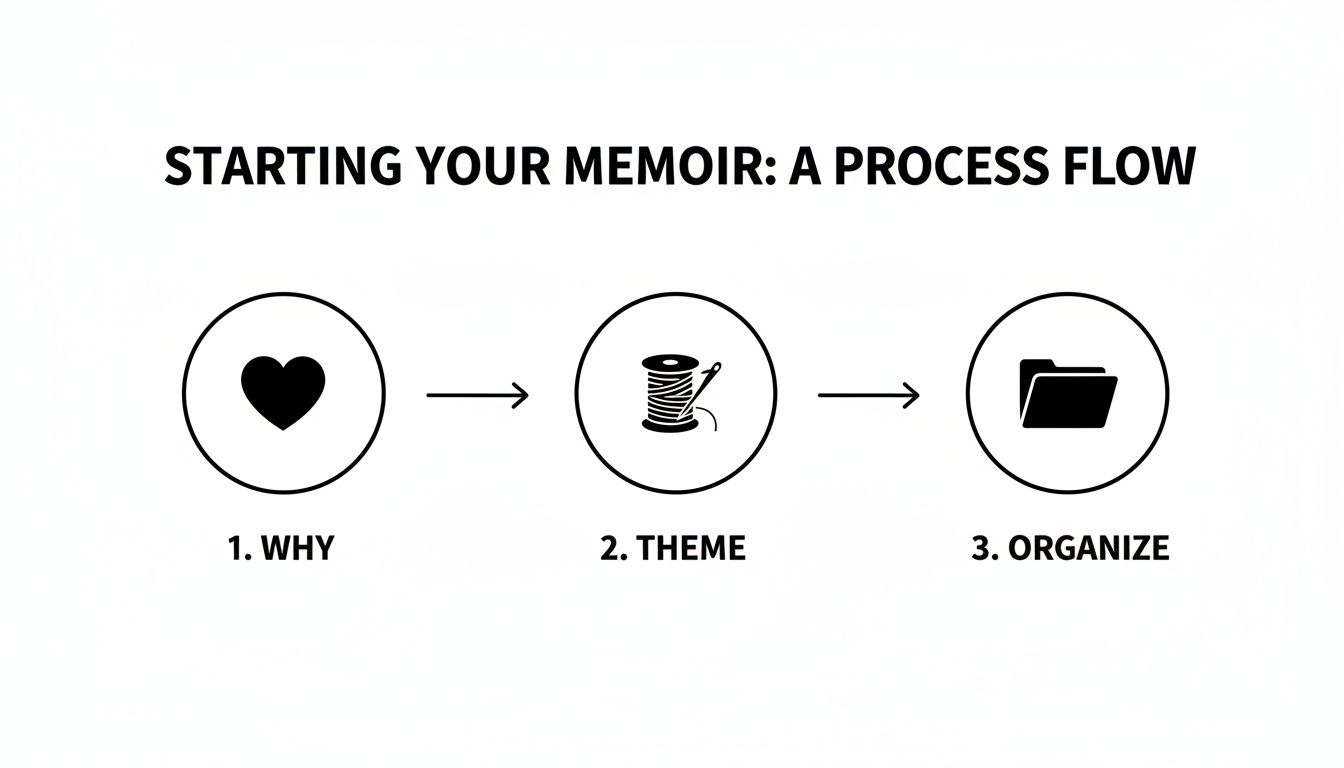
As you can see, understanding your motivation (Why) and central message (Theme) absolutely must come before you even attempt to structure your memories (Organize). By doing this prep work, you transform a chaotic pile of memories into a clear, purposeful story just waiting to be told.
Finding the Heartbeat of Your Story
You’ve found your "why," that powerful, personal reason for writing your memoir. That’s the engine. Now, we need to build the frame around it. A story without a clear structure is just a collection of memories, and while they might be beautiful, they won't take your reader on a journey.
This isn’t about cramming your life into a rigid, one size fits all box. It's about finding the natural shape of your story, its unique rhythm. Think of yourself as a composer. You have all these vibrant, sometimes chaotic notes from your life. The structure is how you arrange them into a melody that someone will actually want to listen to from start to finish.

If that sounds a little daunting, don't worry. You're tapping into something readers are deeply hungry for. The memoir genre has seen explosive growth, with real life stories consistently dominating bestseller lists.
In fact, between 2022 and 2024, nearly 50% of New York Times non-fiction bestsellers were memoirs. This just proves what we already know deep down: authentic, human stories are what connect with us the most. You can dive deeper into these trends and statistics over on meminto.com.
Choosing Your Narrative Structure
Okay, so how do you actually organize a lifetime of experiences? Most memoirs rely on a few classic structures. The key isn't to follow a rulebook but to pick the one that feels most true to the story you need to tell.
Here are the most common approaches I've seen work wonders:
-
The Chronological Classic: This is the most familiar path, "this happened, then that happened." It’s direct, easy to follow, and perfect for stories that show a clear progression or transformation over a specific period. Think of it as a straight road from point A to point B.
-
The Thematic Approach: Instead of a timeline, you build your chapters around central ideas like "Loss," "Adventure," or "Finding My Voice." This is a fantastic choice if your story is less about the sequence of events and more about the emotional truths and lessons you've gathered along the way.
-
The Braided Narrative: Now this one is a bit more sophisticated, but incredibly powerful when done right. You might weave two different timelines together, say, scenes from your childhood alternating with your present day life, to show how the past is constantly shaping the now. It can create wonderful suspense and emotional depth.
My Two Cents: The right structure is the one that best serves your central theme. If your story is about healing from a single event, a chronological narrative moving toward and away from that moment could be perfect. But if it's about a lifelong pattern of resilience, a thematic approach might be far more impactful.
This is a huge decision, so let’s lay out the options to make it clearer.
Choosing Your Memoir's Structure
Here's a quick comparison of the common memoir structures to help you figure out which narrative approach is the best fit for your personal story and theme.
| Structure Type | What It Looks Like | Best For Stories About… |
|---|---|---|
| Chronological | A to B to C. Follows a clear timeline from a starting point to an end point. | A specific period of transformation, coming-of-age, or a journey with a clear beginning and end. |
| Thematic | Chapters are organized by ideas (e.g., love, fear, family), not time. | Exploring complex emotional truths or lessons learned over a lifetime, where the timeline is less important than the insight. |
| Braided | Weaves together two or more timelines or perspectives in alternating chapters. | Showing cause and effect over long periods, or creating suspense by revealing past events slowly. |
Choosing a structure is a huge leap forward. It gives you a container for your memories, making the whole project feel more manageable and less like a chaotic sea of anecdotes.
Mapping Your Story's Arc
Once you’ve settled on a structure, the next move is to sketch out your story's arc. Every great story you've ever heard has a beginning, a middle, and an end. It sounds basic, I know, but consciously identifying these signposts in your own life is a total game changer for your writing process.
-
The Beginning (The Inciting Incident): What kicks everything off? This isn’t your birthdate. It’s the moment the world tilted on its axis for you, the event that set you on the specific path your memoir will explore.
-
The Middle (The Rising Action & Climax): This is the heart of the journey. It's the string of challenges, breakthroughs, and turning points that build tension and lead toward the story's peak moment of conflict or revelation.
-
The End (The Resolution): What’s different now? This is the "after." It's where you reflect on the journey, make sense of it all, and share the wisdom you fought for.
Laying out these key points gives you a solid roadmap. For a much more detailed walkthrough of this process, check out our guide on how to write a memoir outline. It's a fantastic resource for turning these big ideas into a concrete, chapter by chapter plan.
This is often the moment a memoir starts to feel real, when that overwhelming cloud of memories finally starts taking the shape of an actual book. If this part feels like you’re trying to assemble a puzzle in the dark, just know you don't have to go it alone. This is where a talented ghostwriter truly shines. A ghostwriter is like an architect for your story. They help you find the structure within your experiences and build a framework that lets your voice come through, loud and clear. It makes the process so much easier, and a lot more fun.
Not sure whether you need a ghostwriter or an editor?
If you already have 30,000+ words drafted, an editor at $3,000–$12,000 will serve you better than a ghostwriter at $40,000. The quiz sorts this out in five questions — honestly, even when the answer is the smaller job.
Navigating the Messy Middle and Getting Words on the Page
Welcome to the writer’s jungle. This is where the romantic, coffee shop fantasy of writing a memoir crashes head on into the reality of a blinking cursor on a blank page. It can be messy and frustrating, and suddenly, alphabetizing your spice rack feels like a top priority.
This is your survival guide for what I affectionately call "the messy middle." It’s that point where the initial buzz wears off and the real work begins. Let's get one thing straight: if you find this part hard, you're not failing. You're just doing it right.
Conquering the Blinking Cursor
The biggest hurdle isn’t crafting the perfect sentence; it’s just getting any sentence down. The pressure to be profound from the get go is a story killer.
Your first draft has one job and one job only: to exist. It doesn't need to be pretty. It just needs to be written.
One of the most effective ways to break through is to ditch the keyboard entirely. Seriously. If you’re someone who thinks better out loud, learning about transcribing voice memos can be a total game changer. Talking is often so much easier than typing, and it’s a brilliant way to sidestep your internal critic.
Another trick? Write like you're telling the story to a close friend over coffee. As memoir coach Marion Roach Smith wisely advises, think of it as a letter home. You wouldn't try to sound like a stuffy historian; you'd just share what happened and how it felt. That authenticity is exactly what readers are looking for.
Creating a Writing Habit That Actually Works
Forget the idea that you need a secluded cabin and four uninterrupted hours every day. That's a lovely thought, but for most of us, life just gets in the way. A sustainable writing practice is built on small, consistent efforts, not grand, unrealistic gestures.
-
The 15-Minute Sprint: Can you find just 15 minutes? Set a timer and write without stopping. Don't edit, don't second guess, just let the words tumble out. You'll be amazed at what you can get down in these tiny pockets of time.
-
Habit Stacking: Piggyback your writing time onto a habit you already have. For example, "After I finish my first cup of coffee, I will write for 20 minutes." This makes it an automatic part of your routine, not just another thing on your to do list.
-
Lower the Bar: Is a goal of 500 words a day paralyzing you? Make it 50 words. The goal isn't the word count; it's the simple act of showing up. Giving yourself a ridiculously easy win is the best way to build momentum.
The first draft is for you. It’s for you to sort out your story, what you need to say, and how you’ll say it. You need to claim that space and time and put publication fantasies and worries aside. Just get the story down.
This is the stage where the raw material of your life starts taking shape. It’s also where the emotional weight of your memories can hit you like a ton of bricks.
Handling the Emotional Hangover
Writing a memoir isn't just a creative exercise; it's an emotional excavation. You're revisiting moments of profound joy, deep pain, and everything in between. It is completely normal to feel drained, sad, or even overwhelmed after a writing session. This emotional hangover is real.
So, be kind to yourself. After digging into a particularly tough memory, plan something to refill your cup. Take a walk, call a friend, watch a silly movie, whatever helps you return to the present moment. Acknowledging the emotional labor involved is crucial to staying the course.
This is also where so many incredible stories get stalled. The sheer effort of wrestling with prose, structure, and intense emotions can be exhausting. It’s why many people decide to bring in a co pilot.
Working with a professional ghostwriter isn't cheating; it's a brilliant partnership. You are still the author, the visionary. A ghostwriter is the skilled craftsperson who takes your memories, your voice, and your vision and helps you build the beautiful, sturdy structure that will house your story. They handle the heavy lifting of sentence construction and chapter flow, freeing you up to focus on the heart of your experience. It makes the entire process easier and more fun, and you still get to see your vision brought to life.
Shaping Your Story: The Art of Editing and Refining
So, you have a first draft. Congratulations! Let me be the first to tell you it’s probably a glorious, beautiful mess. And that is exactly how it should be. The hardest part, getting the story out of your head and onto the page, is done. You should feel so proud.
Now, the real magic begins.
Editing isn’t just about hunting for typos with a red pen. It's about taking that raw clay of your experience and shaping it into something powerful, something that will last. It’s what turns a diary into a legacy.

This is the stage where your collection of memories transforms into a polished book that truly honors your experience and captivates your reader. It’s where the story finds its final, most powerful form.
First, Look at the Big Picture
Before you start obsessing over commas or word choice, you need to zoom way, way out. This first pass is what the pros call a developmental edit. Think of it as checking the architectural blueprints of your house before you even think about picking out paint colors.
You have to ask yourself some tough questions:
- Does the structure hold up? Does your story flow logically from beginning to end, or does it feel disjointed and confusing in places?
- How’s the pacing? Are there chapters that drag on forever while others feel like a whirlwind, leaving the reader behind?
- Is your theme crystal clear? Does every single chapter, every anecdote, serve that central heartbeat of your story we talked about earlier?
Honestly, this is the hardest part of self editing. You’re so close to the story, you lived it, after all. Getting that kind of objective distance is tough, which is why bringing in a professional can feel like a huge weight off your shoulders. You can find some great advice on finding the right partner in our guide on how to hire freelance book editors.
Now, Zoom in on the Details
Once you feel confident about the overall shape and flow of your memoir, it’s time to pull out the magnifying glass. This is the sentence level work, the line edit, where you make your prose truly sing. Your goal is to make every single word earn its place on the page.
Here’s a quick checklist for your line level edit:
- Hunt down clichés: We all use them. Phrases like "at the end of the day" or "a diamond in the rough" are comfortable, but they don't pack a punch. Swap them out for fresh, specific language that is uniquely yours.
- Strengthen your verbs: Instead of saying someone "walked quickly," try "hurried," "scurried," or "dashed." Strong verbs do the heavy lifting in a sentence.
- Read it out loud: This is my absolute secret weapon. Your ears will catch awkward phrasing, clunky sentences, and repetitive rhythms that your eyes might just skim over.
Editing is like tidying a room. You’re not throwing everything out. You’re just deciding what to keep, what to put on display, and what to store in the attic. The goal is to make space for the story to breathe.
Speaking of your story finding its space, it’s worth remembering that a polished memoir can have a life well beyond your family bookshelf. Writing a memoir is a totally viable business move. Publisher’s Marketplace data shows a steady 267 memoir deals in 2024 alone. And get this: a whopping 23% of those deals went to regular folks without massive platforms, sold purely on the merit of their writing. This completely debunks the myth that only A list celebrities get book deals. You can dig into more data on how non famous voices are landing deals over at River Editor.
The Undeniable Power of Fresh Eyes
Let’s be real: you can only edit your own work so far. After a while, you become "story blind." You know what you meant to say, so you read what you meant, not what’s actually on the page.
Getting fresh eyes on your manuscript is non negotiable. This could be a trusted friend, a writers' group, or a professional editor. Their job isn’t to tear your work apart but to show you where your story is shining and where it might be a little foggy for an outside reader.
This whole editing process can feel like running a second marathon right after you finished the first one. It demands a different kind of energy and a very specific skill set, and frankly, this is where many brilliant memoir projects lose steam.
If this all feels like a daunting chore, remember you don't have to go it alone. An expert ghostwriter is much more than just a writer; they are an experienced editor and story shaper. They can take your beautiful, messy draft and help you polish it into a masterpiece, all while keeping your unique voice perfectly intact. It’s how you can make the final stretch not just easier, but a whole lot more exciting.
From Manuscript to Masterpiece: What Happens Next?
You did it. You wrestled with memories, stared down that blinking cursor, and finally shaped your life's stories into a manuscript. Take a moment. Breathe it in. That document represents an incredible act of courage and creation, and you should be immensely proud.
But now what? How does this file on your computer become a real, physical book you can hold in your hands, a treasure to pass down through generations? This is the final, thrilling leg of the journey where your story finds its forever home.

From here, you’ve got a couple of classic paths to choose from. Think of them as the "Gatekeeper Gauntlet" and the "DIY Dream."
The Traditional Publishing Path
This is the route you’ve probably seen in movies. It involves writing a killer query letter, finding a literary agent who falls in love with your story, and having them pitch it to a big publishing house. It sounds glamorous, and honestly, when it works, it is.
- The Upside: You get an advance (yes, money upfront!), a team of pros handling editing, design, and distribution, and the prestige that comes with a traditional publisher's stamp of approval.
- The Downside: It’s a long, slow, and often soul crushing process filled with rejection. You give up a significant amount of creative control, and it can take years just to see your book on a shelf.
Getting a traditional deal is a fantastic goal, but it’s a bit like trying to win the lottery. It's absolutely possible, but it requires a ton of persistence, a bit of luck, and perfect timing.
The Self Publishing Revolution
This path puts you squarely in the driver's seat. You become the CEO of your own book. You’re in charge of everything from hiring an editor and cover designer to handling the formatting and marketing. It sounds like a lot of work because, well, it is.
- The Upside: You have 100% creative control over every single aspect of your book. You also keep a much higher royalty percentage on every copy sold, and your book can be available for sale in a matter of weeks, not years.
- The Downside: The upfront costs are all on you. You're also responsible for marketing, which is a full time job in itself.
The great news is that you don't have to be a tech wizard to make this happen. Once your memoir is polished, you just need a plan to share it with the world. For many, the most direct route is to publish your book on Amazon, and the tools available today have made this path more accessible than ever.
Choosing a path isn't about which one is "better." It's about what aligns with your personal "why." If your goal is hitting a bestseller list, traditional might be your aim. If you want to create a beautiful family heirloom with total control over the final product, self publishing is a perfect fit.
The market for authentic stories has never been stronger, regardless of how you get there. Memoirs are booming. In fact, over 60% of memoir authors now choose to self publish. At the same time, traditional publishing saw 267 memoir deals in 2024 alone, an 85% increase from a decade ago. It just goes to show that real stories from real people are in high demand.
A Simpler, More Direct Route
Let’s be honest. Both of those paths can sound pretty exhausting. What if you just want a beautiful, finished book without becoming a publishing expert or spending years chasing agents?
This is where a full service production partner comes in. Think of it as your personal concierge for creating a book. You can bring them a finished manuscript (or even just your core idea), and they’ll handle the entire process: professional editing, bespoke cover design, interior layout, printing, and even distribution.
It’s truly the best of both worlds. You get the quality and polish of a traditionally published book with the speed and creative control of self publishing, but without having to do all the legwork yourself. It’s your vision, your story, your legacy, brought to life with an expert team dedicated to honoring it. This is often the simplest, most joyful way to ensure your manuscript becomes the masterpiece it deserves to be.
Common Questions About Writing Your Memoir
You have questions. Of course you do. Deciding to put your life on the page is a massive, wonderful, and honestly, pretty intimidating commitment. It’s completely normal for your mind to start buzzing with all the "what ifs" and "how tos."
And let's be real, these aren't just simple logistical questions. They're deeply personal, tied to everything from family dynamics to your own sense of self worth. So, let's walk through some of the most common concerns we hear and give you some straight up, practical answers.
How Do I Write About People Without Causing Drama?
This is the big one, isn't it? It’s the single question that keeps so many incredible stories gathering dust in the back of people's minds. The most important thing to remember is this: it's your story, told from your perspective. You're sharing how events landed on you, not presenting a legal argument with cold, hard facts.
Here are a few ways to handle these tricky situations:
- Own your point of view. Stick to "I" statements. Focus on how you felt and what you experienced, rather than trying to state what someone else was thinking or intending. It’s your emotional truth.
- Change the details. You can absolutely change names, locations, and even merge a few people into a single composite character to protect identities. This preserves the emotional core of the story while respecting privacy.
- Think about having a conversation. In some cases, talking to the person beforehand can ease tensions. But let me be clear: you do not need anyone's permission to tell your own story.
This is an area where a skilled ghostwriter can be invaluable. They are masters at telling a story with both honesty and compassion, helping you find the right words to navigate sensitive relationships with grace.
What If My Life Isn't Exciting Enough?
You would be amazed. Truly. The memoirs that stick with us are rarely about climbing Mount Everest or brokering world peace. They're about universal human experiences: love, heartbreak, resilience, failure, and joy.
Your story’s power doesn’t come from extraordinary events. It comes from your unique perspective on ordinary ones. If you have lived and felt deeply, you have a story that deserves to be told.
Think about it, millions of people have dealt with loss, but only you experienced it in your exact way. That specific, personal lens is precisely what makes a memoir so compelling.
How Long Should My Memoir Be?
The general industry standard for a memoir manuscript falls somewhere between 60,000 and 80,000 words. In a finished book, that usually shakes out to around 240 to 320 pages.
But please, don't get hung up on word count during your first draft. That's like worrying about the exact shade of blue for the shutters before you've even laid the foundation of the house. Your only job at the beginning is to tell a complete, satisfying story. The right length is whatever it takes to tell your story well.
Is It Cheating to Use a Ghostwriter?
Not in a million years. It’s time we put this myth to bed for good.
Think of a ghostwriter less as a secret author and more as a creative partner, a master craftsman who helps you realize your vision. You're the architect with the blueprint; they're the expert builder who knows how to put it all together.
It's your story, your memories, your voice, and your message. Their entire job is to capture that unique essence and shape it into a powerful book. It’s a collaboration that honors your legacy while saving you hundreds of hours of frustration. It’s not cheating; it’s just plain smart.
At My Book Written, we provide the resources you need to organize your mind and materials, whether you're just starting or trying to get a project across the finish line. Explore our guides at https://mybookwritten.com to find the clarity you need to bring your book to life.
Thinking about getting help with your memoir?
Tell us where you are and we will shortlist memoir specialists who work at your budget — plus an honest read on whether you need a writer or just an editor.
Read next
What will your book cost?
Set the type, length and timeline. Get a real 2026 range in 30 seconds.
Open the calculator