
Deciding to write your life story can feel like deciding to build your own house from scratch. It’s a huge, worthy goal, but that first step can feel like a doozy. The most important thing I can tell you is this: just begin. Your life is a unique treasure, and creating a book is the most beautiful way to preserve your memories and wisdom for generations to come.
This isn’t about tackling a daunting task. Think of it as a joyful act of sharing.
Your Life Story Is a Gift Waiting To Be Unwrapped
You’ve lived a life packed with moments, big and small, that deserve to be remembered. There are incredible stories, hard-earned lessons, and memories that have shaped the very person you are. The idea of capturing all that in a book can feel like trying to bottle sunshine. It’s a wonderful thought, but it can also feel a little intimidating.

So, let's get one thing straight. This isn't some stuffy lecture on proper prose. Think of this more like a warm, friendly chat over a cup of tea about creating something truly meaningful. We're talking about a legacy that will echo long after we're gone.
The Honor of Remembering
So many people I’ve talked to feel a deep calling to write their story, but then they get stuck. They worry their life wasn't "exciting" enough, or that no one would want to read about it. I’m here to tell you that’s nonsense, pure and simple.
Your story isn’t about unbelievable plot twists; it’s about the real, human journey.
- The quiet strength you found during tough times.
- The sound of laughter that filled your home on holidays.
- The lessons you learned from love and from loss.
- The funny mishaps that became family legends.
These are the moments that matter. They are the threads that weave the beautiful tapestry of a life well lived. Your experiences are a precious gift to your children, your grandchildren, and even the great grandchildren who will one day wonder, "Who was I named after? What were they really like?"
You Don’t Have to Do This Alone
Now, let's talk about the elephant in the room. Writing a whole book is a big project. It’s like deciding to knit a blanket for the entire family. A wonderful idea, but the sheer number of stitches can feel overwhelming. Staring at that blank page can make your energy drain right away.
This is precisely why so many people choose not to go it alone. Partnering with a professional ghostwriter isn't cheating; it's smart collaboration. It's having an expert guide who can handle the heavy lifting of organizing, writing, and polishing, while you get to do the best part: sharing your memories.
Imagine just talking about your life, telling your favorite stories, and then seeing them magically appear on the page, perfectly crafted in your unique voice. This is your vision, your memories, and your legacy, but without the headache of doing it all yourself. This journey should be about joy and connection, and sometimes the best way to find that is with a helping hand.
Your story deserves to be told. Let’s make sure it gets unwrapped.
Not sure whether you need a ghostwriter or an editor?
If you already have 30,000+ words drafted, an editor at $3,000–$12,000 will serve you better than a ghostwriter at $40,000. The quiz sorts this out in five questions — honestly, even when the answer is the smaller job.
How To Unlock Your Most Cherished Memories
Let's be honest: staring at a blank page can feel like a monumental task. It's often the single biggest reason people put off telling their stories. But what if we thought about it differently? Instead of a chore, let's treat this as a treasure hunt. Your stories are all there, just waiting for you to find the right key.

If you're feeling a bit stuck, you're in good company. A surprising 68% of aspiring senior authors say that jogging their memory and managing their time are the biggest hurdles they face. And it’s no wonder that 53% struggle to organize scattered memories into a single, flowing story.
The goal right now isn’t to recall every detail with perfect clarity. It’s simply to coax those beautiful, colorful stories out from where they're hiding.
Awaken Your Senses
Our brains have a funny way of storing information. A direct question like, "What happened in 1965?" might draw a total blank. But the smell of freshly baked bread or the opening notes of a specific song can instantly transport you back to your mother’s kitchen or your very first dance.
This is all about using your senses to time travel.
- Create a playlist: What songs were always on the radio when you were a teenager? What was your wedding song? Music is an incredibly powerful trigger for memories.
- Revisit familiar tastes: Try cooking a meal from an old family recipe. The simple act of smelling and tasting something from your past can unlock a whole flood of associated moments.
- Explore through touch: Do you have an old quilt, a piece of jewelry, or a worn out book? Holding these objects and feeling their texture can bring back the emotions and stories connected to them.
Don't even think about writing just yet. This is about remembering and feeling. Just jot down whatever comes to mind without any pressure at all.
Become a Detective of Your Own Life
Those old photo albums aren't just collections of pictures; they're portals to the past. Each photograph is a story prompt, just waiting for you to ask the right questions. Don’t just look at who is in the picture. Look at everything happening around them.
Pull out an old photo and ask yourself: "What was I feeling in that exact moment? What happened right before this picture was taken, and what happened right after?" The best stories are often found just outside the frame.
You're essentially interviewing yourself. Grab a notebook or a simple voice recorder and just start talking. Don't worry about sounding polished or getting it perfect. The idea is simply to capture the raw material of your life.
Sometimes, bringing in a friendly face can make all the difference. Ask a child or grandchild to sit with you and just chat. Having someone else ask the questions can feel much more natural and fun. Resources with lists of thoughtful questions to ask your aging parents can be a fantastic starting point for these conversations.
Fun And Easy Ways To Spark Your Memories
There's no single "right" way to get the stories flowing. The best method is whichever one feels most natural and enjoyable to you. Here are a few creative techniques I've seen work wonders for people.
| Technique | How It Works | Best For |
|---|---|---|
| The "Life Map" | Draw a long, winding road on a large piece of paper. Add major life events (births, moves, jobs, marriage) as landmarks along the way. | Visual thinkers who like to see the big picture of their life laid out. |
| The "Object Story" | Gather 5-10 meaningful objects from around your home. For each one, tell the story of where it came from and what it means to you. | People who connect memories to physical items and heirlooms. |
| The "Sense Journey" | Light a scented candle, play old music, or taste a familiar food. Close your eyes and write down any memories or feelings that surface. | Tapping into deep, emotional memories that aren't tied to a specific date. |
| The "Photo Prompt" | Go through an old photo album and choose one picture. Write down everything you can remember about that day, not just what's in the photo. | Uncovering the hidden details and feelings behind a single moment in time. |
Experiment with a few of these and see what sticks. The goal is to make this process feel less like work and more like a delightful exploration of your own history.
The Gentle Art of Getting Organized
Once the memories start flowing, you might feel like you've opened a dam. Suddenly, you'll have notes, stories, and ideas scattered everywhere. This is a wonderful problem to have, but it can also feel a bit chaotic.
The temptation is to jump right into writing "Chapter One," but I'd suggest holding off for just a bit. One of the most common reasons people give up is that they feel overwhelmed and disorganized.
This is the perfect moment to think about bringing in a co-pilot. A professional ghostwriter is an expert at taking that beautiful, messy pile of memories and seeing the structure within. They can help sort your stories into themes or a clear timeline, transforming what feels like a jumbled attic into a beautifully curated museum of your life. With a service like Opus Eternal, it’s still your vision and your voice, but you have an expert architect helping you build it. This makes the entire process easier, more joyful, and ensures your legacy is captured just right.
Structuring Your Book Without The Headache
So, you've started the delightful process of coaxing your memories out into the open. The stories are flowing, and you have a wonderful collection of moments, anecdotes, and reflections. Now, the big question is: what on earth do you do with all of them?
This is the part where many people get a little wobbly. It can feel like you have a thousand puzzle pieces scattered on the table with no picture on the box to guide you. But I promise, giving your book a solid structure isn't as scary as it sounds. In fact, it can be one of the most satisfying parts of the whole journey.
Think Like a Homebuilder, Not a Novelist
Let's set aside any intimidating ideas about complicated literary theory. Instead, let's use a much simpler analogy that we can all see and understand: building a house.
Your book is your house, and every house needs a solid blueprint before you start putting up walls.
- The Foundation (Your Theme): This is the single big idea your book is built on. Is it a story of resilience? A celebration of family? A journey of faith? Your theme is the concrete slab that holds everything else up.
- The Walls (Your Key Events): These are the major, non negotiable parts of your story. Think of them as the main rooms of your house. Childhood, career, marriage, parenthood. They define the overall shape of your life story.
- The Furniture (Your Stories): These are the specific, colorful anecdotes that make your house a home. The story of your first date might be a cozy armchair in the living room. The memory of a hilarious holiday mishap is the big dining table where everyone gathers.
See? When you think of it this way, structuring your book becomes less about outlines and more about lovingly decorating a space that represents your life.
Finding Your Blueprint
One of the biggest hurdles for anyone trying to write their life story is figuring out how to organize all those wonderful memories. In my experience, it's the number one reason people stall. Research actually backs this up, showing that a whopping 61% of seniors find it hard to organize their ideas into chapters without some guidance. Many also hesitate to share vulnerable memories, with 52% reporting this as a key challenge.
The good news is, you don’t need a complicated system. A simple, straightforward approach is always best.
My favorite bit of advice is this: don't force a structure that doesn't feel right. Your life didn't follow a neat and tidy plot, so your book doesn't have to either. The best structure is the one that lets your stories shine the brightest.
A chronological timeline, for instance, is a classic for a reason. It's easy for you to write and for your family to follow along. Or, you could organize your book thematically, with chapters on "Lessons in Love," "Adventures and Mishaps," or "Wisdom from the Garden." Each approach is perfectly valid. To dive deeper into this, our guide on creating a memoir outline offers some fantastic, easy to follow templates.
Your Secret Weapon: The Ghostwriter
Now, I'll be perfectly honest. Blueprinting a book is where having a professional in your corner can turn a stressful task into an absolute joy. It’s one thing to have the memories; it’s another to know how to arrange them for the most emotional impact.
Think of a ghostwriter as your personal architect and interior designer rolled into one. You bring them the beautiful materials of your life, and they help you design the perfect home for them.
They are experts at seeing the "big picture" and can help you:
- Identify your core theme: Sometimes you’re too close to your own story to see the powerful thread running through it all.
- Group your stories logically: They can take your collection of memories and suggest a structure that flows beautifully from one chapter to the next.
- Ensure a satisfying pace: A great book has a natural rhythm. A good writer knows how to arrange your stories so the reader is always engaged, moved, and eager to turn the page.
Choosing to work with a ghostwriter isn't about giving up control. Quite the opposite. It’s making a smart, strategic choice to ensure your legacy is presented in the most beautiful and powerful way possible. It lets you focus on the fun part, the storytelling, while an expert handles the heavy lifting of construction.
Finding Your Writing Rhythm and a Helping Hand
Alright, let's talk about the practical side of things. We've unearthed so many incredible memories and even sketched out a blueprint for your book. Now comes the part where we actually start building it, word by word.
This is where the real work begins, but it’s also where many people hit a wall. The idea of writing a whole book can feel a bit overwhelming. Some days you’ll be on a roll, with stories pouring out of you. Other days, you might feel like you’re trying to run through mud. Both are perfectly normal parts of the journey.
Creating Your Comfort Zone
You don’t need a fancy, sound proofed office to write your life story. Honestly, you just need a spot where you feel relaxed and can think clearly. For my grandfather, that place was his favorite armchair, with a steaming cup of tea always close by.
So, what does your ideal writing nook look like?
- Find your "golden hour": Are you a morning person, sharpest as the sun comes up? Or do you find your focus in the quiet of the afternoon? There’s no right or wrong time to write, only the time that works for you.
- Comfort is everything: Make sure your chair is supportive and the lighting is good. You shouldn't be straining your back or your eyes. This is about creativity, not an endurance test!
- Embrace helpful tools: If typing for long stretches is a pain, just don't do it. Modern voice to text software is fantastic these days. You can simply speak your stories and watch them appear on the screen. It's a great way to keep your natural storytelling voice. Our guide on the best tools for writing a book has some excellent suggestions.
The whole point is to remove any little annoyances that get in the way of your storytelling.
The Honest Truth About Going It Alone
Now, I want to have a frank conversation here, and it comes from a place of deep respect. Writing an entire book on your own is a monumental task. It takes a huge amount of sustained energy, focus, and time.
The numbers don't lie. A staggering 65% of seniors who start writing a book unfortunately don't finish it. The reasons are completely understandable. Time is a big one; most people can only find about 1.2 hours a day to write, which often isn't enough to build real momentum. When you add in potential health issues or just the sheer difficulty of the task, it’s easy to see why so many wonderful stories get stuck on a hard drive.
If the thought of wrestling with thousands of words, endless editing, and tricky formatting makes you want to take a very long nap, please know you are not alone. It doesn't mean your story isn't worth telling. It just means you're human.
This is the exact moment when the wisest people I know make a brilliant decision: they ask for help.
Why a Ghostwriter Is Your Secret Weapon
Let's clear something up right away. Working with a professional ghostwriter isn't "cheating." Not even close. It's a smart, powerful collaboration. Think of it like hiring a master chef to cook a meal using your treasured family recipes. The ingredients, the flavor, the love, it's all yours. The execution is just flawless.
A great ghostwriter does so much more than type. They become your partner, your organizer, and your biggest cheerleader.
- They do the heavy lifting: All that structuring, writing, polishing, and formatting? That's their job. You get to focus on the best part: remembering and sharing your stories.
- They capture your unique voice: A true pro doesn’t write in their own style. They listen carefully to how you talk, your phrases, your humor, your rhythm, to make sure the book sounds exactly like you.
- They provide the momentum: When your energy dips, they are there to keep the project moving forward, ensuring your book actually gets finished.
Imagine the freedom of just telling your stories in comfortable, easy conversations, and then seeing them transformed into beautiful chapters. That’s what it feels like.
With an expert service like Opus Eternal, for example, you get that premium quality without the outrageous price tag or long timelines of many traditional ghostwriters. This isn't about giving your story away; it’s about giving it the professional, loving care it deserves. It’s your story, your vision, and your legacy, brought to life with an expert helping hand.
How To Find The Perfect Ghostwriting Partner
So, you're thinking about bringing in a co-pilot for this journey. Brilliant! Honestly, it’s one of the smartest moves you can make to ensure your beautiful story gets told without all the stress and frustration. Trusting someone with your life’s memories is a huge deal, and finding the right person is everything.
Think of it like finding a dance partner. You need someone who knows the steps, but more importantly, someone who can follow your lead and make you feel completely comfortable on the floor. The goal is to find a writer who doesn’t just have the technical skill, but also the heart to truly hear your story and capture your unique voice.
This little decision tree can help you figure out if getting some professional help is the right path for you right now.
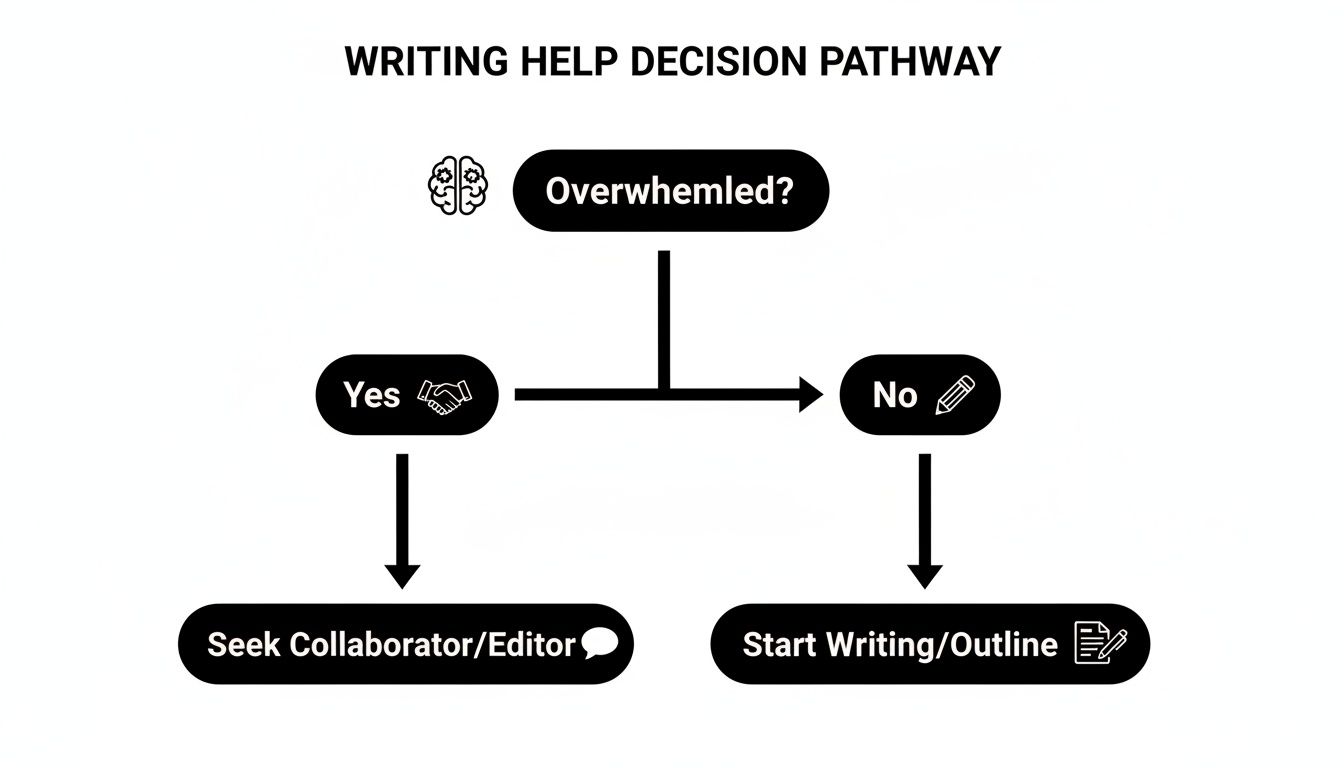
As the chart shows, if the thought of the project feels overwhelming, collaboration is a great choice. But if you’re feeling confident and ready, you might be all set to start writing on your own.
What To Look For Beyond The Writing Sample
When you start looking, you’ll see plenty of portfolios and writing samples. Those are important, of course, but they only tell you half the story. A writer can be technically perfect but still be a terrible fit for you.
What you're really looking for is a connection. This person is going to spend hours listening to your most personal memories, so you need to feel safe, respected, and genuinely heard.
Here are a few things to keep an eye out for:
- A portfolio with variety: Do they only write in one style, or can they adapt their voice to match different people? Look for examples that feel authentic and personal, not like a corporate report.
- Clear communication: How do they respond to your first email or call? Are they prompt, friendly, and clear? This first interaction is a huge clue about what it will be like to work with them.
- Genuine curiosity: A great ghostwriter is a great listener. During your initial chat, they should be asking thoughtful questions about you and your story, not just talking about themselves.
The Must-Ask Questions For Your First Chat
Once you’ve narrowed it down to a few potential partners, it’s time for a conversation. This isn't a formal job interview; it's a "get to know you" chat to see if your personalities click.
Don't be afraid to ask questions that go beyond their resume. The answers will tell you everything you need to know about their approach and their heart.
My absolute favorite question to ask is: "Tell me about a time a client’s story truly moved you." A passionate writer’s face will light up when they answer this. You’ll hear the empathy in their voice, and that’s the magic ingredient you’re looking for.
Here are a few other great questions to have in your back pocket:
- How do you make sure the book sounds like me, not you? (Listen for words like "interviews," "listening," "capturing your voice," and "collaboration.")
- What’s your process for handling sensitive or difficult memories? (You want to hear a response that is full of compassion, patience, and respect for your privacy.)
- How do you handle feedback if I want to change something? (The right answer should be enthusiastic! It’s your book, after all, and they should be eager to get it just right for you.)
Spotting Red Flags From A Mile Away
Just as important as knowing what to look for is knowing what to avoid. Your gut feeling is your best guide here. If something feels off, it probably is.
Be wary of anyone who:
- Makes big promises too quickly: If they guarantee a bestseller or a six figure book deal before they’ve even heard your story, they are likely more of a salesperson than a writer.
- Doesn’t ask you any questions: A writer who talks endlessly about their own accomplishments isn't interested in your story; they're interested in their ego.
- Has a confusing or unclear contract: The agreement should be simple, straightforward, and clearly outline the scope of work, the timeline, and the payment schedule. No surprises.
Finding the perfect partner takes a little time, but it is so worth the effort. For an even deeper dive, check out our complete guide on how to find a ghostwriter for more practical tips. At Opus Eternal, we've found that this isn't just about hiring help; it's about choosing an ally who will honor your legacy and help you create a timeless gift for your family.
Your Finished Book: A Legacy That Lasts Forever
Picture this. You're settled into your favorite armchair on a quiet afternoon. You reach for a book on the end table. The cover is beautiful, and there, in elegant script, is your name. You can feel the satisfying weight of it in your hands, the smooth pages filled with your life, your laughter, your hard won lessons.

This isn't just any book. It's a time machine. It’s a warm hug for your great grandchild, who will one day read it and feel like they’ve spent an afternoon with you. This is so much more than a personal accomplishment; it’s a tangible piece of your soul that will be passed down, a permanent record of a life well lived.
Every Story Matters, Especially Yours
We’ve walked through the whole process, from jogging old memories to structuring chapters and finding the right help. But if there’s one thing I want you to take away from all of this, it’s that your story is absolutely worthy of being told.
It doesn’t matter if you never climbed Mount Everest or ran a Fortune 500 company. Your life is packed with its own unique brand of heroism.
- The quiet courage it took to raise a family.
- The resilience you found when life threw you a curveball.
- The simple, everyday moments of joy that grew into cherished family traditions.
These are the stories that truly resonate. They’re the universal truths that connect us all. Please, never let that little voice that whispers, "My life wasn't interesting enough," win. That voice is a terrible editor.
The Final Chapter Is Just The Beginning
Finishing a book is a monumental achievement. It’s a testament to your commitment, to honoring your own life and creating something beautiful for the people you love. Whether you typed every word yourself or had the wisdom to team up with a professional ghostwriter, you did it. You took all those wonderful, scattered memories and gave them a permanent home.
This book will become a cornerstone of your family's history. It’s the answer to a future generation's questions. It’s the context behind old photographs. It’s your voice, echoing with love and wisdom, long after you’re gone.
As your book becomes a cherished family record, you might also find yourself thinking about other ways to create a lasting tribute. Many people, for instance, find comfort and guidance in learning how to craft a heartfelt eulogy, ensuring spoken words can honor a life with the same grace as written ones. Both are truly acts of profound love.
The most important thing now is to simply start. Don't wait for the "perfect" time, it will never show up. The perfect time is right now, while your stories are bright and your desire to share them is strong. Your story isn't just a collection of memories; it's a legacy waiting to be written.
It's time to create your timeless gift.
Thinking about getting help with your memoir?
Tell us where you are and we will shortlist memoir specialists who work at your budget — plus an honest read on whether you need a writer or just an editor.
Read next
What will your book cost?
Set the type, length and timeline. Get a real 2026 range in 30 seconds.
Open the calculator