
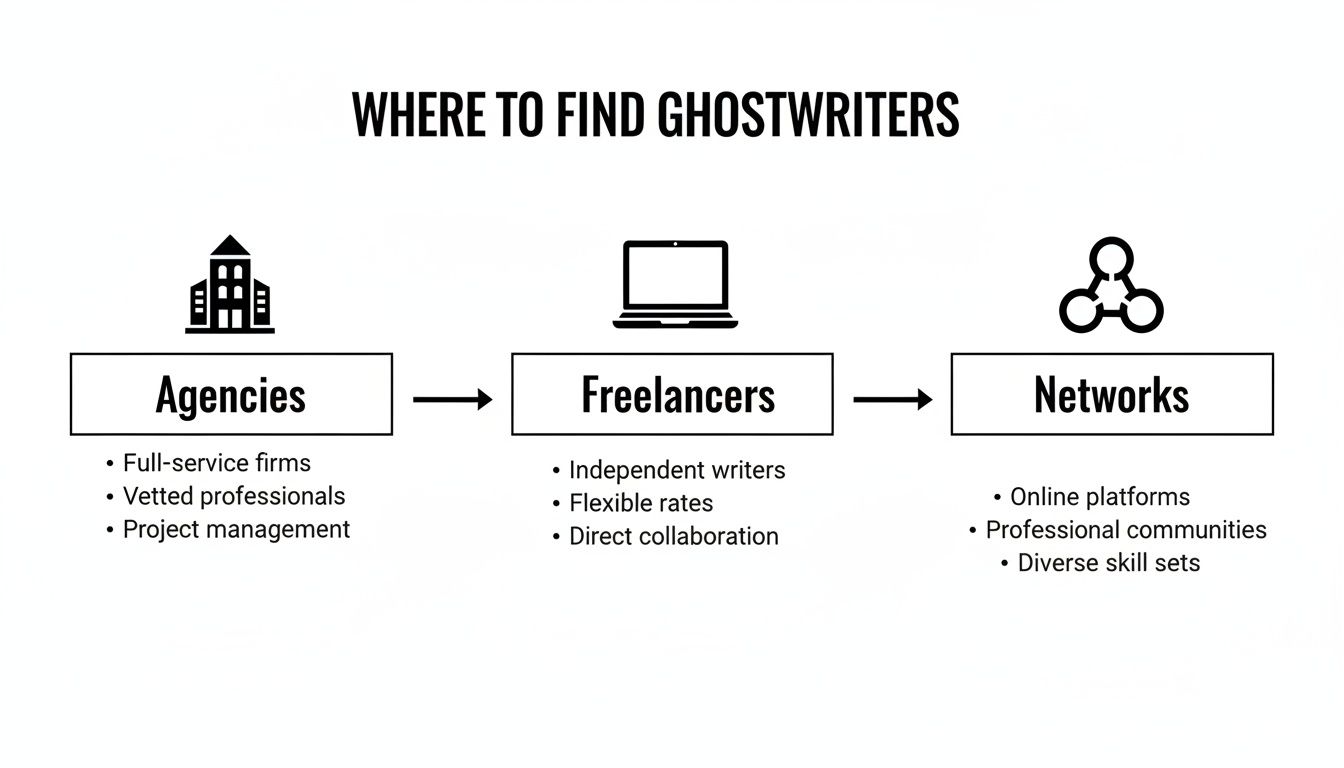
So, where do you even start looking for a ghostwriter? It's a bit like trying to find the best coffee shop in a new city. You could wander aimlessly, or you could ask the locals. Most people kick things off by searching freelance platforms, reaching out to specialized agencies, or simply asking their professional network for a good referral. The goal isn't just to find a writer, but to find the one with a killer portfolio in your niche, a clear process, and a writing style that feels like coming home.
Your Book Idea Deserves to Be More Than a Dream
That idea for a book you've been sitting on? Let's be honest. It’s not just an idea. It’s a legacy, a super-powered business card, a story that the world genuinely needs to hear. But if you’re like most people I talk to, it’s probably gathering digital dust in an old Word doc or scattered across a dozen sticky notes plastered to your monitor like modern art.
Feeling stuck is completely normal. I've seen it a thousand times. Every successful entrepreneur, expert, and thought leader has faced that intimidating blank page, wondering if they really have what it takes. That blinking cursor can feel like it's mocking you, and the sheer size of the project is often just plain paralyzing. Believe me, I get it. It's a lonely feeling.
The good news? You don't have to go it alone. And you shouldn't have to.

Permission to Create Without the Struggle
Consider this your official permission slip to stop struggling and finally start creating. I want to show you how bringing on a professional ghostwriter isn't about giving up; it's about gearing up. It’s a strategic move to partner with a skilled collaborator who can transform your vision into a real, physical book you can hold in your hands. A book that will outlive us all.
Think of it this way: you're the architect with the brilliant blueprint for a dream home. Would you be expected to pour the concrete and frame the walls all by yourself? Of course not. Your role is the visionary. The ghostwriter is the expert builder who brings the structure to life, word by word, making sure every room is exactly where you pictured it.
The greatest honor you can give your story is to ensure it gets told, and told well. A ghostwriter is simply the most effective partner to help you do just that.
Working with a ghostwriter makes the whole thing manageable and, honestly, a lot more fun. It frees you from the solitary grind of writing and turns the book into an exciting, collaborative adventure. You get to focus on what you do best, the big ideas, the core message, and the personal stories, while they handle the heavy lifting of drafting, structuring, and polishing.
This isn't about someone else telling your story for you. It’s about finding a professional who can help you tell it with the impact and clarity it deserves. It is still 100% your book, your voice, and your legacy. They’re just the "ghost" in the machine, the secret weapon that helps you get from a jumble of brilliant ideas to a beautifully finished manuscript.
Not sure whether you need a ghostwriter or an editor?
If you already have 30,000+ words drafted, an editor at $3,000–$12,000 will serve you better than a ghostwriter at $40,000. The quiz sorts this out in five questions — honestly, even when the answer is the smaller job.
Where to Find Your Perfect Writing Partner
So, where do these talented wordsmiths actually hang out? It’s not a big secret, but you do need to know where to look. Finding the right person is all about knowing the best hunting grounds, so you don't end up with a writer who makes your book sound like a car manual.
Think of it like dating. You wouldn’t look for a serious partner at a chaotic party where you can't even hear yourself think, right? The same logic applies here. You need to search for your ghostwriter in places where the professionals gather. This hunt is the first, crucial step toward turning your brilliant ideas into a book people can actually hold.
Ghostwriting Agencies: The Curated Experience
If you want a vetted, managed, and predictable process, a ghostwriting agency is probably your best bet. These companies are the matchmakers of the literary world. They’ve already done the heavy lifting of finding and screening top-tier talent, so you’re picking from a pre-approved roster of pros. It's like having a personal shopper for your book.
An agency essentially acts as your project manager. They handle the contracts, the payments, and make sure everything stays on track. It's a fantastic option if you're busy and value having that extra layer of security and oversight. No chasing down freelancers, just pure, creative progress.
What to look for:
- Detailed Case Studies: Do they showcase books they've worked on that feel similar to yours in tone or topic?
- A Clear Process: They should be able to walk you through their entire system, from the first call to the final manuscript delivery. No "winging it."
- Transparent Communication: You should know exactly who your point of contact is and how you'll collaborate with your writer.
This route is perfect for entrepreneurs, executives, or anyone who just wants a structured, hands-off experience. For a deeper dive, you might find our guide on the best ghostwriting services helpful.
Freelance Marketplaces: The Grand Bazaar
Platforms like Upwork or Guru are the grand bazaars of the freelance world. You can find writers at every price point and experience level imaginable, which is both a blessing and a curse. It definitely requires more legwork on your part to sift through proposals and vet candidates, but you can also uncover some incredible hidden gems. It’s a bit of a treasure hunt.
The key to success here is to be incredibly specific in your job posting. Don't just write, "Looking for a writer." Instead, describe your book idea, the kind of collaborator you're looking for, and the voice you're trying to capture. Use the platform’s built-in filters to find candidates with "Top Rated" status or a high "Job Success Score." These are usually solid indicators of reliability.
Professional Networks and Direct Outreach
Sometimes the best connections come from good old-fashioned networking. This is where you put on your detective hat and do a little digging. You'd be surprised who you can find with a little bit of clever searching.
- LinkedIn: Search for "ghostwriter," "book ghostwriter," or "memoir writer." Check out their profiles, read their articles, and see who they've worked with. A polished, professional profile is a great sign.
- Writer Associations: Organizations like the Association of Ghostwriters are full of established professionals who take their craft seriously. These are often the folks working on major bestsellers behind the scenes.
- Referrals: Just ask your network! A recommendation from a trusted colleague who has already published a book is often the most reliable way to find someone great. It's like getting a restaurant recommendation from a foodie friend. You just trust it.
The demand for skilled writers is exploding. The global ghostwriting services market is projected to hit $4,276.85 million in revenue by 2025. This surge is largely driven by leaders in North America who want to turn their expertise into legacy-building books. You can read more about this growing market trend and see why finding a great writer now is a smart move.
Choosing where to look is about aligning the search with your own personality. Do you want a curated, guided experience, or are you ready to roll up your sleeves and dig for gold yourself?
No matter which path you take, remember this: your story is worth the effort. Finding the right partner to help you tell it is an investment in your legacy. The perfect writer is out there, ready to help you turn that blinking cursor into a finished masterpiece.
How to Vet Ghostwriters Like a Pro
Alright, you’ve waded through the proposals and have a shortlist of promising candidates. Now for the most critical part. It’s time to put on your detective hat, because vetting a ghostwriter is less about what they say and more about what their work shows.
Choosing a writer based on a slick proposal alone is like buying a house from the online photos. It might look great on the surface, but you need to see what’s really there before you commit. This isn't about hoping for the best; it's about making a smart, informed choice so you don't end up with a literary lemon.
Beyond the Portfolio Glance
Anyone can cherry-pick their three best articles for a portfolio. Your job is to dig deeper. Don’t just skim the samples; analyze them.
What you're looking for is versatility. If every single sample has the exact same tone and sentence structure, you might have found a one-trick pony. That’s fine if their one trick is exactly what you need, but what if it’s not?
A truly skilled ghostwriter is a chameleon. Their portfolio should show an ability to adapt to different voices and styles. One piece might be a warm, conversational memoir, while another is a sharp, authoritative business book. That’s the sign of a pro who genuinely listens and channels their client, rather than just writing in their own default voice. You should walk away thinking, “Wow, they can really capture different personalities,” not, “Well, they sure have a consistent style.”
Understanding the principles behind mastering professional writing standards can give you a better lens through which to evaluate their work.
The Art of Reading Testimonials
Testimonials are great, but they can also be pure fluff. Your goal here is to read between the lines. Vague praise like, "They were great to work with!" is nice, but it tells you almost nothing useful.
Instead, look for specifics. What are past clients really saying?
- "She was brilliant at organizing my chaotic notes into a clear outline." (This tells you they’re a great structural thinker.)
- "He made the interview process feel like a comfortable conversation with an old friend." (This signals strong interpersonal and listening skills.)
- "The revision rounds were so smooth, and they incorporated my feedback perfectly." (This shows they are collaborative and not precious about their writing.)
These little details paint a much clearer picture of their process and actual strengths. If a writer seems promising, don’t hesitate to ask if you can speak with one of their past clients. A confident professional will have zero issues with this request.
The best ghostwriters don’t just deliver a manuscript. They deliver an experience that makes you feel heard, understood, and brilliantly represented on the page.
And if you're looking for writers who already come with a proven track record, our list of vetted professional book writers for hire is a fantastic place to start your search.
Ghostwriter Vetting Quick Reference Guide
To make your detective work a bit easier, here’s a quick-glance guide to help you sort the pros from the potential problems. Use this table to quickly spot the differences between a professional ghostwriter and a potential headache.
| Attribute | Green Flag (Look For This) | Red Flag (Avoid This) |
|---|---|---|
| Portfolio | Samples showcase a variety of voices and styles, demonstrating adaptability. | All writing samples sound identical, suggesting a limited range. |
| Process | They have a clear, documented process for interviews, outlines, and revisions. | Their process is vague or they say, "We'll just figure it out as we go." |
| Contract | Provides a detailed contract that covers ownership, confidentiality, and scope. | Hesitates to use a contract or offers a very basic, one-page agreement. |
| Questions | They ask you lots of thoughtful questions about your vision, audience, and goals. | They barely ask any questions and are more focused on getting the deposit. |
| Communication | They are responsive, professional, and clear in their communications. | Communication is slow, sloppy, or feels unprofessional from the start. |
This chart is your cheat sheet. Keep these points in mind as you evaluate candidates from various sources.
Whether you’re talking to a high-end agency or an independent freelancer you found on a marketplace, these vetting principles hold true. Your book is a piece of your soul, a permanent legacy. Taking the time to properly vet the person you entrust it to is the most important move you'll make.
Asking the Right Questions in the Interview
Alright, you’ve done the detective work, checked their past projects, and now you’re sitting down (probably on a video call) with your top candidate. This conversation is where the magic happens… or where it fizzles out.
The interview is so much more than a simple skills test. It’s all about the chemistry.
This is your chance to find out if this person truly gets you and your vision. It's easy to ask, "Have you written a business book before?" but that's just scratching the surface. You're not just hiring a typist. You are inviting a collaborator into your world, into your story, and trusting them with your legacy.
This is a partnership, and that requires a real connection. Let's make sure you ask the questions that reveal if you've found your perfect match.
Uncovering Their Process and Style
Every great writer has a system. Your goal here is to understand that system and see if it aligns with how you want to work.
Vague answers are a huge red flag. A pro will be able to walk you through their process with the confidence of someone who has done this a hundred times before.
Here are a few questions designed to peek behind the curtain:
- "Can you walk me through your process for capturing a client's voice?" This is the million-dollar question. A great answer will involve things like listening to recordings of you speaking, reading your emails or past articles, and conducting deep, conversational interviews.
- "What does the revision process look like from your perspective?" You want to hear words like "collaborative" and "feedback-driven." Their job isn't to defend their words but to refine them until they perfectly match your vision.
- "How do you handle it when a client gives you feedback you don't necessarily agree with?" This reveals their ego level. A true professional will explain that it's your book and their role is to advise, but ultimately, the final say is always yours.
Their answers should make you feel secure, not intimidated. You want to walk away feeling like you'll be in safe, experienced hands.
A ghostwriter interview is less about finding someone who can write and more about finding someone who can listen. Their ability to understand you is more important than their ability to craft a perfect sentence on the first try.
Gauging the Creative Chemistry
Beyond the practical stuff, you need to know if you'll actually enjoy working with this person for the next several months. Your book project should feel exciting and inspiring, not like a chore.
Don't be afraid to ask questions that reveal a bit of their personality.
A few clever questions to test the vibe:
- "What was the most challenging project you ever worked on, and what made it so tough?"
- "If you could give one piece of advice to every aspiring author, what would it be?"
- "What kinds of books do you actually enjoy reading for fun?"
These questions don't have a "right" answer. What you're listening for is passion, thoughtfulness, and a personality that clicks with your own.
I once had a client ask me what my favorite 'bad' movie was. We spent five minutes laughing about cheesy '80s action flicks, and in that moment, we both knew it was a perfect fit.
Remember, this is a deeply personal journey. You’ll be sharing stories, ideas, and vulnerabilities. Finding someone you trust and genuinely like isn’t just a bonus; it’s essential for creating a book that feels authentically, wonderfully you.
Trust your gut. If the conversation flows and feels easy, you’re on the right track.
Understanding Ghostwriter Pricing and Contracts
Let's talk about the elephant in the room: money.
It can feel awkward, almost like asking a stranger how much their awesome shoes cost. But when it comes to creating something as permanent and important as your book, clarity is kindness. Getting the financial side sorted isn't just a smart move; it’s the bedrock of a smooth, successful partnership.
Think of this conversation not as a tense negotiation, but as an alignment. You're making sure you and your future writing partner are on the same page, with the exact same expectations. This is where you build the foundation of trust for your entire project.

What Are You Really Paying For?
When you see a ghostwriter's price tag, you’re not just paying for words on a page. That’s like saying when you buy a car, you’re only paying for the metal. What you're really investing in is an entire creative and strategic process, handled by a professional.
You’re paying for the dozens of hours they’ll spend interviewing you, absorbing your stories, and learning to think and speak in your unique voice. You’re also paying for the painstaking research, the meticulous outlining, the structural architecture of the book, and the endless cups of coffee that fuel the first, second, and third drafts.
It’s a truly all-inclusive service. When you hire a professional, you’re getting a project manager, a storyteller, an editor, and a creative confidant all rolled into one. It’s an investment in getting your legacy right.
The Spectrum of Ghostwriting Fees
So, what does that investment actually look like? Ghostwriting fees aren't one-size-fits-all. They vary wildly based on the writer's experience, the complexity of your book, and the amount of research involved.
You'll find writers who charge a few thousand dollars, and you'll find elite storytellers who command six-figure fees. Generally, though, the pricing landscape has settled into a few distinct tiers. Most experienced professionals now cluster around the $50,000 mark for a full-length book, with a common range falling between $30,000 and $95,000. This reflects a broader shift in the industry toward specialized, high-value services.
Remember, you often get what you pay for. A suspiciously low price can be a major red flag for inexperience or, even worse, a "ghost" who might just disappear on you. Your story is priceless; find a partner whose fee reflects the professional quality you deserve.
The Contract Your Book Can’t Live Without
If the interview is the handshake, the contract is the unbreakable vow. It’s the single most important document in your collaboration, protecting both you and your writer. It’s not about mistrust; it's about creating crystal-clear expectations so you can both focus on the fun part: making your book.
A true professional will always insist on a detailed contract. Never, ever work with someone who is hesitant to put everything down in writing.
Here are the absolute non-negotiables your contract must include:
- Total Ownership of Rights: This is the big one. The contract must state, in no uncertain terms, that 100% of the rights, copyright, and royalties belong to you. Your name goes on the cover, and the writer is compensated only for their fee.
- A Rock-Solid Confidentiality Clause: You’ll be sharing personal stories and potentially proprietary business information. A non-disclosure agreement (NDA) or a strong confidentiality clause is mandatory to ensure your ideas and stories remain yours and yours alone.
- A Detailed Scope of Work: What exactly are they delivering? The contract should specify the estimated word count, the number of revision rounds, and what’s included (like outlining and research) versus what’s not (like finding a publisher or handling marketing).
- Clear Payment Schedule: Payments are typically tied to milestones. For example, you might pay an initial deposit, another portion upon approval of the outline, another after the first half of the manuscript is delivered, and the final payment upon completion.
Beyond just understanding these terms, knowing how to draft a contract that protects your business is a crucial skill when formalizing your agreement.
For a great starting point, we have a comprehensive guide you might find useful. Check out our deep dive into what goes into a solid ghostwriter contract template.
Walking into the financial conversation with this knowledge gives you confidence. You'll be ready to secure a fair deal and embark on this incredible journey, knowing your masterpiece is in safe, professional hands.
Got Questions About Ghostwriting? Let's Talk.
It’s a great sign that you have questions. It means you’re taking this seriously, and you should be. This isn't just another project; you're creating a book, and that’s a beautiful, messy, wonderful journey. You're preparing to share a piece of yourself, and you deserve to feel completely confident about how it all works.
Let’s tackle some of the common questions that might be bouncing around in your head. The goal here is to swap any uncertainty for clarity, so you can get back to being excited about this adventure.
How Much of My Time Will This Actually Take?
This is easily the most common question I get, and it cuts right to the chase. The short answer? You’re the visionary, not the one doing the grunt work. Your heaviest time commitment is right at the start.
You can expect to spend several hours in deep-dive interviews and conversations. This is where your writer gets to soak up your stories, understand your unique perspective, and learn the rhythm of your voice. Think of it as a friendly, structured brain dump.
After that initial discovery phase, your main role is to provide feedback. You'll review outlines and read chapters as they come in. But the whole point of hiring a professional is that they do the heavy lifting. Your job is to hold the vision and be the final authority on what makes it to the page. A great ghostwriter makes it feel inspiring, not like you've taken on a second job.
Will It Really Sound Like Me?
One hundred percent. Yes. If a ghostwriter can't deliver on this, walk away.
A truly skilled ghostwriter is a vocal chameleon. Their job isn’t to inject their own style; it’s to channel yours. They’ll study how you talk, read things you’ve written, and listen intently to capture your cadence, your go-to phrases, and your unique way of looking at things. They don't just write your story; they write it in your key.
The revision process is your ultimate safety net. You’ll have multiple opportunities to read drafts and say, "You know, this part doesn't quite feel like me." The finished book should sound so authentically you that you’ll forget someone else typed the words.
What If We Just Don’t Click?
This is a totally valid fear. You’re about to get creatively vulnerable with a near-stranger, so the chemistry really matters. This is exactly why a professional contract is so crucial.
Any solid ghostwriting agreement will include a termination clause, often called a "kill fee." This clause is designed to protect both of you. It typically allows either party to part ways after an initial milestone, like the outline or the first chapter. You’d pay for the work completed, keep the rights to it, and be free to find someone who’s a better fit.
Honestly, though, if you do your homework up front with proper vetting and good interview questions, the odds of a mismatch are pretty slim. Always, always trust your gut during those initial calls.
Is Using a Ghostwriter Cheating?
Not in a million years. Let’s put this myth to rest for good. And frankly, this question always makes me a little sad, because it stops so many great stories from ever being told.
Think about it like this: when a brilliant CEO decides to build a new headquarters, do they mix the concrete and hang the drywall themselves? Of course not. They hire expert architects and builders to execute their vision.
You are the architect of your book. The ideas, the wisdom, and the stories are all yours. The ghostwriter is the master builder who brings your blueprint to life with skill and craft. It’s a smart, strategic move that ensures your story gets told the way it deserves to be. Far from a shortcut, it’s a way to truly honor your message.
At My Book Written, we believe your story deserves to be told with clarity and passion. If you're ready to move from idea to manuscript, explore our resources at https://mybookwritten.com and let's build your legacy together.
Ready to talk to an actual writer?
Five questions and we come back with two or three ghostwriters who fit your book, your budget and your timeline. Free, and no writer gets your details until you say so.
Read next
What will your book cost?
Set the type, length and timeline. Get a real 2026 range in 30 seconds.
Open the calculator