
A book ghostwriter is a professional writer you hire to turn your ideas, stories, and expertise into a polished book. They do the heavy lifting of writing, but it's your voice and your name on the cover. Think of them as your silent, word-slinging partner in storytelling.
What Is a Book Ghostwriter Anyway?
Let's be real for a moment. You have a book in you. Maybe it’s your incredible life story, a collection of hard won business lessons, or a family history you feel compelled to preserve for your grandkids. The idea is there, solid and meaningful. But the actual process of writing it? That can feel like trying to build a house from scratch with no blueprint and a pile of mismatched LEGOs. It’s completely overwhelming.
This is exactly where a book ghostwriter comes in. Forget the spooky name, they aren't some mysterious spirit haunting your keyboard. A better way to think of them is as a master architect for your ideas. You have the vision for the home, the memories that will fill each room, and the purpose for its foundation. The ghostwriter brings the blueprint, the tools, and the construction know how to build it, brick by brick, exactly to your specifications.
Your Story, Your Voice
The biggest myth about ghostwriting is that it's somehow "cheating." Let's just put that idea to bed. It couldn't be further from the truth. A great ghostwriter doesn't inject their own opinions or stories; their entire job is to become a channel for yours. They are expert listeners and mimics, skilled at absorbing your unique speaking style, your sense of humor, and your passion, then translating it seamlessly onto the page.
You're not just hiring someone to type. You’re partnering with a professional storyteller who knows how to:
- Organize scattered thoughts into a compelling narrative.
- Conduct insightful interviews to draw out your best stories and ideas.
- Structure chapters that flow logically and keep readers hooked.
- Handle the soul crushing work of drafting, editing, and polishing.
This kind of partnership is way more common than you might think. The global ghostwriting services market was valued at $3.3 billion in 2024 and is projected to climb to $6.2 billion by 2032. This boom is happening because leaders, experts, and everyday people are realizing they need a professional to bring their books to life without putting their own careers on hold. It's not about being unable to do it yourself, it’s about choosing a smarter, easier, and more enjoyable path.
Ultimately, hiring a ghostwriter is a decision to honor your story. It’s a smart move to give your ideas the professional craftsmanship they deserve. For a deeper dive into their role, you can explore what a ghostwriter does and how they work. It’s still your vision, your wisdom, and your book, just with a lot less hair pulling along the way.
The Ghostwriting Journey from Idea to Manuscript
So, how does the magic happen? How do all those brilliant, swirling ideas in your head become a real, tangible book you can hold in your hands? It’s less abracadabra and more of a thoughtful, structured partnership.
Think of it like building a custom piece of furniture. You have the vision, the style, the wood, the purpose, and your ghostwriter has the tools, the skills, and the blueprint to bring it to life. It's a true collaboration, and honestly, it's a ton of fun.
Let's walk through the entire journey, step by step, so you know exactly what to expect. This whole process is built on trust and a shared goal: getting your story and your voice exactly right.
Here's a bird's eye view of how your vision becomes a reality.
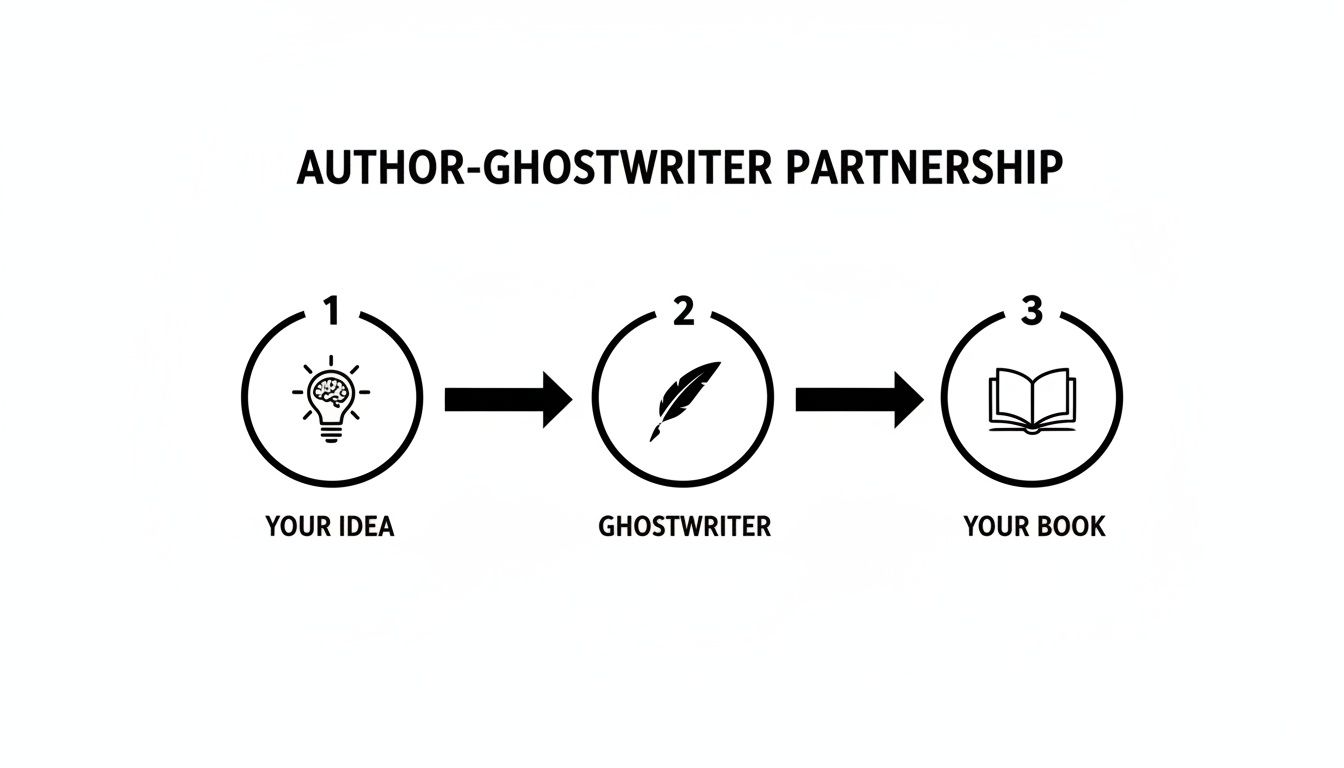
This visual shows the simple, direct path from your core idea, through the ghostwriter's craft, all the way to the finished book.
The Initial Mind Meld
Every great ghostwriting project kicks off with what I like to call the “mind meld.” This is where you and your writer connect, usually over several long conversations. It’s not just about sharing your idea; it's about sharing you.
The writer’s job is to completely absorb your personality, your unique way of speaking, your sense of humor, and your distinct perspective. They essentially become a student of your voice.
For instance, imagine a retiring CEO who wants to write a book about her company's wild ride from a garage startup to an industry giant. Her first few meetings with a ghostwriter won't be about chapter one. They'll be about her early fears, her proudest wins, and that hilarious story about the time the office coffee machine nearly caused an international incident. It's all about capturing the human element first.
Gathering the Raw Materials
Once your writer has a feel for your voice, it's time to gather the raw materials for your book. This is where the real work begins.
For a memoir or a business book, this phase almost always involves a series of recorded interviews. You’ll talk for hours, sharing your stories while the writer listens, asks insightful questions, and gently guides the conversation. These recordings become the very soul of the book.
When working on non fiction and memoirs, knowing how to efficiently transcribe interviews is a game changer. It turns hours of spoken conversation into searchable text, making it much easier for the writer to find that perfect quote or pinpoint a specific anecdote. This is one of those professional tricks that saves everyone a headache.
The interview phase isn’t an interrogation; it's a series of heartfelt conversations. A great book ghostwriter creates a space where you feel comfortable sharing the memories and insights that truly matter, ensuring the book is deeply and authentically yours.
Creating the Blueprint
With all the interviews and source materials collected, your writer switches hats and becomes an architect. They'll sift through everything, every story, every fact, every tangent, and create a detailed book outline. Think of this as the structural blueprint for your entire manuscript.
This blueprint will clearly map out:
- The core theme and central message of your book.
- The chapter by chapter flow of the story.
- The key stories, examples, and data points that will live in each section.
You and the writer will review this blueprint together, tweaking and adjusting it until it feels just right. Getting the outline approved is a massive milestone. It guarantees you're both perfectly aligned on the book's direction before a single chapter is written, saving countless hours and preventing any "wait, that's not what I meant" moments down the line. It's like agreeing on the house plans before the first nail is hammered.
From Drafts to Done
Now for the really exciting part. Your ghostwriter takes that approved blueprint and starts writing. They'll typically deliver the book in chunks, maybe 1 to 3 chapters at a time. This is your cue to jump in with feedback.
Your job here is to read and react. Does this sound like you? Is the tone spot on? Did they miss any important details? This back and forth revision process is a collaborative dance, and your feedback is the music that guides the writer's steps toward perfection.
Finally, after all the chapters are written, revised, and polished, you get the complete manuscript. It's a surreal and wonderful moment. The idea that once lived only in your head is now a finished book, ready to be shared with the world. It’s your legacy, brought to life. And you didn't have to agonize over every single comma.
Understanding Book Ghostwriter Costs and Fees
Alright, let's pull back the curtain and talk about the big question: money. You're thinking about creating something that will last forever, a physical piece of your legacy. That feels priceless, but hiring a professional to help you build it definitely has a price tag. And that’s okay.
Hiring a book ghostwriter is a serious investment, not just in a product, but in yourself and your story. Trying to figure out what it should cost can feel like navigating a maze in the dark. So, let’s flip on the lights and make this crystal clear.
Common Pricing Models for Ghostwriters
You'll quickly find that ghostwriters structure their fees in a few different ways. There’s no single “right” way, but understanding the options helps you find a partner whose process feels fair and comfortable for you.
- Flat Project Fee: This is the most common and, frankly, the most straightforward model. The writer quotes you a single, all inclusive price for the entire project, from the first interview to the final manuscript. It’s clean, predictable, and you won’t have any surprise invoices down the road. Peace of mind is priceless.
- Per Word Rate: Some writers charge by the word. This can seem appealing because the math is simple, but it can also get tricky. A 60,000 word book at $1.00 per word is $60,000, but what happens if the story naturally needs to be 65,000 words? The final cost becomes a moving target.
- Per Page Rate: This is similar to a per word rate and has the same potential for fluctuating costs. A standard manuscript page is 250 words, but you'll find this model is much less common for full length books.
For the peace of mind it offers both the author and the writer, a flat project fee is usually the best route. It encourages a true partnership focused on creating the best possible book, not just hitting an arbitrary word count.
So, What's the Actual Price Tag?
Okay, let's get down to the numbers. The cost of a book ghostwriter can vary wildly based on a few key factors: the writer’s experience, the complexity of your topic, the amount of research needed, and the length of the book.
Think of it like hiring a contractor to build a deck. A simple, square platform is one price. A multi level masterpiece with built in lighting and a custom fire pit is another. Both are decks, but the skill, time, and effort required are completely different.
Similarly, a straightforward family memoir based on a handful of interviews is going to cost less than a dense business book that requires digging through decades of company archives and interviewing a dozen executives.
A cheap quote is often the most expensive mistake you can make. If a price seems too good to be true, it almost always is. It might mean you’re working with someone inexperienced, which could lead to a weak manuscript, missed deadlines, and a whole lot of heartache. It’s just not worth the savings.
Recent industry data provides a helpful benchmark. By 2025, ghostwriting fees can span from a few thousand dollars to over $500,000 for celebrity projects. However, for a standard length book, most experienced professionals cluster around the $50,000 mark, with a common range of $30,000–$95,000. If you want to dive deeper into the numbers, you can explore the full ghostwriting industry report.
That might sound like a lot, but remember what you’re investing in. It's not just words on a page. You're paying for a skilled professional's time over 6 to 12 months to interview you, capture your unique voice, structure your narrative, and craft a polished book that truly honors your story. It's an investment in getting it right the first time, and having a great time doing it.
How to Find the Right Ghostwriter for Your Book

Alright, let's get into the most critical part of this whole journey. Finding the right book ghostwriter isn’t like hiring someone to fix a leaky faucet. It’s deeply personal. In fact, think of it like dating, you’re searching for a creative partner who not only has the skills but who truly gets you and your vision.
You're about to hand over your most valuable stories, your hard earned expertise, and your unique voice to someone. This is the person who will help shape your legacy. No pressure, right? Don't sweat it. Finding this person doesn't have to be a nightmare. Let's reframe it as an exciting treasure hunt.
Where the Good Writers Hide
First thing's first: where do you even begin your search? The best professional ghostwriters aren't lurking on gig sites offering to write your book for the price of a fancy steak dinner. Top tier talent tends to gather in specific, professional circles. You've got to know where to look.
Here are a few trusted places to kick off your search:
- Professional Associations: Organizations like the Association of Ghostwriters are a fantastic starting point. These are communities of vetted professionals who take their craft seriously.
- Reputable Agencies: Think of ghostwriting agencies as matchmakers. They maintain a roster of skilled writers and can connect you with someone who has direct experience in your genre, whether it's a high level business book or a heartfelt family memoir.
- Referrals: This is the gold standard, hands down. Ask trusted colleagues, your business coach, or friends in your network if they can recommend a great writer. A personal referral is often the most reliable way to find a real gem.
It's just common sense, really. You wouldn't ask a total stranger for life changing advice; you'd turn to a friend or a trusted mentor. Apply that same logic here.
Vetting Potential Partners
Once you've got a shortlist of candidates, it's time to do a little homework. Put on your detective hat and dive into their portfolios. A writer’s past work is their real world resume, their creative footprint.
As you look through their samples, don't just scan for good grammar. Look for voice. Does each book sample feel distinct, reflecting a different author's personality? A great ghostwriter is a chameleon. Their portfolio shouldn’t sound like one person wrote everything; it should sound like ten different experts did.
Pay special attention to projects that feel similar to yours. If you're writing a raw, personal memoir about overcoming adversity, a writer whose portfolio is packed with dry technical manuals on corporate finance probably isn't the right fit, no matter how skilled they are. You need someone with the right emotional toolkit for your story.
A writer's portfolio is your window into their creative soul. You're not just looking for a good writer; you're looking for your writer. You'll know it when you see it. The voice will just feel right.
The All Important Interview
This is it, the first date. The interview is less about grilling a candidate and more about feeling out whether there’s a genuine connection. This is your chance to move beyond the portfolio and see if they have the qualities that truly matter: a collaborative spirit and incredible listening skills.
Ditch the generic questions like, "How many books have you written?" Instead, ask questions that reveal their process and personality. Here are a few to get you started:
- "How would you describe your process for capturing my voice?" Their answer reveals everything about how they view this partnership. Listen for keywords like "collaboration," "interviews," and "listening."
- "Tell me about a time a project went off the rails. How did you get it back on track?" This uncovers their problem solving skills and professionalism when things inevitably get complicated.
- "What parts of my story are you most excited to write about?" A passionate writer is an engaged writer. If their eyes light up when talking about your project, that's a fantastic sign.
- "How do you handle feedback and revisions?" You want a partner, not a prima donna. Their response should show they welcome your input and see revisions as a crucial part of the process, not a personal attack.
The goal here is to find someone you genuinely click with. Remember, you're going to be spending a lot of time with this person over the next 6 to 12 months. Finding someone you actually like talking to is a huge part of what makes this journey enjoyable.
Finally, trust your gut. If a writer seems more interested in their own ideas than in yours, or if they’re dismissive of your questions, walk away. These are major red flags. Your story deserves a partner who will be its passionate steward, not a reluctant employee. Choosing the right book ghostwriter makes all the difference between a frustrating chore and one of the most rewarding experiences of your life.
Contracts, Credit, and Keeping Your Story Safe

You did it. You found "the one." After all that searching and interviewing, you’ve landed on the perfect ghostwriter, someone who gets you, is passionate about your story, and who you genuinely enjoy talking to.
It feels like the hard part is over, right? But before the real fun begins, there’s one more crucial step: making it official.
Let’s talk about the contract. I know, I know, the word itself is enough to make anyone’s eyes glaze over. It sounds so formal, so corporate, and so… uncreative. But I promise you, a good contract isn’t a creativity killer. It’s the exact opposite.
A solid agreement is the foundation that lets your creative partnership flourish without any wobbles or misunderstandings down the line. It's what allows both of you to focus on the book, not the “what ifs.”
Your Contract is Your Creative Shield
Think of the ghostwriting agreement as the friendly rules of the road for your journey together. It’s a document that protects both of you by making sure everyone is on the same page from day one. Any professional writer will insist on one, and you should, too.
Your contract should spell out a few key things in plain, simple English. If it’s loaded with confusing legal jargon, don't be afraid to ask for a rewrite. Clarity is king.
- Scope of Work: What, exactly, is the writer delivering? Is it a full manuscript of 60,000 words? Does that fee include editing and proofreading? Get specific.
- Payment Schedule: How much is the total fee, and when are payments due? Most projects are broken into milestones, like a deposit, a payment upon outline approval, and subsequent payments as chapters are delivered.
- Revision Rounds: How many chances do you get to provide feedback on each chapter? Two or three rounds of revisions per section is a healthy industry standard.
- Termination Clause: What happens if, for some reason, things just don't work out? A good contract outlines a fair and clear exit strategy for both parties.
Getting these details buttoned up now means you'll never have to have an awkward conversation about them later. It’s all about creating a stress free space for your story to come to life.
The Big Questions: Credit and Copyright
Now for the two juiciest topics: who owns the book, and who gets the credit? Let’s make this simple.
The copyright? It’s 100% yours. You are the author. Period. The moment you pay the final invoice, you own every single word. A standard ghostwriting contract is a "work for hire" agreement, legally ensuring that the writer has no claim to your intellectual property. Your story, your expertise, your book. Full stop.
The question of credit is a little more flexible and deeply personal. As the name "ghostwriter" implies, they are meant to be invisible. You are under absolutely no obligation to credit them.
However, acknowledging your writer is a kind and professional gesture that many authors choose to make. It doesn't diminish your authorship in any way. It simply honors the craftsperson who helped you build your legacy.
You have a few options, and they're all perfectly acceptable:
- A simple "thank you" in the acknowledgments section.
- Listing them as a "writing partner" or "developmental editor."
- A "with [Writer's Name]" credit on the cover.
Discuss this with your writer upfront. It’s a conversation that shows respect for their work and helps you decide what feels right for your project.
And speaking of respect, the final piece of this puzzle is confidentiality. Your contract should include a robust non disclosure agreement (NDA) to legally protect your privacy and ensure your story remains your own. This is your shield, keeping your personal journey safe until you’re ready to share it with the world.
Your Next Steps Toward a Finished Book
Feeling that spark? That little nudge telling you your story is ready to be told? Let’s grab that feeling and turn it into real, tangible action. This isn't about conquering the entire mountain tomorrow; it's about taking that very first step today.
Creating a book is an incredible journey. It takes real courage to put your ideas and experiences out there, but it's an amazing gift to the people who will one day read your words. This is your moment to stop dreaming and start doing.
If You're Starting with a Blank Page
First, take a deep breath. You don’t need a perfectly polished manuscript to get started. All you need is a starting point. Think of it like packing for a big trip, right now, you're just gathering the essentials.
- Do a "Brain Dump": Grab a notebook, a blank document, whatever works for you, and just write. Pour out every story, idea, lesson, or random thought that relates to your book. Don't edit, don't judge, just let it all spill onto the page.
- Find Your "One Thing": Once you have your list, look it over. If a reader could only take away one single idea from your book, what would you want it to be? That idea is your North Star, the guiding light for the entire project.
- Gather Your Artifacts: Pull together anything and everything that connects to your story. We're talking old journals, photos, business plans from a decade ago, scribbled notes, you name it. These aren't just "materials"; they're the tangible heartbeats of your book.
Doing this simple prep work hands a book ghostwriter a fantastic set of ingredients to start cooking up your first draft.
A book isn't built in a day. It's assembled from a hundred small acts of courage, starting with the decision to simply write down the first idea. That's where the magic begins.
If You Have a Dusty Draft
Guess what? You are so much closer to the finish line than you think! That half finished document sitting on your hard drive isn't a sign of failure; it's a foundation waiting to be built upon. Your job now is just to get it ready for a fresh pair of eyes.
Start by rereading what you’ve already written. As you go, make a simple list of what feels missing or where the story gets a little tangled up. You don’t have to fix anything yourself, just identify the knots. For a ghostwriter, that kind of roadmap is pure gold.
Whether you're starting from scratch or breathing new life into an old draft, the path forward is always clearer when you don't have to walk it alone. Bringing your story into the world should feel like a joy, not a burden. This is your chance to create something that lasts forever.
Your Ghostwriting Questions, Answered
You’ve got questions, and that’s a good sign. It means you’re taking this seriously. Let's tackle a few of the most common ones we hear from authors standing on the verge of bringing their big idea to life.
Will the Book Actually Sound Like Me?
One hundred percent. A professional ghostwriter’s core skill isn't just writing; it's capturing your unique voice. Think of them as a method actor for the page.
They spend hours listening to you, studying your speech patterns, your sense of humor, and the specific way you turn a phrase. The goal is for the final manuscript to sound so authentically you that even your closest friends would swear you wrote every single word yourself, just with a little extra polish.
Do I Have to Give the Ghostwriter Credit?
Nope, not unless you want to. The entire premise of being a "ghost" is anonymity. The standard agreement is that you are the sole author. You get the byline, you hold the copyright, and the ghostwriter remains completely behind the scenes.
That said, some authors choose to give their writer a nod in the acknowledgments section, or sometimes even a "with" credit on the cover. This is entirely your call and something you’ll sort out in the contract before a single word is written. It's a kind gesture, but never an obligation.
A great book ghostwriter’s goal is to make your voice shine so brightly that no one ever suspects you had help. Your story, your name, your legacy.
How Long Does This Whole Process Take?
Good things take time, and a book is a legacy project. While the exact timeline depends on the book’s complexity and length, a solid rule of thumb is 6 to 12 months for a standard nonfiction book.
This gives you both breathing room for all the important stuff: in depth interviews, thoughtful drafting, and a back and forth revision process that doesn't feel rushed. It’s a marathon, not a sprint, and every step is designed to get your story just right.
Ready to take the next step in bringing your book to life? At My Book Written, we provide the resources and clarity you need to organize your ideas and prepare for a successful partnership. Whether you have a blank page or a half-finished draft, we're here to help you build the foundation for your legacy. Start your journey with us today at https://mybookwritten.com.