
So you've got this incredible idea for a nonfiction book. It's brilliant! You see the empty space on the bookshelf, you know exactly who needs this message in their life, and you're buzzing with the energy to make it real.
But then someone whispers the dreaded words "book proposal," and it feels like hitting a wall of wet cement. It sounds so formal, so complicated, and frankly, a little soul-crushing.
Let's just take a breath and clear the air. A book proposal isn't a monster under the bed. It's your golden ticket. It's the key that unlocks the door to getting your words into the world.
What Is a Book Proposal, Really?
Think of a book proposal as the business plan for your book. For nonfiction, you almost never write the whole manuscript first. That's a huge relief, right? Instead, you create this amazing document to convince a literary agent and a publisher that your book is not just a wonderful idea, but also something people will actually line up to buy.
It’s your audition. It’s the delicious smell that sells the meal. It's your way of saying, "Trust me, this is going to be something special."

Its entire job is to answer the tough, practical questions a publisher will have before they even think about offering you a contract. You know, the practical stuff like:
- Who is this book actually for? You need to prove a hungry audience is already out there, waiting for it.
- Why does the world need this book now? This is where you show how your idea connects to what people are talking about and feeling today.
- Why are you the perfect person to write it? Here's where you get to shine and show them your unique sparkle and credibility.
- And the big one: Will it sell? At the end of the day, publishing is a business. Your proposal has to make a compelling financial case without feeling yucky.
It's Your Book's Blueprint
A client I worked with once called his proposal "the instruction manual for my book's success," and I've never forgotten that. It's the perfect description. It's the architectural drawing that proves you’ve thought everything through. From the solid foundation of your core message to the nitty-gritty details of how you'll help market it.
A great proposal is both passionate and pragmatic. It gets an agent excited about the vision while assuring them you've got a solid plan to execute it.
Here's an insider tip: crafting a proposal is a unique skill. So many brilliant authors team up with a professional ghostwriter or book proposal coach to get this part right. It's honestly a game changer. It lets you focus on your big ideas while an expert handles the industry-specific packaging. It’s easier, way more fun, and still 100% your vision.
In this guide, we're going to pull back the curtain on every single piece of a winning proposal. By the time we're done, you'll see it not as a hurdle, but as the single most powerful tool for turning your incredible idea into a published book you can hold in your hands.
The 7 Core Ingredients of a Winning Book Proposal
Before we dive deep, here's a quick look at the essential sections that make up a standard book proposal. Think of this as our road map for the rest of the guide.
| Section Name | What It Does in Plain English |
|---|---|
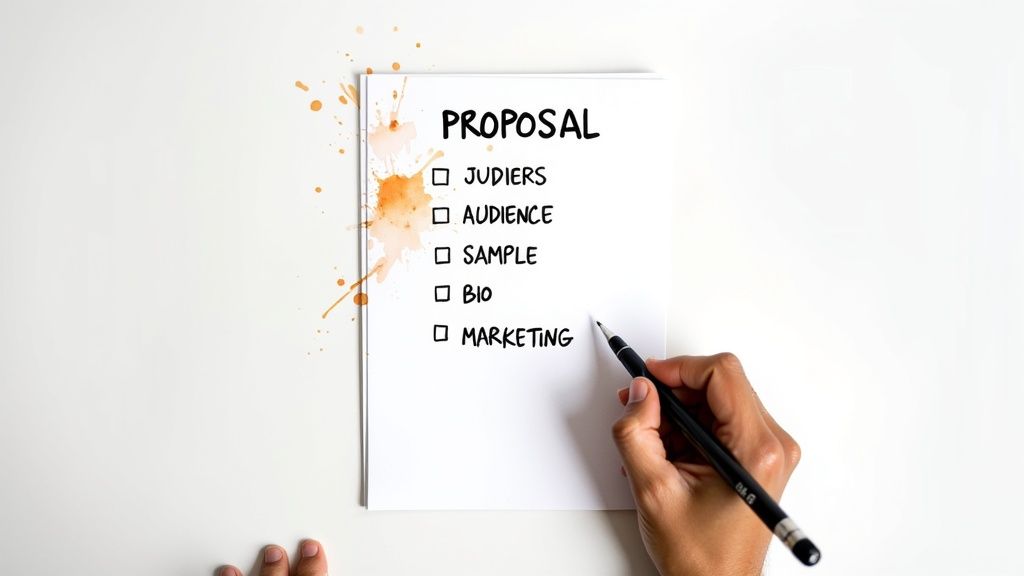
| 1. Overview | This is your elevator pitch. A quick, exciting summary of the book and why it matters. |
| 2. Target Market | You'll identify exactly who will buy your book and prove that this audience is large enough. |
| 3. Author Bio | Here, you establish your credibility and explain why you're the only person who can write this book. |
| 4. Chapter Outline | A detailed, chapter-by-chapter summary that shows the book's structure and flow of ideas. |
| 5. Sample Chapters | Your chance to prove you can write! You'll include 1-2 polished chapters to showcase your voice. |
| 6. Marketing Plan | This section outlines how you'll actively help sell the book, using your platform and connections. |
| 7. Comparative Titles | You'll analyze 3-5 similar books to show where yours fits in the market and how it's unique. |
Don't worry, we're about to break down each of these components with clear examples and straightforward advice. Let's get started. I promise it's not as scary as it sounds.
Deconstructing a Winning Proposal Section by Section
Alright, let's roll up our sleeves. A book proposal can feel like this big, scary monster, but it's really just a collection of smaller, totally manageable parts. Think of it less like writing a legal document and more like building with LEGOs. Each brick has a purpose, and when you snap them all together, you get something amazing.
We're going to walk through this together, piece by piece, so that intimidating feeling melts away. I've seen so many brilliant people freeze up at this stage, worried they're not doing it "right." Let me tell you a secret: there's no magic formula, just a logical structure designed to answer a publisher's questions before they even ask them.
The Hook and Overview
This is your grand entrance. The overview is the first thing an agent or editor reads, and it needs to grab them by the collar. It's not a dry summary; it's the passionate, exciting story of your book.
Think of it as the trailer for your movie. It should answer three core questions with energy and clarity:
- What is this book about? Get straight to the heart of your idea.
- Why does it need to exist right now? Create a sense of urgency and relevance.
- Why are you the only person who can write it? Show off your unique perspective and authority.
A friend of mine, a literary agent, once told me she can tell within the first page if a proposal has potential. It's all about the energy. If you’re not excited about your book in the overview, why should she be?
Target Audience and Market
This is where you prove you’re not just an artist but also a savvy entrepreneur who understands your readers. Saying your book is "for everyone" is a classic rookie mistake. It's a sweet thought, but publishers need to know who your core audience is. The people who will run out and buy your book on day one.
Be specific. Instead of "people interested in wellness," try "burnt-out millennial women aged 25-40 who follow wellness influencers but are tired of restrictive advice." See the difference? One is vague, the other paints a picture of a real person. Then, you back it up with data showing this group is large and actively buys books.
This section is also where you prove your idea is commercially sound. A modern book proposal example must also consider digital formats. Global e-book sales are projected to hit $14.92 billion in 2025, showing that a huge part of your audience consumes content on screens. Acknowledging this shows you're thinking about every possible revenue stream. You can discover more insights on this topic by exploring the latest book sales statistics on Newprint.com.
Chapter Outline and Sample Chapters
This is the "show, don't tell" part of your proposal. The chapter outline is your book's skeleton, a detailed summary of each chapter that proves you have a clear, logical structure for your ideas. It should read like a thrilling table of contents, making the agent desperate to see how you connect all the dots.
Then come the sample chapters. This is your chance to shine. It's where you prove you have the writing chops to deliver on the promises you made in the overview.
This is often the point where aspiring authors get overwhelmed. Crafting perfect sample chapters while juggling everything else is tough. A professional ghostwriter can be a lifesaver here, transforming your raw ideas into polished prose that sings. It’s still your voice, just perfectly tuned. Honestly, why make it harder on yourself?
Your Author Bio and Platform
Let's be honest: this is the bragging section, and you've earned it. The author bio is where you prove your credibility. List your credentials, your experience, and anything that makes you the authority on this subject. Don't be shy!
But it's more than just a resume. Publishers are also looking for your author platform. This is your built-in audience, your ability to reach readers directly through things like:
- Social media followers
- An email newsletter list
- Speaking gigs or workshops
- Media connections
A strong platform dramatically reduces a publisher's risk. It shows them you aren't just bringing them a manuscript; you're bringing them a community of future readers. It's one of the most important parts of getting a modern book deal.
How to Analyze Competing Titles
Think of your book as a new guest at a dinner party. Before it can join the conversation, it needs to know who else is at the table. In publishing, these other guests are your “comparable titles,” or comps. Analyzing them isn't just a box to check; it’s one of the most persuasive parts of your entire book proposal.
This is where you prove there’s an existing, hungry audience for your book. It sounds counterintuitive, but you want to show that similar books are already selling. If you were opening a new coffee shop, you’d be encouraged by the sight of other busy cafés, right? It proves people in that neighborhood love coffee. Your comps do the same thing. They prove a market is already waiting for you.
Your goal is to show an agent or publisher exactly how your book will fit into the current landscape while also bringing something fresh and essential to the conversation. It’s about finding that sweet spot between familiar and unique.
Finding Your Book's Family Tree
The trick is to find comps that are "just right." You’re looking for successful books, but not once-in-a-generation blockbusters. Comparing your leadership guide to a mega-hit like Atomic Habits can come off as naive. Instead, you want to find titles that demonstrate a healthy, engaged readership and show you understand the real world of publishing.
Ready to do some sleuthing? Here’s where to start:
- Hit the Bookstore: There’s no substitute for walking into a real bookstore. Head to the section where your book would live and see what’s on the shelves. Pick them up, read the back cover, and check out who published them. This is boots-on-the-ground research.
- Go Down the Digital Rabbit Hole: Hop on Amazon or Goodreads and search for your topic. The real magic is in the “Customers also bought” and “Readers also enjoyed” sections. This is a goldmine for discovering your book’s closest relatives.
- Keep it Current: Aim to find 3-5 titles that were published in the last 3-5 years. Publishing trends move quickly, and what sold like hotcakes in 2015 isn't necessarily relevant today. Fresh comps show agents you have your finger on the pulse of the current market.
Analyzing Comps Without Having a Meltdown
Okay, maybe you won't have a meltdown, but staring at a list of successful books can feel a little intimidating. Don't let it! Remember, you aren't looking for books that are identical to yours. You're looking for books your ideal reader is already buying and enjoying.
For each comp you choose, you’ll write a short, punchy analysis (around 100-150 words) that answers two critical questions:
- How is this book similar to mine? Does it tackle a similar problem? Is it written for the same audience? Maybe it shares a similar tone. Witty, academic, or inspirational.
- How is my book different (and better)? This is your chance to shine. Perhaps the comp is too theoretical, while yours is packed with actionable advice. Maybe it only explains the "what," and you’re here to deliver the "how."
A classic rookie mistake is to tear down the competition. Never do that. It comes across as unprofessional. Instead, be respectful. Acknowledge what the comp does well, then gently pivot to explain how your book fills a crucial gap it left open. It’s a subtle shift in tone, but it makes all the difference.
This is also where you get to show off some real industry awareness. According to seasoned pros on forums like Absolute Write, you can get a sense of a book's performance by checking Ingram's database. A book that sold 1,200 copies last year shows a modest, viable market. A book that sold over 10,000 is considered a solid hit. This context is vital in a U.S. market where only 0.01% of books break the 100,000-copy mark. You need to show you’re benchmarking against realistic success stories, which you can learn more about by exploring the scale of the book publishing industry on MarketResearch.com.
If digging through sales data and articulating your book’s unique angle feels like a chore, this is a great place to tag in a professional ghostwriter. They are market analysis wizards and know exactly how to frame your comps to make publishers lean in. It's still your brilliant idea, just with an expert helping you map the terrain.
A Complete Book Proposal Example With Annotations
Theory is great, but let's be real. It’s one thing to talk about the ingredients for a cake and another thing entirely to bake one that doesn't set off the smoke alarm. This is the part where we get our hands dirty.
We're going to walk through a complete book proposal, section by section, for a fictional nonfiction book. I want you to think of me as a friendly guide sitting next to you, pointing things out with little notes in the margins. You'll see how each piece connects to the next, building a story that's not just about a book idea but about its inevitable success.
This isn't about copying and pasting. It's about understanding the engine of a proposal so you can build one for your own brilliant, world-changing book.
Let’s get this show on the road.
Fictional Book Proposal Title Page
Let's imagine our author is a financial therapist named Dr. Anya Sharma. She has a fantastic idea for a book that reframes budgeting as an act of self-care, not deprivation. Her title page should look clean, professional, and straight to the point.
A BOOK PROPOSAL
The Kind Budget: A Practical Guide to Financial Wellness Without the Guilt
By Dr. Anya Sharma
[Your Name/Agent Name]
[Contact Information]
[Date]
Annotation: See how simple this is? No fancy graphics, no wild fonts. Just the essential information, presented clearly. The title itself is fantastic because it immediately tells you the book's core premise and promise. "Kind Budget" is memorable, and the subtitle explains exactly what the reader will get.
The Overview
This is Dr. Sharma's chance to grab the agent's attention right away. She'll start with a hook that speaks to a universal pain point before introducing her unique solution.
For millions of people, the word "budget" triggers a wave of shame, anxiety, and failure. We've been told that financial health requires spreadsheets, sacrifice, and the willpower of a saint. But what if this entire approach is wrong? What if the secret to financial wellness isn’t about restriction, but about kindness?
The Kind Budget is a groundbreaking guide that reframes personal finance as an act of self-care. It dismantles the toxic belief that budgeting is punishment and replaces it with a compassionate framework designed for real, messy human lives. This book will teach readers how to align their spending with their values, heal their relationship with money, and build lasting wealth without the guilt.
Annotation: That opening paragraph is pure gold. It identifies a shared struggle and immediately offers a new perspective. It’s empathetic and hooks you right from the start. The second paragraph clearly states the book's promise and what makes it different from everything else on the shelf.
The Target Market Analysis
Now Dr. Sharma has to prove there's a hungry audience waiting to buy this book. She needs to get specific, using data and psychographics to paint a crystal-clear picture of her ideal reader.
The primary audience for The Kind Budget are millennial and Gen Z women (ages 25-45) who are overwhelmed by traditional financial advice. They follow wellness and self-care influencers on social media, listen to podcasts about mental health, and are actively seeking holistic approaches to life’s challenges. They are tired of the shame-based "latte factor" rhetoric and are hungry for a money philosophy that feels empowering, not punishing.
Annotation: This is brilliant. She's not just saying "women who want to save money." She’s describing a lifestyle, a mindset. Publishers know this audience well and understand they are active book buyers. It shows she's not just guessing; she truly gets her reader.
It’s also important to remember that this isn't just a local audience. The global book publishing market is expected to grow from $95.02 billion in 2024 to $110.15 billion by 2029. A book proposal like this shows awareness of that bigger picture. You can learn more about the global book publishing market on ResearchAndMarkets.com.
This is just a peek into the first few pages. As you can see, a great book proposal doesn’t just list facts. It tells a story, creates excitement, and proves with every sentence that this book needs to exist. And if weaving all these threads together feels daunting, remember that a skilled ghostwriter can be the perfect partner to help you build this compelling case for your future bestseller.
Common Proposal Mistakes to Avoid
We've all been there. Staring at a blank page, pouring our hearts into a project, and making a few stumbles along the way. It's just part of the creative process. But when it comes to your book proposal, some mistakes are less like stumbles and more like trapdoors. They can send your hard work straight to an agent's "pass" pile before they've even finished their morning coffee.
Let's walk through some of the most common pitfalls I've seen over the years. The goal here isn't to scare you, but to give you a bit of insider knowledge so you can gracefully sidestep them. Think of this as getting the secret map to the minefield. Knowing where not to step is half the battle.
The "It's for Everyone" Trap
This is, hands down, the biggest red flag for any agent or editor. When they see the phrase, "This book will appeal to everyone," they don't see a potential bestseller. They see an author who hasn't thought deeply enough about their audience.
Saying your book is for everyone is like saying a new restaurant is for anyone who eats food. Sure, it's technically true, but a five-star sushi bar and a beloved neighborhood pizza joint have very, very different customers. You need to know exactly who you're cooking for. Be specific.
- Instead of: "This book is for anyone who wants to be healthier."
- Try: "This book is for burnt-out professionals over 40 who have tried every fad diet and are looking for a sustainable, science-backed approach to wellness."
See the difference? The second one paints a picture of a real person with a real problem.
The Marketing Plan of Hopes and Dreams
Another classic blunder is a marketing plan built on wishes. It usually looks something like, "I'll start a blog," or "I'm hoping a post goes viral on TikTok." A marketing plan isn't a list of things you're willing to do; it’s a concrete list of the assets and audience you already have.
Publishers are looking for a foundation they can build on, not just a wishlist. An agent friend of mine once told me she received a proposal where the entire marketing section was, "Get Brené Brown to endorse it." We can all dream, but that's not a plan. It's a lottery ticket. Focus on the audience you can genuinely reach right now.
Let's be honest: marketing is a completely different skill set from writing. If the thought of building a platform and crafting a strategy makes you want to hide under your desk, you're not alone. This is often where partnering with an experienced ghostwriter can be a game-changer. They've been through this before and can help you shape a realistic, impressive plan. It's so much less stressful.
Tiny Errors That Scream "Amateur"
You might have the most brilliant, world-changing idea, but if your proposal is full of typos and grammatical errors, it sends a powerful message: you don't care about the details. And in publishing, the details are everything.
I’ve heard absolute horror stories from agent friends. Proposals that misspelled the agent's name, or my personal favorite, had a typo in the title of the book. Ouch.
These little things matter more than you think. They signal that you might be careless or difficult to work with during the editing process. Proofread your proposal like your career depends on it. Then, have a trusted friend read it. Read it out loud to yourself. Do whatever it takes to make that document pristine. It’s a simple sign of respect for the agent’s time, and more importantly, for your own work.
Why You Might Want a Professional Partner

Let’s be honest. After seeing all the pieces we've just walked through—the market analysis, the competitive titles, the detailed chapter breakdowns—it's easy to feel overwhelmed. If you're looking at all this and thinking it feels like assembling a space shuttle with instructions written in ancient Greek, you're definitely not alone. This is a ton of work.
Bringing a book into the world is an incredible act of passion. It’s about bottling up the wisdom you’ve worked so hard for, the stories you’ve lived, and creating something that lasts. But here's the reality: you're an expert in your field, not necessarily an expert at crafting a book proposal that stops a publisher in their tracks.
The Power of a Strategic Partnership
And that’s exactly where the magic of collaboration comes in. Thinking about partnering with a professional ghostwriter isn’t taking a shortcut or "cheating." It's one of the smartest, most strategic decisions you can make to do justice to your big idea.
Think about it like this: if you were building your dream home, you’d hire an architect, wouldn't you? You have the vision, the dream, the "why" behind it all. They have the technical expertise to draw up a blueprint that makes sure the roof doesn't cave in. A great ghostwriter is your book’s architect.
Partnering with a ghostwriter is all about bringing in specialized expertise. It allows you to stay in your zone of genius. Your core message. While they handle the craft of shaping arguments, sharpening prose, and navigating the often-baffling world of publishing.
Hiring a pro isn't about giving up control. It’s about adding a secret weapon to your team. It’s always your voice, your ideas, and your name on the cover.
Your Vision, Expertly Crafted
A talented ghostwriter is, at their core, a translator. They listen to the passion, the knowledge, and the unique voice inside your head and translate it onto the page in a way that hooks agents and connects with readers. They know the ins and outs of structuring a killer proposal and making your submission impossible to ignore.
Here’s a little peek at what that partnership often looks like:
- You bring the brainpower: Through a series of engaging, often fun, interviews, you simply talk about what you know and love.
- They build the framework: Your ghostwriter then takes all those brilliant thoughts and organizes them into a rock-solid proposal and outline.
- You guide the process: They write, you review and give feedback. This back-and-forth ensures the final manuscript sounds exactly like you.
The end result? Your vision comes to life faster and more powerfully than you might have ever managed on your own. It frees you from the tyranny of the blank page and lets you focus on the joy of creating something meaningful. It's a beautiful process, truly.
Answering Your Lingering Questions
Alright, let's be honest. Even after all this, you probably still have a few questions swirling around. That’s a good thing! It means you're really digging in and taking this seriously. Let's tackle some of the most common questions that come up when you're deep in the trenches of writing a proposal.
How Long Should a Book Proposal Be?
This is the big one, isn't it? While there's no single magic number, most proposals end up being somewhere between 15 and 50 pages, and that includes your sample chapters. A shorter proposal isn't automatically better. What really matters is that every single page is working hard to build a rock-solid case for your book.
Think of it as the Goldilocks principle. Too short, and it might look like you haven't fully baked the idea. Too long, and you risk an agent getting bogged down in the details. You're aiming for that "just right" spot where every section is punchy, clear, and persuasive.
Can I Send My Proposal to Multiple Agents at Once?
Yes! You absolutely can, and you should. This is called making "simultaneous submissions," and it's completely standard practice in the publishing world. Sending your proposal out one at a time would take an eternity, and you've got a book to get out into the world.
Just be sure to handle it professionally. If an agent offers you representation, it's common courtesy to let the other agents who are reviewing your proposal know. Give them a week or so to make a counteroffer if they're interested. It's a small professional gesture that goes a long way.
What if My Author Platform Isn't Huge?
Okay, take a deep breath. This is the fear that stops so many amazing ideas from ever seeing the light of day. A massive platform is a great asset, but it's not the end-all-be-all. Publishers are also looking for a knockout idea, fantastic writing, and a perspective that only you can offer.
If your platform is still in its early stages, focus on what you do have and frame it with confidence. Instead of saying, "I only have 800 email subscribers," you could say, "My highly-engaged email list is growing by 25% month-over-month, demonstrating a strong interest in this topic."
Don't forget, you don't have to go it alone. Teaming up with a ghostwriter can be a huge advantage here. They are experts at highlighting the strengths you already have and can help you craft a proposal so polished and compelling that it makes your platform, no matter the size, look like a powerful starting point.
It’s all about showing momentum and proving you’re actively building a community that’s hungry for what you have to say. Your passion and expertise are your most powerful tools.
At My Book Written, we believe every great idea deserves to become a book. If you're ready to turn that dream into a reality, we have the resources to guide you with clarity and confidence. Start exploring our guides and begin your journey at https://mybookwritten.com.