
So, what exactly is a ghostwriter for autobiography? Picture this: they're a professional writer you bring on board to turn your incredible life story into a real, hold-it-in-your-hands book. Through a series of fun, relaxed conversations, they capture your authentic voice and experiences. They handle all the heavy lifting of writing, structuring, and editing while you get to focus on the best part—sharing your memories.
Your Story Is Worth Telling, But You Don’t Have to Write It Alone
Let’s be honest. The thought of writing your life story is a massive undertaking. It’s exciting, sure, but it can also feel like trying to solve a Rubik's Cube in the dark. You have decades of memories, hard-earned lessons, and life-changing moments all jumbled together in your mind. The big question isn't "Is my story even worth telling?" because it absolutely, one hundred percent is.
The real question is, "How in the world do I get all of this down on paper without losing my ever-loving mind?"

This is precisely where hiring a professional ghostwriter feels less like a luxury and more like bringing in a master architect to build your legacy. Don't think of them as some stuffy author. Think of them as a skilled partner who helps you construct the beautiful home your experiences deserve to live in forever.
The Art of Outsourcing Your Inner Author
You wouldn't attempt your own root canal just because you have teeth, would you? Of course not. So why force yourself through the agony of staring at a blinking cursor, wrestling with writer's block, and trying to shape a lifetime of events into a story that actually flows? It's just cruel and unusual punishment.
Working with a professional is about bringing in an expert to handle the craft while you provide the heart. It's a true collaboration, not a surrender. It's your story and your voice, guided by their expertise. It's still your vision brought to reality, just without all the headaches.
Here’s why it’s often the most joyful and effective way to get your book done:
- They’re master storytellers. A great ghostwriter knows how to find the golden thread running through your life, turning a collection of memories into a story people can't put down. They're like narrative detectives.
- They offer an objective perspective. It's incredibly hard to see the big picture when you're standing inside the frame. A ghostwriter can spot the powerful moments and themes you might have overlooked because you were too busy living them.
- They save you from the "writer's-block-blues." You get to do the fun part: reminiscing and sharing your stories. They take on the daunting task of crafting every single sentence.
- It ensures the book actually gets finished. Life has a funny way of getting in the way. A dedicated writer keeps the project moving forward, turning that "someday" idea into a finished manuscript you can be proud of.
You're Not Alone in Seeking Help
Many people write an autobiography to cement their professional legacy; learning some strategies to become a thought leader can make that book even more impactful. This has fueled a booming industry for skilled writers.
In fact, the global ghostwriting services market was valued at around $3.3 billion and is expected to hit $6.2 billion by 2032. This isn’t some niche, underground service; it’s a powerful resource for busy professionals, entrepreneurs, and anyone with a story that needs to be told.
Your job is to live an interesting life. Your ghostwriter's job is to make it an interesting read. It's the ultimate creative partnership, and the result is a legacy that honors your true voice.
This guide is here to walk you through finding the right partner, avoiding the common pitfalls, and finally turning your journey into a beautiful book. It’s time to get that story on the shelf where it belongs.
How to Find a Ghostwriter Who Truly Gets Your Voice
Finding the right ghostwriter for your autobiography feels a lot like dating. You need someone with the right skills, sure, but the real magic is in the connection. This is the person you’re going to trust with your most personal, vulnerable, and triumphant stories. It's a big deal.
You're not just looking for a good writer; you're looking for your writer. You need someone who hears the music behind your words, understands your particular sense of humor, and can capture the unique rhythm of your speech. It’s less about a glittering resume and more about genuine empathy and curiosity.
Where to Look for Your Storytelling Partner
Forget just typing "ghostwriter for autobiography" into a search engine. While that’s a start, the best collaborators are often found in more curated spaces where quality and professionalism are the focus. Think of it like looking for a Michelin-star chef. You probably wouldn't start at a fast-food directory.
Here’s where you can kick off a more targeted search:
- Professional Ghostwriting Agencies: Companies like Gotham Ghostwriters or Reedsy are essentially marketplaces that vet their writers. They act as matchmakers, connecting authors with seasoned professionals who have proven track records in memoir and autobiography. It's like having a friend who knows all the best people.
- Literary Agent Referrals: If you have any connections in the publishing world, an agent is an incredible resource. They know who the best writers are and can often recommend someone perfectly suited to your story’s tone and subject matter.
- Writing Associations: Organizations like the Association of Ghostwriters are packed with dedicated professionals. Exploring their member directories can lead you straight to talented writers who specialize in life stories.
The goal is to step away from the anonymous chaos of the open internet and into communities where writers are held to a higher standard. This simple shift can save you countless hours of sifting through unqualified candidates.
Reading Portfolios: The Art of Spotting True Talent
Once you have a shortlist of potential writers, it's time to put on your detective hat and dig into their portfolios. Don't just skim their work; read it with a purpose. You’re looking for evidence that they can do more than just write clean, error-free prose.
A great ghostwriter disappears into their client’s voice. As you read their samples, ask yourself if each piece sounds distinct. If every writing sample has the exact same tone and style, that’s a major red flag. It might be their great voice, but you need someone who can capture yours.
The portfolio of a brilliant ghostwriter should read like an anthology of different people’s stories, not like a collection of essays by the same person. You are looking for a chameleon, not a lion.
To truly get your voice, your ghostwriter will likely conduct extensive interviews. Knowing how to properly transcribe an interview is a critical skill for them to have, as it ensures they capture every nuance of your spoken narrative. It’s this attention to detail that separates the pros from the amateurs.
Why Niche Experience Can Be a Game Changer
Finally, think about the writer’s background. Did you build a tech empire from your garage? Finding a writer who understands the startup world will make a huge difference. Did you spend 30 years as a surgeon? Someone with a medical or scientific background might grasp the nuances of your career more intuitively.
This doesn't mean you need to find your exact twin, but some shared experience can create an instant shorthand. A writer who already speaks the language of your world will ask better questions and capture the authenticity of your experience on a much deeper level. It’s often the final piece of the puzzle in finding a true partner to bring your legacy to life.
Vetting Your Ghostwriter and Dodging Red Flags
You’ve got your shortlist. Nicely done! Now comes the part where you put on your detective hat and start asking the tough questions. This is where you separate the true professionals from the writers who just look good on paper.
Choosing a ghostwriter for your autobiography is a huge act of trust. You’re not just hiring a writer; you’re bringing on a partner for what might be the most personal project you ever tackle. This vetting stage is your single best tool for making sure you find the right one.
Asking Questions That Reveal More Than a Resume
A resume or portfolio tells you what a writer has accomplished, but it can’t tell you how they work. Your interview should feel less like a formal interrogation and more like a real conversation. The goal is to get a feel for their process, their communication style, and, most importantly, their ability to truly capture your voice.
Instead of lobbing generic questions that get you canned answers, you need to dig a little. You want to get them talking about their actual, on-the-ground experiences.
This is the time to really listen, not just to what they say, but how they say it. Below is a table of questions designed to get you past the resume and into the heart of how a ghostwriter actually operates. These will give you a much clearer picture of who you’d be working with day-to-day.
Essential Interview Questions for Your Potential Ghostwriter
Use these questions to move beyond the resume and understand how a ghostwriter truly works.
| Question Category | Sample Question to Ask | What to Listen For in Their Answer |
|---|---|---|
| Voice & Adaptation | Tell me about a time you had to capture a client's voice that was very different from your own. How did you approach that challenge? | Details about their process for listening, researching, and adapting. Do they mention specific techniques like studying speech patterns or reading the client's old letters? |
| Workflow & Process | Walk me through what the first month of working together would look like. What would you need from me, and what would I receive from you? | Clarity and structure. They should be able to outline a clear plan for interviews, initial drafts, and feedback. It shows they have a proven system. |
| Collaboration & Feedback | Describe a situation where a client gave you difficult or unclear feedback. How did you handle it to get the project back on track? | Professionalism and problem-solving skills. Look for a calm, non-defensive attitude and a focus on finding a solution, not placing blame. |
| Confidentiality | How do you ensure the privacy and confidentiality of your clients' stories, both during and after the project? | Specifics on secure file storage, NDAs, and their professional ethics. A pro will take this very seriously and have clear protocols in place. |
| Conflict Resolution | We all hit creative roadblocks. What’s your approach when you and a client disagree on the direction of a chapter or story? | A collaborative mindset. Do they sound like a partner ("we can try it both ways") or a dictator ("my way is best")? You want a collaborator, not a bulldozer. |
These kinds of questions open a window into how your potential ghostwriter thinks, collaborates, and handles the beautiful, messy process of writing a life story. The right person will welcome this level of detail.
A great ghostwriter won't just answer your questions; they'll ask you thoughtful ones in return. Their curiosity about you and your story is one of the biggest green flags you can get.
Red Flags to Watch for on Your Search
Just as important as knowing what to look for is knowing what to run from. Your gut feeling is an incredibly valuable guide here, but there are also some concrete warning signs that should give you serious pause.
Think of these as giant, waving signs telling you to slow down, ask more questions, or just walk away entirely.
🚩 Vague Answers and Process-Speak
If a writer can’t clearly explain their process for interviews, writing, and revisions in plain English, that’s a problem. Be wary of anyone who hides behind buzzwords and jargon instead of giving you a straightforward picture of how they get things done.
🚩 Pressure for Full Payment Upfront
This is a big one. No reputable ghostwriter will demand 100% of the project fee before a single word is written. The industry standard is an initial deposit, typically 25-50%, followed by payments tied to specific milestones. Anything else is a major cause for concern.
🚩 No Professional Contract
A handshake is a nice gesture, but it won’t protect you when things get complicated. A professional will always insist on a detailed contract that outlines the scope of work, deliverables, payment schedules, revision rounds, and confidentiality. If they wave it off as unnecessary, that's your cue to leave.
🚩 A "My Way or the Highway" Attitude
Remember, this is your story, not their creative showcase. A great ghostwriting partner is flexible, open, and collaborative. If a candidate seems rigid, dismisses your ideas out of hand, or seems unwilling to adapt their process, they aren’t the right fit for such a personal journey.
Finding the right person is a bit like finding a key to a lock you've been carrying around for years. When you find the one that fits, you'll know. Trust your instincts, ask smart questions, and you'll find an amazing partner to help bring your story to life.
Navigating Ghostwriting Costs and Contracts
Alright, let's talk about the two things that can feel the most awkward: money and legal papers. I know, it’s not as fun as diving into your incredible stories, but getting this part right from the get-go is the foundation of a great partnership.
Think of the cost not as an expense, but as an investment in your legacy. You're commissioning a piece of art that will live on forever. And just like any piece of art, the price tag can vary wildly based on the artist's experience and skill.
Unpacking the Price Tag
So, what does it actually cost to hire a ghostwriter for an autobiography? Honestly, there's no single answer. The rates are a direct reflection of a writer’s experience, how complex your story is, and the amount of research needed to do it justice. It's less like buying a product off the shelf and more like commissioning a custom-built car.
You'll generally run into a few common ways ghostwriters structure their fees:
- Per-Project Fee: This is the most common for autobiographies, and for good reason. The writer gives you a single, flat rate for the entire book, from the first interview to the final manuscript. It's wonderfully predictable and great for budgeting.
- Per-Word Rate: While less common for a whole book, some writers charge this way. It can work for shorter projects, but it can feel a bit like watching a meter run on a full-length memoir.
- Hourly Rate: This is usually reserved for smaller tasks like editing or consulting, not for writing an entire book from scratch. The final cost is too hard to predict, which can create a lot of stress for both you and the writer.
For a full-length book, a per-project fee is almost always the way to go. It puts everyone on the same page with the same goal: you want a fantastic finished book, and they get paid to deliver it.
What Should You Actually Expect to Pay?
The numbers can feel big at first, but they reflect hundreds of hours of highly skilled work. A recent industry survey found that 1 in 3 ghostwriters earn over $100,000 a year. In fact, 25% of them charge that much for a single nonfiction book like an autobiography.
Generally, you'll see fees fall into tiers, with seasoned professionals often clustering around the $50,000 mark. For families looking to preserve a parent's story or CEOs documenting their journey, these figures underscore the value of the investment. You can read the full report on ghostwriter compensation to see the data for yourself.
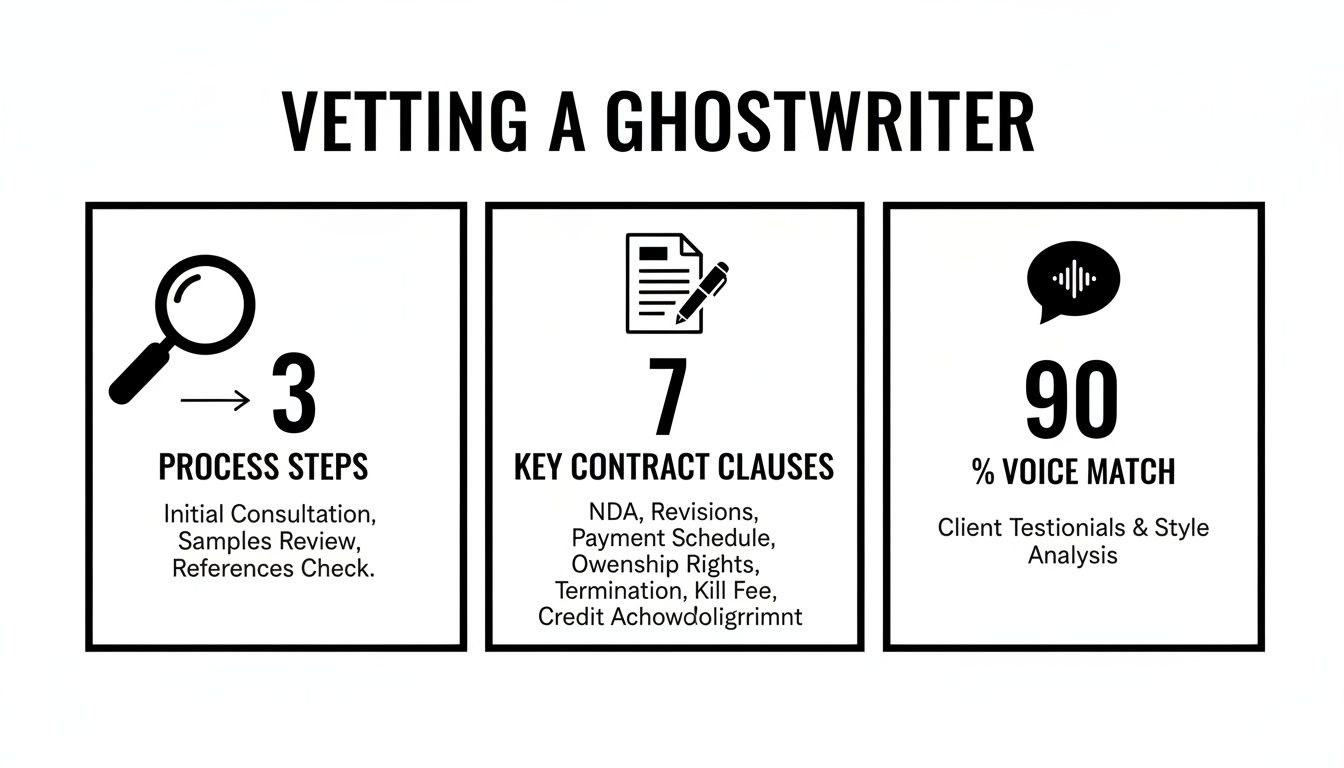
This infographic drives home the point: a solid contract, a clear process, and a genuine voice match are the three pillars of a successful partnership.
The Contract: Your Project’s Best Friend
If a potential writer ever tells you, "Oh, we don't need a contract, a handshake is fine," I want you to smile politely and then run for the hills. A professional contract isn't about mistrust; it’s about clarity. It protects both of you and ensures everyone is on the exact same page from day one. Think of it as the official roadmap for your project.
Your agreement should be written in plain English, not confusing legalese, and it should clearly lay out every single detail of your collaboration.
A good contract doesn't create problems; it prevents them. It’s the most boring, least emotional, and most important document you’ll sign during this entire process.
Here are the non-negotiables that absolutely must be in your ghostwriting contract:
- Scope of Work: What, exactly, is the writer delivering? This should get specific, including the estimated word count, the number of interviews, and the format of the final manuscript (e.g., a Word document).
- Ownership and Credit: The contract must state, in no uncertain terms, that you are the sole author and 100% owner of the copyright. It should also confirm the writer's name will not appear on the book (unless you've agreed to something else).
- Confidentiality Clause: A rock-solid Non-Disclosure Agreement (NDA) is essential. You're sharing your life story: the good, the bad, and the private. This ensures it all stays that way.
- Payment Schedule: This breaks down the total fee into manageable installments, usually tied to project milestones. A common structure is an initial deposit, a payment after the first draft of Part One is delivered, and so on.
- Revisions Process: How many rounds of revisions are included? A good standard is one or two major revision rounds per section or chapter. This prevents endless tweaking and keeps the project moving forward on schedule.
Getting the money and paperwork handled upfront frees you to focus on the magic of telling your story. It’s a crucial moment of professionalism that paves the way for a truly wonderful creative journey.
The Collaborative Dance: Writing Your Story Together
You’ve hired your ghostwriter. Fantastic! That’s a huge step, and you should absolutely celebrate. But this isn't a simple hand-off; it's the start of a deep, creative partnership. The real magic happens now, in the collaboration that turns a collection of memories into an unforgettable book.
Think of it this way: You're the one who lived the incredible life, gathering all the unique ingredients. Your ghostwriter is the master chef who knows exactly how to combine them into a dish that tastes, feels, and sounds just like you. Your experiences are the raw materials; their job is to shape them into a masterpiece.

This process is a true dance, one built on trust, open communication, and a shared obsession with getting your story just right.
From First Chat to Final Chapter: What to Expect
Every project has its own unique rhythm, but most autobiography collaborations follow a pretty predictable path. Knowing what's coming helps you relax and actually enjoy the journey instead of stressing about the next step.
Here’s a look at how things typically unfold:
- The Deep-Dive Interviews: This is the heart and soul of the project. You’ll spend hours on recorded calls, simply sharing your memories. Don't worry about getting everything in perfect chronological order. Just talk. A skilled writer is a master listener and will start finding the threads and patterns right away.
- Creating the Blueprint: After those initial conversations, your writer will get to work building a detailed outline or a "book map." This is the architectural plan for your story. Nothing gets written until you’ve reviewed this and given it your enthusiastic approval.
- Drafting in Chunks: No one writes an entire book in one go. Your ghostwriter will deliver it to you in manageable pieces, usually a chapter or a section at a time. This gives you a chance to provide feedback early and often, ensuring the project stays on the right track from the start.
- The Revision Rounds: This is where you polish the stone until it gleams. You’ll read the drafts and share your thoughts. Is the voice right? Did they capture the emotion of that specific memory perfectly? This back-and-forth is what transforms the manuscript from a well-written story into your story.
- Final Polish and Delivery: Once you’ve approved the full manuscript, it goes through one last, meticulous proofread. Then, the polished, finished book lands in your inbox. Time for more champagne!
How to Give Feedback Without Feeling Like a Jerk
Giving notes on someone’s writing can feel a little awkward, I get it. But remember, your ghostwriter wants your feedback. They’re not mind-readers, and your honest input is the only way they can be sure they’re hitting the mark.
The goal of feedback isn't to criticize; it's to clarify. A professional writer will never be offended by your notes. They see it as essential data for getting your voice right.
Try framing your feedback as a team effort. For example:
-
Instead of saying: "This sounds nothing like me."
-
Try this: "This is a great start! Can we work on injecting a bit more of my sarcastic humor into this section?"
-
Instead of: "You got this part all wrong."
-
Try this: "I love the way you described the scene, but the feeling I had was more bittersweet than triumphant. Can we adjust the tone here?"
This partnership is definitely a two-way street. And the ghostwriting process itself is evolving, too. For instance, the AI-assisted ghostwriting market is exploding, projected to grow from $4.2 billion to a staggering $14.6 billion. While technology can offer speed, the empathy and nuance of a human ghostwriter for autobiography projects remain vital. If you're a professional with a half-finished draft who needs a faster, more accessible alternative, some platforms now offer premium ghostwriting at a fraction of traditional costs. It's worth a look to discover more about this booming market and how different models can help bring your story to life.
Staying Energized for the Long Haul
Writing a book is a marathon, not a sprint. Some days you’ll be buzzing with excitement, and other days your energy will dip. That’s completely normal.
To keep the momentum going, schedule regular check-in calls with your writer, even if there isn't a new chapter ready for review. Just connecting can reignite the spark.
And don't forget to celebrate the small wins! Finishing the interviews is a huge accomplishment. Approving the first three chapters is definitely a reason to cheer. Breaking the journey into smaller milestones makes the whole process feel less overwhelming and a whole lot more fun. This is your vision, brought to life with an expert guide right by your side.
Got Questions About Hiring a Ghostwriter? You're Not Alone.
Thinking about hiring a ghostwriter for the first time can feel a lot like planning a big trip to a new country. It’s thrilling, but you’ve probably got a long list of questions. Let’s tackle some of the most common ones that come up when people are ready to get help telling their life story.
It's completely normal to have a mix of excitement and nerves. You're about to trust someone with your most important memories, so let's get you the answers you need to move forward with confidence.
Will the Book Still Sound Like Me?
Absolutely. In fact, that's the whole point of hiring a great ghostwriter. This is the number one concern I hear, and it’s a good one. A true professional’s job isn't to inject their own voice; it's to become a crystal-clear channel for yours.
They’ll spend dozens of hours interviewing you, learning your unique way of speaking, getting a feel for your sense of humor, and really understanding your outlook on life. They aren't inventing your story; they are carefully sculpting it from the words and memories you provide. The final book is built from your insights, your personality, and your memories.
Here's a good way to think about it: an architect might draw the blueprints for your dream home, but no one would say the house isn't yours. You provided the vision and the purpose; they just brought the technical skill to build it. It’s that same kind of beautiful partnership.
How Much of My Time Will This Actually Take?
Hiring a ghostwriter will definitely save you hundreds, if not thousands, of hours staring at a blank screen. But it’s not a hands-off process. This is a collaboration, and you’re the star of the show.
You can expect to commit anywhere from 20 to 50 hours of your own time, but this will be spread out comfortably over several months. The best part? Most of that time is spent in interviews, where you just get to sit back, relax, and share your stories.
Here’s a rough idea of where that time goes:
- Interview Sessions: These are usually done in 1- to 2-hour blocks to keep the energy high and the stories flowing.
- Reviewing Drafts: You'll also need time to read through chapters as they're written and give your feedback.
The more you put into the process, the more the final book will shine with your unique spirit. Your ghostwriter does the heavy lifting with the writing, but your active participation is the secret ingredient that makes it all work.
What Happens If I Don’t Like What They’ve Written?
This is another huge, and totally understandable, fear. What if you read a chapter and think, "This just isn't me"? This is exactly why a solid contract and a clear, step-by-step process are non-negotiable.
A professional ghostwriting agreement always includes clauses for revisions. You won't just be handed a finished book at the end. Instead, you'll review the work in manageable chunks, usually chapter by chapter. This lets you provide feedback early and often, ensuring the project never gets too far off track.
The first draft is never the final draft. Think of it as a block of marble from which you and your writer will carve the statue together. Revisions aren't a sign of failure; they are a normal, essential part of the creative process.
If you don't like a chapter's tone or how an event was described, you just share your notes. The writer’s job is to listen and make the adjustments. It's a process of refinement, which is why it's so important to find a writer you can communicate with openly from day one.
Do I Have to Give the Ghostwriter Credit on the Cover?
Nope, not at all. The "ghost" in ghostwriter means they are meant to be invisible. Standard industry practice is that you, the author, receive all the credit and retain 100% of the rights and royalties.
Your writer is paid a fee for their service, and their name doesn't appear on the cover or anywhere else in the book. This is all spelled out clearly in the contract, which should also include a strong confidentiality clause or non-disclosure agreement (NDA). While some authors might choose to add a "with" or "as told to" credit, that is completely your call and is not the norm.
It's your story, your name, and your legacy. Period.
At My Book Written, we know that starting this journey is a profound act of courage. We're here to provide the calm, thoughtful guidance you need to turn your life's story into a book, whether you're starting with a blank page or a jumble of notes. Explore our resources and build the perfect blueprint for your autobiography.