
Let's be real for a moment. You have an incredible story bubbling inside you, a game changing business idea, a powerful life lesson, a memoir just waiting to be told. But the thought of actually sitting down and wrestling that story onto a blank page? It can feel like you're trying to build a spaceship with a glue stick.
This is where a ghostwriter for a book comes in. They're your professional partner, the skilled writer who takes your brilliant ideas, your scattered notes, and your hours of conversation and masterfully weaves them into a polished manuscript. Think of them less as a writer for hire and more as your creative collaborator, 100% dedicated to capturing your unique voice and bringing your vision to life.
Your Brilliant Book Idea Needs a Ghostwriter
So, you’ve got this incredible idea. It’s been living in your head, rent free, for who knows how long. Maybe it’s the story of how you built your company from scratch, a deeply personal account of overcoming adversity, or a lifetime of wisdom you’re burning to share. You can almost feel the satisfying weight of the finished book in your hands. It's a beautiful, powerful dream.
Then reality crashes the party. The blinking cursor on a blank document starts to feel like a tiny, mocking eyeball. The thought of wrangling 50,000 or more words into a coherent narrative suddenly seems less like an adventure and more like trying to herd cats. Through a blizzard. Uphill. Trust me, you're not alone in feeling this way. The dream of creating something permanent is powerful, but the process of getting it done can be a serious grind.

Publishing's Best Kept (Not So Spooky) Secret
This is the exact moment to let you in on publishing's best kept secret: the ghostwriter. And no, they don’t wear sheets and rattle chains, though they do have a knack for making words magically appear. They’re professional writers, story architects, and expert interviewers who have mastered the art of translating your brilliance onto the page.
Hiring a ghostwriter isn't cheating; it's a strategic partnership. It’s one of the smartest moves you can make on your journey to becoming an author. Let’s get a few common misconceptions out of the way right now:
- It is absolutely your book. You are the source of the soul, the stories, and the expertise. The ghostwriter is the craftsperson who provides the structure, the polish, and the thousands of keystrokes needed to get it done.
- It’s written in your voice. A truly great ghostwriter is a chameleon. Their goal isn't to sound like themselves; it's to listen so deeply and intuitively that they can write in a way that sounds exactly like you on your best day.
- It’s an investment in your legacy. You wouldn't try to build your dream house without an architect or navigate a complex legal battle without a lawyer. Your book, your legacy, deserves that same level of professional expertise.
A ghostwriter doesn't steal your voice; they amplify it. They take the raw materials of your life and ideas and build a cathedral of words that honors your vision.
Here’s another way to look at it: you’re the director of a blockbuster film. You have the vision, you know the story, and you have the final say on every single detail. The ghostwriter is your Oscar winning screenwriter, working tirelessly behind the scenes to make sure the script is nothing short of perfect. You bring the magic; they bring the mechanics.
Together, you create something unforgettable. Your story deserves to be told, and you don’t have to go it alone.
So, What Does a Ghostwriter Actually Do?
Hiring a ghostwriter isn't a one size fits all kind of deal. Think of it like a home renovation. Some projects need a master architect to draw up the blueprints from your wildest dreams. Others need a master builder to construct the whole thing, beam by beam. And sometimes, you just need a brilliant interior designer to come in and make the existing structure shine.
That's why it's so important to understand the different services a ghostwriter can offer. It ensures you find the perfect partner for your specific journey, whether you’re starting with a blank page or a manuscript that just needs a little love to cross the finish line.
This isn't some niche service anymore, either. The global ghostwriting market is valued at approximately $3.3 billion in 2024 and is projected to hit $6.2 billion by 2032. That boom is fueled by people just like you who have a story to tell but need a professional to help build it.
Let's break down the main ways a ghostwriter can help.
The Full Ghostwrite: Your Personal Scribe
This is what most people picture when they think of hiring a ghostwriter for a book. It’s the most hands off option for you as the author and the most intensive for the writer. You are the source, the visionary. The ghostwriter is the dedicated craftsperson who translates your ideas, stories, and expertise into a complete manuscript.
The process usually kicks off with a series of in depth interviews. You’ll talk, they’ll listen, and they’ll ask the kinds of questions that pull out memories and ideas you didn’t even know were there. A ghostwriter's fundamental skill is taking all these disparate threads and weaving them into a coherent narrative. For tips on developing this crucial skill, it's helpful to see how to synthesize information in writing like an expert.
Best for you if: You have a powerful story or deep expertise but lack the time, writing skill, or desire to spend hundreds of hours at a keyboard. It’s perfect for the busy CEO, the retiring founder, or anyone who wants their legacy documented beautifully without the writing grind.
Co-Writing: A True Creative Partnership
Maybe you love the idea of writing but want a guide and partner to share the journey. If that's you, a co writing or collaborative arrangement is a fantastic middle ground. In this model, you and the writer are a team.
You might write sections or chapters yourself, and the writer then refines, expands, and polishes your work to ensure it has a professional flow and a consistent voice. This is a true partnership where your name often appears on the cover alongside the writer's, as in "by Your Name with Writer's Name." It’s a wonderful way to stay deeply involved in the writing process while still benefiting from a professional's structural and storytelling expertise.
Book Doctoring or Heavy Editing: The Manuscript Makeover
Let’s say you’ve already done the hard part. You’ve poured your heart and soul onto the page and have a finished, or mostly finished, manuscript. But something’s… off. The pacing feels clunky, the voice isn’t quite right, or the structure just isn't landing.
Enter the book doctor. This service isn't about fixing commas and typos; it’s a deep, substantive edit. A book doctor will diagnose the manuscript's core issues and perform the necessary surgery to fix them. This can involve:
- Restructuring entire chapters for better flow.
- Rewriting sections to strengthen the narrative voice.
- Enhancing clarity and tightening your prose.
This is the perfect choice when your book has good bones but needs a professional to get it ready for the world. It’s less of a ground up build and more of a masterful renovation.
Ghostwriting Services At a Glance
Feeling a bit overwhelmed by the options? This table breaks down the different types of ghostwriting services to help you identify which one best fits your project needs and your desired level of involvement.
| Service Type | Best For You If… | Your Involvement Level |
|---|---|---|
| Full Ghostwriting | You have the ideas but not the time or skill to write. | Low to Medium: Mostly interviews and reviews. |
| Co-Writing | You want to write but need a professional partner. | High: Actively writing and collaborating. |
| Book Doctoring | You have a completed draft that needs major work. | Medium: Providing feedback on structural changes. |
Ultimately, choosing the right service comes down to knowing yourself, your timeline, and how hands on you want to be. Each path can lead to a fantastic book, it's just a matter of picking the one that feels right for you.
The Ghostwriting Journey: From Idea to Manuscript
How does a jumble of brilliant ideas, scattered notes, and heartfelt stories actually become a finished book? It’s not magic, it’s a process. And a great process feels less like pulling teeth and more like the creative adventure you always hoped for.
Bringing a book to life is a huge undertaking, but with the right partner, the journey can be genuinely joyful. Let's pull back the curtain on how it typically works.
Phase 1: The Deep Dive and Blueprint
It all starts with connection. Before any contracts are signed, you’ll have discovery calls to see if the chemistry is right. A good ghostwriter will spend a lot of time just listening, getting a feel for your personality, your humor, and your unique way of seeing the world. This isn't just a transaction; it's the start of a deeply personal partnership.
Once you’re on board, the real fun begins: the deep dive interviews. This is where your story pours out. You’ll talk for hours over several sessions as your writer asks the kind of insightful questions that unlock memories and connect ideas you hadn't linked before. They aren't just taking notes; they're absorbing your voice.
From these conversations, the writer crafts the book's blueprint. This is a detailed outline that maps out the entire structure, from the introduction to the final chapter.
This blueprint is your project’s North Star. It ensures you and your ghostwriter are perfectly aligned on the book's message, flow, and key takeaways before a single chapter is written. You’ll review it, tweak it, and approve it, giving you complete control.
Phase 2: The Writing and Review Cycle
With the blueprint locked in, the writing begins. This is one of the most exciting parts of the whole thing. Your ghostwriter will usually deliver the manuscript chapter by chapter, and you get to see your ideas and stories spring to life on the page, often in ways more powerful than you imagined.
This phase is a collaborative dance. Here’s a simple breakdown of the rhythm:
- Writer Delivers a Chapter: You get a polished chapter in your inbox, ready for you to read.
- You Provide Feedback: You read it over and share your thoughts. Is the tone right? Did they capture that memory perfectly? Is there anything you want to add or change?
- Writer Revises: The writer then folds in your feedback, making sure every word feels true to you.
- Repeat: This back and forth continues, chapter by chapter, until the first draft is complete.
This approach means there are no big, scary surprises at the end. It guarantees the final manuscript is exactly what you envisioned, just without the headache of staring at a blank page yourself.
This visual timeline breaks down the journey into its core stages, from that initial spark to holding a finished book.
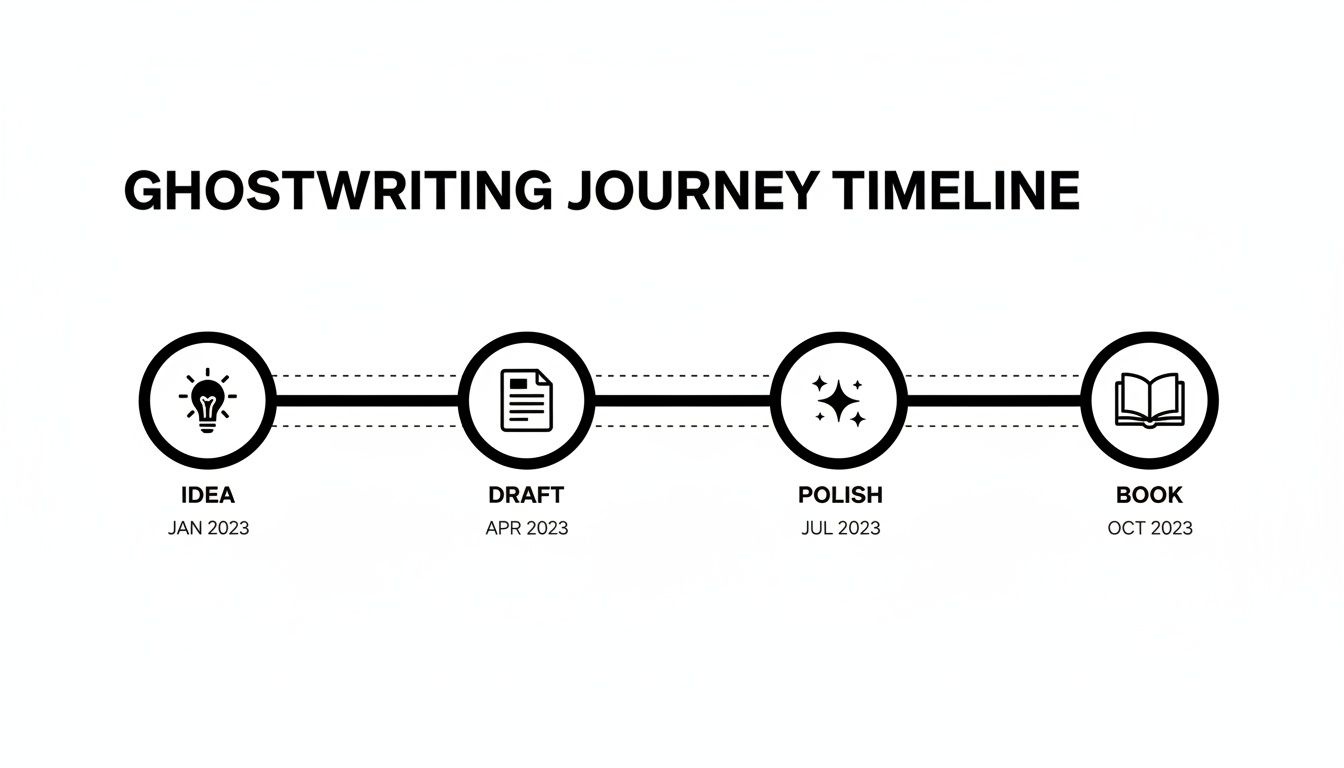
As you can see, the process is structured to keep your vision front and center at every single step.
From "Boring" to Bestseller: A Real Story
I once worked with a retired CEO who wanted to document his company's history. He was genuinely worried it was too "boring" for a book, all financial data and dry corporate milestones. He felt the story was important for his family and old employees, but he just couldn't see how anyone else would want to read it.
His ghostwriter saw something different.
Through hours of interviews, she uncovered the human stories behind the numbers: the near bankruptcy averted by a gut wrenching decision, the fierce loyalty of his first employees, the personal sacrifices he made along the way. She wove what could have been a dry corporate history into a compelling narrative about resilience, leadership, and community.
The CEO was floored. He told her, "I lived this story, but I never truly saw it until now." The final manuscript wasn't just a record of events; it was a powerful tribute to his life's work. That’s the transformation a skilled ghostwriter can bring. They don’t just write your story; they help you see it in a whole new light.
How Much Does a Ghostwriter for a Book Cost?
Alright, let's talk about the elephant in the room: money.
Wondering about the cost of a ghostwriter for a book can feel a bit like trying to price a custom built home. The final number depends on the size, the complexity, and the level of craftsmanship you're after. It’s a significant investment, and you deserve to know what that investment actually looks like.
Handing over your story, and your resources, to someone else is a huge act of trust. So, let’s demystify the numbers. My goal is to give you the confidence to talk about fees without feeling like you’re lost in the woods.
The Three Flavors of Ghostwriting Fees
Just as there's more than one way to write a book, there's more than one way to charge for it. Most professional ghostwriters stick to one of three common pricing models, and understanding them helps you see exactly what you’re paying for.
- Per-Project Flat Fee: This is the industry standard and, frankly, the best model for authors. The writer gives you a single, all inclusive price for the entire project, from the first interview to the final manuscript. It provides total budget certainty, which is a beautiful thing.
- Per-Word Rate: Some writers charge by the word, say, anywhere from $0.50 to $2.00+ per word. While it sounds straightforward, the final price can be a moving target if the book's length changes during the creative process.
- Hourly Rate: This is less common for full book projects but might pop up for editing, coaching, or "book doctoring" services. It’s flexible, but it can be nerve wracking to watch the clock tick.
For a full-length book, a per-project fee is almost always the way to go. It aligns everyone’s goals: to create a brilliant, finished manuscript without any surprise invoices along the way.
So, What's the Real Price Tag?
Okay, let's get down to it. While prices vary wildly based on the writer’s experience, the genre, and your project's complexity, here are some realistic ballpark figures to help you plan. Think of these as a starting point for a conversation.
- Short Ebook or Manifesto (15,000 – 25,000 words): Expect a range from $8,000 to $20,000.
- Standard Non-Fiction or Business Book (40,000 – 60,000 words): This is the sweet spot for many projects, and costs often fall between $25,000 and $70,000.
- Full-Length Memoir or Deeply Researched Book (60,000 – 80,000+ words): For complex, interview heavy projects that require a ton of research, it's not uncommon to invest $50,000 to well over $100,000.
If those numbers made you gulp, I get it. But remember what you're investing in: hundreds of hours of a professional’s dedicated time, creative energy, and specialized skill. The demand for top tier writers is climbing fast. North America currently leads the ghostwriting scene, and the global industry is projected to jump from $4.2 billion in 2024 to $7.5 billion by 2033. You can learn more about the exploding ghostwriting market on cognitivemarketresearch.com.
For those with incredible stories but tighter budgets, there are more accessible options. Services like Opus Eternal provide expert ghostwriting at a fraction of the traditional cost, offering a fantastic path to get your book done without compromising on quality.
Ultimately, hiring a ghostwriter is an investment in your legacy. It’s about honoring your story by giving it the professional craftsmanship it truly deserves.
Finding Your Perfect Writing Partner
Trusting someone with your life’s story or your big idea is a huge deal. It’s like picking a partner for a cross country road trip. You need someone with a good sense of direction, a compatible taste in music, and who won’t eat all the snacks in the first hundred miles. Finding the right ghostwriter requires that same blend of chemistry, trust, and shared vision.
So, how do you find ‘The One’ without all the drama? This isn’t about just finding someone who can string sentences together. It’s about finding a true partner who gets you and is committed to honoring your voice. You’re not just hiring a typist; you’re entrusting someone with your legacy.
Let’s get you ready to find your perfect match.

Asking the Right Questions
Your initial interviews are more than just a vibe check. They’re your chance to go beyond, "So, have you written a book before?" and really understand who you’ll be working with. Think of it as a friendly interrogation, but with more coffee and less of a single bare lightbulb hanging from the ceiling.
Here are some must ask questions to get the conversation rolling:
- "How do you approach capturing an author's unique voice?" A great ghostwriter should be able to walk you through their process for this. They might mention listening to interview recordings multiple times, reading things you’ve already written, or a calibration phase with the first chapter.
- "Can you describe your ideal author partnership?" This question reveals a lot about their working style. Do they prefer a hands off client or someone deeply involved? Their answer will tell you if your collaboration styles will click or clash.
- "What does your revision process look like?" You need to know how feedback is handled. A pro will have a clear, structured system for revisions that makes you feel heard, not like you’re being a pain for asking for changes.
- "What happens if we hit a creative roadblock or disagreement?" A seasoned professional won’t be scared by this question. They’ll have stories and strategies for navigating bumps in the creative road, which shows they’re a problem solver.
Spotting Red Flags Before They Trip You Up
Just as important as knowing what to look for is knowing what to run from. Your story is precious, and the last thing you need is a partnership that causes more headaches than it solves.
Keep an eye out for these warning signs:
- The "Bestseller" Guarantee: If a writer promises you a spot on the New York Times list, back away slowly. No one can guarantee that. A professional will promise a high quality manuscript, not fame and fortune.
- A Vague or Nonexistent Process: If they can’t clearly explain their step by step process, it’s a major red flag. A great ghostwriter has a well oiled machine for getting a book from idea to completion.
- A Portfolio That Misses the Mark: If their writing samples don’t resonate with you, that’s okay. But if the quality is poor or the style feels completely alien to your vision, they’re probably not your person. Trust your gut.
- Pressure Tactics: A true partner will give you space to make a decision. Anyone rushing you to sign a contract or pay a deposit immediately might be more interested in their cash flow than your story.
This reliance on pros is surprisingly common. Imagine cracking open a bestselling non fiction book, only to discover that upwards of 80% of them were penned by ghostwriters. This stems from a harsh reality: writing a book demands 500-1,000 hours on average, which is why thought leaders turn to a ghostwriter for a book.
The Contract: A Foundation of Trust
Finally, let’s talk contracts. A solid agreement is the bedrock of a healthy, productive partnership. It’s not about mistrust; it’s about clarity. A good contract protects both of you and ensures everyone is on the same page from day one.
Your contract should clearly outline things like the scope of work, payment schedule, revision rounds, and, most importantly, that 100% of the rights and authorship belong to you. It’s your name on the cover, your story, your legacy. The contract just makes it official.
Beyond your ghostwriter, some authors find additional support by working with a dedicated writing accountability partner to maintain momentum.
Finding the right person takes a little effort, but it’s worth every second. You’re not just looking for a writer; you're looking for the person who will help you build something that lasts forever.
Ready to Bring Your Book to Life? Here's What to Do Next
You’ve made it this far, which tells me that little whisper of a book idea has grown into a roar you can no longer ignore. You get the process, you know what a great partnership looks like, and now you’re standing at the edge, ready to jump in.
It’s an incredible feeling, knowing you’re about to create something that will last forever. But I also know that taking that first real step can feel like the hardest part. The good news? You don’t have to figure it all out at once. All you have to do is take one small, simple step forward.
Let’s turn that big, beautiful, slightly scary dream into a manageable to do list.
Your Simple Action Plan
This isn't about writing the entire book tomorrow. It's about building momentum. Here’s a friendly nudge to get the ball rolling, one small task at a time.
- Clarify Your Core Message. Grab a notebook and answer this question: If a reader could only take away one single idea from your book, what would it be? Get it down in one sentence. This becomes your anchor, the North Star that will guide every decision you make from here on out.
- Gather Your Raw Materials. Don’t worry about organizing anything perfectly just yet. Just start a "book brain dump" folder on your computer or even a physical box in your closet. Toss in old journals, interview transcripts, scattered notes, links to articles, anything that feels like part of your story. Think of it as a treasure hunt for your own life.
- Schedule a No-Pressure Chat. The final, and most important, step is to simply talk to someone who does this for a living. Find one or two ghostwriters whose work resonates with you and book an introductory call. You’re not committing to anything; you’re just exploring what’s possible.
The distance between having a book idea and holding a finished manuscript isn't as vast as you might think. It's bridged by a series of small, intentional actions, starting with the decision to simply begin.
Partnering with a professional ghostwriter for a book is the most powerful way to honor your story. You bring the heart, the soul, and the vision. They bring the structure and the craft to bring it all to life.
This isn't just about getting a book written; it's about giving your legacy the beautiful, permanent home it deserves. Your story matters. It’s time to tell it.
A Few Common Questions About Ghostwriting
Stepping into the world of ghostwriting can feel a bit like learning a new language. It’s exciting, but you’re bound to have some questions. Let’s tackle a few of the most common ones we hear from authors to be.
It's totally normal to feel a mix of curiosity and maybe a little apprehension. Your story is personal, and handing it over to someone else is a big deal. We get it.
Will I Still Be the Author of My Book?
Yes! A thousand times, yes. This is probably the biggest and most important question, so let's be crystal clear. When you hire a professional ghostwriter, the contract explicitly states that they have no claim to the authorship, copyright, or any royalties.
You are the author. Full stop. The ghostwriter is a skilled professional you've hired to help bring your vision to life.
Think of it like building a custom home. You hire an architect to draw up the blueprints based on your ideas, needs, and dreams. But when the house is finished, it's your name on the deed, not theirs. The same principle applies here. The book is your intellectual property, born from your vision.
How Much of My Time Will This Take?
This is where the magic really happens, you get to decide how much involvement works for you. While your input is crucial, the process is designed to be incredibly efficient with your time.
Most of the heavy lifting for you happens right at the start. You'll spend time in deep dive interviews, usually totaling between 10 to 40 hours over a few weeks. This is where you download your ideas, stories, and expertise to the writer.
After that initial phase, your main job is to review chapters as your ghostwriter sends them and provide feedback. You're the director, giving notes to shape the final performance.
The real beauty of hiring a ghostwriter is the time you save. Instead of the 500 to 1,000 hours it typically takes to write a book from scratch, you might only invest 30 to 60 hours total. The pro handles the rest.
Can a Ghostwriter Really Sound Like Me?
A great ghostwriter is part writer, part actor, and part detective. Their entire job is to disappear, leaving only your voice on the page. It's a skill they've spent years honing.
So, how do they pull it off?
- They Listen Deeply: During interviews, they're not just transcribing your words. They’re listening for your cadence, your humor, your favorite phrases, and the unique rhythm of how you speak.
- They Do Their Homework: Many will ask to see your emails, blog posts, or past talks, anything that helps them absorb your natural communication style.
- They Calibrate Through Feedback: The first chapter or two is a "getting to know you" phase. Your honest feedback is what helps them dial in the voice until it sounds exactly like you on your very best day.
It’s a true partnership. A talented ghostwriter is committed to getting it right, making sure the words on the page perfectly match the story in your head.
Your story deserves to be told with care, skill, and a true partner by your side. At My Book Written, we connect authors like you with the resources and guidance to make your book a reality.
Ready to learn more? Explore our comprehensive guides to get started.