
Before you can even think about chapters and timelines, you have to gather your materials. The very first step in organizing your life story into a book is to simply collect everything without any pressure to make it perfect. Forget structure for a moment. Just create a "story sandbox" filled with every photo, letter, and anecdote you can find. This phase is all about rediscovery, not writing.
Embracing the Beautiful Mess of Your Memories
So, you want to get your life story down on paper, but right now, it probably feels less like an organized library and more like a junk drawer after an earthquake. Good. That’s not just okay; it’s the absolute best place to start.
Consider this your official permission slip to forget about structure for a while and just celebrate the beautiful, chaotic mess of a life well lived. Before you build a castle, you have to play in the sandbox. The first step isn’t about crafting perfect sentences. It's about pure, unadulterated memory gathering.
The Art of the Brain Dump
Think of this as a mental spring cleaning. Your job is to get all those stories, feelings, and half remembered moments out of your head and into the physical world. Don't censor yourself. Don't worry if a memory seems "unimportant." Just get it down.
I once worked with a client who wanted to write his dad's life story but was stuck on "Chapter One" for a month. I told him to forget the page and grab a shoebox instead. He started tossing in anything that reminded him of his dad: old fishing lures, a faded concert ticket, a funny smelling hat. Within a week, that box was overflowing with stories, not just stuff. That's the energy we're after here.
Key Takeaway: This initial phase is about volume, not quality. Your mission is to create a rich, messy pile of raw material to sift through later. The more you gather now, the more gems you'll find when it's time to build your narrative.
This simple, three step process is a great way to visualize moving from raw materials to connected ideas.
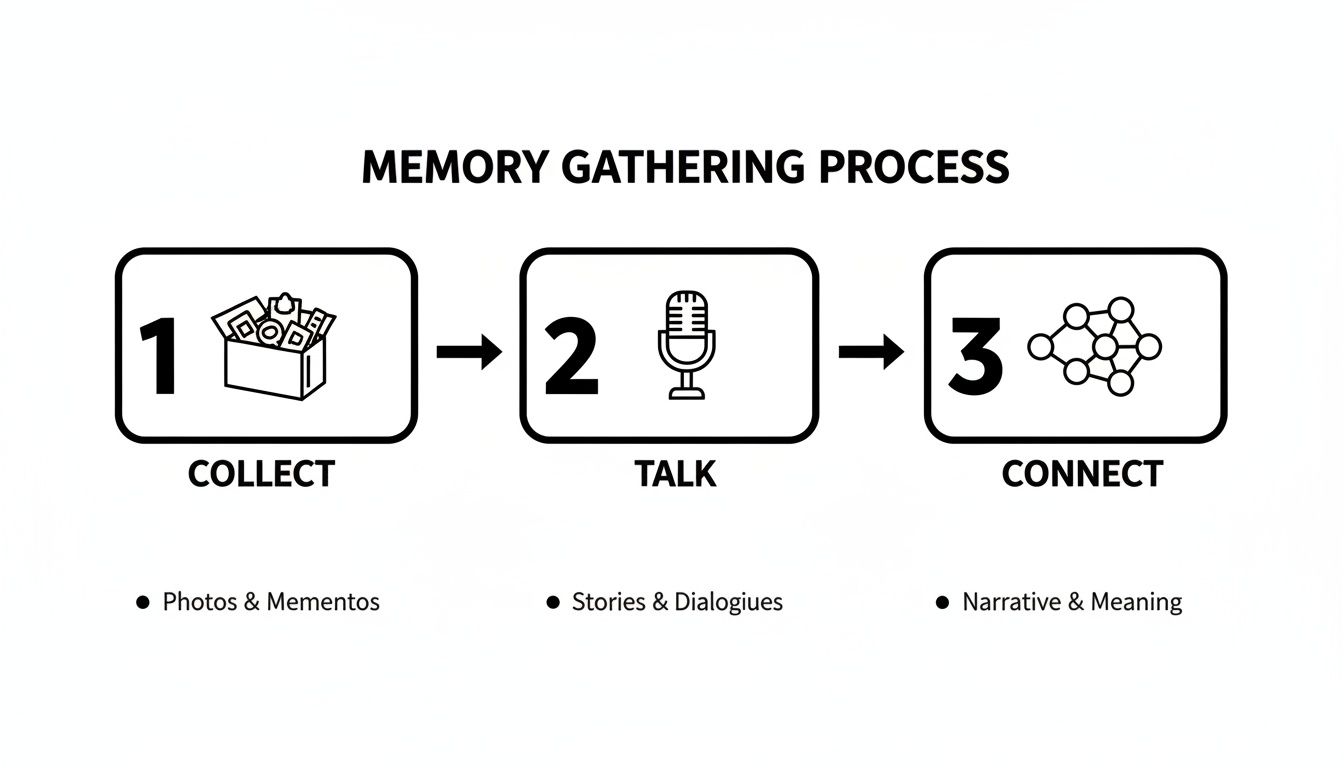
Starting with physical collection, moving to just talking about it, and then mapping out the connections helps you see your life's patterns organically.
Your Story Gathering Toolkit
So, how do you actually do this? You need a few simple, pressure free ways to capture your memories. Think of it less like writing and more like a treasure hunt for your own life.
The table below outlines a few practical methods to get you started on building your collection of raw story material.
| Collection Method | Why It Works | Pro Tip |
|---|---|---|
| The Shoebox Method | Physical items trigger deep sensory memories that words alone can't. Think photos, letters, ticket stubs, or a recipe in your grandmother's handwriting. | Label items with a sticky note explaining their significance right when you add them so you don't forget the context later. |
| Voice Memos | Recording your stories out loud captures your natural, conversational flow and removes the intimidation of the blank page. | Tell a story to a friend, your dog, or just the empty room. Don't worry about sounding polished; the goal is authenticity. |
| Mind Mapping | Starting with a central idea (e.g., "My First Job") and branching out with related memories, people, and feelings helps you see unexpected connections. | Use different colored pens for different emotions or themes (e.g., green for happy memories, blue for sad ones) to spot patterns visually. |
These methods are meant to be mixed and matched. The more angles you approach your memories from, the richer your collection will be.
And remember, this process can be surprisingly emotional. If you find yourself getting stuck, it might be a sign that having a co pilot could help. A great ghostwriter isn't just a writer; they're an expert story excavator. They know the right questions to ask to unearth the memories you didn't even know you had. It's a lot easier and more fun, and you still get your vision brought to life.
At Opus Eternal, we see our role as helping you make that gathering process easier and even fun, ensuring your vision is captured beautifully right from the start.
Finding the Golden Thread in Your Narrative
So, you’ve done the hard work. You’ve waded through that beautiful, chaotic mess of your life and gathered all the raw material. Looking at that pile of photos, letters, and scribbled notes can feel a little daunting, right? Now what?
Now, we find the golden thread.
Every memorable story has a central theme, a current that pulls the reader along from the first page to the last. This is your book's backbone. It’s the answer to the simple but profound question, "What is this story really about?" This is where we stop just collecting memories and start shaping them into a book that feels cohesive and powerful, not just a chronological list of things that happened.

I know this part can sound a bit abstract, but trust me, it’s more like solving a satisfying puzzle than writing a stuffy academic paper. You’re simply looking for the pattern that connects all your most important memories.
Chronological or Thematic? Choosing Your Path
When it comes to structuring your narrative, you have two main highways you can take. Neither is inherently better than the other; it all comes down to the kind of story you want to tell.
One path is the familiar chronological journey. This is the classic "and then this happened" approach, guiding the reader from your first scraped knee to your most recent victory. It’s direct, easy to follow, and works wonderfully for stories centered on personal growth over time. You might say it's telling your story in order to succeed.
- A business memoir, for instance, could follow the company's timeline from that first idea sketched on a napkin all the way to its IPO.
- A coming of age story is a natural fit, tracking the evolution of a person through childhood, adolescence, and into adulthood.
The other path is a thematic structure. With this approach, you organize chapters around core ideas or recurring life lessons, not the calendar. This is an incredibly powerful way to explore a specific aspect of your life from multiple angles. A book about resilience, for example, could have chapters dedicated to overcoming financial hardship, navigating health scares, and mending broken relationships, even if those events happened decades apart.
To start uncovering your theme, try asking yourself a few key questions:
- What’s the one lesson I seem to learn over and over again?
- If my life were a movie, what would the tagline be?
- What’s the single most important message I want my reader to take away?
Sometimes, answering these questions can feel like trying to catch smoke. If you're struggling, this is often the moment where bringing in a professional can make all the difference. A good ghostwriter is trained to listen to your stories and spot the patterns you’re too close to see yourself. They act as a mirror, reflecting your core themes back to you with incredible clarity. It’s still your vision, just brought into sharp focus.
How a Narrative Thread Works in the Real World
Let me give you a concrete example. I once worked with a client who wanted to write about her long career as a surgeon. Her first instinct was to go chronologically, starting with med school. But as we talked more, we realized the true "golden thread" wasn't the timeline of her career, but her personal journey of learning to balance clinical detachment with genuine human empathy.
Suddenly, her book had a soul. Instead of a dry timeline, we built it thematically:
- Chapter 1: The first patient she lost (a powerful lesson in helplessness).
- Chapter 2: A difficult diagnosis she had to deliver (a lesson in compassionate communication).
- Chapter 3: A profound moment of connection with a patient's family (a lesson in shared humanity).
The book was no longer a career recap; it was a deep exploration of the human side of medicine. That’s the magic of finding your thread.
The goal isn't just to list your memories; it's to arrange them in a way that reveals a deeper truth about your life. Your structure is the invisible architecture that gives your story its emotional power.
And please, don't worry if your story doesn't feel "famous" enough. There's a huge appetite for genuine human stories. The memoir market is projected to see 28% year over year growth, and it isn’t just celebrities cashing in. Of 159 memoirs sold in a recent year, 23% came from everyday people whose stories simply connected with readers. You can discover more insights on the thriving memoir market trends and see just how powerful a well told story can be.
Finding your golden thread is the most crucial step in turning that box of memories into a book that lasts. Take your time with it, be patient with yourself, and remember you're not just organizing events. You're uncovering the meaning behind them.
How to Blueprint Your Book Chapter by Chapter
Alright, let's get tactical. Thinking about "writing a book" can be paralyzing. But "writing this one chapter"? That feels manageable. This is where we stop admiring the pile of memories we've gathered and start framing the actual structure of your story.
Think of your book as a house. Each chapter is a different room, each with its own purpose. One room might be for quiet reflection, another for a dramatic showdown, and a third for that hilarious memory involving a questionable haircut in the 80s. Our job now is to draw the floor plan for that house, one room at a time.
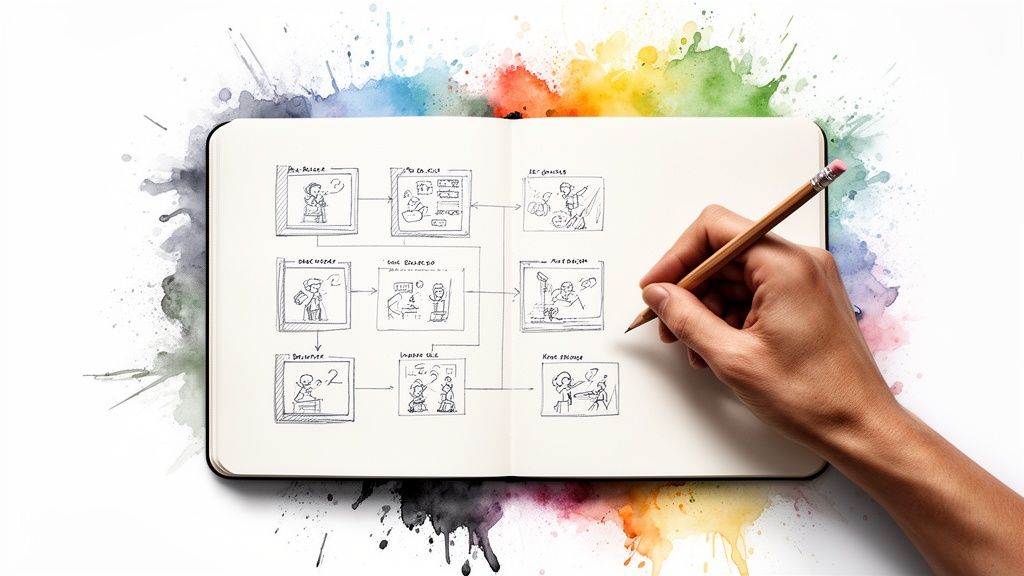
This blueprinting process is your secret weapon against the dreaded blank page. When you know exactly what a chapter needs to accomplish, the words have a funny way of showing up.
The Three Pillars of a Chapter Blueprint
For every single chapter, you're going to define three simple things. I call them the "three pillars" because they hold up the entire structure. No wobbling allowed.
- The Core Purpose: What is the one single thing this chapter must do? Is it introducing a key person? Highlighting a major turning point? Revealing a hard earned lesson? Nail this down in one sentence.
- The Key Scenes: What specific moments or anecdotes will bring that purpose to life? List them as bullet points. These are the building blocks, the actual “stuff” that happens on the page.
- The Emotional Takeaway: How do you want the reader to feel when they finish the chapter? Hopeful? Anxious? Inspired? This is your emotional North Star.
That’s it. It’s a simple, repeatable system that turns a mountain into a series of small, climbable hills. Once you've found your golden thread, the book itself becomes a major undertaking. To keep from feeling overwhelmed, it helps to learn how to manage multiple projects effectively by centralizing and prioritizing your tasks.
A Sample Chapter Blueprint in Action
Let's imagine your book's golden thread is about "finding strength in failure." You want to write a chapter about your first disastrous business venture, the one with the artisanal, gluten free dog biscuits that only pigeons would eat.
Here’s what your blueprint might look like:
Chapter 4: The Crumbling Cookie Empire
- Core Purpose: To show how my biggest business failure taught me the invaluable lesson of resilience.
- Key Scenes:
- The initial excitement, baking late at night in my tiny apartment kitchen.
- The disastrous farmers' market debut where my own dog, Brutus, refused to even sniff a sample.
- The awkward conversation with my disappointed investor (my dad).
- The low point, sitting alone with 500 unsold dog biscuits.
- The final realization that the process was the real prize, not the product.
- Emotional Takeaway: I want the reader to feel a sense of empathetic failure, but ultimately, hope.
See the difference? "Write about my failed business" becomes "write the scene about Brutus." It's bite sized and completely doable.
This blueprinting phase is also where a great ghostwriter can act as an architect for your story. They are masters at seeing how individual scenes connect to build emotional momentum, helping you design a structure that isn't just a list of events but a true journey for the reader. It’s much easier to do it with a professional than trying to do everything yourself.
This approach ensures your story has real momentum and that every chapter serves your central theme. The good news is, it's more accessible than ever to share your story. The audiobook market alone is growing at 25.7% annually, which means more people are listening to personal stories just like yours.
Navigating the Writing Process Without Losing Your Mind
Alright, here we are. The writing desk. The blank page is staring back at you, maybe even smirking a little. Before you even think about panicking, just take a breath. This is where the real magic, and the real mess, truly begins.
Let's be completely honest with each other. This part is hard. Writing a book, especially one holding the pieces of your own life, is an emotional rollercoaster. Life gets in the way. Your motivation will play hide and seek. And that little voice in your head, your inner critic, will suddenly find a megaphone.
It’s an incredible, honorable thing to create a physical book that will last forever. But the process itself can make you want to tear your hair out.
Taming the Clock and the Inner Critic
One of the biggest hurdles most people face isn't a lack of stories; it's a profound lack of time. Very few of us have the luxury of disappearing into a cabin for six months to write. We have jobs, families, and lives that demand our attention. This is where you have to get clever.
Forget trying to block out eight hours on a Saturday. That's a recipe for disappointment. Instead, try the 20 minute story sprint. Set a timer for just 20 minutes and write down one single memory. That’s it. You can do almost anything for 20 minutes, and you’ll be stunned at how those little sprints add up over a week or a month.
Of course, you’ll hit moments where the words just won’t flow. For a little help navigating those frustrating patches, you can find some great advice on how to overcome writer's block.
Remember, the goal is simply progress, not perfection. This drafting phase is where so many brilliant books stall out and gather dust in a forgotten folder. The dream of "help organizing my life stories into a book" can quickly become a source of anxiety.
A Gentle Reminder: Writing about your life is not a straight line. Some days will feel like a creative tidal wave, and others will feel like you're wading through emotional cement. Both are perfectly normal. Be kind to yourself.
The publishing world is hungry for authentic stories, which is fantastic news for you. In 2022, a full 57% of memoirs sold came from everyday voices, not established celebrities. Yet, it's estimated that up to 80% of aspiring authors get stuck with an unfinished manuscript right at this stage. It’s a bottleneck for a reason.
When to Call for a Co-Pilot
There often comes a point where the emotional weight and the sheer logistics of writing become too much. This isn't failure; it's a sign that you might benefit from bringing in a co pilot.
Hiring a professional ghostwriter isn't cheating. It's one of the smartest collaborations you can make.
Think of it this way: you are the architect with the complete vision for the house. The ghostwriter is the master builder who knows exactly how to pour the foundation, frame the walls, and make sure the roof doesn't leak. The final creation is still, unequivocally, your house.
Working with a professional makes the process easier and, honestly, more fun. It ensures your unique vision is brought to life without you sacrificing your sanity to the blank page. For a deeper look into the specific hurdles of memoir writing, check out our guide on writer's block for memoir authors.
For a long time, this kind of expert help felt out of reach for most people. But that's changing. Services like Opus Eternal now offer expert, premium quality ghostwriting that is remarkably fast and efficient.
.png)
This shows how a dedicated service can turn a complex process into a manageable one, making a high quality book more attainable than ever. They provide a stellar alternative, often at less than half the cost of traditional routes, without ever compromising on the quality that makes your story shine.
It's all about honoring your story enough to give it the best possible chance to be told beautifully. And sometimes, that means having a trusted partner by your side to help you build it, word by word.
How to Find the Right Partner to Trust With Your Story
So, you’ve decided to bring in a co pilot. First off, congratulations. That’s a huge, brave, and incredibly smart decision. But now comes the part that can feel a little daunting.
Choosing a ghostwriter isn't like hiring someone to fix a leaky faucet. You're entrusting someone with your heart, your history, your entire legacy. This isn't just a transaction; it's a profound partnership. You need someone who not only writes well but who will honor your story with the care and respect it deserves. It’s about finding someone who just gets you.
Let's make sure you find your perfect match.

Look for Chemistry Before Credentials
Of course, you want a writer with skill and experience, that’s a given. But more than anything, you need to find someone you genuinely connect with. You’re going to spend a lot of time with this person, sharing deeply personal memories.
If the conversation feels stiff, forced, or like a dental appointment, they’re not the one. You should feel a sense of ease and trust, even excitement, when you talk to them. This person will be channeling your voice, so it’s critical they understand its unique rhythm and quirks.
Key Takeaway: A great portfolio gets a ghostwriter in the door, but genuine human connection is what should seal the deal. Trust your gut. If the vibe is off, move on, no matter how impressive their client list is.
Questions to Ask Your Potential Ghostwriter
When you're interviewing potential partners, you're not just checking boxes. You’re trying to get a feel for their process and, frankly, their heart. Don't be afraid to ask direct, detailed questions. This is your story on the line.
Here are a few essential questions to get the ball rolling. Their answers will tell you everything you need to know.
- How will you capture my unique voice? A great writer won't impose their style on you. They should talk about their process for listening, asking insightful questions, and studying your natural speech patterns to ensure the book sounds like you, not them.
- What does your collaborative process look like from start to finish? Look for clear, transparent steps. They should be able to walk you through interviews, outlining, drafting, and revisions without any hand waving. Ambiguity is a red flag.
- How do you handle sensitive or difficult memories? This one is huge. You need a partner who can create a safe, empathetic space for you to share tough stories. Their answer should be full of compassion and show a deep respect for your emotional journey.
These questions help you move beyond the resume and figure out if this person can truly be the steward your story needs.
Spotting the Red Flags
Just as important as knowing what to look for is knowing what to avoid. A few warning signs can save you a world of headache and heartache down the road.
Be wary of anyone who:
- Makes grand promises too quickly: If they guarantee a bestseller before they’ve even heard your story, they’re selling you snake oil, not their writing skills.
- Doesn't ask you many questions: A good ghostwriter is endlessly curious about you. If they do all the talking and very little listening, they're more interested in their own ego than in your story.
- Has a confusing or non existent contract: Every detail, timelines, deliverables, payment, confidentiality, should be spelled out clearly in a professional agreement. No exceptions.
Finding the right person is a journey, but it’s one of the most important parts of bringing your life's stories together in a book. To dig deeper into this, our guide on how to hire a ghostwriter for my life story offers even more detailed advice.
Ultimately, you’re looking for a true partner who sees the beauty and honor in what you’re creating. Someone who will protect your memories, celebrate your voice, and help you build something that will last forever. Don't settle for anything less. Your story deserves it.
Your Questions About Organizing a Life Story
We get it. The idea of turning a lifetime of memories into a book is exciting, but it also brings up a lot of questions. It's a big, beautiful, and sometimes baffling project. Let's tackle some of the most common ones we hear from people just like you.
How Long Should My Book Be?
This is always one of the first questions people ask, and it's a good one. The typical memoir or business book usually lands somewhere between 50,000 and 80,000 words. But please, don't get hung up on that number just yet. Your only job at the beginning is to get the story down, not to hit a specific target.
Think of it this way: you wouldn't start baking a cake by deciding it needs to weigh exactly four pounds. You'd focus on the recipe, add the right ingredients, and let it turn out the size it's meant to be. A solid outline is your recipe; it will guide the book to its natural, most powerful length. A punchy, focused 50,000 word book will always be better than a rambling 90,000 word one padded out with filler.
What If My Life Doesn't Seem Exciting Enough?
If you've had this thought, you're in good company. Just about every author I've ever met has felt this at some point. Let me put your mind at ease: a compelling book isn't about car chases or dramatic plot twists. It's about honesty, emotion, and relatable human truths.
Your story has value because it is uniquely yours. The real magic is in the telling, the insights you share, the lessons you've learned, and the courage it takes to be vulnerable on the page. That's what truly connects with readers, not how many dragons you've slain.
Can I Still Call the Book "Mine" If a Ghostwriter Helps?
Absolutely. Positively. 100% yes.
Let’s clear this up for good. A ghostwriter is a professional collaborator who helps you tell your story in your voice. They are the instrument; you are the composer.
All the ideas, memories, wisdom, and emotions come from you. A ghostwriter is simply a skilled partner who helps shape that raw material into the best possible version of your book. It’s not just "your" book; it’s your story, professionally told.
How Do I Handle Sensitive or Painful Memories?
Writing about the tough stuff can be incredibly difficult, but it can also be a powerful part of the healing process. The most important thing is to be gentle with yourself.
Writing is a journey of rediscovery. When you revisit painful memories, it's important to have a support system in place, whether that's friends, family, or a professional who can help you navigate those emotions with care.
Here are a few things that can help:
- Write in short bursts. You don't need to sit for hours. Even twenty focused minutes can be incredibly productive.
- Take frequent breaks. When you feel overwhelmed, step away. Go for a walk, listen to some music, and give yourself space to breathe.
- Create a safe space. A great ghostwriter is trained to handle sensitive topics with deep empathy, creating a secure environment where you feel comfortable sharing your truth without judgment.
Feeling ready to take the next step but want a trusted partner to guide you? At Opus Eternal, we specialize in helping people organize their thoughts and materials, turning an incredible life story into the beautiful book it deserves to be. If you're looking for an accessible, premium ghostwriting service, explore our process and start your journey today.