
Let's be honest. That book idea you have is brilliant. It’s the one that pops into your head at 3 a.m., the one you sketch out on napkins, the one you can’t stop telling your friends about. It has that fire, that spark that tells you it needs to exist. It’s a piece of you that wants to be shared.
But then comes the hard part. Turning that spark into a few hundred pages of beautiful, polished prose? That can feel like trying to build a skyscraper with nothing but a hammer and a dream.
The blinking cursor on a blank screen starts to feel less like an opportunity and more like a taunt. Life, as it always does, gets in the way. You have a business to run, a family to raise, a life to live. All those brilliant notes and big ideas start to feel less like a manuscript in waiting and more like an impossible mountain to climb. And so, the book stays an idea, a ghost of what it could be. And that’s a tragedy.
It’s Your Vision, Professionally Built
This is where a ghostwriter comes in, and let me tell you, it's not cheating. It's brilliant. Deciding to hire a ghostwriter to write your book isn’t giving up. It’s like hiring a master architect to build your dream home. You are the visionary. They are the expert builder with the right tools and the blueprint to bring your vision to life, brick by beautiful brick.
It’s your story, your insights, your voice. The ghostwriter is the skilled artisan who shapes it all into something solid, something that can stand the test of time and connect deeply with readers. They help you create that physical object you can hold in your hands and say, "I made this."
This is a game changer, especially when you feel stuck. And if you are wrestling with that blank page right now, you might find some helpful strategies to overcome writer's block that could get the ball rolling, whether you decide to write it yourself or bring on a collaborator.
A great ghostwriter doesn't hijack your story; they inhabit it. They become a student of your voice, listening with genuine empathy to translate your ideas into a powerful narrative. It is an act of translation, not invention.
Think of this guide as your roadmap. We are going to walk through the entire process, step by step, to help you find that perfect creative partner. Your story is far too important to stay locked away in your head. Let’s get it out into the world, where it belongs.
Map Your Project Before You Start the Hunt
Okay, before you jump into scrolling through writer profiles and getting lost in portfolios, let’s pause for a second. I know you are excited to find the right person, but honestly, the secret to a great match is knowing exactly what you need before you start looking. This prep work is the single most important thing you can do to attract a truly talented writer.
Think of it this way: you would not hire a builder to construct your dream house without a blueprint, right? A clear project plan does the same for your book. It’s like a beacon, drawing in the writers who immediately understand your vision and politely warding off those who are not a good fit. This step saves everyone a ton of time, frustration, and those painful "Wait, I thought you meant…" conversations later on.
And you are definitely not alone in this. The desire to get a story out into the world is a powerful one, and more people than ever are hiring ghostwriters to make it happen. In fact, the global ghostwriting market is expected to rocket to nearly $3 billion by 2033. That’s a huge leap, driven by leaders and experts who know a book’s value but just do not have the time to write it themselves. You can dive into the full ghostwriting market trends to see just how fast this partnership model is catching on.
This chart really captures the emotional journey so many authors go through, from that brilliant flash of an idea, through the struggle of the blank page, to the incredible relief of finding a great partner.
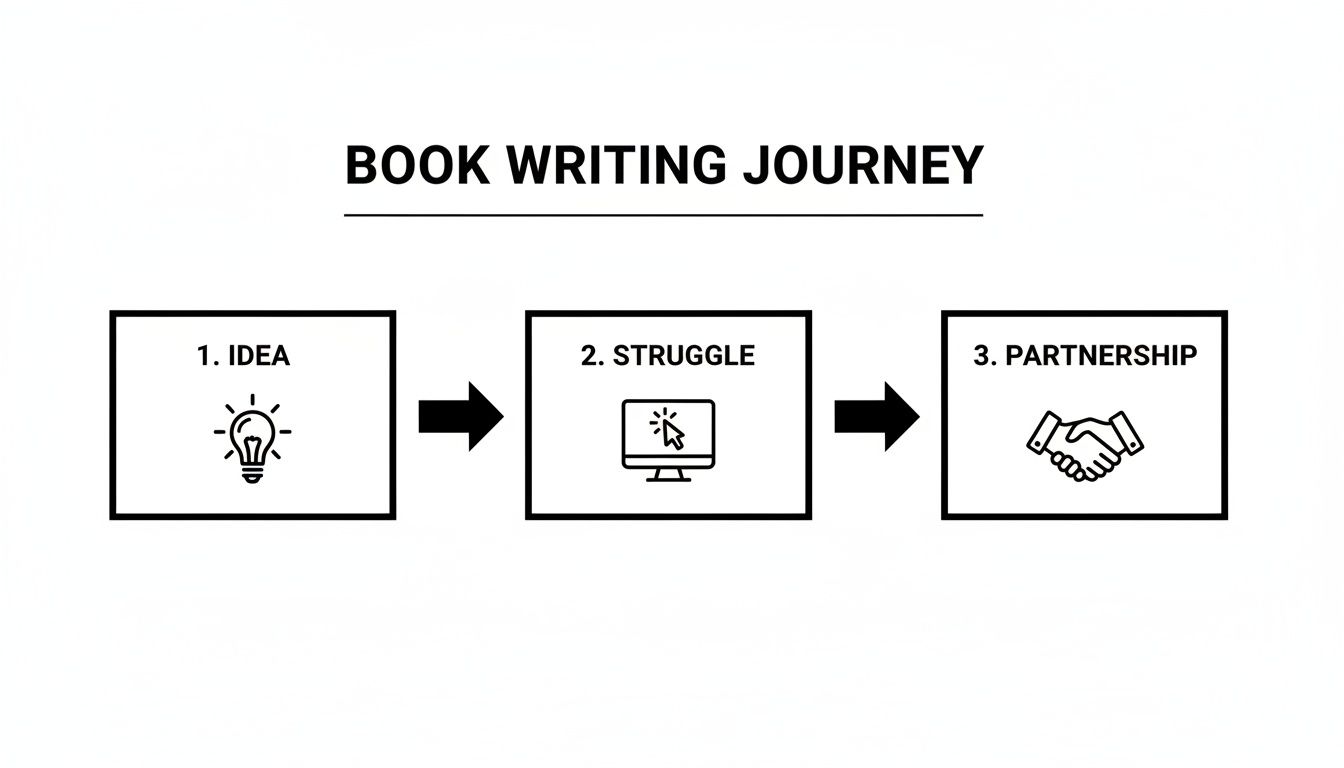
It’s a perfect reminder that feeling stuck is a totally normal part of the process. Finding the right collaborator is often the key that unlocks everything.
Your Project Brief: The One-Page Wonder
Your project brief does not need to be a novel itself. A single, well crafted page is usually more than enough. The whole point is to capture the soul of your project so a potential writer can feel its heartbeat from the get go.
Here’s what your one pager should cover:
- Your Big Why: Why does this book need to exist? Is it to share a lesson you learned the hard way? To cement your authority in your field? Maybe it is to leave a legacy for your family. A good ghostwriter needs to connect with your core motivation.
- Your Ideal Reader: Get specific here. "Entrepreneurs" is too broad. Try this: "Early stage SaaS founders who are struggling with their first funding round and are battling a serious case of imposter syndrome." Paint a vivid picture of the person whose life your book will change.
- The Core Message: If a reader could only remember one single idea from your book, what would it be? This is your North Star.
- A Rough Outline or Mind Map: Do not get hung up on a formal, Roman numeral style outline. A simple list of key stories, chapter ideas, or a timeline of crucial events is perfect. For a memoir, this might be a list of 10-15 defining moments. For a business book, it could be your five step framework.
A strong project brief is your best filter. It ensures the first conversation you have with a writer is already ten steps ahead, focused on creative execution rather than basic discovery.
Real-World Examples in Action
Let's make this tangible. A retiring CEO looking to document her company's history might create a brief with a timeline of major milestones, a list of key employees to interview, and a core message about "building a people first culture against all odds." Her "why" is to honor the people who built the company with her.
Or imagine a therapist writing a book on healing from trauma. Their brief might include anonymized case studies they plan to use, a target audience of "women in their 30s and 40s rebuilding their lives," and a "big why" of "showing readers that post traumatic growth is not just possible, but achievable."
Putting in this little bit of effort up front is a huge sign of respect for your own story. It honors the journey you have been on and sets the stage for a collaboration that feels less like a transaction and more like a true creative partnership. You are not just looking for a hired pen. You are looking for someone to help bring your legacy to life. This map ensures they know exactly where the treasure is buried.
How Much Does a Ghostwriter Cost?
Alright, let's talk about the elephant in the room. The one with a price tag dangling from its ear. I know this is the question that’s been on your mind from the start. What’s the real investment when you decide to hire a ghostwriter? Let’s pull back the curtain and talk numbers, honestly and without any fluff.

When you start looking around, you will see that ghostwriter pricing is all over the map. You will find everything from folks on freelance sites charging a few thousand dollars to seasoned professionals commanding six figures. It’s enough to make your head spin, but there’s a good reason for that huge range. You are not just paying for words on a page.
Understanding The Value Behind The Price Tag
Think of it like this: are you commissioning a simple sketch or a detailed oil painting? A lower price might come from an enthusiastic but inexperienced writer who is hungry to build their portfolio. They might be a fantastic wordsmith, but the process itself could be a little bumpy. In that scenario, they are learning the ropes of project management, interviewing, and structuring a book length narrative right alongside you. They could write a perfectly fine book, but you will be doing a lot more of the heavy lifting.
On the other hand, a higher fee buys you a seasoned pro. This is someone who has navigated the entire author journey many times over. They do not just write. They act as your project manager, your interviewer, your structural architect, and your creative partner. They have a refined process for everything, from conducting interviews that unearth your best stories to organizing your ideas into a compelling structure. That expertise is what turns a good idea into a truly great book.
Think of it less as an "expense" and more as an investment in your legacy or your brand. The right partner saves you time, prevents costly mistakes, and ensures the final product is something you are immensely proud of.
Recent industry insights show that ghostwriting fees have settled into distinct tiers, which is actually great news for you. While rates can vary wildly, you can generally find a professional who aligns with your project's scope and budget. For a deeper dive, check out the 2025 ghostwriting industry report to get a handle on these financial benchmarks.
A Look At Different Investment Levels
So, what does your budget actually get you? Let’s break it down into some general tiers. This isn’t an exact science, as every project is unique, but it will give you a solid idea of what to expect as you start your search.
To help you match your budget with the level of service you can anticipate, here’s a quick breakdown of what you can expect at different investment levels.
Ghostwriter Investment Tiers and What to Expect
| Investment Level | Typical Price Range | What You Get |
|---|---|---|
| Emerging Talent | $10,000 – $30,000 | A passionate writer, often early in their career, who is eager to build their portfolio. Expect solid writing skills, but you may need to provide more hands on guidance with project structure and pacing. |
| Experienced Professional | $30,000 – $75,000 | A proven writer with a portfolio of successful books. They bring a polished process for interviews, research, and manuscript development. This is the sweet spot for many first time authors. |
| Top-Tier & Bestselling | $75,000+ | An elite ghostwriter with a track record of bestsellers or deep industry expertise. They often have connections to agents and publishers and offer a comprehensive, turnkey service from concept to proposal. |
Ultimately, choosing where you land on this spectrum comes down to your personal goals and how involved you want to be. Are you looking for a collaborator to help shape a rough draft, or do you need an expert to guide the entire process from a blank page?
Knowing the answer will give you the financial confidence to move forward and find the perfect partner to bring your story to life.
Finding and Vetting Your Perfect Writing Partner
Alright, this is where the fun begins. It’s time to go find your ghost. No proton pack required, I promise. You have already done the hard work of mapping out your vision, and now you get to find the creative partner who will help bring it all to life. Think of it as casting the perfect costar for your life's story.

But where do you even start looking? The internet is a vast sea of talent, but wading through it can feel like trying to find a specific fish in the ocean. The key is to fish in the right ponds.
Where the Best Ghosts Haunt
Forget wandering aimlessly through crowded freelance marketplaces where you have to sift through thousands of profiles. To hire a ghostwriter to write your book, you want to go where the serious professionals gather.
Here are a few of the best places to start your search:
- Professional Organizations: Groups like the Association of Ghostwriters are goldmines. Their members are vetted pros who take their craft seriously. You know you are getting quality.
- Reputable Agencies: Ghostwriting agencies essentially act as matchmakers. They have a roster of skilled writers and can connect you with someone who specializes in your genre, which saves you a ton of legwork.
- Curated Freelance Platforms: Look for platforms that focus on high level talent rather than a race to the bottom on price. Think of them as the boutique shops of the freelance world.
Sometimes, a great option pops up right when you feel most stuck. If you have a half finished manuscript collecting dust or feel overwhelmed by the traditional process, a service like Opus Eternal can be a fantastic alternative. They offer premium quality ghostwriting that’s incredibly efficient, often at less than half the cost of traditional routes. It is a very accessible path to finishing your book without compromising on quality.
How to Read a Portfolio Like a Pro
Once you have got a few candidates lined up, it’s time to dive into their portfolios. This is about more than just checking for good grammar. You are looking for a chameleon. A writer who can slip into different voices and styles with absolute ease.
Do not just read one sample. Read several. Can they write a warm, conversational business book for a CEO and then turn around and capture the raw, emotional tone of a memoir? Look for that versatility. A great ghostwriter does not have one voice. They have a whole choir of them and know exactly which one to use for your project.
A portfolio is a ghostwriter's audition reel. You are not just looking for a good writer. You are looking for a good actor, someone who can convincingly play the part of you on the page.
For instance, if you are writing a book on leadership, look for samples that are clear, authoritative, and engaging. If it’s a family legacy project, seek out writing that feels warm, personal, and full of heart. The writing should make you feel something.
The Interview Questions That Reveal Everything
The interview is where the real magic happens. This is your chance to see if your personalities and working styles click. A great writer is also a great listener. They should be asking you more questions than you ask them. If they are not intensely curious about your story, your vision, and your "why," that’s a massive red flag.
Go beyond the basics. Here are a few of my favorite questions to ask a potential ghostwriter:
- "Tell me about a project that was particularly challenging and how you handled it." This reveals their problem solving skills and resilience.
- "How do you prefer to receive feedback?" This is crucial. You want someone who sees feedback as a collaborative tool, not a personal criticism.
- "What part of my project excites you the most?" This question uncovers their passion. You want someone who is genuinely thrilled by your idea, not just punching a clock.
Their answers will tell you everything you need to know. Are they a rigid "my way or the highway" type, or are they a flexible partner who is ready to dance with you through this process?
Spotting the Red Flags
Just as important as finding the right fit is knowing how to spot the wrong one. A great partnership is built on trust and communication, and certain behaviors should give you pause.
Keep an eye out for these warning signs:
- They don’t ask you questions. A ghostwriter’s primary job is to listen. If they are not asking deep, thoughtful questions about your story, they will not be able to capture your voice.
- They overpromise. Be wary of anyone who guarantees a bestseller or an overnight success. The publishing world is unpredictable, and an honest professional will manage your expectations from the start.
- Their communication is poor. If they are slow to respond or unclear in their emails before you have even signed a contract, imagine what it will be like once the project gets going.
Trust your gut. This is a deeply personal partnership. You are inviting someone into your story, your memories, and your expertise. Finding someone you genuinely like and trust is just as important as finding someone with a killer portfolio. When you find that person, you will know. It will feel less like hiring help and more like finding a friend who just happens to be a brilliant writer.
Making It Official: The Contract and Collaboration Kickoff
Alright, you have done it. After all the searching, interviewing, and vetting, you have found the person you trust to bring your story to life. It’s an exciting moment, but before you start dreaming of your book launch party, there’s one crucial step left: making it official.
Do not think of this as the boring legal part. This is the "let's make sure this amazing creative journey stays amazing" part.
A solid contract is your project’s best friend. It’s not about mistrust. It is about getting on the same page from day one. Think of it as the roadmap you both agree on before you even start the engine. A great contract prevents future headaches and ensures everyone feels secure, respected, and ready to create something incredible.
The Must-Haves in Your Agreement
Every project is unique, so every contract will be a little different. But there are a few non negotiables that should be in every single one. Do not sign anything until these points are crystal clear. This is not just paperwork. It’s your peace of mind.
Here’s a quick checklist of what to look for:
- Scope of Work: Get specific. Really specific. Does the project include research and interviews? How many rounds of revisions are you getting? Will they help you craft a book proposal? Spell it all out so there are no surprises later.
- Payment Schedule: Most professional ghostwriters work on a payment plan tied to project milestones. A common structure is an initial deposit to start, another payment after a certain section is approved, and the final payment upon manuscript delivery.
- Confidentiality Clause: This is a big one. A non disclosure agreement (NDA) is standard practice and ensures your ideas, your personal story, and your identity are kept completely under wraps.
- Ownership of Work: Let me be perfectly clear on this. You, the author, must own 100% of the rights to the final manuscript. The contract should explicitly state this is a "work for hire" agreement. The ghostwriter is being paid for a service, and you are the sole author and owner of the finished product. Full stop.
Your contract is your project’s constitution. It protects both you and your writer, creating a safe space where creativity can thrive without any "what if" anxieties creeping in.
The Human Side of the Ghostwriting Partnership
With the logistics locked down, let's talk about the heart of the matter: how you will actually work together. The goal is a creative dance, not a difficult chore, and that comes down to great communication and mutual respect.
This is where the human touch is absolutely vital, especially as automated content becomes more common.
Interestingly, while many writers are experimenting with new tools, the best in the business still rely on deep human connection. A recent study found that while 68% of ghostwriters have used AI at some point, the vast majority working on high end books use it sparingly, if at all. Clients who want to create a lasting legacy know the value of the emotional intelligence and nuanced storytelling that only a human partner can provide. You can read more about how professional writers are balancing tech and tradition.
This partnership thrives on clear, kind, and constructive feedback. When your writer sends you a chapter, simply saying "I do not like it" is not helpful. Instead, try to pinpoint why. Is the tone not quite right? Does a certain story feel like it’s missing a key detail? The more specific you are, the faster your writer can dial into your voice and vision.
Remember, they want your feedback. It’s how they learn to sound more like you. You are not just hiring a keyboard. You are inviting a creative partner into your world. Be open, be honest, and get ready for an incredible journey. When you get this part right, the process of writing your book becomes one of the most rewarding experiences of your life.
Common Ghostwriting Questions Answered
It’s completely normal to have a few questions rattling around before you decide to bring a ghostwriter on board. This whole process is a big deal. You are investing your heart, your story, and your resources, so let's tackle some of the most common queries I hear from authors.
Is It Cheating to Hire a Ghostwriter?
Let's get this one out of the way first. Is it cheating? Absolutely not.
Think of it this way: when a visionary CEO builds a company, do they personally write every line of code or design every marketing graphic? Of course not. They bring in experts to execute their vision. That's what leaders do.
You are the author. You are the source of the ideas, the keeper of the story, the heart of the book. The ghostwriter is the skilled artisan you hire to bring that vision to life with words. It’s a collaboration, not a cop out. It is the smartest way to honor your story.
Will the Book Actually Sound Like Me?
This is the big one, is not it? The fear that you will get back a manuscript that feels like a stranger wrote it. I get it. Your voice is everything.
A great ghostwriter's number one job is to capture your unique voice, your humor, your way of seeing the world. They become a student of you. They do this through deep listening during your interviews, studying how you speak, and reading anything you have already written (emails, blog posts, you name it). They learn your rhythm and your quirks.
A professional ghostwriter doesn't impose their voice on your story. They act as a mirror, reflecting your voice back to you in a clear, polished, and powerful way. It is your story, just told with a little professional polish.
Do I Have to Give the Ghostwriter Credit?
This is completely up to you and something that should be clearly defined in your contract from the very beginning.
Most ghostwriting agreements are "work for hire," which means you are the sole author and the writer remains completely anonymous. That’s the industry standard. They are happy to be your secret weapon.
However, sometimes an author chooses to give credit, maybe with a "with [Writer's Name]" on the cover or a special thank you in the acknowledgments. This is a personal choice, and there is no right or wrong answer.
What Happens After the Book Is Written?
Once you have a finished manuscript you love, the next adventure begins! You will move into the publishing phase, which might involve finding an agent, self publishing, or working with a hybrid press. This is also when you really start building your author platform.
After your book is written and you are ready to share your story with the world, a crucial step in building your author platform is securing professional AI headshots for authors to use on your book cover, website, and promotional materials.
Bringing a book into the world is an act of incredible courage and generosity. It is a piece of you that will live on forever, and that is a beautiful, powerful thing. You have got this.
At My Book Written, we believe every story deserves to be told. If you're ready to organize your ideas and take the first step toward creating your legacy, explore our resources to guide your journey. Find the clarity and confidence you need at https://mybookwritten.com.