
So, you have an incredible idea for a book. Now what? The quickest way to get moving is to explore trusted freelance platforms like Upwork or Reedsy, look into specialized ghostwriting agencies, or simply ask for personal referrals from colleagues you trust. These routes connect you with proven talent who can help make your book a reality.
Your Brilliant Book Idea Needs a Co-Pilot
That idea that keeps you up at night? The one about your life story, that game changing business strategy, or the incredible world you have imagined? It deserves more than a half finished note on your phone. It deserves to be a real, hold it in your hands book that people will read and remember for generations.
But let’s be honest. The path from a great idea to a polished manuscript is a marathon, not a sprint. It’s a tough journey, filled with blinking cursors, moments of soul crushing doubt, and the sheer challenge of wrestling a lifetime of thoughts into a coherent structure. It’s no surprise so many amazing stories never see the light of day. They get stuck in the starting blocks.
The good news? You do not have to run this race alone. Not even a little bit.
Why a Ghostwriter Is Your Secret Weapon
Hiring a ghostwriter is not about giving up or admitting you cannot do it. Think of it as bringing on a co pilot for your journey. A professional ghostwriter is far more than a typist. They are a creative partner, a story architect, and a skilled navigator who can translate your brilliance into chapters people cannot put down. They are the literary wind beneath your wings.
You are the visionary. You hold the map, the destination, and the heart of the story. The ghostwriter is the expert pilot who understands the complex controls of storytelling, structure, and pacing needed to get you there smoothly. It is your vision, brought to life through their expertise.
This kind of collaboration turns an overwhelming chore into an exciting, creative adventure. Suddenly, writing your book is fun again.
You’re also in good company. The ghostwriting market is growing fast, at a rate of about 6.8% annually. This boom is directly linked to the explosion in self publishing, where platforms like Amazon's KDP see over 1.4 million books released every year. Ghostwriters are not just for celebrities anymore. They are essential partners for leaders, experts, and anyone with a powerful message to share. If you are curious, you can discover more about these ghostwriting industry trends and see how authors are tapping into this resource.
From Big Idea to Published Book
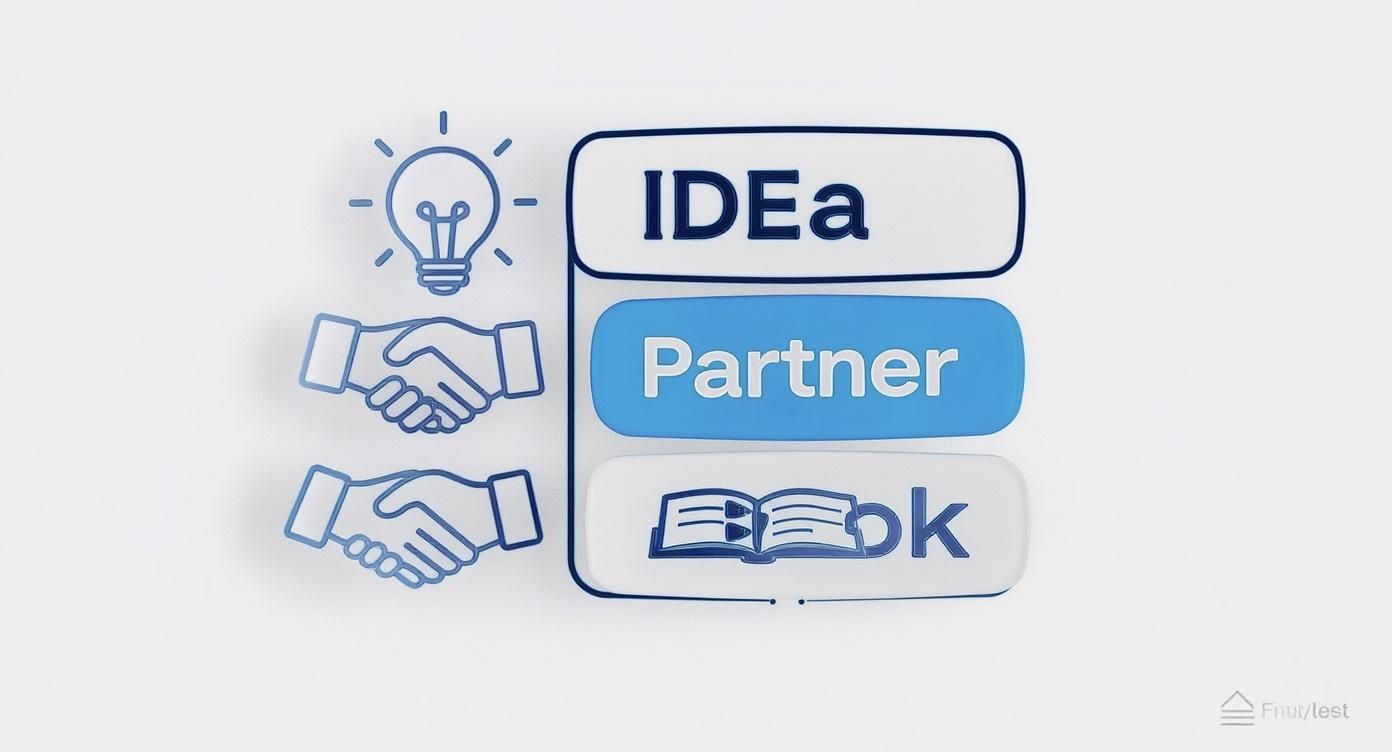
This image really captures the essence of the partnership. It all begins with your unique idea, gains momentum through collaboration, and culminates in a finished book that brings your vision to the world. A book that will last forever.
Ultimately, finding the right ghostwriter is about honoring your story. It’s about giving it the professional craftsmanship it needs to connect with readers and stand the test of time.
Where Do the Best Ghostwriters Actually Hang Out?
So, you are ready to find your co pilot. Fantastic! This is where the real adventure begins. But where do you actually find these literary magicians? It can feel a bit like searching for a unicorn, but I promise, they are out there, and they are looking for meaningful projects just like yours.
Let's demystify the search. Knowing where to look transforms this process from a frustrating shot in the dark to a targeted, successful mission. You would not look for a five star chef at a fast food joint, right? The same logic applies here.

Freelance Platforms: The Curated Marketplaces
Let's start with the most common hunting grounds. Freelance platforms are like bustling online markets where talented writers showcase their skills. The trick is to avoid the noise and focus on platforms that attract serious professionals, not just content mills churning out disposable words.
For book length projects, two of the best are Upwork and Reedsy.
- Reedsy is a fantastic, curated platform specifically for publishing professionals. Think of it as a boutique firm where every ghostwriter has been carefully vetted. It is an excellent place to start if you want to be sure you are only seeing experienced pros.
- Upwork is a much larger ocean, which means more variety in both skill and price. The key here is to master its filters. Zero in on writers with specific "book writing" or "ghostwriting" experience and a strong portfolio of completed projects.
When you post your project, be incredibly specific. A vague "looking for a writer" post will get you buried in generic proposals. Instead, try something like, "Seeking an experienced ghostwriter for a 60,000-word business memoir about overcoming industry disruption." That’s a brief that acts like a magnet for the right talent. It shows you're serious, and serious people attract other serious people.
Ghostwriting Agencies: The White-Glove Service
If the thought of sifting through dozens of profiles makes your head spin, a ghostwriting agency might be your perfect match. These companies are essentially matchmakers. They maintain a roster of vetted writers and will assign the best fit for your specific project and personality.
This is the "white glove" option. You will typically pay a premium, but you save a massive amount of time and energy on the search. The agency handles the contracts, payments, and project management, letting you focus solely on telling your story. It is an ideal choice for busy executives or anyone who wants a more guided, hands off experience.
"Working with an agency provides a safety net. They've already done the hard work of finding and vetting talent, which can be invaluable when you're investing so much into your book."
Personal Referrals: The Hidden Gem
Finally, never underestimate the power of a good old fashioned referral. This is often how the absolute best, most in demand writers find their projects. They are so busy with word of mouth work that they do not even need to be on public platforms.
Tap into your network. Do you know any authors, publishers, or business leaders who have published a great book? Ask them who they worked with. A personal recommendation is gold because it comes with a built in layer of trust and a real world review of their process. Just like when my friend Sarah asked me for a recommendation after she saw how my business book came out. I was thrilled to connect her with my writer, and now her book is a bestseller in her niche. It is all about connections.
This approach requires a little more legwork, but it can lead you straight to a true partner for your project. Someone who comes highly recommended for their skill, professionalism, and uncanny ability to capture a client's voice. The search itself is the first step in honoring your story. Now, let's talk about how to tell the pros from the pretenders.
How to Spot a Pro from a Pretender
Alright, you have waded through the platforms, tapped your network, and now you have a shortlist of potential ghostwriters. This is where the real work begins. It is time to put on your detective hat and figure out who the real deal is.
How do you separate the seasoned storytellers from those who just own a fancy thesaurus? This is your evaluation toolkit. We are going to look past the shiny profiles and get to the heart of what makes a great writing partner. Remember, it is less about finding a perfect writer and more about finding your perfect writer.
What to Look for in a Portfolio
A portfolio is more than just a grammar test. It is a window into a writer’s creative range. Do not just skim for typos. You need to dig deeper and look for evidence of their ability to adapt.
A truly great ghostwriter is a chameleon. Their portfolio should not have one single, uniform "writer voice." Instead, it should be a gallery of different tones and styles, each one fitting the client it was created for.
- Look for voice versatility. Can they write a warm, conversational memoir piece just as effectively as a sharp, authoritative business chapter? If you are writing a deeply personal story, a portfolio full of corporate white papers probably is not the right fit, and vice versa.
- Check for genre experience. Have they written books in your world before? While a skilled writer can tackle almost any subject, someone who already gets the language and expectations of your industry or genre has a massive head start.
- Read between the lines. Look for pure storytelling structure. Even in a business book sample, can you see a clear narrative arc? Do they know how to hook a reader, build an argument, and deliver a satisfying conclusion? That is the craft you are paying for.
The Mystery of the Hidden Portfolio
You might run into a frustrating situation where a fantastic writer says, “I’d love to show you my work, but… I can’t.” Do not immediately cross them off your list. This is often a very good sign.
Confidentiality is the sacred vow of ghostwriting. Most projects are locked down by strict non disclosure agreements (NDAs), which means the writer legally cannot share the work or even mention the client’s name. A writer with a limited public portfolio is usually a writer who is in high demand and deeply respects their clients' privacy.
A ghostwriter who honors their past clients' confidentiality is one you can trust to honor yours. Their respect for privacy isn't a red flag; it's a testament to their professionalism.
So, how do you evaluate them? Ask if they have sanitized samples they can share. These are often excerpts with all identifying client details removed. Or, better yet, this is where a paid trial project becomes your best friend, allowing you to see their skills in action on your own material.
Is It a Human or a Clever Bot?
Now for the elephant in the room: Artificial Intelligence. AI is a tool, and a growing number of writers use it. But you are not looking for a tool. You are looking for a partner with a heart, someone who can capture the nuance and emotion of your story. Your legacy.
The rise of AI in writing is creating a clear divide. While about 68% of ghostwriters use AI tools for some tasks, only a small fraction, around 11%, are using them extensively for book length projects. This trend points toward a growing premium market for purely human creativity, which is what your story deserves. You can learn more about AI's role in the ghostwriting industry to understand these shifts better.
So, how can you spot writing that leans too heavily on AI?
- Listen for the echo. AI generated text often feels a bit generic and formulaic. It hits all the right notes but lacks a distinct personality or rhythm. It is perfectly competent but rarely memorable. It sounds a little too… perfect.
- Watch for soulless sentences. Does the writing feel emotionally flat? Can it make you laugh or feel a lump in your throat? True human connection is still the hardest thing for an algorithm to fake.
- Just ask them. A professional will be transparent. Ask them directly, "What is your philosophy on using AI tools in your writing process?" Their answer will tell you everything you need to know about their commitment to authentic, human centric storytelling. Your book is a legacy. It deserves a human touch.
The All-Important Chemistry Check
A killer portfolio proves a writer has the technical skills. A great interview, on the other hand, tells you if they are the right person to build your book with. This is not just a formality. It is the most critical chemistry check for a collaboration that could last months, or even a year.
You are about to get incredibly personal with this person, sharing stories and ideas that are close to your heart. You have to be sure you can trust them.
Think of it this way: You would not hire an architect to design your dream home without meeting them first, right? You need to know they truly "get" your vision, understand your quirks, and will not roll their eyes when you insist on that secret library behind a bookcase. This conversation is your chance to see if your creative energies actually click.

Questions That Reveal More Than a Resume
Let's move beyond the tired, "So, tell me about your experience" question. You already know that from their portfolio. This conversation is about digging into their process, their passion, and their personality. You are looking for a partner, not just a service provider.
To get to the heart of things, you need to ask questions that reveal how they think and work. Here are a few of my go to's.
Having a list of smart, targeted questions ready for your interview is crucial. It helps you stay focused and ensures you are evaluating each candidate on the same core criteria. This is not an interrogation. It is a structured conversation designed to see if you are a good fit.
Here is a table of essential questions to guide you through the process.
Essential Questions to Ask a Potential Ghostwriter
| Category | Sample Question | What You're Looking For |
|---|---|---|
| Voice & Style | "Can you walk me through your process for capturing a client's voice?" | A detailed process involving deep listening, studying your existing materials (videos, articles), and a focus on understanding your unique cadence and perspective. You want them to become a student of you. |
| Collaboration | "How do you handle constructive feedback or major revisions?" | A professional, collaborative attitude. They should see feedback as a tool to get the book right, not a personal critique. Eagerness to collaborate is a huge green flag. A real pro will say, "I love feedback, it makes the book better." |
| Process | "What does your ideal author-ghostwriter relationship look like?" | An answer that aligns with your own working style. Do they prefer weekly check ins? Do they send drafts as they go or wait until a section is complete? This reveals expectations. |
| Passion & Fit | "What part of the ghostwriting process do you find most rewarding?" | Genuine enthusiasm. Do their eyes light up talking about structuring a narrative or the initial interviews? You want someone who truly loves this work, not just sees it as a job. |
| Logistics | "What’s your availability over the next 6-12 months, and how many other projects will you be handling?" | Realistic capacity. A great ghostwriter is often busy, but they should not be so overbooked that your project gets pushed to the back burner. Look for transparency. |
These questions are not just a checklist. They are conversation starters. Pay close attention to how they answer, not just what they say. Your gut feeling here is incredibly important.
The Non-Negotiable Paid Trial
After a fantastic interview, you might be tempted to jump right in and sign the full contract. Let me give you a piece of advice that has saved my clients from a world of potential heartache: always, always do a paid trial project first.
This is not an insult to the writer. It is a smart business decision for everyone involved. Think of it as a test drive before you buy the car. It gives you a real world preview of their writing and process, and it gives them a chance to see what it is truly like working with you.
A typical trial project could be:
- Writing the first chapter of your book based on an interview.
- Developing a detailed, expanded book outline.
- Rewriting a short piece you have already drafted to see how they can elevate it.
A small upfront investment in a trial project is the best insurance policy you can buy for your book. It confirms the chemistry and ensures their writing style truly matches your vision before you commit to the full manuscript.
This simple step moves your decision from a gut feeling to a confident choice backed by evidence. It is how you know, without a shadow of a doubt, that you have found the right partner to help build your legacy. After all, this is about finding the one person who feels like they were meant to tell your story. And that connection is absolutely everything.
Alright, let's talk about the part of the process that can make people a little squeamish: money and contracts.
I know, I know. Shifting from the creative energy of finding your perfect writing partner to the black and white world of legal agreements can feel like a buzzkill. But I want you to reframe this. Getting the financials and the paperwork sorted is not about a lack of trust. It is the exact opposite. It is about creating a foundation of absolute clarity and mutual respect.
Think of a solid contract as the unsung hero of your book project. It is the silent partner that ensures everyone feels secure, valued, and completely on the same page from day one.
Decoding the Dollars and Cents
So, what is this actually going to cost? The honest answer is… it depends. There is no universal price tag for a ghostwriter. The investment really hinges on the writer’s level of experience, the complexity of your book, how much research is needed, and the overall scope of the project.
In my experience, you will typically run into a few common pricing models:
- Per Word: This is exactly what it sounds like. You pay a set rate, often somewhere between $0.50 and $2.00 per word, for the final manuscript. It is simple, but the total cost can be a bit of a moving target.
- Per Page: Very similar to the per word model, but it is based on a standard 250-word manuscript page.
- Flat Project Fee: This is, by far, the most common approach for a full book. The ghostwriter quotes one all in price for the entire project. The beauty of this is budget certainty. No surprises. For a full length book with a truly experienced professional, you can expect these fees to range from $30,000 to well over $100,000.
- Monthly Retainer: For bigger, more involved projects that might span a year or more, some writers work on a monthly retainer. This model guarantees their time and focus are dedicated to you each month.
Do not let the sticker shock get to you. See this as a direct investment in your legacy, your brand, and your message. The value of a professional writer is immense, which is why the ghostwriting industry is on track to become a USD 6.2 billion market by 2032. It is a reflection of just how critical these partnerships are. You can explore more about the ghostwriting market's expansion here.
The Key Ingredients of a Great Contract
A ghostwriting contract is not just a formality. It is the blueprint for your entire collaboration. It should be written in plain English you can actually understand, not a bunch of dense legalese. And while you should always have a lawyer give it a once over, a great agreement should feel fair and transparent right from the start.
Your contract isn't a weapon for worst-case scenarios. It’s a roadmap for a best-case collaboration. It ensures you both know the route, the milestones, and the destination.
Any professional contract worth its salt will clearly outline a few non negotiables.
What Every Ghostwriting Agreement Must Include
- Scope of Work: This has to be crystal clear. What, exactly, is the writer delivering? Are we talking just the manuscript, or does it include the book proposal and query letters? How many rounds of revisions are included? Define the target word count, the specific deliverables, and the timeline for everything.
- Payment Schedule: Nobody likes having awkward conversations about money. A good contract lays out the payment terms and schedule in no uncertain terms. This is often tied to key milestones: an initial deposit to kick things off, another payment upon delivery of the first few chapters, one at the halfway point, and a final payment on approval of the manuscript.
- Confidentiality Clause (NDA): This is huge. A non disclosure agreement is your legal guarantee that everything you discuss, your stories, your ideas, your business secrets, remains 100% private. It is the legal backbone of the trust you are building.
- Intellectual Property and Ownership: Let me be perfectly clear here: you own 100% of the rights to your book. The contract must explicitly state that this is a "work for hire" agreement. This means the ghostwriter has no claim to your copyright, no right to royalties, and no credit on the cover unless that is something you both specifically agree to. You paid for a service, and you own the final product. End of story.
- Termination Clause: What if, for some reason, things just do not work out? A solid contract provides a fair and orderly exit strategy for both of you. It details what happens to the work that is already been completed and the payments already made if the partnership has to end prematurely. It is the "in case of emergency" clause you will hopefully never need, but you will be glad is there.
Nailing down these details is not just about ticking boxes. It is the final confirmation that you have found a true professional. A writer who presents you with a clear, fair, and comprehensive contract is a writer who respects you, their craft, and is ready to be the partner your story truly deserves.
Got Questions About Hiring a Ghostwriter? Good.
Let's be honest, you have probably got a million questions swirling around. That is a great sign. It means you are taking this seriously and doing your homework to protect the story you have worked so hard to live.
Over the years, I have heard just about every question in the book from leaders and authors to be. Here are the big ones that come up time and time again, answered without any fluff. My goal is to give you the confidence you need to take the next step.
How Much Does It Actually Cost to Hire a Ghostwriter for a Book?
This is the million dollar question, is not it? Or at least, the "how many thousands of dollars" question. The honest answer is: it depends. Anyone who throws out a flat number without knowing your project is selling you something. It is like asking, "How much for a car?" A used hatchback is a totally different ballpark than a brand new SUV.
The real investment comes down to a few key factors:
- The writer's track record: A seasoned pro with a library of successful books under their belt will naturally command a higher fee than someone just starting out.
- The scope of your book: A snappy, 30,000-word business book is a much different project than a deeply researched, 80,000-word family memoir that spans generations.
- How much digging is involved: If your ghostwriter needs to conduct dozens of interviews or spend weeks buried in archives, that time and expertise will be part of the cost.
So, what is a realistic range? A short ebook from a newer writer might run you a few thousand dollars. But for a full length, professionally crafted manuscript from an established ghost, you are typically looking at a starting point in the low five figures, and it can go up from there.
Do not let that number cause sticker shock. Think of it as an investment in your legacy. When it comes to your story, the one thing that will outlast you, the cheapest option is almost never the best one.
Will the Book Still Feel Like Mine If Someone Else Writes It?
Yes. A thousand times, yes. In fact, if the finished book does not feel like it came directly from your soul, the ghostwriter has failed.
This is where the magic happens. A truly great ghostwriter is a master chameleon. Their entire job is to climb inside your world, understand your perspective, and absorb your unique rhythm of speaking until they practically disappear. They do not just write for you. They write as you.
A ghostwriter isn’t there to steal your voice; they’re there to amplify it. They are the skilled artisan who helps you build the cathedral you designed. It’s your name on the cover because it’s your wisdom on the pages.
The entire process is a deep collaboration. Through hours of interviews, conversations, and your feedback on every draft, the writer learns your cadence, your go to metaphors, and your sense of humor. You have the final say on every single word. The end result is not just your book. It is you, in book form.
What Materials Should I Have Ready Before I Start Looking?
Walking into the conversation prepared makes a world of difference. It helps you get a more accurate quote, and frankly, it shows a potential ghostwriter that you are a serious, organized partner they will be excited to work with.
You definitely do not need a polished manuscript. But having these items on hand is a massive head start:
- A Clear Vision: Get to the heart of your book's "why." What is the one message you want to leave with your reader? Who is this book for? How do you want them to feel when they turn the last page?
- A Rough Outline: This can be super simple. A bulleted list of chapter ideas, key stories you have to tell, or major turning points works perfectly. It is a roadmap for the writer.
- Any Existing Content: Gather up any blog posts, speeches, interviews, journal entries, or even rambling voice memos you have. This is pure gold, the raw material a writer will use to start capturing your voice.
The more you bring to the table, the smoother and faster the process will be.
What If I Disagree with What the Ghostwriter Has Written?
That is not a "what if". It is a "when." And it is not a problem. It is part of the process!
This kind of feedback is a completely normal and essential part of any creative collaboration. A professional ghostwriter expects and welcomes your notes. They do not have a fragile ego. They have a singular mission: to get your book right.
Your contract should spell out how many rounds of revisions are included. The trick is to give feedback that is both honest and helpful.
Instead of a vague, "I do not like this chapter," try to pinpoint why. For example: "This paragraph does not quite capture how betrayed I felt in that moment. Can we make the language sting a bit more?" A good writer will take that direction and run with it, getting closer to your truth with each draft.
This is a partnership. Your open and honest communication is the fuel that drives the entire project forward. Never be afraid to speak up. It is your story, and you get to make sure every word rings true.
At My Book Written, we know that starting this process is a huge step. It’s an act of courage and a promise to give your story the platform it deserves. Our resources are designed to provide the clarity you need, from organizing your initial ideas to finding the perfect writer to bring them to life. Explore our guides and start building your legacy today.