
Let's get one thing straight: that half-finished manuscript isn't a failure. It's not a headstone for your great idea. Think of it as a milestone. It's a sign that your first brilliant strategy has taken you as far as it can, and now it's time for a new one. It's not a sign that your story isn't worth telling.
Your Half-Finished Book Is a Milestone, Not a Mistake
I know that blinking cursor on page 147 feels less like an invitation and more like a tiny, flashing judgment. That document holds your passion, your late nights, your best ideas… and right now, it just feels heavy. Like trying to carry a piano upstairs.
If that sounds familiar, welcome to the club. We have jackets. Hitting a wall isn’t a sign of failure; it’s a rite of passage for authors. You're standing where countless creators have stood before, wondering if they have what it takes to get to the finish line. It's a lonely feeling, but trust me, you are in profoundly good company. The journey to creating a physical book, something that will outlast you, is a beautiful and honorable quest. This is just part of the terrain.
The Dreaded Messy Middle
So, what’s really going on here? More often than not, writers get tangled up in what’s affectionately known as the "messy middle." The initial adrenaline rush of the big idea has faded, but the triumphant finish line is still a distant mirage. You're just… in it. The literary equivalent of a long car ride where the kids keep asking, "Are we there yet?"
This is exactly where plot threads start to feel like a knotted ball of yarn a cat's been playing with. Characters might start acting out, going in directions you never planned. That brilliant structure you meticulously outlined? It can suddenly feel more like a cage. It’s like setting out to build a magnificent cathedral and finding yourself staring at a pile of bricks, with no blueprint in sight. This is completely normal. The messy middle is where the real work of storytelling happens, and it demands far more grit than genius.
That Sudden Crisis of Confidence
Another common culprit is a sudden, gut-wrenching crisis of confidence. One minute you’re a literary artist weaving a masterpiece; the next, you're convinced you’re writing the world's most boring grocery list. The doubts creep in, whispering all the worst things:
- "Is this even any good?"
- "Who is actually going to care about this story?"
- "I have absolutely no idea what I'm doing."
This isn’t just your inner critic running wild. It’s the raw, natural fear that comes with creating something from nothing and hoping, praying, it will connect with another human being. It’s vulnerable, deeply personal work.
Here’s the truth: Your unfinished book isn't a dead end. It’s a project waiting for a new plan, a story that deserves to be told. This stall is just an inflection point, a moment to pause, reassess your map, and then get back on the road.
Sometimes, the best strategy is realizing you don't have to walk the path alone. For busy professionals or anyone feeling crushed by the sheer scale of the project, bringing in a professional ghostwriter can be the key that unlocks everything.
This isn't about giving up on your vision. It's about hiring an expert architect to help you build your cathedral. It makes the entire process easier and more fun, and it ensures your vision becomes a reality, beautifully and efficiently. This is your legacy we're talking about, and it's worth getting right.
Quick Wins to Get Your Story Moving Again
When your car is stuck in the mud, you don't need a lecture on automotive engineering. You need a winch. That's what we're going to find right now, the little tricks that can pull your manuscript out of the muck and get you moving again.
These aren't massive, soul-searching overhauls. They're small, actionable tactics designed to do one thing: build momentum. The goal isn’t to write the perfect chapter. It’s simply to get words on the page and prove to yourself that you can still do this.
Progress over perfection. That's the mantra. Especially when you're staring at a blank page, it helps to have a few strategies for overcoming creative blocks in your back pocket.
Is Your Stall Technical or Emotional? A Quick Diagnosis
Before diving into solutions, it's incredibly helpful to figure out why you're stuck. Is it a plot hole, or is it fear of failure? This quick checklist can help you pinpoint the source so you can apply the right fix and get back to writing faster.
| Symptom You're Experiencing | What It Might Mean | A Quick Win to Try |
|---|---|---|
| Staring at a blank page for hours | Emotional Block: You're feeling overwhelmed or intimidated by the task. | The "Bookend" Method. Just write one sentence today. |
| Deleting every sentence you write | Technical/Emotional Mix: You might have a "perfectionism" problem, or the scene simply isn't working. | The "Character Interview." Let your protagonist tell you what's wrong. |
| Feeling bored with your own story | Technical Block: The current scene lacks conflict or your routine has become stale. | A "Change of Scenery." Switch up your font and background color. |
| The plot just doesn't make sense | Technical Block: You have a genuine structural issue or plot hole. | Reverse outlining. Work backward from the end of the chapter. |
Identifying the root cause is half the battle. Once you know what you're up against, you can stop spinning your wheels and start making real progress.
Trick Your Brain with a Change of Scenery
Sometimes, the problem isn’t your story; it's your brain's sheer boredom with the routine. Staring at the same black on white Times New Roman font for six months can create a mental block all on its own.
So, let's redecorate. Change your document’s font to something totally different, like Courier, or even something silly like Comic Sans for an hour. Switch your background to a calming sepia or a focused dark mode.
This tiny shift can trick your brain into feeling like it’s working on something new and exciting, breaking that stale association you've built with the manuscript. It’s the literary equivalent of rearranging the furniture. If you're looking for a fresh interface, you might find some inspiration exploring the best tools for writing a book.
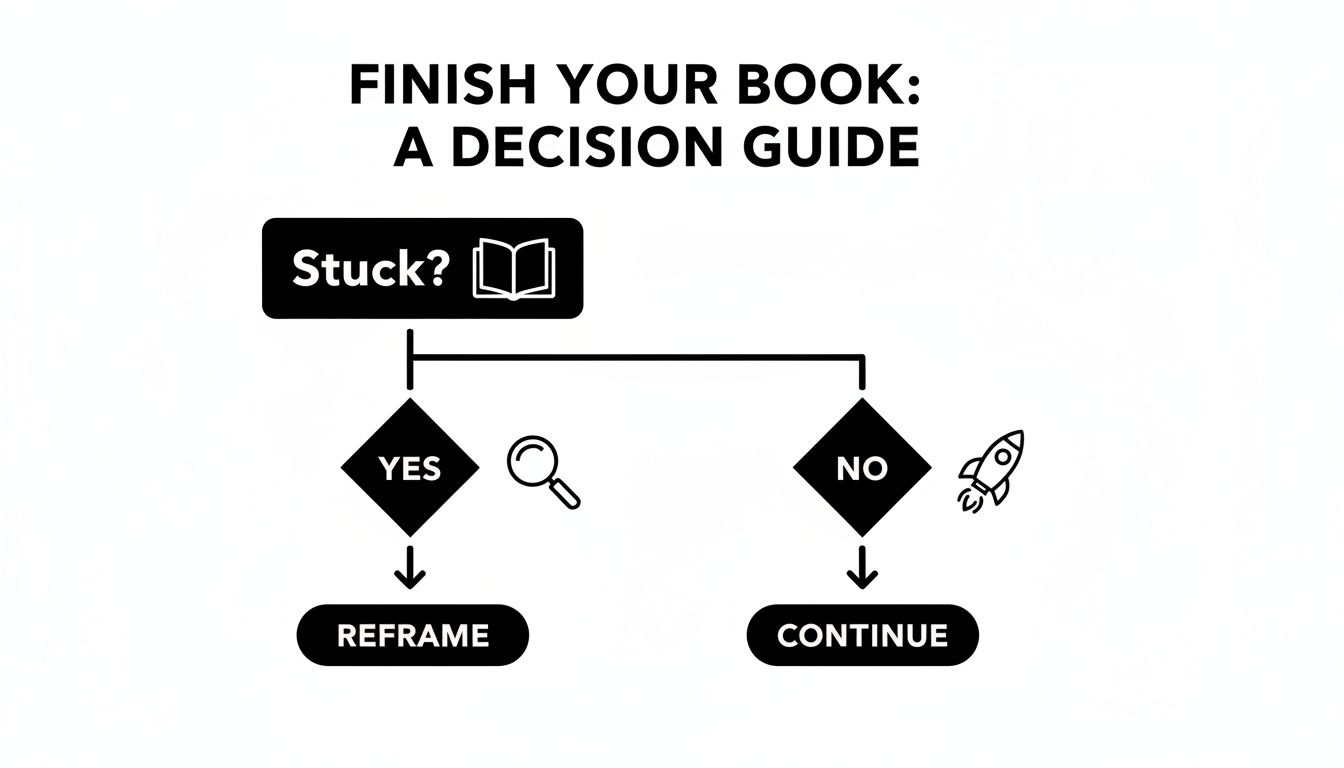
As you can see, getting stuck isn't a dead end. It's a signal to reframe your approach and try something new.
Give Your Characters the Mic
Feeling all the pressure to figure out what happens next? Stop. Take yourself out of the equation for a moment.
Open a totally new document and "interview" your main character. I'm serious. Ask them direct questions and just write down whatever they would say, in their own voice.
You could try prompts like:
- "So, what do you really want right now? Forget what the plot says."
- "What are you most afraid is going to happen next?"
- "If you could give me, the author, one piece of advice, what would it be?"
I once did this with the subject of a historical memoir I was helping with. He flat out told me, "I wouldn't have gone to London. I'd have stayed to fight." It was a complete tangent from my outline, but it revealed his core motivation so clearly that it unlocked the entire next chapter.
Master the Art of the "Bookend"
The idea of writing for two hours can feel crushing when you’re stuck. So don’t. Instead, try the "bookend" method. Your task is beautifully simple:
First, the starting bookend: Open your manuscript and just reread the very last paragraph you wrote. That's it.
Then, the closing bookend: Write one new sentence. Just one. It doesn’t even have to be a good one.
That’s your entire writing session for the day. You’ve officially made progress. More often than not, that one sentence will turn into two, then a paragraph, and suddenly you’re moving again. It lowers the barrier to entry so much that it becomes harder to procrastinate than to just do it.
Getting your book done isn’t just about getting unstuck; it’s about reclaiming your story. It's a testament to your vision and a legacy in the making. But you don't have to build it brick by brick all by yourself.
If these quick wins feel like you're just patching a sinking ship, it might be a sign you need more than a temporary fix. Bringing a professional ghostwriter on board isn't quitting; it’s hiring a master shipbuilder to help you reach the shore. It can make the journey more fun, ensure a beautiful final product, and keep your original vision right at the helm. It’s your story, brought to life with an expert partner.
Redrawing the Map When Your Story Is Lost

Sometimes the problem isn’t your writing engine; it’s the GPS. If the quick fixes we just talked about helped but didn't solve the core issue, it might be time to pull over and really look at the map. You could be following a route you plotted months ago that just doesn't lead where you want to go anymore.
This stage isn't about criticizing your early work or getting lost in line edits. It’s about getting a 10,000 foot view of your story’s skeleton to see what’s actually on the page, not just what you think is there. A structural problem can feel exactly like a writing problem, but they demand totally different solutions.
One of the most powerful tools in my arsenal for this is something called reverse outlining. Don't let the jargon scare you. It’s simply the process of creating an outline from what you’ve already written, and believe me, it’s a game changer for getting a book finished.
See Your Story in a New Light
Think of a reverse outline as an X-ray of your manuscript. It lets you see the bones of your story without getting distracted by all the beautiful sentences you’ve worked so hard on. Suddenly, those pesky plot holes, weird pacing issues, and characters who took a wrong turn somewhere in the second act become glaringly obvious.
Here’s how you can do it:
- Go through your book, one chapter or scene at a time.
- For each one, write a single sentence summarizing what happens and why it matters.
- Compile these sentences in order in a fresh document.
That’s it. Now you have a clean, scannable map of your book. Looking at this "synopsis" of your own work is incredibly revealing. You might notice, for instance, that your protagonist spends three chapters agonizing over a decision… but never actually does anything.
This process isn’t a setback; it’s a renovation. It’s about ensuring every single part of your book supports your core message and keeps the reader utterly hooked until the very last page.
A solid structure is non-negotiable for keeping readers invested, and the data backs this up. The completion rates for even blockbuster books are shockingly low. Donna Tartt’s celebrated novel The Goldfinch was only finished by 44% of readers, while Daniel Kahneman's Thinking, Fast and Slow saw a completion rate of just 7%. This tells us that narrative momentum and clear pacing are absolutely critical for holding a reader’s attention.
Permission to Make Big Changes
Once you’ve got your reverse outline laid out, you can start asking the tough questions. Is that chapter you absolutely love actually moving the story forward? Does that side character who was so much fun to write serve any real purpose?
This is where you have to give yourself permission to be ruthless. I once worked with a CEO on his business memoir, and he had a brilliant chapter about his first failed startup. The stories were hilarious and full of insight, but the reverse outline showed us it landed right when his main company was facing its biggest crisis. It completely killed the story’s momentum.
Cutting that chapter was painful for him, like saying goodbye to an old friend. But as soon as it was gone, the pacing of the entire book improved dramatically. The renovation was a success.
Here's what to look for on your new map:
- Dead Ends: Where does the story’s energy just… fizzle out?
- Detours: Are there subplots or characters that wander off and never come back?
- Repetitive Loops: Do you find characters learning the same lesson over and over?
- Missing Bridges: Are there huge logical leaps between scenes that might leave a reader confused?
Finding these issues is a victory, not a failure. Now you have a clear blueprint for what needs to be fixed. If you’re not sure how to build that initial map in the first place, check out our guide on how to create a book outline to get a solid foundation.
Honestly, this level of structural work is where many authors realize they could use an expert partner. A professional ghostwriter isn’t just a writer; they are a story architect. They can help you redraw the map and rebuild your book with a structure that is both elegant and incredibly strong, honoring your vision while making the whole process a lot more manageable.
Creating a Writing Routine You Can Actually Stick To

Let’s get one thing straight right away. That romantic image of the tortured artist, chain smoking and banging out a masterpiece until dawn? It’s a myth. It makes for a good movie scene, but it's a terrible strategy for actually finishing a book.
Writing a book is a marathon, not a sprint. It demands a calm, sustainable pace, not frantic, caffeine fueled bursts of inspiration. This isn't about magically finding eight free hours a day. It’s about building a practice that fits into your real, messy, beautiful life and honoring the commitment you made to your story without burning out.
Ditch the "Write Every Day" Guilt
The most common piece of writing advice is also the one that torpedoes the most writers: "Write every day." For most of us with jobs, families, and other commitments, it’s just not realistic. Missing one day makes you feel like a failure, and that guilt can easily spiral into avoiding your manuscript for weeks.
So, let's reframe this. Forget the daily grind. Think in terms of consistent, scheduled writing appointments.
Pull up your calendar and find two or three realistic slots in your week. Maybe it's an hour on Tuesday morning before the house wakes up, or a couple of hours on Saturday afternoon. Block them out. Treat them like a non-negotiable meeting with your legacy, because that’s exactly what they are.
Master the Art of the Focused Burst
When you show up for your writing appointment, you need to make every minute count. This is where a technique like the Pomodoro Method becomes your secret weapon. It’s almost laughably simple, but it’s a game changer for training your brain to focus.
Here’s how it works:
- Set a timer for 25 minutes. For those 25 minutes, you do nothing but write. No checking email, no scrolling social media, no "quick" research detours that lead you down a rabbit hole. Just write.
- When the timer dings, you stop. Seriously. Get up, stretch, grab some water, and take a genuine 5 minute break.
- Rinse and repeat. After four of these focused bursts, or "Pomodoros," give yourself a longer break of 15 to 20 minutes.
This works because it breaks the overwhelming task of "writing a book" into a manageable chunk. Anyone can do anything for 25 minutes. It respects your brain’s natural rhythm and prevents the burnout that comes from trying to force creativity for hours. As you build your schedule, it's helpful to think about energy management vs time management; you want to write when your mind is sharpest, not just when you have a free hour.
Your writing routine shouldn’t feel like a punishment. It should be a protected, sacred space you look forward to. If it’s causing more stress than satisfaction, it’s the wrong routine for you.
This focused approach is more critical than ever. In 2019, Americans spent an average of just 16 minutes per day reading, a steep drop from 23 minutes daily back in 2004. With shorter attention spans, your book needs to be sharp and compelling from page one. That's a lot easier to achieve with focused writing sprints than with exhausted, marathon sessions. You can dig into more of these reading trends on Scioto County Daily News.
When Time Is the Real Obstacle
Of course, sometimes no amount of clever scheduling can create time that just isn't there. If you're a founder, a busy executive, or a parent juggling a million things, your time and energy are already maxed out. The roadblock isn't a lack of ideas, it's the raw, logistical reality of your life.
In these situations, bringing in a strategic partner can be the smartest move you make. Hiring a ghostwriter isn't admitting defeat. It’s delegating the heavy lifting of drafting to a professional so you can focus on what only you can provide: the vision, the expertise, and the soul of the book. It’s how you get your story told without sacrificing your sanity or your business.
For anyone who feels their message is too important to stay stuck, exploring a service like Opus Eternal can be a true breakthrough. They offer premium, expert ghostwriting with a remarkably efficient process. Often, their pricing is less than half that of traditional agencies, making the dream of a beautifully finished book an accessible reality, without ever compromising on quality.
Knowing When to Ask for a Helping Hand
There's a quiet, profound honor in creating a book. You're building something that will last, a piece of your mind and heart made tangible. But nowhere in the rulebook does it say you have to lay every single brick by yourself.
Knowing when to bring in reinforcements isn’t a sign of weakness; it’s a sign that you respect your vision enough to see it through to the end. Frankly, it’s a strategic move, a mark of a savvy creator.
So, how do you know if you need a hand, and what kind of help is right for you? Let's demystify this. It’s not about giving up control. It’s about finding the perfect partner to help you build your legacy.
Diagnosing Your Needs
Think of your book as a beautiful, sprawling garden you're trying to grow. Sometimes you just need a bit of advice on where to plant the roses. Other times, you need a master landscaper to help you design the whole thing from scratch.
Here’s a quick guide to figuring out what kind of expert your project might need:
- The Book Coach: You're the gardener who's lost motivation or can't figure out the next step. A coach is your cheerleader and strategist, helping you set goals, bust through emotional blocks, and stay accountable. They don't write for you, but they make sure you keep writing.
- The Developmental Editor: You've planted everything, but the layout just feels… off. The roses are choking out the daisies, and there's a weird empty patch in the middle. This editor looks at your finished or partial draft and helps you fix the big picture structural problems, pacing, plot holes, character arcs, and flow.
- The Ghostwriter: You have the vision for a breathtaking garden but lack the time or the specific expertise to do all the digging, planting, and pruning yourself. A ghostwriter is your master landscaper, the one who takes your grand design and brings it to life, chapter by chapter.
Choosing to work with a professional is an investment in your vision. You're not outsourcing your story; you're bringing in a specialist to ensure its beauty is fully realized.
And what a time to be doing it. The global book market is projected to reach an incredible $156.04 billion by 2030, with self published authors making up a huge part of that growth. This just means there are more pathways than ever for your finished book to find its audience. You can discover more insights about these book sales statistics on Newprint.
Vetting Your Potential Partner
Once you've decided you need a partner, the next step is finding the right one. This is a crucial decision. You're not just hiring a contractor; you're trusting someone with your story, your voice, and your legacy.
It's not just about finding a good writer; it's about finding your writer. You need someone who gets your vision on a gut level. As you start looking, keep a few key things in mind.
A simple mental checklist can be a huge help here. When you’re speaking with potential ghostwriters or editors, make sure you feel confident about these points:
- Do they listen more than they talk? A great partner is obsessed with understanding your vision, not pushing their own agenda.
- Does their portfolio show versatility? You want a chameleon who can adapt their style to match your voice, not a writer with only one note.
- Are they transparent about their process? You should know exactly how they work, from interviews and outlining to revisions and deadlines. No black boxes.
- Do you genuinely enjoy talking to them? You’ll be spending a lot of time with this person. A good rapport is absolutely non-negotiable.
Finding the right person can feel overwhelming, but it doesn't have to be. For a deeper dive into this process, you might be interested in our guide on how to hire a ghostwriter.
Ultimately, for so many aspiring authors, hiring a ghostwriter is the clearest path forward. It's easier, it's often more fun, and it guarantees that your idea, the one that feels stuck right now, becomes a beautifully crafted, physical book that you can be proud of forever. It's your vision, brought to reality.
Common Questions About Finishing Your Book
You’ve made it this far, which tells me you’re serious about getting this book out of your head and into the world. But as you get ready for that final sprint, a few nagging questions are probably still bouncing around. That’s completely normal. In fact, it’s a good sign, it means you care about getting this right.
Let's dive into some of the most common hurdles that pop up when you're this close to the finish line.
How Do I Know If I Have Writer's Block or a Bad Idea?
This is the big one, isn't it? The fear that keeps so many talented people from finishing their work. Let me put your mind at ease: true writer's block is almost always about fear, perfectionism, or just plain burnout. It’s rarely about having a “bad” idea.
Here's a quick gut check I tell my clients to do. Grab a friend you trust, someone who gets you, and try to explain your book concept to them. If you can still talk about its core message with even a tiny spark of excitement, the idea is solid. A truly "bad" idea usually feels hollow or flimsy when you say it out loud. You'll find yourself struggling to explain why anyone should care.
More often than not, your idea is perfectly fine. It's usually the approach that needs a fresh look. Remember, even the best ideas feel wobbly and a little ridiculous somewhere in the messy middle.
Is It Still My Book If a Ghostwriter Helps Finish It?
Yes. Absolutely. 100% yes.
Think of a ghostwriter like the master builder you hire to construct the house you designed. You provide the blueprint, the vision, the personal stories, and the soul of the project. The ghostwriter brings the specialized craft of structuring sentences and weaving your ideas into a page turner. Their job isn’t to invent; it's to translate your genius onto the page.
You are the author. They are the expert collaborator whose skill brings your unique, authentic vision to life. It’s an incredibly smart and efficient way to build your legacy.
Their contribution is invisible by design. The final book is, and always will be, undeniably and authentically yours.
What's the Difference Between Editing and Ghostwriting?
This is a critical distinction that can save you a ton of time and frustration. It all boils down to what you have versus what you need.
- An editor works with words you've already written. They are masters of refinement. They’ll take your completed manuscript, fix structural problems, polish your prose, and get it ready for readers.
- A ghostwriter helps you create the content from scratch. They are the builders. They can take your interviews, scattered notes, and outlines and transform them into finished chapters.
So, if you have a complete but messy draft, you need an editor. If you have a half finished manuscript and are totally stuck on writing the rest, a ghostwriter is your best bet.
How Long Should I Wait Before I Decide I'm Stuck?
There’s no magic number here, but you can usually tell by looking at a mix of time and emotion. If you've been actively trying different unsticking strategies for a month and have made zero real progress, that’s a pretty clear signal that it's time for a new game plan.
Even more importantly, listen to how you feel. If the thought of opening your manuscript fills you with dread, apathy, or anxiety for weeks on end, your current process is officially broken. Don't let that frustration fester until it becomes resignation.
Reaching out for help the moment you feel genuinely stuck isn’t a sign of failure; it's a strategic move. It's a smart decision that can save you months, or even years, of spinning your wheels. Your story is far too important to leave it stranded.
At My Book Written, we understand the profound honor and vulnerability that comes with creating a book. Whether you're just starting or are stuck midway through, we provide the resources to help you organize your vision and find the perfect partner to bring it to life.