
Let's be real for a second. Pouring your soul, your expertise, or your life's work into a book is a monumental act. You are crafting a piece of your legacy. This is something that will sit on shelves and in digital libraries, sharing your unique perspective long after the work is done. It is a beautiful, honorable thing.
But once that final manuscript is done, a different feeling often creeps in. "Okay… now how do I get people to actually read this?" It's a universal hurdle. You have conquered the creative mountain, only to find yourself at the base of another one called marketing. For most experts and visionaries, this feels like a completely different, and frankly, intimidating skill set.
You're a Messenger, Not a Marketer
Here’s the secret: you do not have to transform into a slick, sales obsessed guru overnight. Forget the hard sell. Think of this process less as "marketing" and more as "sharing." You are simply inviting people to benefit from the knowledge you have so carefully packaged.
This guide is your co pilot, designed for the expert who had the wisdom to focus on the big ideas and maybe even partnered with a professional ghostwriter to handle the prose. You focused on the vision. Now, let's focus on getting that vision into the right hands.
We are going to skip the confusing jargon and get straight to the practical, actionable steps you can take to share your book with the world. This is not a chore. It is the final, exciting step of giving your gift.
The most successful authors do not start marketing on launch day. They start building relationships months, sometimes years, in advance. Promotion is simply the act of inviting your new friends to the party you have been planning.
The entire flow of a successful book promotion campaign really just comes down to three foundational ideas.
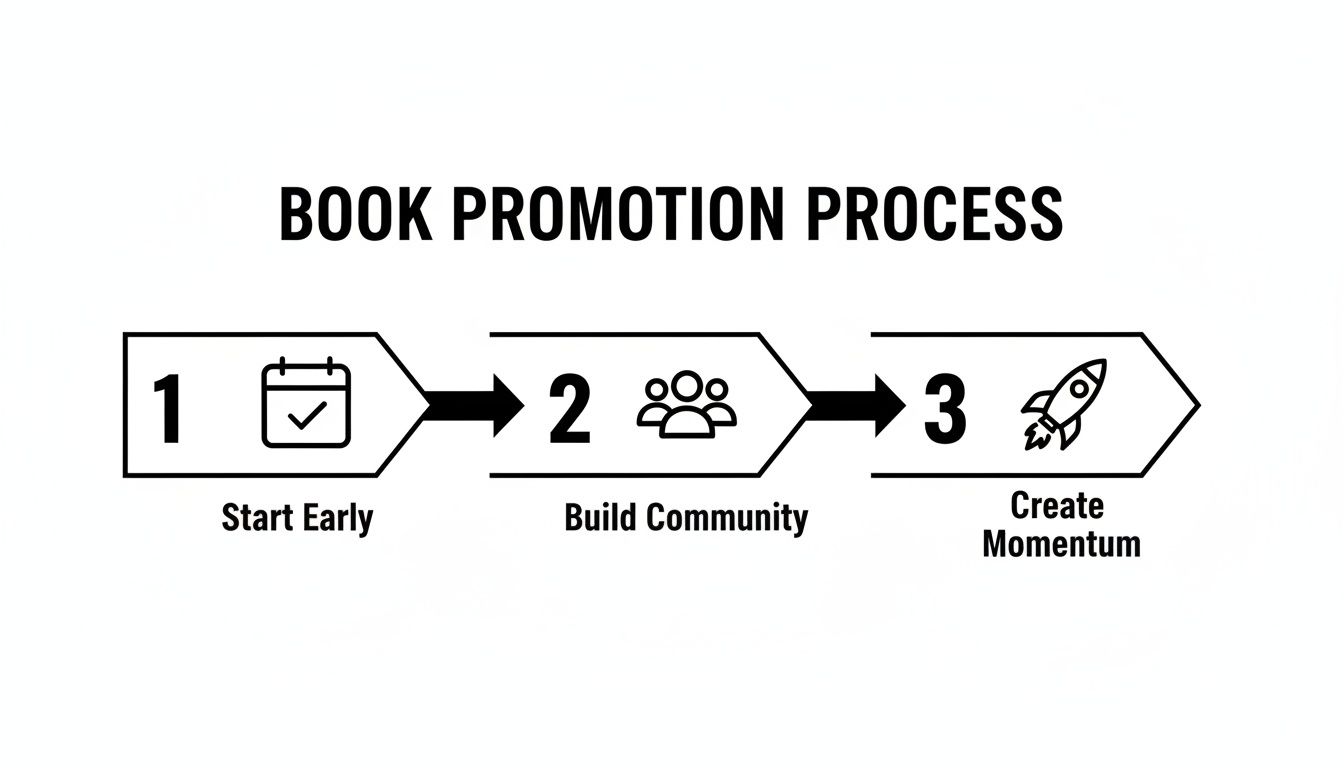
This simple framework shows that great book promotion is not a one time event. It’s a journey built on foresight, genuine connection, and sustained energy.
The Three Pillars of Book Promotion
You do not need a massive budget or a team of marketing experts to make a real impact. All you need is a thoughtful plan built around these core principles.
-
Start Early: The single biggest mistake authors make is waiting until their book is published to start talking about it. The real work begins months in advance by building an audience that is primed and excited for your message.
-
Build a Genuine Community: This is not about chasing vanity metrics like follower counts. It is about creating real, human connections with people who will not only buy your book but become its most passionate champions.
-
Create Sustainable Momentum: A massive launch week is fantastic, but what happens in month two? Or year two? The goal is to build simple, repeatable systems that keep introducing your book to new readers long after the initial buzz has faded.
Think of it like this: your book is a seed. The pre launch phase is preparing the soil. Launch week is the big, nourishing rainstorm. And the post launch activities are the steady sunshine and water that help it grow for years to come.
Your Book Promotion Quick Start Checklist
To make this even clearer, here's a quick start checklist that breaks down the essential activities for each phase. Think of this as your 30,000 foot view of the entire process.
| Phase | Core Activity | Why It Matters |
|---|---|---|
| Pre-Launch | Build Your Email List & Audience | You need a direct line to people who are eager to buy on day one. An email list is the most valuable asset you can have. |
| Launch Week | Execute a Coordinated "Push" | Concentrating your efforts (reviews, social media, PR) in a short window creates a powerful burst of visibility and sales velocity. |
| Post-Launch | Establish Ongoing "Systems" | Setting up evergreen marketing channels (like podcast interviews or paid ads) ensures your book continues to find new readers automatically. |
This table maps out the journey from foundational work to long term success. Keep these three phases in mind as we dive into the specific tactics for each one.
Build Your Audience Before Day One

Here's a little secret that separates the books that fly off the shelves from the ones that gather dust: the real work starts long before the book even exists. I know, I know. You just finished the marathon of creating a book and pouring your expertise onto the page. The last thing you want to hear is that another race is just beginning.
But this part is different. It’s less of a sprint and more like planning a fantastic party. You would not just throw a party without telling anyone, right? You would drop hints, build excitement, and make your guests feel special. That is exactly what we are doing here.
The single biggest mistake I see new authors make is waiting until launch day to start talking about their book. That is like throwing that party without sending a single invitation and just hoping people show up. They will not. The magic happens when you start building your "launch team," your core group of future fans and readers, months in advance.
Your Digital Home Base
First things first, you need a little corner of the internet to call your own. A simple author website is non negotiable. Do not let that scare you! You do not need a computer science degree or a massive budget for this. Just think of it as your digital business card.
At a minimum, it just needs three things:
- A page about you and your story.
- A page dedicated to your new book.
- A clear way for people to join your email list.
That is it. It's a central hub to send anyone who is curious about your work. If setting this up feels like one task too many, and it often does, this is a perfect job to delegate. Just like hiring a professional ghostwriter helped get your book written, a virtual assistant can get a simple, elegant site online in a weekend. It is all about preserving your energy for the parts only you can do.
The Power of an Email List
If your website is your home, your email list is your direct line to your most dedicated readers. Social media is great for finding people, but you do not own your followers. An algorithm change can wipe out your reach overnight. Your email list, however, is an asset that’s yours to keep.
Getting started is easier than you think with platforms like Mailchimp or ConvertKit. The real question is: what do you actually send to people? You send them the good stuff, the inside scoop.
Give them a reason to be excited:
- Share a compelling snippet from a chapter that leaves them wanting more.
- Tell the emotional story of why you decided to write this book.
- Get them involved by asking them to vote on two different cover designs.
The goal of an email list is not just to sell. It is to serve. It is about starting conversations and making people feel like they are part of your journey. When you do that, the selling part takes care of itself.
Making Connections on Social Media
Now, let's talk about finding these new friends. The first step in any marketing plan is knowing exactly who you are talking to. If you are not sure where to begin, learning how to identify your target audience will make all your promotional efforts laser focused and much more effective.
Once you know who you are looking for, you can find them where they already are. The rise of TikTok’s #BookTok phenomenon is proof of social media's incredible power, directly influencing a huge number of print book sales. This is not just a trend for fiction; it’s a powerful blueprint showing how authentic, creator driven buzz can launch a book into orbit, especially with global online book sales projected to reach billions.
You do not need to be everywhere. Just pick one platform where your ideal readers hang out and start sharing. Post about your writing journey, the messy parts and the breakthroughs. Ask questions. Be a real person. This is not about shouting into the void; it is about building genuine connections, one conversation at a time.
Crafting an Unforgettable Launch Week
Alright, take a deep breath. All those months of planning, of pouring your heart and soul into the manuscript, it has all led to this. Now, it is time to pop the champagne. This is your book's grand opening, and our job is to make some noise.
Everything you did to build an audience was the setup. This is the payoff. Launch week is all about bringing those threads together to create a “thunderclap” moment, a coordinated surge of energy that lets the world know something special has arrived.
And listen, the goal here is not just about hitting a bestseller list (though that would be amazing, right?). The real mission is to spark a wave of momentum that will carry your book forward for months, even years.
Your Launch Team Is Your Secret Weapon
Remember that community you have been building? Your email list, your social followers, those early supporters? They are your launch team, and honestly, they are the absolute heart of a successful launch week. These are the people who will buy the book on day one, tell their friends, and, most importantly, leave those crucial early reviews.
But you have to ask them. People are busy, and even your biggest fans need a clear, friendly nudge. This is not about being pushy; it is about inviting them to the party you have been telling them about for months.
Here’s how to frame the ask without feeling weird about it:
- Get specific. Do not just say, "Hey, please support my book!" Instead, try something like, "Would you be willing to buy the book on Tuesday and leave a quick review on Amazon by Friday? It would mean the world to me."
- Make it dead simple. Give them direct links to the book's sales page and the review page. You can even draft a few sample social media posts they can copy, paste, or tweak. The less work they have to do, the more likely they are to jump in.
- Show your gratitude. Thank them like crazy, both before and after. Make them feel like the heroes they truly are.
Getting those first 10 to 15 reviews on Amazon is a game changer. It creates what’s called “social proof,” signaling to new visitors that other people have read and valued your book, making them much more likely to take a chance on it.
Launch week is less about selling a product and more about mobilizing a community. The energy of a few dozen passionate advocates is far more powerful than a thousand silent followers.
Stoking the Fires of Excitement
Beyond rallying your core supporters, a few other tactics can really turn up the heat during launch week. One of the most powerful moves is a limited time price drop.
The Power of the Launch Week Discount
Launching your ebook at a special price, like $0.99 or $1.99, for the first few days can drive a massive number of early sales. This initial sales velocity sends a strong signal to Amazon’s algorithms, helping your book climb the charts in its categories and get in front of new readers.
It might feel like you are losing money, but think of it as a short term dip in revenue for a huge long term gain in visibility. It is a loss leader for attention.
Get on Podcasts
Another fantastic way to reach a perfectly targeted audience is to be a guest on podcasts. You do not need to land a spot on a top ten show. A guest appearance on a smaller, niche podcast can introduce your story and your book to hundreds of listeners who are exactly the people you wrote it for.
Start by searching for podcasts in your field of expertise. Send a short, personalized pitch explaining the value you can bring to their audience. It is a wonderfully personal and effective way to connect with potential readers.
The scale of the opportunity here is massive. You are launching your book into a global market that is projected to hit over $142 billion in revenue. While print books still dominate in the U.S., ebooks represent a multi billion dollar segment, making a hybrid promotion strategy essential. Just look at how platforms like TikTok's #BookTok have driven tens of millions of U.S. print sales. It is proof that authentic promotion works. You can find more details about these book sales statistics to see just how your book fits into this exciting picture.
Keep the Momentum Going Long After Launch
Launch week is the big, flashy firework show. It is exciting, it is loud, and it gets a lot of attention. But what happens after the smoke clears? That initial burst of energy is incredible, but it is the slow, steady burn that turns a book into a long term asset.
I get it. The thought of endless promotion can feel completely exhausting. You have already poured your heart and soul into creating this book, maybe even with a professional ghostwriter to help translate your vision. And now I am telling you the work continues?
Do not worry. This is not about running yourself ragged. It is about building simple, sustainable systems that keep your book finding new readers long after the launch party confetti has been swept away. Think of it less like chasing butterflies and more like tending a garden.
Content That Keeps on Giving
Your book is a goldmine of content just waiting to be repurposed. You have already done the heavy lifting by creating the core material; now it is time to slice and dice it into bite sized pieces for different platforms. This is one of the best ways to show people the value inside your book without just shouting, "Buy my book!"
This approach does not just promote your book; it cements your authority and builds genuine connections with potential readers.
Here are a few ideas to get you started:
- Blog It Out: Take a key concept or chapter from your book and expand it into a detailed blog post. Give readers a taste of your expertise that leaves them hungry for the whole meal.
- Create a Mini Series: Turn the core themes into a short, three to five part video series for YouTube or social media. Each video can tackle one idea, offering practical advice and ending with a gentle nudge toward the book for a deeper dive.
- Host a Webinar: Invite your email list to a free live training or Q&A session based on a central chapter. This provides immense value and fosters a direct, personal connection with your most engaged followers.
This is not about creating more work. It is about working smarter. You have already made the beautiful, handcrafted table; now you are just setting it for new guests.
The Gentle Art of Partnerships
You do not have to do this all by yourself. In fact, one of the most powerful, and enjoyable, ways to keep the momentum going is to team up with others who are on a similar journey. Think community over competition.
The most beautiful thing about the world of books is that a reader’s love for one book does not diminish their capacity to love another. It expands it. Partnering with other authors is not splitting the pie; it is baking a bigger one together.
Collaborating introduces your work to a brand new, pre qualified audience that already trusts the person you are partnering with.
Here are some simple partnership ideas:
- Newsletter Swaps: Find an author with a similar audience and agree to feature each other’s books in your newsletters. It is a simple, effective, and free way to cross promote.
- Co Host an Online Event: Team up with a fellow author for a joint Instagram Live, a webinar, or an online Q&A session. It is more fun for you and offers double the value for your combined audiences.
- Bundle Up: If you have written a nonfiction book, consider creating a digital bundle with other authors in your space. Everyone contributes a product (like an ebook or a mini course), and you all promote the bundle to your respective audiences.
The Never Ending Quest for Reviews
Reviews are the lifeblood of a book's long term success. They provide the social proof that helps new readers decide to take a chance on your work. The key is to continuously and gently encourage readers to leave them, long after launch week is a distant memory.
A simple, non icky way to do this is to add a polite request right into the back of your book. A short, heartfelt note at the end, thanking the reader and explaining how much a brief, honest review helps, can work wonders.
You can even include a direct link to the review page to make it ridiculously easy for them. This creates a slow, steady trickle of new reviews that keeps your book looking fresh and relevant for years to come.
Your Essential Book Promotion Toolkit

Let's be honest, the moment someone says “marketing toolkit,” it’s easy to imagine a hundred complicated apps and a credit card bill that looks like a phone number. I promise, that is not what this is about. You do not need a mission control center to promote your book effectively.
You just need a few good, reliable tools in your corner. Think of it like this: you would not try to build a beautiful bookshelf with just a spoon, right? These tools are your hammer and nails, helping you do the job right without all the frustration.
The goal is to automate the tedious bits so you can focus on what really matters, connecting with your readers. And here is my favorite part: if even this feels like too much, this is the perfect stuff to hand off to a virtual assistant. Your job was the vision and the story. Let someone else handle the nuts and bolts.
Your Direct Line to Readers
We have talked about how vital an email list is, but which platform should you use? The two biggest names you will hear are Mailchimp and ConvertKit. They both get the job done, but they are built for slightly different people.
-
Mailchimp: This is often the go to for beginners. It's known for its user friendly, drag and drop design, making it super easy to create pretty newsletters without any technical fuss. It is like the "getting started" kit for email.
-
ConvertKit: This one is built with creators and authors in mind. It might look a little plainer, but its power is in its simplicity and automation features. It makes it really easy to tag subscribers based on their interests and send them super relevant content.
My advice? Do not overthink it. Pick one and start. You can always switch later if you need to.
Taming the Social Media Beast
Trying to post on social media every single day is a surefire recipe for burnout. That is where scheduling tools come in. They are an absolute lifesaver, letting you plan your posts for the week or month in one sitting.
Platforms like Buffer or Later allow you to write your posts, add your images, and schedule them to go live at the perfect time. This frees you from the tyranny of having to think, "Oh no, what should I post today?" every single morning. An organized approach is key, and a helpful marketing content calendar is an essential tool for planning and tracking all of this.
The right tools do not add complexity; they create simplicity. They give you back your most valuable resource: time. Time you can spend writing your next book or just, you know, living your life.
Creating Eye Catching Graphics
You do not need a graphic design degree to make your book look good online. Seriously. Tools like Canva and BookBrush were made for people who do not have a creative bone in their body but still want to create stunning visuals.
They have templates for everything: social media posts, ads, and even cool 3D mockups of your book. You just drag your cover in, change the text, and you have got a professional looking graphic in minutes. It is almost… too easy.
Essential Book Promotion Tools Compared
Choosing your tools can feel overwhelming, so I have put together a quick comparison to help you find the right fit for your needs and budget. Remember, the best tool is the one you will actually use consistently.
| Tool Category | Popular Options | Best For | Typical Cost |
|---|---|---|---|
| Email Marketing | Mailchimp, ConvertKit | Beginners (Mailchimp), Authors & Creators (ConvertKit) | Free plans available; Paid starts ~$10-30/mo |
| Social Media | Buffer, Later | All-in-one scheduling (Buffer), Instagram focus (Later) | Free plans available; Paid starts ~$6-18/mo |
| Graphic Design | Canva, BookBrush | General-purpose graphics (Canva), Book mockups (BookBrush) | Free plans available; Paid starts ~$12-13/mo |
Do not feel like you need the most expensive option. Start with the free tiers, get comfortable, and only upgrade when you have a clear reason to.
A Gentle Intro to Paid Ads
Okay, deep breath. The words "Facebook Ads" or "Amazon Ads" can strike fear into the hearts of even the bravest authors. But let’s demystify it. The goal is not to become a world renowned advertising expert.
It is simply to understand if a small, targeted ad spend could give your book a little boost. Think of it as putting $5 a day toward showing your book to people who have already read books just like yours. Both platforms have made it easier than ever to get started with automated campaigns. It is worth experimenting with a tiny budget to see what happens. You might be pleasantly surprised.
Got Questions? Let's Talk It Out.
Okay, let's take a breath. That was a lot of information, and if your head is spinning a bit, you are in good company. Pouring your soul into a book is an incredible achievement. But promoting it? That can feel like you have been asked to learn a new language overnight.
It is totally normal for questions to pop up as you dive into this. So, let's tackle a few of the most common ones I hear from authors. Think of this as our little coffee chat. No question is off limits.
"How Much Money Do I Actually Need for Promotion?"
Ah, the big one. The honest, slightly annoying answer is: it depends. I know, I know. A better way to frame it is, "What is the smartest way to spend the budget I do have?"
You can absolutely launch a book with a budget of $0. This is the "sweat equity" route, where you trade your time for exposure through things like guest posting, podcast interviews, and methodically building your email list. It works.
On the flip side, you could put a few hundred dollars toward some targeted ads or a featured spot on a book promo site.
The best budget is not a fixed number; it is a flexible strategy. Start small, see what actually gets you sales, and then reinvest your profits into that. Whatever you do, do not go into debt to promote your book.
Here’s a quick breakdown to help you think about it:
- The "Coffee Fund" Budget ($50 – $200): This is your experimentation phase. Dip your toes in with a small Amazon Ad campaign, boost a couple of social media posts, or buy a slot on a smaller book promo newsletter. Your goal here is purely to gather data on what resonates.
- The "Serious Hobby" Budget ($200 – $1,000): Now you can get a little more strategic. You could hire a designer on Fiverr for some pro level graphics, run ads more consistently, or stack a few paid promo services together to create a bigger splash during a price drop.
- The "Business Investment" Budget ($1,000+): At this level, you are scaling up. This might mean hiring a virtual assistant to handle your social media outreach or a PR specialist to help you land bigger media interviews. This is when your book promotion starts looking like a real business operation.
"Do I Really Have to Be on Every Social Media Platform?"
Please, no. For the love of your sanity, do not do this.
Trying to be everywhere at once is the fastest way to burn out and do a mediocre job everywhere. It is like trying to have five meaningful conversations at five different parties simultaneously. It just does not work.
The secret is to pick one or two platforms where your ideal readers are already spending their time and go all in there.
- Wrote a business book? LinkedIn is your playground.
- Is your book highly visual, like a cookbook or design guide? Instagram or Pinterest should be your focus.
- Targeting a younger audience? The #BookTok community on TikTok is a force of nature.
Your mission is not to shout into the void on every channel. It is to build a genuine community in one specific corner of the internet. It is far better to have 1,000 true fans on one platform than 100 lukewarm followers spread across ten.
"How Do I Handle a Bad Review?"
First, a reality check: you will get negative reviews. It is going to happen. Even the most beloved, classic books have one star reviews. It is simply part of the deal when you put your work out there for the world to see.
When it happens, take a deep breath. Step away from the computer. Go for a walk.
Here is the single most important rule: Never, ever, ever engage with the reviewer.
Replying almost always makes you look petty and defensive. It is like pouring gasoline on a tiny spark. Remember, your response is not just for that one person; it is for every single potential reader who stumbles upon that exchange.
Instead, try to see it as a strange badge of honor. A negative review means your book is reaching people outside your supportive circle of friends and family. It means you created something that provoked a strong enough reaction in a total stranger that they felt compelled to write about it.
So, what is the right move? Focus all that energy on getting more positive reviews. One bad apple gets drowned out pretty quickly by twenty glowing ones. Your book is your legacy. It deserves a champion, not a defender in the comments section.
At My Book Written, we believe the world needs your story. Turning your vision into a physical book is one of life's most rewarding journeys, and you do not have to walk it alone. Whether you are just starting to organize your ideas or you are looking for the perfect professional to help bring them to life, we are here to guide you. Discover our resources and start your journey.