
So, you've decided to write a novel. That’s a huge, exciting, and maybe slightly terrifying step. I get it. To hold an idea in your head, a whole world no one else can see, and decide to make it real… that’s an act of courage. The journey from that fleeting thought to a physical book in your hands breaks down into a few key first stages: capturing that initial idea, defining its core, and then sketching a rough blueprint for your plot and characters. It’s all about creating a solid foundation before you ever worry about crafting that perfect first chapter.
Catching That First Spark of an Idea

Every book you've ever loved started as a whisper in someone's mind. A "what if" that took root and just wouldn't let go. This is that sacred, messy, beautiful beginning, and it’s a thrill just to be here, thinking about bringing something new into the world. It's an honor to even try.
But let's be real, that initial spark can feel incredibly fragile. It’s like one wrong move or a single gust of self-doubt could extinguish it completely. The pressure to be a "Writer" with a capital "W" can be paralyzing right out of the gate.
So, for now, let’s just forget all that. Your only job is to be an idea-catcher. Think of yourself as a creative butterfly collector, gently gathering those fleeting thoughts before they flutter away for good.
From Messy Brain Dump to Story Bible
The blank page is the classic villain in every writer’s origin story. It just stares back, judging you, daring you to mar its pristine surface. The best way I’ve found to defeat it is to get messy on purpose.
This is where the brain dump comes in. It’s exactly what it sounds like. Grab a notebook (or a document, or the back of a napkin) and just… dump everything. No order, no grammar checks, just pure, unfiltered thought.
- Scribble down that bizarre dream you had last Tuesday.
- Write out that snippet of conversation you overheard at the coffee shop.
- Jot down the image of an old lighthouse keeper with a dark secret.
This isn't writing; it's excavating. You're just digging for the raw materials you’ll shape later on. I once worked with a brilliant CEO whose world changing business book started as a series of frantic notes scrawled on a cocktail napkin during a flight. It doesn't have to be pretty. It just has to exist somewhere outside of your head.
The goal isn't to write a perfect first sentence. The goal is to give your idea a home, a safe place to grow from a flicker into a flame. This is where you prove to yourself, and the universe, that the idea is real.
Once you have this chaotic collection of notes, you can begin to bring some order to it. This is when you start building what many writers lovingly call a story bible. It’s simply a central document where you keep all the important details: character sketches, setting descriptions, key plot moments, and scraps of dialogue.
If you're feeling a bit lost on just where to start your writing journey, creating this simple document is a fantastic and foundational first step.
Don't Just Write It, See It
Sometimes, words can feel too linear for a big, sprawling new idea. When that happens, visual tools can become your best friend. A mind map, for instance, can be a total game-changer. Just put your core concept in the center of a page and draw branches out to characters, plot points, themes, and settings. It helps you see connections you might have otherwise missed.
Think of it this way: 96% of indie authors in one survey were already published and working on their next project. They got there by pushing through this initial phase. Starting a novel is all about organizing your ideas before the blank page can intimidate you into quitting. In my experience, authors who blueprint their structure early on have much higher completion rates.
This is all part of the same process: making the intangible tangible. And if this part feels overwhelming, remember you don't have to go it alone. Bringing in a professional ghostwriter at this stage can be incredibly helpful. They are experts at asking the right questions to pull the story out of you, organize your thoughts, and build that story bible right alongside you. It’s still your vision, just with an experienced co pilot to help navigate the takeoff. It's easier and, honestly, more fun.
Finding Your Story's True North
Alright, you’ve wrangled those wild, beautiful ideas and got them into a corral. Seriously, take a moment to celebrate that. It’s a huge win. But now, we need to give this magnificent beast some direction. If you just open the gate, it’ll run off in a hundred different directions, and you’ll spend the next year chasing it through the weeds.
So, let's find your story's compass.
What is this story truly about? I’m not talking about the cool plot twists or the snappy dialogue you've been dreaming up. At its absolute core, what is the single, beating heart of your novel?
This is where you craft a logline. Think of it as one powerful sentence that acts as your anchor. Forget about using it for a book proposal or pitching an agent for now. This one is just for you. It's the little lighthouse you’ll look to when you're lost in the fog of chapter three, wondering if any of this makes sense anymore.
The Magic Logline Formula
Let's keep this simple. A good logline usually contains a few key ingredients: the protagonist, what they want, and the big, scary thing standing in their way. It’s your whole story in a nutshell.
Try these fill-in-the-blank templates to get the ball rolling:
- A [flawed protagonist] must [achieve a specific goal] before [a terrible thing happens].
- When [an inciting incident occurs], a [surprising hero] has to [do something difficult] in order to stop [a powerful antagonist].
Let’s plug in some famous examples to see how it works:
- The Hunger Games: A resourceful teenage girl must win a televised fight to the death before the totalitarian government destroys her home and family.
- The Hobbit: A comfort loving hobbit has to help a group of dwarves reclaim their stolen treasure from a dragon in order to save his own life and find his courage.
See? It instantly clarifies the stakes. Spend some real time on this. Write ten different versions if you have to. While you're figuring out your story's direction, you might also want to explore the Plotters vs. Pantsers debate, as it can really help you understand what kind of planning process feels right for you.
Your logline is your promise to the reader and, more importantly, to yourself. It’s the true north on your creative map that will always guide you home when you feel lost.
Who Is Telling This Story Anyway?
With your anchor set, it’s time to make a huge choice: the Point of View, or POV. Put simply, who is telling this story, and why does it have to be them? This one decision will change absolutely everything about how the reader experiences your world.
For most novels, it comes down to two main contenders:
- First-Person ("I"): We are inside a character’s head, seeing the world directly through their eyes. The experience is colored by their biases, fears, and hopes. It's intensely personal and creates an immediate, powerful bond with the reader.
- Third-Person ("He/She/They"): An outside narrator tells the story. This can be "limited," where we’re still closely tied to one character's thoughts and feelings, or "omniscient," where the narrator knows everything about everyone.
There’s no right or wrong answer here, only what best serves the heart of your story. I once worked with an author whose manuscript felt flat and distant. We made the terrifying decision to rewrite the whole thing from the main character’s first person POV. It was a mountain of work, but it saved the book. Suddenly, the story had a pulse.
Choosing your POV is tough. Sometimes, the idea of getting that intimate with a character or juggling multiple perspectives is just… a lot. This is another one of those moments where collaborating with a professional ghostwriter can be a lifesaver. They can help you experiment with different voices and find the perfect lens for your story, ensuring your vision comes through with maximum impact. It’s your story, your world; they just help you find the best seat in the house for the reader.
Building the Scaffolding for Your Novel
Let's be real for a second. The thought of writing an entire novel can feel overwhelming enough to make you want to take a long nap. You’ve got this brilliant story buzzing around in your head, but getting from that initial spark to "The End" feels like trying to cross an ocean in a rowboat.
This is where we build the scaffolding.
You wouldn't start building a house without a blueprint, would you? A novel is no different. You need a solid framework to hold your story together as you lay down each sentence, paragraph, and chapter. Without one, things have a tendency to get wobbly, especially around the messy middle.
Think of it less as a rigid set of rules and more as an emotional roadmap for your reader. Story structures have been the bedrock of storytelling for centuries for one simple reason: they work. They create that deeply satisfying rhythm of tension and release that keeps people glued to the page.
Making Friends with the Three-Act Structure
The most well known of these roadmaps is the classic three-act structure. It’s the hidden skeleton inside almost every book you've loved and every movie that’s kept you on the edge of your seat.
Let's break it down in a way that’s actually helpful, not like a stuffy old literature class.
- Act One: The Setup. This is where we meet your protagonist in their normal, everyday world. We see what they care about, what their life is like, and then, BAM!, something happens that shatters their reality. This is the inciting incident, the call to adventure that they can't ignore.
- Act Two: The Confrontation. Welcome to the long, messy, wonderful middle. Your hero is in a new world (literally or figuratively), chasing their goal while facing escalating obstacles. They’ll have small victories, crushing defeats, and they’ll be forced to grow and change along the way.
- Act Three: The Resolution. This is the climax. All hope seems lost, and your hero is at their lowest point. They have to dig deep and use everything they’ve learned to face their ultimate fear, confront the antagonist, and win the day (or lose in a way that’s just as meaningful).
Want a fun exercise? Pick your favorite movie and try to identify these beats. When does Act One end? What’s the "all is lost" moment right before the final showdown? Seeing it in action makes the whole concept click into place.
Pro Tip: This kind of structural blueprint is pure gold if you decide to work with a ghostwriter or a developmental editor. Handing them a clear, thoughtful structure saves a ton of time, money, and headaches, ensuring the final book is the one you envisioned from the start.
To help you get started, here's a super simplified blueprint of the three-act structure. Think of it as a cheat sheet for mapping out the emotional journey of your story.
Three-Act Story Structure Blueprint
| Story Act | Key Events and Purpose | Chapter Goal Example |
|---|---|---|
| Act 1: The Setup | Introduce the main character and their world. The Inciting Incident disrupts their life, and they cross a Point of No Return. | Chapter 1: Introduce Sarah, an anxious librarian who lives by the rules. Chapter 3: Sarah finds a mysterious, coded journal that belonged to her late grandmother. |
| Act 2: The Confrontation | The character faces rising obstacles, makes allies and enemies, and experiences wins and losses. This culminates in a Midpoint Reversal and an All-Is-Lost Moment. | Chapter 10: Sarah deciphers a clue but is almost caught by a shadowy figure. Chapter 15: Her only ally betrays her, leaving her completely alone. |
| Act 3: The Resolution | The character rallies for one final push. They face the antagonist in the Climax, leading to a final Resolution where the main conflict is resolved. | Chapter 25: Using her wits, Sarah confronts the villain in the library's archives during the final battle. Epilogue: Sarah embraces a life of adventure. |
This table isn't meant to be a rigid cage, but rather a flexible guide to help you build a narrative with a satisfying arc.
From Blueprint to Chapter Map
Okay, knowing the big picture is one thing. But how does that translate into what you're supposed to write tomorrow morning? The secret is a chapter map. This is where you break your huge, intimidating story into small, manageable chunks.
Every single chapter needs its own mini-mission. It must accomplish something specific: reveal a vital clue, raise the stakes, introduce a complication, or deepen a character relationship. If a chapter doesn't move the story forward, it’s just pretty scenery, and readers will start to skim.
Here’s a dead simple way to start mapping:
- Open a spreadsheet or a simple document.
- For each chapter, write a single sentence summarizing the most important thing that happens. (e.g., "Jane discovers the secret letter hidden in the old floorboards.")
- Add another note about the chapter's main goal. (e.g., "Raise the stakes by revealing the villain knows more than Jane realized.")
This simple roadmap transforms the terrifying task of "writing a novel" into a series of small, achievable missions. Suddenly, you know exactly what you need to do each time you sit down to write.
This simple diagram shows how your core idea (the logline) informs the lens through which you tell the story (your POV and perspective), which then provides the foundation for your structure.
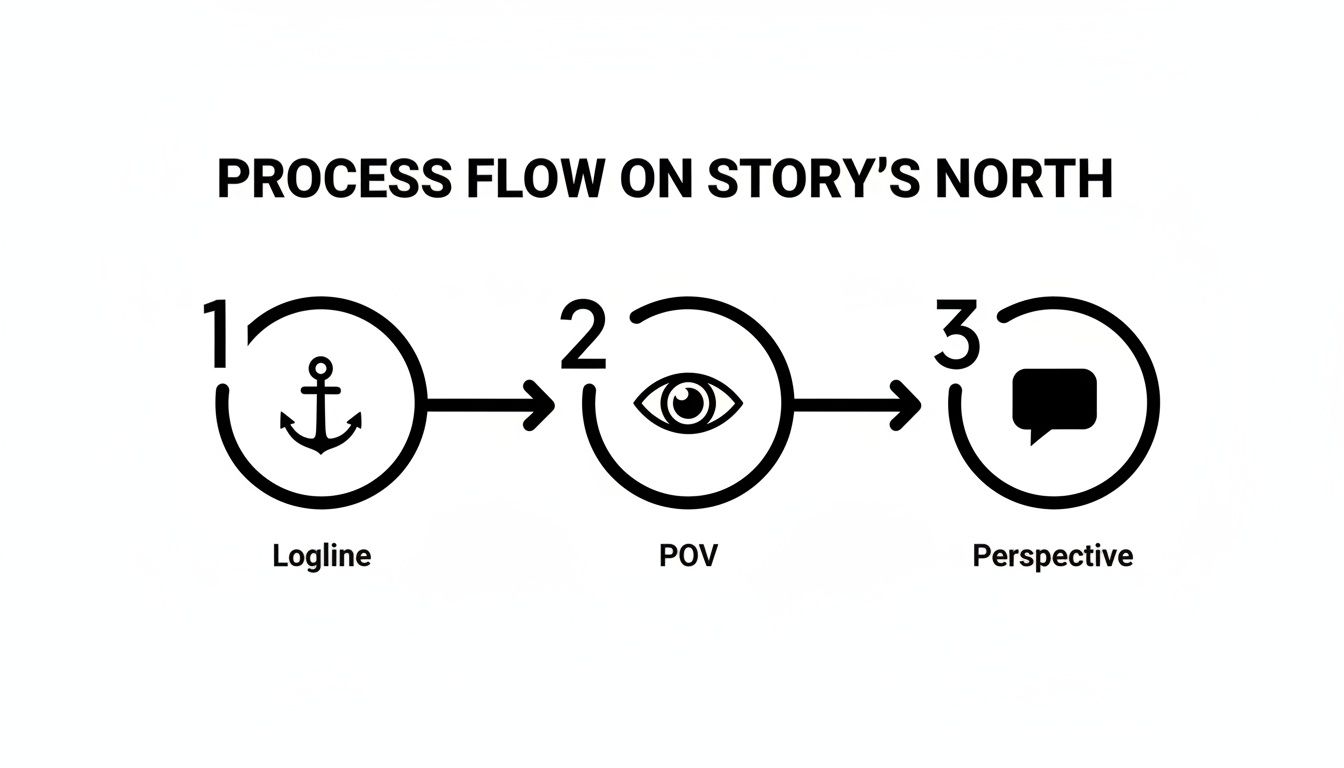
Each decision builds on the last, giving your story a solid, logical foundation before you even write a single chapter.
And trust me, people are hungry for great stories. With the global book publishing industry projected to hit a staggering $126.9 billion in 2025, the appetite for fiction is only growing. If you want to dive deeper into what's selling, you can explore more book sales statistics on Newprint.com. The point is, there's a huge audience waiting for a well-told story. Giving yours a strong backbone is the best first step you can take.
Breathing Life into Your Characters
If your plot is the sturdy skeleton of your story, and your structure is the architectural blueprint, then your characters are the heart, soul, and mischievous brain. Without them, you've just got a beautifully designed, empty house. It's the people inside, with their arguments, laughter, and drama, that make it a home.
This is where things get personal. Creating characters isn't about filling out a stat sheet with hair color and a favorite food. It's an act of deep empathy, of climbing inside someone else's skin to see the world through their eyes. It’s what separates a puppet from a person.
More Than Just a Name on a Page
Forget the generic. The characters who stick with us for a lifetime feel real because their creators knew them intimately. They knew their deepest desires, their secret, irrational fears, and the old wounds that quietly dictate every decision they make.
So, let's ditch the questionnaires for a minute. Try this instead: put your main character in a really inconvenient, low stakes jam. Imagine they get stuck in an elevator for three hours with their old high school rival. How do they react?
- Do they crack jokes to cut the tension?
- Do they immediately start plotting a lawsuit against the building?
- Do they have a quiet, internal panic attack while pretending everything is fine?
How they handle the small stuff reveals everything about how they'll navigate the big, plot defining moments later. Understanding this is absolutely critical when you're figuring out how to start a novel that feels truly alive.
A great character isn't defined by what they do when things go right. They are forged in the fire of what they do when everything goes horribly wrong. It’s their choices under pressure that reveal their true nature.
The Secret Ingredient: A Defining Wound
Every truly compelling character, from heroes to villains, is driven by a past wound. This doesn't have to be a huge, dramatic trauma (though it certainly can be). It can be a quieter moment from their past that shaped their worldview, created a deep seated fear, and established a fundamental lie they tell themselves.
Maybe your hero was once publicly humiliated for speaking up, so now they believe, "Staying quiet keeps me safe." Their entire journey in your novel will be about challenging that lie. This wound becomes the invisible engine of their arc.
Now, this is the deep, soulful work that can sometimes feel a bit daunting. It takes a lot of introspection. This is also one of those areas where partnering with a ghostwriter can be such a gift. A great ghostwriter is part psychologist, part storyteller. They're experts at interviewing you, asking the probing questions that help you unearth these deep character truths and weave them seamlessly into the plot.
Crafting Scenes That Sizzle
Once you know your characters inside and out, writing scenes becomes a joy instead of a chore. Think of a scene not just as a description of events, but as a mini-story with its own goal, conflict, and outcome.
For every single scene, ask yourself two simple questions:
- What does my character want in this moment? (To get a confession, to escape a boring party, to find a moment of peace.)
- What is standing in their way? (A stubborn detective, their chatty boss, a noisy neighbor.)
The friction between what they want and what’s stopping them is what creates tension and makes a scene pop. I once worked with an author whose scenes felt a little lifeless. We quickly realized her character was just passively observing things. The moment we gave him a clear, urgent goal in every scene, the entire manuscript crackled with new energy.
This is the real alchemy of novel writing. It's about breathing life into people who exist only in your imagination, honoring their stories, and building a world for them to inhabit. It’s a beautiful, sometimes maddening process, but there is truly nothing else like it.
Your Secret Weapon: The Professional Ghostwriter
Let's be real for a moment. You have a story burning inside you. Maybe it's the chronicle of your business, a rich family history, or a life changing experience the world needs to hear.
But here’s the reality check: you might not have the next two, three, or even five years to learn the incredibly complex craft of novel writing from scratch. And you know what? That’s perfectly okay.
We’ve somehow bought into this myth that to be an author, you have to personally agonize over a keyboard for thousands of hours. It sounds romantic, but it’s not the only path to creating something meaningful and lasting. You have another option, one that gets your vision into the world faster and often with more joy: hiring a pro.
This Isn't Cheating, It's Directing
Let's get one thing straight right now: using a ghostwriter is not "cheating." That’s like saying a movie director "cheated" because they didn't personally operate the camera, design the sets, and act in every single scene. When you put it that way, it sounds a little absurd, doesn't it?
Hiring a professional ghostwriter is an act of directing. You are the visionary. It’s your idea, your voice, and your wisdom. The writer is the skilled professional you bring on board to execute that vision with craft and precision. Think of them as the master builder for the house you designed.
I once worked with a CEO who had a fantastic book idea but called it "impossible" because his schedule was relentless. By teaming up, we took his "impossible" idea and turned it into a bestselling book in just six months. The story was always his; he just needed a professional partner to help him get it onto the page.
This is about honoring your story enough to give it the professional execution it truly deserves. You’re not outsourcing your voice; you’re amplifying it with an expert’s touch.
How the Partnership Actually Works
So what does this kind of collaboration actually look like? It’s far less mysterious than you might think. At its core, it's a series of deep, guided conversations. The process generally breaks down into a few key stages:
- The Interviews: This is where the magic happens. You and your writer will spend hours just talking. You'll share your stories, your half formed ideas, and random anecdotes. They’ll ask questions you never thought to ask yourself, expertly pulling out the golden threads of your narrative.
- The Blueprint: From those conversations, the writer constructs a detailed outline or chapter map. This becomes the architectural plan for your book. You get to review and approve every detail before a single word of the manuscript is even written.
- The Writing: With the approved blueprint in hand, the ghostwriter gets to work, channeling your unique voice and style into chapters. You’ll review the pages as they're completed, giving feedback to make sure it sounds exactly like you.
It’s a true partnership. It's often easier and more enjoyable than going it alone, and it ensures your vision becomes a physical book you can actually hold.
Readers are hungry for authentic stories. Just look at the numbers: print book sales grew by 9% in 2021, and the fiction market is projected to hit $11.07 billion in 2025. Yet so many incredible stories from leaders and innovators never see the light of day. Partnering with a pro is often what makes all the difference. You can discover insights on the book publishing market and see these trends for yourself.
Got Questions About Starting Your Novel?
Taking that first step to create a real, physical book, something that could last for generations, is a huge deal. It's only natural to have a million questions swirling around. Let's tackle a few of the big ones we hear all the time from authors getting started.
How Can I Be Sure My Novel Idea Is Any Good?
This is the big one, isn't it? The question that keeps writers up at night. But here's the thing: a "good" idea isn't usually about some mind bending plot twist nobody's ever thought of. It's about emotional resonance.
Does the idea make your own heart beat a little faster? Do you find yourself drifting off, thinking about the characters while you're supposed to be doing something else? If it taps into a universal human experience, love, betrayal, ambition, the fear of the unknown, then you're already on solid ground.
A great little trick I love is the "coffee shop pitch." Just casually tell a friend the core concept. If they lean in, their eyes get wide, and they start firing questions back at you, you’ve got a winner. Ultimately, though, the only vote that truly matters is yours. If you're genuinely excited about it, that passion is the secret sauce that will make your story shine.
What’s the Best Way to Deal With Writer’s Block?
First off, don't panic. Writer's block is not a sign of failure. Think of it more like a helpful nudge from your subconscious, a little tap on the shoulder saying, "Hang on, something a few pages back isn't quite right."
Instead of trying to force your way through that wall, take a step back. Go reread a chapter you absolutely loved writing just to reconnect with that initial spark. Another great move is to jump ahead and write a fun, low stakes scene you've been looking forward to.
My go to move is to "interview" my main character. Seriously. I open a fresh page and start a dialogue. "Okay, why are you being so stubborn? What are you really afraid of here?" You'd be amazed at what they tell you.
And if that doesn't work? Walk away. Go for a run, see a movie, do anything else. Your brain is an amazing problem solving machine that will keep chewing on the issue in the background. Trust me, it works.
Is It Cheating to Hire a Ghostwriter?
Let's clear this up right now: absolutely not. Thinking of it as "cheating" is completely missing the point.
Imagine you're the architect of a stunning building. You have the complete vision, the detailed blueprint, the aesthetic, and the ultimate purpose. You make every key decision, from the grand design down to the doorknobs.
A ghostwriter is your master builder. They're the seasoned professional with the tools and expertise to lay the foundation, frame the structure, and ensure every part is crafted to perfection according to your plan. The final creation is 100% yours.
It's a powerful and strategic partnership. It lets you focus on your unique vision and voice while an expert handles the nuts and bolts of the writing craft. Your story deserves the best possible telling, and bringing in a professional partner is a smart way to make that happen.
Ready to turn your vision into a blueprint? The team at My Book Written can help you structure your ideas and connect you with the perfect professional to bring your story to life. Explore how we can help you get started.