
So, you've got this story inside you. It's been whispering, maybe even shouting, that it's time to let it out. The idea of writing a memoir feels huge, beautiful, and maybe a little terrifying. That's because it is. You're not just writing a book; you're creating a legacy, something your family can hold for generations. It’s a genuine honor.
But let's be real for a second. The gap between wanting to write a memoir and actually knowing how to start writing a memoir can feel like the Grand Canyon. Where do you even begin with a whole lifetime of memories? It’s enough to make you want to go organize your spice rack instead. I get it. The frustration is real.
The first thing to do is take a huge breath and forget the idea of writing your entire life story. A great memoir isn’t a minute-by-minute replay. It’s the emotional heartbeat of a specific journey, a story about overcoming a huge fear, finding where you belong, or making a life-altering choice. That's what gives your story a soul and turns your memories into something that truly connects with people.
Your Story Is Worth Telling, So Let’s Actually Start Writing It
That little voice telling you to write your story? It’s right. Your life, with all its beautiful messes and quiet triumphs, is worth capturing. Putting it on paper is how you create something that lasts forever.
But the "how" can feel like trying to assemble a piece of IKEA furniture with the instructions written in Klingon. You've lived it all, so how do you untangle the threads? Don’t worry. We’re going to do this one step at a time. And hey, if it gets too much, there are amazing people called ghostwriters who are basically professional IKEA assemblers for stories. More on that later.
First Things First: The Why Behind Your Words
Before you type a single sentence, you need to know why you're telling this particular story right now. This isn't some fluffy, navel-gazing exercise. It's your North Star. It's the thing you'll cling to when you're lost in a forest of your own memories, wondering if that story about your pet turtle is really relevant (it might be!).
Think of it this way: an autobiography is like a Wikipedia entry of your life. A memoir is like the one incredible story you'd tell a friend over coffee, the one that changed everything. You have to zero in on that powerful slice of life.
This simple visual breaks it down: you start with a question, define your purpose, and then you can finally get to the fun part of writing.
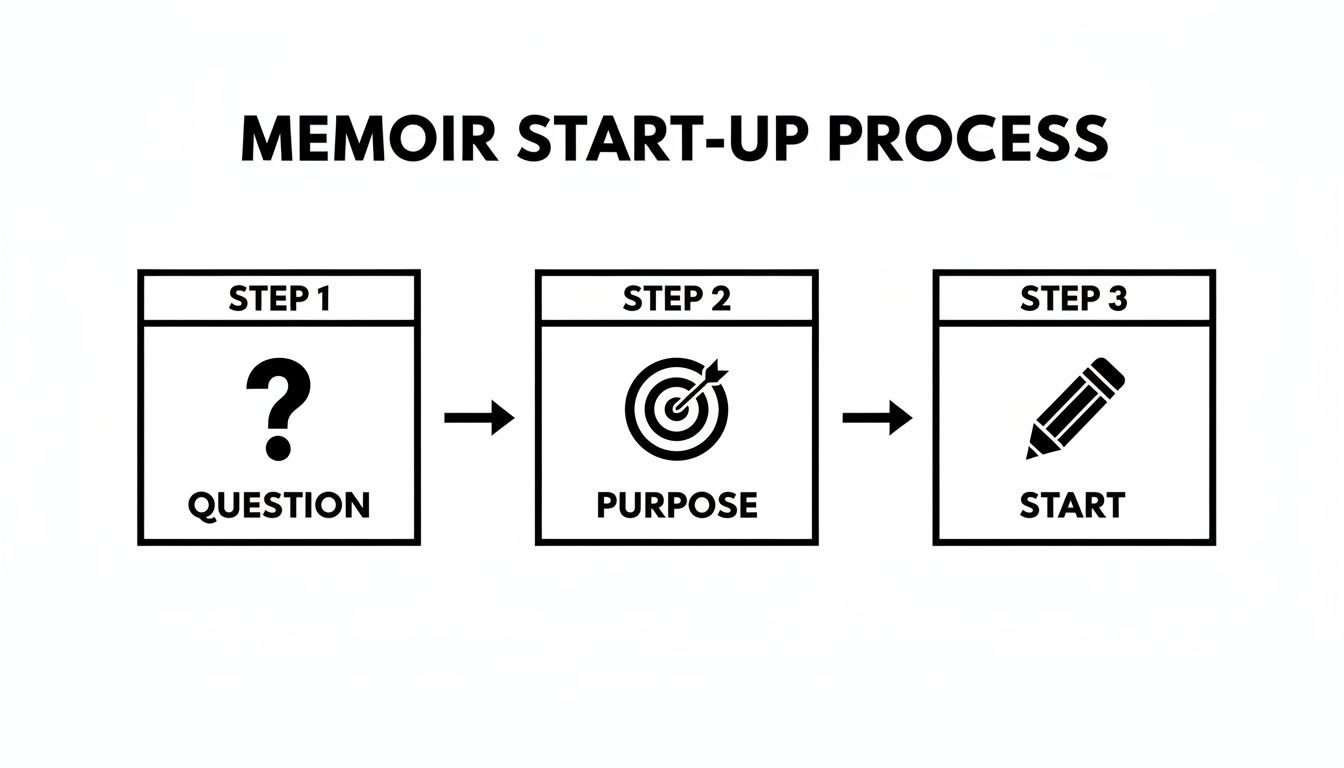
Moving from a vague idea to a focused, powerful story is the most important step you can take right now.
And the great news? People are hungry for stories like yours. The memoir and biography market is one of the most successful genres out there. With the global book industry hitting a market size of $126.9 billion, a huge slice of that pie comes from readers looking for real human experiences that make them feel connected.
Before you write a single word, ask yourself these questions. Answering them will give you the clarity to see this beautiful project through.
Your Memoir Starting Checklist
| Key Question | Why It Matters | A Quick Example |
|---|---|---|
| What is the central theme? | This is your story's soul. It's the "so what?" that turns a personal anecdote into a universal truth. | Instead of "My childhood," try "How learning to forgive my father taught me what family really means." |
| Who is my ideal reader? | You're not writing for everyone. Picturing one person makes your writing more intimate and focused. | "I'm writing this for other women in their 40s who feel like they've lost themselves in motherhood and are trying to reconnect with their passions." |
| What do I want them to feel? | Emotion is everything. Do you want them to feel inspired? Understood? Hopeful? This will shape your tone. | "I want my reader to finish the last page and feel a surge of hope, knowing it’s never too late to start over." |
| Why am I the only person who can tell this story? | This gets to the heart of your unique perspective. It’s what makes your story compelling and irreplaceable. | "No one else was in that operating room. My perspective as the surgeon, not just the patient's daughter, is what makes this story different." |
Taking a few minutes to think through these points is like creating a map before a road trip. It doesn’t mean you can’t take fun detours, but it ensures you’ll always know which way is north.
The Honor of Capturing a Legacy
Writing your story isn’t just another item on your to-do list; it’s an act of profound self-reflection and a gift to others. It’s about making sense of your past while creating a physical book that your family can hold for generations.
Your perspective is your superpower. No one else has lived your life, felt your heartbreaks, or celebrated your victories in quite the same way. That unique lens is what makes a memoir truly powerful.
As you start this journey, finding your unique writing voice is what will make your story feel undeniably yours. It’s the secret sauce.
But let’s be brutally honest. This process is tough. It’s emotional, it’s complicated, and it requires a skill set that most of us don’t use every day. This is exactly why so many incredible stories are brought to life with the help of a professional ghostwriter. It’s not cheating; it’s collaborating. You bring the heart and memories. They bring the craft and expertise. It makes the journey more fun, less stressful, and ensures your legacy is everything you dreamed it would be.
Finding the Heartbeat of Your Story
So, you’ve decided to write your story. That’s a huge, beautiful step. Now comes the part that can feel a bit like staring into a foggy abyss: figuring out what your story is really about. A great memoir isn’t just a laundry list of life events. It’s a story with a soul, a central theme that makes it unforgettable.

Think of it this way. Your life is the entire ocean, vast and full of everything. Your memoir, however, is a single, perfect wave. You can’t write about the whole ocean; you have to choose the wave. Finding this central theme, this "so what?" of it all, is how you start writing a memoir that connects with people on a deep level.
What Is Your Story Truly About?
Before you write a single word, take a breath and ask yourself: What is the one big idea my story explores? Is it about finding your voice after years of silence? Maybe it's a story about overcoming a devastating loss, or perhaps learning to love again after heartbreak. This isn't about the plot; it's about the emotional truth simmering underneath.
This central theme becomes your golden thread. It’s the idea that will tie all your seemingly random memories and anecdotes together into a coherent, powerful narrative.
Let’s try a quick exercise. Grab a notebook and jot down a few answers to these prompts:
- The time I felt the most alive was when…
- The single event that changed my direction in life was…
- If I could teach the world one thing I learned the hard way, it would be…
Now, look at your answers. Do you see a pattern? Maybe the word "resilience" keeps popping up, or "forgiveness," or "the courage to start over." That, my friend, is the beginning of your theme. It’s the universal story that allows readers who have never met you to see themselves in your journey.
A common misconception is that a memoir is just a window for the reader to peer into your life. In reality, the events you describe are the vehicle to tell a bigger, universal story.
This is what makes a reader connect with a story about surviving cancer even if they’ve never been sick. They aren't just reading about treatments; they're connecting to the underlying story of hope, fear, and human strength.
Who Are You Writing For?
Once you have a whisper of a theme, the next crucial question is: Who is this for? The answer dramatically shapes every word you choose and the stories you include. Are you writing for your grandkids or for a stranger in an airport bookstore?
Your audience could be:
- Your Family: You might be creating a legacy project. In this case, you can include all the inside jokes and family-specific details that wouldn't make sense to anyone else. It's your history, for your people.
- The World: If you're aiming for publication, your audience is broader. You'll need to explain things a stranger would need to know and lean heavily on that universal theme we just talked about.
- Just Yourself: Sometimes, the most important audience is you. Writing can be a deeply therapeutic journey of making sense of your own past. If this is your goal, you have total freedom to be as raw as you need to be.
Knowing your audience keeps you from trying to be everything to everyone, which is a sure-fire recipe for a story that feels generic.
Honestly, this part is tough. Pinpointing a theme and audience is a massive challenge. It requires you to step back from your life and see it with a storyteller's eye, which is incredibly difficult when you're so close to the material. This is often the moment people realize the immense value of a professional ghostwriter. They are experts at this! A great ghostwriter acts like a story detective, helping you uncover the powerful theme that ties your life together. It’s still your vision, just brought to life with a skilled partner who makes the process easier and, frankly, a lot more fun.
Unearthing Your Best Stories: A Guide to Mining Your Memories
Okay, you've figured out the "why" behind your memoir. You know the core message. Now comes the fun part that feels a bit like treasure hunting. Seriously. We're about to become archaeologists of our own pasts, digging through the rich, messy, beautiful soil of our lives.
Your memories are the raw materials for your book. But some of the best stuff is buried deep. You need the right tools, a bit of a plan, and the willingness to get your hands dirty. This is where we stop trying to remember and start creating the conditions for memories to come rushing back.
The Art of Jogging Your Memory
Forgetting things is completely normal. Our brains do it on purpose to keep us from being overwhelmed. So if you can't recall the exact pattern on your childhood wallpaper, it doesn't mean you're failing. It just means you need a better shovel.
Forget sitting in a silent room trying to "think hard." That rarely works. Instead, let's get our senses involved, because that’s where the most powerful memories live.
Here are a few tricks I’ve seen work wonders:
- Create a Soundtrack: Fire up Spotify and make a playlist from a specific era. Cue up those angsty teenage anthems or the cheesy pop you blasted in your first car. Music is a potent time machine. Nothing brings back a feeling faster than a song.
- Go Through Old Photos: And I mean really go through them. Don't just glance. Study the details. Who's that person in the background? What were you wearing? What was happening just outside the frame of that awkward family portrait?
- Revisit a Location: If you can, go back to a place that holds significance. Walk the halls of your old school, sit on the bench in the park where you had your first kiss, or drive by your childhood home. Pay attention to the sounds and smells.
- Cook an Old Recipe: The scent of your grandmother’s Sunday sauce isn't just a smell; it’s an entire chapter of your life waiting to be unpacked.
These aren't just trips down memory lane. They are strategic tools for unlocking the vivid, sensory details that will make your memoir feel real.
Building Your Memory Bank
As these memories start to surface, you need a place to catch them. Don't worry about order, grammar, or whether a story even "fits" yet. Your only job is to capture everything. I call this building a memory bank.
This could be a physical notebook, a folder of voice memos, or a chaotic Google Doc. The medium doesn't matter. Whenever a memory strikes, toss it in the bank. No judgment, no editing. Just capture.
This is the glorious, messy, no-rules phase of writing. Think of it as collecting all the puzzle pieces before you even look at the picture on the box. Give yourself permission to be disorganized.
This process is about more than just cataloging events. It’s about remembering how things felt. That emotional connection is what publishers and readers want. The memoir market has a huge appetite for authentic stories, but it takes more than just an interesting life to break through. As industry analyses often show, the most memorable memoirs come from the unique insights a writer brings to their own experiences. To get a better sense of what's resonating now, you can explore the latest global publishing trends for life stories.
Ultimately, it’s not just what happened that matters. It's how you've come to understand it.
What to Do When Memories Are Murky or Missing
So, what happens when a crucial memory is fuzzy? This is a great time to bring in reinforcements. Interviewing a sibling, a parent, or an old friend can be incredibly illuminating. They can help fill in gaps and will often share details you’d completely forgotten.
Just remember, their memories are filtered through their own experiences, too. Two people can witness the same event and remember it in completely different ways. That's not a problem; it's part of the story.
This whole memory-mining process can feel overwhelming. This is another area where working with a ghostwriter can be a game-changer. A good ghostwriter is a professional interviewer. They know the right questions to ask to gently excavate those buried gems. It's like having a personal archaeologist who not only helps you find the treasure but also knows how to display it beautifully.
How to Structure Your Story Without a Meltdown
You did it. You went on an archeological dig of your own life and now you have this beautiful, chaotic pile of memories. This is the exact moment where most people freeze, stare at the mess, and decide that maybe renovating the bathroom is a better use of their time. I get it. The word "structure" sounds rigid and intimidating, like something that will squeeze all the life out of your stories.
But your memoir does not have to be a boring, chronological march from birth to today. In fact, some of the most powerful stories play with time like a Slinky, stretching and compressing it for bigger emotional impact. Let's make this structure thing less scary and more fun.

Different Ways to Frame Your Narrative
Think of structure as the "container" for your story. It's the vessel that holds all those memories and gives them a shape that makes sense to a reader. Your job is to pick a container that feels right for the story you want to tell.
Here are a few popular structures:
- The Classic Chronological Arc: The most straightforward approach. You start at a clear beginning and move forward. This works wonders for coming-of-age stories or narratives about a specific journey, like training for your first marathon. Easy peasy.
- The Thematic Approach: Instead of following a timeline, you follow an idea. Each chapter could explore a theme like "Love," "Loss," or "Forgiveness," pulling in memories from different periods of your life that fit. It’s like creating a mixtape for each emotion.
- The Braided Narrative: This is a bit more advanced but incredibly powerful. You weave two or more storylines together, often a past and present narrative. For example, a chapter might alternate between scenes of you learning to parent a teenager today and memories of your own wild adolescence.
The beauty is that there's no single "right" way. The best structure is the one that serves the emotional heart of your story. Understanding how to build a strong structure in writing is the key to organizing your memoir in a way that feels natural and compelling.
Creating a Blueprint, Not a Jail Cell
Okay, let's talk about the dreaded "O" word: outlining. If that word makes you want to hide, you’re not alone. So let’s reframe it. You're not creating rigid rules. You're just sketching a loose chapter blueprint.
Think of your blueprint as a friendly guide for a road trip. It shows you the major cities you want to hit, but it doesn't dictate which quirky roadside dinosaur statues you can stop at along the way.
Start by jotting down 10-15 key scenes that you absolutely must include. These are the pillars of your story. Now, look at them. Can you group them? Do they fall into a natural timeline? This simple exercise is the beginning of your structure.
When to Call in the Architect
I'm going to be honest. Structuring a book is a professional skill. It's one of the hardest parts of writing, and it's where countless amazing stories die. It requires seeing the big picture, understanding narrative tension, and arranging events for maximum emotional payoff.
If looking at your pile of memories still feels like staring at a pile of lumber with no idea how to build a house, this is the perfect time to call in an architect. A ghostwriter is a master of story structure. They can listen to your stories, see the brilliant framework hidden within them, and build a narrative that flows perfectly. It's still your vision, your memories, and your voice. They just handle the blueprints so you can enjoy the rewarding process of watching your story come to life. It makes the journey easier and ensures the final book is something you'll be proud of forever.
Writing Your First Draft Like Nobody's Watching
Alright, let's take a deep breath. You've planned and gathered memories. Now comes the part that sends most aspiring writers running to organize their sock drawer: it’s time to actually write.
But here’s the secret: the pressure you’re feeling isn’t real. For this first pass, your one and only job is to get the story out of your head and onto the page. That’s it.
It won't be perfect. It will be messy. And that's not just okay, it's exactly what you want.
Author Anne Lamott has a famous name for this stage: the "shitty first draft." I like to call it the "get-it-out draft." Think of it as downloading the story from your heart to your keyboard, typos and all, without stopping to judge a single word. Every sentence you write is a win.
Silencing Your Inner Critic
The moment you start typing, you’ll notice a new roommate has moved into your head. This roommate is your inner critic, and frankly, they’re a real jerk. They'll whisper that your writing is clumsy and that no one will care.
Your job is not to argue. Your job is to smile, nod, and keep typing.
Your first draft is for you and you alone. It's a private sandbox where you get to make a mess. The only job of a first draft is to exist. Perfectionism is how books go unwritten.
The most effective way to shut down that nagging voice is to write so fast it can't keep up. Don't look back. Don't fix typos. Just let the words tumble out. I promise, you can make it all pretty later.
Build a Tiny, Unbreakable Writing Habit
Forget the fantasy of disappearing into a cabin for a month. For most of us, life gets in the way. Real progress comes from small, consistent efforts.
So, set a goal that’s so small it’s almost laughable. I’m talking about 15 minutes.
Everyone has 15 minutes. Set a timer, open your document, and just write until the alarm goes off. Then, you're done for the day.
This little trick is pure magic. Here’s why:
- It kills procrastination. It's nearly impossible to tell yourself you're "too busy" for just 15 minutes.
- It builds momentum. The hardest part is getting started. Once you're 10 minutes in, you'll often find you don't want to stop.
- It creates an actual habit. Showing up every day, even for a short burst, trains your brain. Writing stops feeling like a monumental task and starts feeling like part of your routine.
Consistency will always beat intensity. A little bit every day is how a book gets written. It’s not magic; it's about showing up.
Handling the Emotional Weight of Your Story
Writing a memoir isn't like writing a business report. You're digging into your own life, revisiting moments that might be joyful, but also painful. This process can be emotionally draining in a way that often catches people by surprise.
It is completely normal to feel overwhelmed, sad, or even angry as you write. You are, quite literally, time-traveling. That's heavy stuff.
Please, be gentle with yourself. If you're writing about a difficult memory and feel your chest tighten, give yourself permission to step away. Go for a walk. Make tea. Call a friend. The manuscript will be right there when you get back.
This is also where a great creative partner can make a world of difference. When you work with a professional ghostwriter, you're not just hiring a writer; you're partnering with someone who knows how to navigate these emotional waters with you. They can listen with empathy and hold the space for your story when it feels too heavy to carry alone. It transforms a solitary, difficult task into a supported, collaborative journey. You still tell your truth, but you don't have to do it by yourself.
Answering Your Top Memoir Writing Questions

Still have a few questions rattling around in that brilliant brain of yours? Good. Venturing into the world of memoir writing can feel like being handed a map where some of the key landmarks are written in invisible ink.
It’s completely normal to have worries and wonders. Let's tackle some of the most common questions we hear from writers just starting out. Here are some straight-up, no-fluff answers to help you move forward.
What If My Life Isn't Interesting Enough for a Memoir?
This is the number one fear, the final boss of self-doubt, and it’s a total myth. A memoir's power doesn't come from climbing Mount Everest. It comes from emotional honesty and a unique window into the human experience. Your story about learning to bake bread after a tough divorce or navigating a complicated friendship contains universal themes that will resonate deeply with readers. It’s not about having an extraordinary life; it’s about sharing ordinary moments in an extraordinary way. It’s about how you tell it, not just what happened.
Do I Have to Write Everything in Chronological Order?
Nope! In fact, sticking to a rigid A-to-Z timeline can sometimes suck the life right out of a great story. Some of the most compelling memoirs are masterclasses in time travel, jumping between past and present to build suspense and emotional depth.
Think outside the linear box. You could structure your book:
- Thematically: With each chapter exploring a concept like "loss," "joy," or "letting go."
- Around a central event: Using a pivotal moment as a frame and flashing back to earlier memories that led you there.
The best structure is simply the one that best serves your story’s central theme. Don’t be afraid to play around.
How Do I Handle Writing About Other People in My Life?
Ah, the million-dollar question. This is a tricky but important part of the process, and it requires a ton of heart. The golden rule is this: you are writing your truth from your perspective. You are the narrator of your experience.
You aren't writing a biography of your mother or an exposé on your ex. You’re telling the story of how their actions affected you. It's also a common and respected practice to change names or identifying details to protect people’s privacy.
Ultimately, your memoir is your story, told through your eyes. Own that. You can't control how others will feel, but you can control the honesty and compassion with which you write your own truth.
Is Hiring a Ghostwriter "Cheating"?
Not in a million years. In fact, it's one of the smartest, most empowering decisions you can make. Thinking a ghostwriter is "cheating" is like thinking a film director is "cheating" because they didn't personally operate the camera, design the costumes, and write the score.
A ghostwriter is your creative partner, your story architect, your collaborator. You bring the vision, the heart, the voice, and the memories. They bring the professional expertise to shape it all into the best possible version of your book.
The story is 100% yours. You're just getting expert help to make sure the book you hold in your hands is a beautiful, powerful, and lasting tribute to your life. It makes the journey easier, more fun, and ensures your vision is brought to life flawlessly.
At My Book Written, we believe every person has a story that deserves to be told with clarity and heart. We specialize in providing the resources and guidance you need to organize your thoughts and prepare your manuscript for success, whether you're writing it yourself or partnering with a professional. Explore our guides and start your book journey with confidence at https://mybookwritten.com.