
So, you're thinking about turning your family's journals into a book. It’s a truly beautiful idea, but it’s easy to feel like you're staring up at a mountain. You’ve got boxes of diaries, letters, and notebooks, and the goal is to transform them all into a coherent, beautiful book that will last forever. It really boils down to four main stages: digitizing the material, structuring a narrative, writing and editing the content, and finally, designing and printing the finished product.
Think of it as turning a collection of scattered memories into a cohesive family heirloom. It's less of a chore and more of a treasure hunt.
Your Family's Story Belongs on a Bookshelf, Not in a Box
That dusty box in the attic, the one filled with your grandmother's diaries or your dad's old travel logs? It’s so much more than just paper and ink. It’s a time capsule, a direct line to the people you love, and you know these stories deserve to be shared, preserved, and honored. But just thinking about where to start can feel completely paralyzing. I get it.
Let’s be real for a moment. Staring at stacks of handwritten pages is daunting. The sheer volume can feel monumental, and it's easy to get stuck in "analysis paralysis" before you even type a single word. You're not just sorting through paper; you're curating a legacy. It's a true labor of love, and feeling the weight of that responsibility is perfectly normal.
The good news? You’re not the only one feeling this way. In fact, you're part of a growing movement of people who see the urgent need to preserve these personal histories before they fade away.
Why This Project Matters More Than Ever
This isn't just a sentimental project; it's a deeply human one. There's a widespread regret among people for not documenting their family histories sooner. A 2023 Pew survey found that a staggering 78% of U.S. adults wished they had recorded more of their family stories.
This desire for connection has fueled a 22% rise in self-published memoirs, now reaching over 1.2 million books globally. It’s clear this isn't just about nostalgia, it's about building a bridge to the past. If you want to dig deeper, the folks at Meminto.com have some great insights on why creating these records is so important.
Tackling a family history book can feel like trying to solve a puzzle where half the pieces are written in cursive and the other half have gravy stains from 1972. It’s messy, it’s beautiful, and it’s totally worth it.
So, where do you even begin? The journey from a box of journals to a beautiful, bound book can be broken down into a clear, manageable process. You just have to take it one step at a time. No need to get lost in the weeds.
To help you see the path forward, here’s a simple visual roadmap breaking the project into its four core phases.
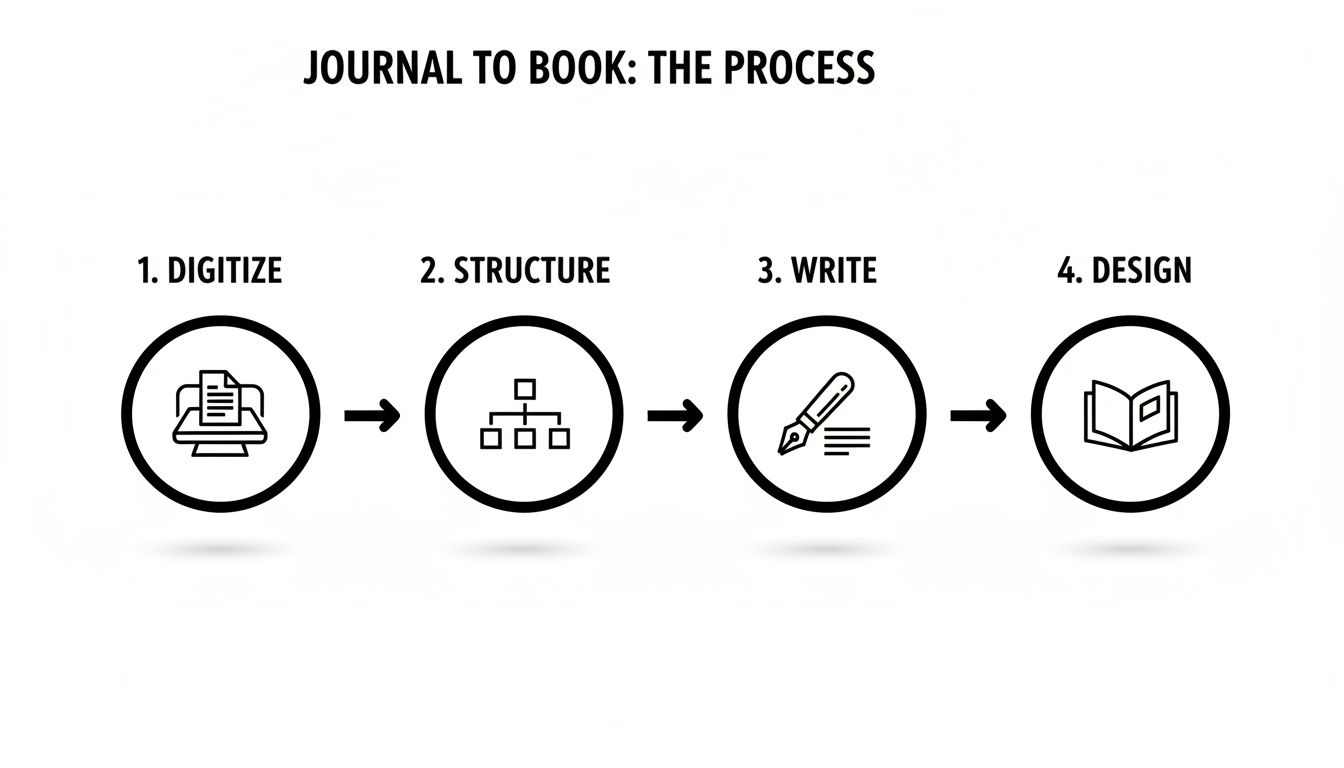
This visual shows how we’ll take the raw materials, all those precious journals, and methodically shape them into a polished, final book. Each step builds directly on the one before it, making sure no story gets left behind.
For a clearer look, here's a quick overview of the key stages involved in bringing your family's story to life.
Your Project At a Glance: The Five Core Phases
| Phase | Key Goal | Why It Matters |
|---|---|---|
| 1. Collection & Digitization | Gather all physical materials and create secure digital copies. | Protects fragile originals from damage and makes them searchable and easy to work with. |
| 2. Organization & Theming | Sift through the digitized content to identify key themes, timelines, and stories. | This is where you find the narrative thread. It turns a pile of entries into a potential story. |
| 3. Structuring & Outlining | Decide on the book's structure (chronological, thematic, etc.) and create a chapter by chapter outline. | A solid outline is your blueprint. It prevents you from getting lost and ensures the book has a logical flow. |
| 4. Writing & Editing | Draft the manuscript, weaving journal entries with your own narration. Then, refine, polish, and proofread. | This is where the magic happens. You breathe life into the raw material and shape it into a compelling narrative. |
| 5. Design & Publishing | Lay out the book's interior, design a cover, and choose your printing or publishing path. | The final step transforms your manuscript from a document into a professional, tangible book to be treasured. |
Seeing the project broken down like this can make it feel much more achievable. It’s a marathon, not a sprint, but every phase brings you closer to holding that finished book in your hands. You've got this.
Gathering and Digitizing Your Family's History
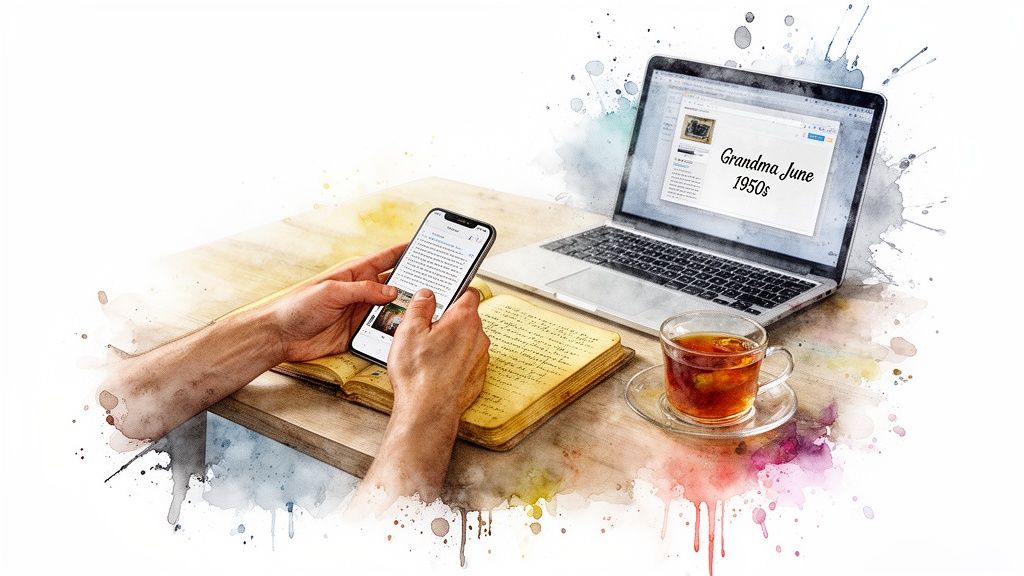
Alright, this is where the real fun begins, the great family treasure hunt. Your first mission is to gather every single journal, diary, and shoebox of letters you can get your hands on. Think of yourself as part historian, part detective. You'll be rummaging through attics, forgotten closets, and maybe even that one mysterious trunk nobody's opened in 50 years.
This part of the journey is pure discovery. You never know what you'll find. It might be a stack of your great aunt's travel diaries from her wild European adventure or the letters your grandparents sent back and forth during the war. Each piece is a vital clue to a bigger story.
Once you have your mountain of memories, the next step is non negotiable: we have to bring these stories into the digital age. This isn't just for convenience; it's about preservation. Old paper is incredibly fragile, ink fades, and accidents happen. Digital copies are the insurance policy for these irreplaceable family heirlooms.
Creating Your Digital Archive
The idea of digitizing everything might sound like a huge chore, but it doesn't have to be. You don't need a high tech lab, just a solid plan and a little patience. The goal is simple: create clean, readable copies of every single page.
Here are a few ways you can tackle this:
- Smartphone Scanning Apps: Your phone is a powerhouse. Apps like Adobe Scan or even the built in Notes app on an iPhone can create surprisingly high quality PDFs. They're perfect for standard sized journals and letters that are still in decent shape. Just find a spot with good, even lighting to avoid weird shadows.
- A Flatbed Scanner: For more delicate, brittle, or awkwardly sized items, a flatbed scanner is your best friend. It holds the pages flat and protects them, which is absolutely essential for old paper or tightly bound diaries you don't want to crack open and damage.
- Professional Scanning Services: If you're dealing with a literal lifetime of material or have documents that feel like they might turn to dust, a professional service is a lifesaver. It costs a bit more, but they have the right equipment and know how to handle precious archives without destroying them.
As you scan, organization is everything. A chaotic digital folder is just as useless as a messy box in the attic.
Create a simple, logical folder system from the get go. I'm talking "Grandma June Journals" with subfolders for "1950s" and "1960s." It will save you from pulling your hair out later. Trust me on this one.
And this isn't just about taking pictures of pages. To make the content truly useful, you'll want to make a PDF searchable. This little bit of tech magic transforms a flat image into a document where you can search for keywords like "wedding" or "Chicago." It’s an absolute game changer.
Tips for a Smooth Digitizing Process
Let's be real, this stage can feel a bit repetitive. Here are a few things I've learned that make it more manageable and even enjoyable.
- Set small, achievable goals. Don't try to scan everything in one marathon weekend session. Aim for one journal or one small box at a time. It keeps you from feeling overwhelmed and gives you those little wins that keep you motivated.
- Handle with care. And I mean that literally. Old paper can be extremely brittle. Make sure your hands are clean and be gentle. If a book is falling apart, don't force it flat. That's when a top down shot with a good camera or a flatbed scanner really shines.
- Embrace the process. As you scan, you're the first person in a long time to read these words. Let yourself get lost in the stories. You’re not just archiving; you’re connecting with your family’s past in a deeply personal and powerful way.
This phase is the foundation for your entire book. By creating a well organized digital library, you’re not only protecting your family’s history, but you're also building the raw material for the incredible book you’re about to create.
Finding the Story Hidden in the Pages
Alright, take a deep breath. You’ve wrestled the scanner and conquered the chaos of digitizing. But now you’re staring at a digital mountain of memories, and it can feel just as daunting as those dusty boxes did. So, where do you even begin to find a single, coherent story in this beautiful mess?
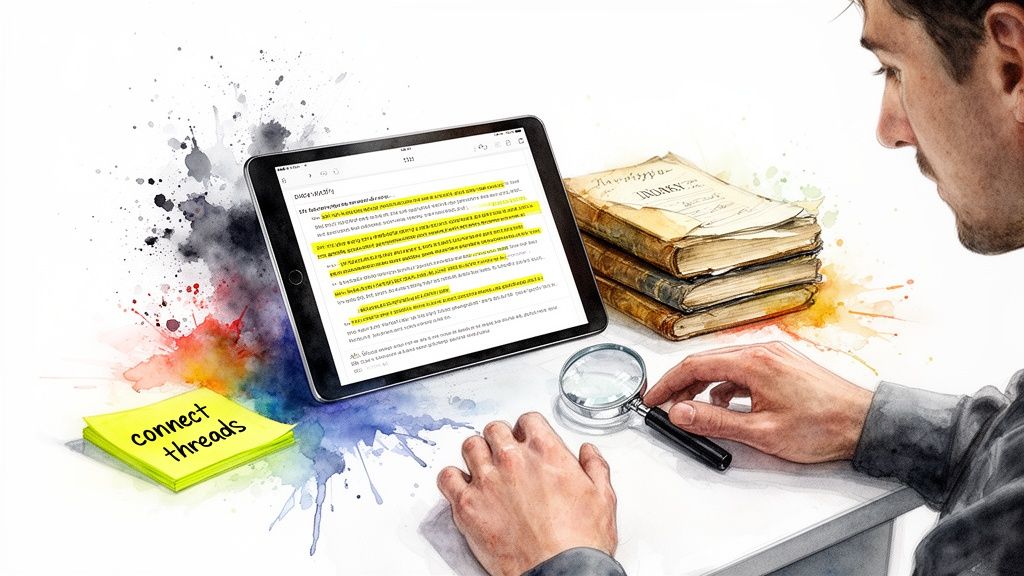
This is the part where you swap your archivist hat for a detective’s magnifying glass. Your first job is simple but crucial: just read. Pour a cup of coffee (or something stronger, we don’t judge), open the first file, and immerse yourself. Don’t worry about organizing or editing just yet. Your only goal is to listen to the voices, feel the emotions, and get a sense of the world they inhabited.
As you read, keep a notebook handy. Jot down recurring names, pivotal events, funny little stories, or phrases that just stick with you. This initial pass isn't about building a structure; it's about making connections. You're mapping the emotional landscape of your family, one journal entry at a time.
Shaping the Narrative Arc
Once you’ve steeped yourself in the material, it’s time to think like an author. Every good book needs a framework to guide the reader, and for a family history project, you have two fantastic options.
The first is the classic chronological approach. You start at the beginning and move forward in time. It’s straightforward, easy for readers to follow, and lets the story unfold just as it happened. For instance, you could begin with your great grandfather’s entries about arriving in a new country in the 1920s and travel decade by decade through your family's journey.
Your second option is a thematic approach, which can be incredibly powerful. Instead of sticking to a timeline, you group entries around central ideas. Imagine a chapter on "Holiday Mishaps," another on "Wartime Letters," and a third dedicated to "Lessons from the Garden." This method weaves a rich tapestry of shared experiences across generations. To get a feel for different storytelling styles, check out these examples of compelling narrative stories.
Choosing Your Book's Structure: Chronological vs. Thematic
Deciding between a timeline and a theme based structure is a big step. This little comparison might help you figure out which path best suits your family's unique collection of stories.
| Approach | Best For… | Potential Challenge |
|---|---|---|
| Chronological | Journals that follow a clear life progression, like a coming of age story or a family's immigration journey. | Can sometimes feel slow if there are long periods with less eventful entries. |
| Thematic | A collection of journals from various family members covering different time periods. | Requires more effort to create smooth transitions between themes and ensure the reader doesn’t get lost. |
Ultimately, there’s no right or wrong answer. Listen to the material. Often, the journals themselves will hint at the best way to tell their story.
This desire to connect with the past is a powerful driver for so many of us. It’s no surprise that genealogy companies have seen this firsthand. In 2022, Ancestry.com revealed that over 25% of its 20 million users had printed a family history book from their data, turning names and dates into tangible keepsakes.
The goal isn't just to reprint diary entries. It's to find the hidden conversation happening across the decades. It's about finding the thread that connects your grandmother's hopes in 1945 to your father's worries in 1985.
This is also the stage where many people hit a wall. Finding the key moments is one thing, but weaving them all together into a page turning narrative is a whole other skill. The thought of writing thousands of words to connect all those dots can feel overwhelming.
This is often the perfect time to consider partnering with a professional ghostwriter. They are experts at seeing the forest for the trees, identifying those golden threads, and helping you build a story that flows beautifully. You remain the director of your family’s legacy; they are simply the skilled writer who helps bring your vision to life on the page. It frees you up to focus on the heart of the project without getting bogged down in the mechanics of writing an entire book.
Weaving the Narrative and Honoring Every Voice
Alright, this is where the real magic begins. You've gathered the memories, wrestled with scanners, and mapped out a solid structure. Now, you get to step into the role of the storyteller, the narrator who will lovingly stitch these precious pieces into a beautiful, coherent story.
Your job is to be the warm, guiding voice that connects the dots for the reader. You’ll provide the context that a journal entry just can't offer on its own. Who was Aunt Carol writing about in that cryptic 1962 entry? What was happening in the world when your grandfather wrote about his fears and hopes? Think of yourself as the bridge between their past and the reader's present.
This is about so much more than just stringing quotes together; it’s about creating a story that feels truly alive. To make sure your family's history lands with everyone who reads it, it's vital to make your writing easy to understand and compelling, transforming simple entries into a narrative that pulls people in.
The Gentle Art of Editing and Sensitivity
Now, let’s touch on something delicate. As you immerse yourself in these journals, you're going to encounter sensitive topics. It's almost a guarantee. You might find conflicting accounts of the same family event, painful secrets, or opinions that feel jarring to a modern reader. This is a sacred responsibility, and navigating it requires a gentle hand.
I like to call this part of the process a sensitivity review. Your main goal is to honor the writer's truth while also being mindful of living relatives. It’s a balancing act, for sure, and there’s no single right answer.
Here are a few ways I’ve seen this handled successfully:
- Provide Context, Not Judgment: If an ancestor expresses views that are outdated or uncomfortable, you can frame them within their historical context. A brief narrator's note can explain the societal norms of the time without excusing or condemning the sentiment.
- Handle Contradictions with Grace: What if two journals tell different versions of the same story? My advice? Include both! Presenting multiple perspectives can add a fascinating layer of depth, showing that memory is a complex and personal thing.
- Protect the Living: For deeply sensitive information that could cause real pain to living family members, you have options. You might choose to omit it, paraphrase it in a way that softens the blow, or even create a special, unabridged version just for a select few.
Your guiding principle should always be this: Tell the truth, but tell it with love. The goal is to build bridges, not burn them. Honor the past without causing harm in the present.
This is, without a doubt, one of the most time consuming and emotionally taxing parts of creating your family book. The sheer weight of writing, editing, and making these tough calls can be immense.
When to Call in a Professional Partner
Let's be perfectly honest for a moment. The thought of writing tens of thousands of words, organizing a lifetime of stories, and navigating tricky family dynamics can be enough to make anyone want to shove the journals right back in the box. And that would be a real tragedy.
If you’re feeling overwhelmed, this is the perfect time to think about bringing in a professional. A ghostwriter isn’t someone who takes over your project; they are a skilled partner who helps bring your vision to life. You are still the author and the visionary. They are the expert craftsperson who handles the heavy lifting of the writing, which frees you up to focus on the heart of the story.
It’s an incredible way to ensure the book actually gets finished, and finished beautifully. You provide the organized materials, the family insights, and the emotional direction, and they use their expertise to weave it all into a polished, compelling manuscript. It makes the process easier, more fun, and often results in a far better book. If you're curious about what this kind of collaboration looks like, our guide on how to write a memoir offers some great insights into the storytelling process.
For those who feel their ideas are scattered and need a clear path to a finished book, services like Opus Eternal offer a fantastic and accessible alternative. They provide expert ghostwriting that is remarkably fast and efficient, often at less than half the cost of traditional options, without ever compromising on quality. It's an amazing way to honor your family's legacy without the stress of doing it all yourself.
Designing and Publishing Your Family Heirloom
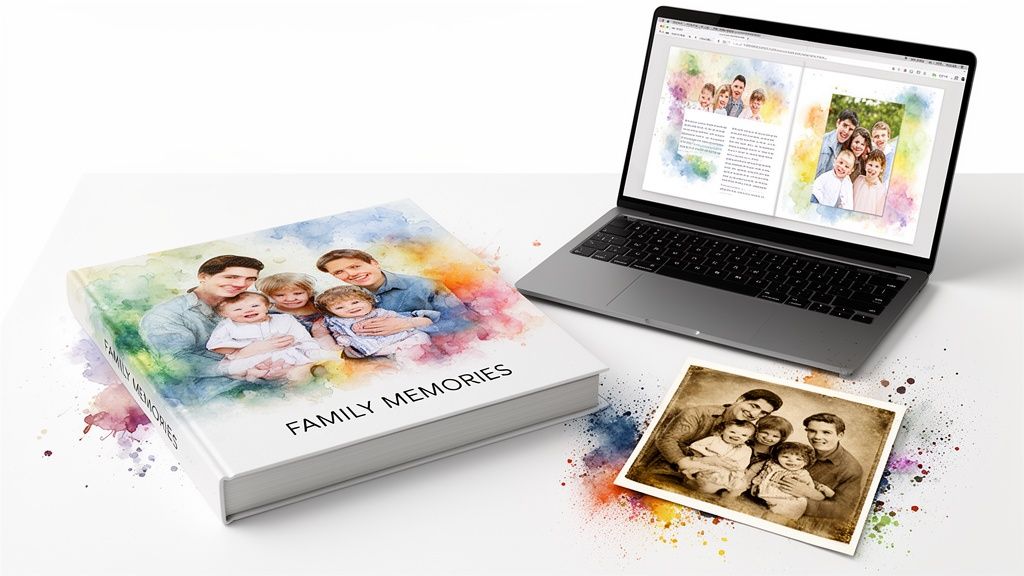
You did it. The writing is done, the stories woven together into a manuscript that holds your family’s heart. Before you do anything else, take a moment to celebrate that. It’s a huge achievement.
Now, let’s get this book dressed for the party.
This is the design phase, where your words move from a document on a screen to a beautiful, tangible object someone can hold, cherish, and pass down. It's the moment your project finally starts to look like a real book. No pressure, right? Don't worry, we'll keep it simple.
Crafting the Interior Layout
The inside of your book, its interior layout, is what shapes the entire reading experience. A good layout is like a quiet, helpful guide, making the journey through the pages feel effortless. A bad one is, well, a headache.
Here are the key elements to get right:
- Font Choice is Everything: Please, step away from the Comic Sans. A classic, readable serif font like Garamond or Georgia is perfect for the main text. They're much easier on the eyes for those long, wonderful reading sessions.
- Give It Some Breathing Room: White space is your best friend. Generous margins and a little extra space between lines make the pages feel inviting instead of crammed and overwhelming.
- Placing Photos and Scans: Don’t just drop images in randomly. Try to place them near the text they relate to. You might even consider creating dedicated photo sections between chapters, perhaps printed on glossy paper for a more premium feel.
This stage is all about making thoughtful choices that honor the stories you've worked so hard to preserve. For a little visual guidance on arranging your pages, a good family history book template can be a fantastic starting point.
Designing a Cover That Tells a Story
They say you can't judge a book by its cover, but let's be honest, we all do. The cover is your book's first impression, and it should capture the soul of the stories inside. This isn't the time for that blurry photo from 1982.
Think about the central theme that emerged from your family’s journals. Was it resilience? Adventure? A deep, abiding love of home? A simple, evocative image often works best. It could be a high quality scan of your grandmother’s elegant cursive, a striking picture of the old family farm, or even a beautiful, minimalist design with just a title and the family name.
Your cover doesn't need to be a detailed summary. It just needs to spark curiosity and whisper, "There's a beautiful story in here."
Printing and Publishing Your Masterpiece
Alright, the book is designed and ready. How do you actually get it into the hands of your loved ones? This is the final step in turning those journals into a book. You’ve got two great options, each with its own perks.
Print on Demand (POD) Services
- How it works: Services like Amazon KDP or Blurb print and ship a single book every time someone orders one. This means there's no upfront cost to you.
- Best for: Projects where you only need a handful of copies or want to make the book available for distant relatives to purchase themselves.
- The catch: The cost per book is higher, and you generally have less control over the final print quality.
Local or Short Run Printers
- How it works: You pay a local or online printer to produce a specific number of copies, say, 50 or 100 books, all at once in a single "run."
- Best for: Family reunions, holiday gifts, or any time you want a higher quality, true heirloom feel book.
- The catch: This requires an upfront investment and leaves you with the happy task of distributing all the copies.
Your choice really depends on your goals. Do you want easy, widespread access for everyone, or a special, limited edition gift? Either way, you're about to hold your family's history in your hands, beautifully bound and ready for the next generation. What an incredible legacy.
A Few Common Questions About Creating Your Family Book
As you get deeper into this beautiful, rewarding project, a few questions are bound to pop up. It’s a journey filled with incredible discoveries, but let’s be honest, it can also have its tricky moments. Here are my thoughts on a few common hurdles people face when figuring out how to turn family journals into a book.
How Do I Handle Sensitive Information in the Journals?
This is probably the most common and important question I get. You've stumbled upon a family secret or a painful memory, and now you have a choice to make. Navigating this requires a lot of heart and a little bit of strategy.
What happens when you find conflicting versions of the same event? I say, consider presenting both. It adds a fascinating layer of truth to the story, showing how memory is personal and subjective. For deeply sensitive information that could hurt living family members, you have a few options:
- Omit it completely. Sometimes, the kindest act is simply to let a story rest.
- Paraphrase gently. You can allude to a difficult situation without sharing every painful detail, capturing the emotion without the trauma.
- Create a limited edition. I've seen families make an "unabridged" version for a select few and a more general one for the wider family. This can be a great compromise.
Always lead with the goal of honoring the story without causing fresh harm. It’s a delicate balance, for sure, but your empathy will be your best guide.
What if the Handwriting Is Almost Illegible?
Ah, the classic historian’s puzzle. Deciphering that spidery cursive from seventy years ago can feel like trying to crack a secret code. But don't give up!
Start by scanning the pages at a very high resolution, at least 300 DPI, but 600 DPI is even better. Sometimes, just being able to zoom in on a crisp digital image makes all the difference. Next, look for a page where the writing is clearer to create an "alphabet key" for that person’s unique script. You might suddenly realize Grandma's "S" always looks like a "G," and that unlocks everything.
If you’re truly stuck, don’t be afraid to ask for help. Online communities on forums like Reddit have entire groups dedicated to deciphering old handwriting. It’s amazing what a fresh pair of eyes can see.
Ultimately, if a few words or sentences remain a mystery, that’s okay. Just transcribe what you can and make a note like [illegible] in your draft. It becomes part of the authentic story of the journal itself.
How Long Does This Entire Process Typically Take?
This is the ultimate "how long is a piece of string" question. The honest answer? It varies wildly depending on the scope of your project.
A smaller book based on a few journals might take you three to six months of dedicated weekend work. A large, multi generational project with dozens of sources, on the other hand, could easily take a year or more. From my experience, the phases that eat up the most time are the initial transcription and then the actual writing and editing.
The key to avoiding burnout is to set small, realistic goals. Celebrate finishing one journal. Feel good about completing one chapter outline. Remember, this is a marathon, not a sprint. The goal is to create a beautiful family heirloom, not to rush a process that is, in itself, a precious act of love.
Turning memories into a manuscript is a monumental act of love, but it doesn't have to be a solitary one. At My Book Written, we provide resources and guidance to help you shape your family's legacy with clarity and confidence. Whether you’re just starting or need help crossing the finish line, we’re here to support your vision. Explore our guides at MyBookWritten.com.