
So, you want to write a business book. And let’s be real, the thought itself is a weird mix of thrilling and completely overwhelming. It’s that dream of taking all your hard-won lessons, those 2 a.m. epiphanies, and all the client stories you tell over coffee, and turning them into something real. Something that will sit on a shelf, solid and permanent, long after a social media post has evaporated into the digital ether.
But that beautiful dream often smacks right into a wall of reality. Your brilliant insights are probably scattered across a dozen notebooks, countless voice memos, and that one desktop folder you ominously labeled “BOOK STUFF.” I get it. I’ve seen it a hundred times. The gap between having a great idea and holding your finished book can feel like a canyon.
The secret is to remember that writing a business book isn't just about typing. It's about finding your one core idea, knowing your reader like a best friend, creating a solid blueprint, and then making the smart call on whether to write it yourself or bring in a pro ghostwriter. It’s a journey, and an honorable one, that turns your expertise into a legacy.
Finding Your One Big Idea
The first step isn't about writing at all. It’s about getting clear. In a world drowning in content, your book needs a sharp, singular focus to slice through the noise. You can't possibly boil the entire ocean of your expertise into 200 pages. Trust me, you don't want to try. Instead, you need to find that one powerful idea that will be the North Star for your entire project.
This isn’t about being flashy; it’s about being genuinely, deeply helpful. For those in professional services, a book is one of the most powerful forms of content marketing for professional services because it builds an insane amount of trust long before a potential client ever thinks about picking up the phone.
Your book shouldn't be a summary of everything you know. It should be a guided solution to a specific problem for a specific person. That’s how you create something that people will cherish.
Your Journey to Your 'Why'
To find that core message, you need to look at where three things overlap: your unique journey, your best ideas, and your ultimate purpose for writing the book in the first place.
This simple flowchart shows how your personal experience flows directly into a focused book concept.
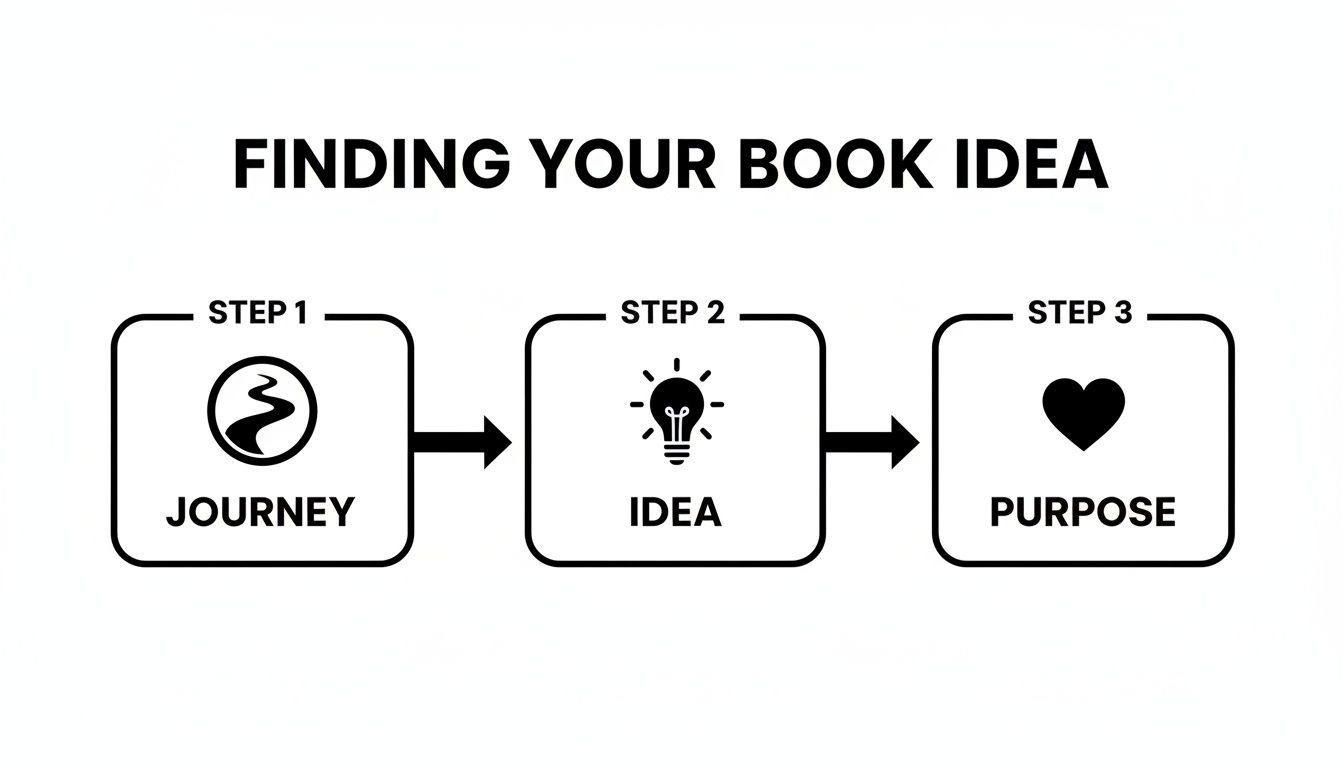
Think of this less as homework and more as laying the sacred foundation of your entire project. It's what connects your professional history to a message your ideal reader is desperately searching for.
Blueprint Your Book Before You Write a Single Word

Let’s talk about the number one reason most business books never see the light of day. It’s not a lack of good ideas. It’s jumping straight into writing without a plan. It’s the author equivalent of trying to bake a cake by just throwing flour and eggs in the general direction of an oven.
Think of it like building a house. You wouldn’t just show up with a pile of lumber and start nailing boards together, would you? You’d end up with a wobbly, frustrating mess. A book is no different. This planning stage, the blueprint, is the invisible work that makes the actual writing flow. It’s the skeleton that gives your book its beautiful shape and strength.
Get to Know Your Reader (Like, Really Know Them)
Before you even think about chapter titles, you need to get painfully clear on who this book is for. And "entrepreneurs" or "managers" isn't specific enough. Not even close. You need to know this person so well you could order their favorite coffee for them.
Who are they? What’s the specific problem that keeps them staring at the ceiling at 3 a.m.? Your book needs to be the answer to that problem.
So, don't just write for "small business owners." Instead, write for "Sarah, a 42-year-old graphic designer who’s brilliant at her craft but completely terrified of sales. She needs a simple, non-sleazy way to find better clients so she can finally stop taking on projects that drain her soul."
See the difference? Suddenly, you're not writing a generic business book; you're having a direct, heartfelt conversation with Sarah.
The Art of Mapping Your Chapters
Once you have your "Sarah" in mind, you can map out the journey you're going to take her on. This is your chapter map, your outline. It's the logical path that guides your reader from their current pain to the brilliant solution you're offering. Each chapter is a kind, deliberate step forward.
Don't think of an outline as a rigid cage. It's more like a GPS for your book. It keeps you from getting lost on weird tangents and makes sure you and your reader arrive at the destination together, feeling accomplished and relieved.
Having this roadmap isn't just a nice idea. It's wildly effective. Research shows that a staggering 62% of business authors with a structured outline finish their book in under six months. Compare that to just 12% of authors who try to "wing it." It makes sense, given that surveys show 70% of writers struggle most with just organizing their thoughts.
Honestly, this is where a great ghostwriter becomes your secret weapon. They are masters at taking all your brilliant, maybe slightly chaotic, ideas and architecting them into a powerful, coherent narrative. It’s a beautiful thing to watch. For a deeper dive, check out our guide on how to create a book outline.
Your Book Blueprint Checklist
So, what does a solid blueprint actually include? It's a set of foundational pillars that give your book its structure and purpose long before you write the first draft.
This simple checklist will help you build a solid foundation, ensuring you have clear answers to the most important questions before you begin.
| Blueprint Component | Key Question to Answer | Why It Matters |
|---|---|---|
| The Core Promise | What is the one big promise this book makes to the reader? | This is your book's North Star. It keeps every chapter focused on a single, powerful purpose. |
| Ideal Reader Profile | Who is "Sarah"? What is her biggest struggle related to your topic? | This focus transforms a generic book into an indispensable guide for a specific person. |
| The Transformation | Where is the reader at the start of the book, and where will they be at the end? | This defines the journey and ensures your book delivers a tangible, valuable result. |
| Chapter-by-Chapter Flow | What is the logical sequence of ideas, from problem to solution? | A smart flow prevents reader confusion and builds momentum from one 'aha' moment to the next. |
| Key Stories & Data | What are the core anecdotes, case studies, or stats for each chapter? | This is the evidence that brings your ideas to life and proves your points with authority. |
Trust me on this. Taking the time to do this foundational work is the single best gift you can give your future author-self. It turns the terrifying task of "writing a book" into the much more manageable process of "filling in the pieces."
The Writing Journey: Your Flow or a Pro's?

So, you've battled through the brainstorming and mapped out a killer blueprint for your book. Now comes the part everyone romanticizes: the actual writing.
This is where the rubber meets the road. It’s that moment of truth when your brilliant ideas have to be wrangled into clear, compelling sentences. There are two main ways to tackle this, and neither is better than the other. It's all about what's right for you.
The DIY Author: Finding Your Rhythm
The first path is the solo trek. Just you, your blueprint, and that infamous blinking cursor that seems to mock your every thought. I need to be completely honest with you here: this path is immensely rewarding, but it's also incredibly hard.
The biggest hurdle isn’t finding the perfect words. It’s finding the time and mental energy to put them on the page. You're already running a business, leading a team, and making a million decisions a day. Adding "author" to that list is a heavy, heavy lift.
This is exactly where the dream of writing a book so often goes to die. Time management is the silent killer of manuscripts. In fact, a heartbreaking 74% of authors report abandoning their drafts because they're burned out from juggling writing with their day jobs.
To make it on your own, you need a system, not just a muse.
- Block It Out: Treat writing like your most critical meeting. Schedule it in your calendar, in pen, and protect that time like a mama bear. Even 30 focused minutes a day is far more effective than waiting for a free weekend that never shows up.
- Embrace the "Vomit Draft": Your first draft has one job: to exist. It’s supposed to be a mess. Give yourself permission to write badly, to just get the ideas down without judging yourself. You can polish the diamond later. This is where you make the clay, not the sculpture.
- Know Your "When": Are you a night owl or an early bird? Write when your brain is at its peak, not when you’re drained from a full day of putting out fires.
This journey is a marathon, not a sprint. It’s all about building a sustainable habit that chips away at the word count, day by day, until you cross that glorious finish line.
The Smarter Path: Working with a Ghostwriter
Now, let's talk about the second path, the one that's often the smartest move for busy leaders. Partnering with a professional ghostwriter isn’t cheating. It’s collaborating. It’s a strategic decision that acknowledges your highest and best use is steering the ship, not rowing it. It's also way more fun.
Think about it: you wouldn't build your own office furniture or code your own website, right? You’d hire an expert. A ghostwriter is an expert in structuring narratives, capturing an author's unique voice, and, most importantly, getting the book finished.
Hiring a ghostwriter isn't giving up on your book. It's giving your book the absolute best chance to come to life exactly as you envision it, but without sacrificing your sanity or your business.
This approach lets you be the visionary. You provide the stories, the hard-won insights, and the voice. They do the heavy lifting of crafting thousands of words into polished, powerful prose. It's a beautiful partnership.
A great ghostwriter is more than just a typist. They become your book architect, your thought partner, and your project manager. They'll interview you, organize your scattered genius, and hand it back to you in a way that sounds just like you, only clearer and more focused.
Whether you tackle it yourself or bring in a pro, the process will eventually require professional writing and editing services to get it ready for prime time.
The ghostwriting path allows you to stay in your zone of genius while a dedicated professional ensures your legacy project moves forward, every single day. For most leaders, this is the secret to finally holding that finished book in their hands. It's often easier, more fun, and the final product is still 100% your vision brought to life.
How to Find the Right Ghostwriter for Your Story
So, you’ve decided to go the smart route and partner with a professional to bring your book to life. This is a huge, exciting step! But let's be honest, it can also feel a little scary. You’re about to hand over your best ideas and most personal stories to someone you’ve just met.
Choosing a ghostwriter is a lot like picking a co-founder for a new venture, but it's even more personal. You're not just hiring someone to type for you; you're entrusting them with your voice, your credibility, and your legacy. It’s a massive act of faith, and you need to be damn sure you're placing it in the right hands.
The good news? Finding that perfect fit isn’t about luck. It’s about knowing what to look for and, more importantly, what to ask.
Looking Beyond the Portfolio
As you start your search, you'll be swimming in portfolios. It’s easy to get wowed by a list of high-profile clients or flashy book covers. But a great portfolio is so much more than a highlight reel.
You’re not looking for a writer who sounds impressive on their own. You’re looking for a writer who can sound exactly like you.
Here’s what to zero in on:
- Vocal Range: Do all their writing samples sound… the same? A truly skilled ghostwriter is a chameleon. Their work should showcase an ability to slip into different voices, from a warm, folksy CEO to a sharp, analytical tech founder.
- Storytelling Chops: Can they do more than just list facts and figures? Look for samples that pull you in with a great anecdote or a powerful, well-structured narrative. Your book needs heart, not just a bunch of data points.
- Clarity and Structure: Is the writing a breeze to get through? Do the ideas flow logically from one to the next? A great ghostwriter brings order to chaos, making even your most complex ideas feel accessible and engaging.
Think of it like casting an actor. You don’t just want someone who can read the lines; you want someone who can disappear into the character.
Asking the Right Questions
Once you’ve got a shortlist, the interview is where the real magic happens. This is your chance to get past the resume and see if there’s a genuine spark. Don't just ask, "So, what have you written?" Go deeper. This conversation is as much about chemistry and collaboration as it is about raw skill.
Finding the right ghostwriter is less about finding the "best" writer and more about finding the right writer for your specific vision, personality, and story. It's a partnership, and the human connection is everything.
You need to know if their working style will vibe with yours. Are they a true collaborator, or are they just a hired gun waiting for instructions? Do they ask insightful questions that prove they're already thinking strategically about your project? Understanding the ins and outs of working with a business book ghostwriter will help you shape this crucial conversation.
Essential Questions to Ask a Potential Ghostwriter
Go beyond the basics to find a true partner for your book project.
This isn't about grilling them. It's about opening a dialogue to see if you can truly create something great together.
| Question Category | Sample Question | What You're Listening For |
|---|---|---|
| The 'Getting You' Factor | "Based on our conversation so far, what do you think is the core message of my book?" | Can they listen, synthesize, and reflect your own ideas back to you with clarity and insight? |
| The Process & Partnership | "Can you walk me through your process for capturing my voice and stories? What does that look like week to week?" | A clear, structured interview and writing process that puts you and your vision at the center of everything. |
| Handling Disagreements | "What happens if I don't feel a chapter sounds like me? How do we handle feedback and revisions?" | An open, collaborative, and ego-free approach. They should welcome feedback as an essential part of the process, not a critique of their ability. |
| The Passion Project Test | "What about this project specifically excites you or connects with you on a personal level?" | Genuine interest in your topic and story. You want a partner who is genuinely invested, not just clocking in for a paycheck. |
Ultimately, this person will be your book's co-pilot. You’re entrusting them with something deeply personal and professionally vital. Take your time, trust your gut, and find the partner who not only has the skill but also the heart to help you create the book you were always meant to write.
From Manuscript to Market: The Publishing Path
You did it. You wrestled with ideas, mapped out that brilliant blueprint, and either found your writing groove or smartly partnered with a pro to get the manuscript done.
Pause for a second. Breathe it in. That is a massive accomplishment most people only ever dream about. It’s a huge milestone, for sure.
But… I have to be the one to tell you it's not the finish line. Now comes the equally crucial, and sometimes bewildering, journey of turning that Word doc into a real book. A book people can hold, highlight, and share.
Polishing Your Masterpiece with Editing
Your first draft, whether you wrote it or a ghostwriter did, is just the raw clay. Editing is what turns that clay into a polished sculpture. And trust me, you cannot skip this part. A book riddled with typos or clunky sentences screams “amateur” and torpedoes your credibility before a reader even gets to your big idea.
There are a few different layers of editing, and you genuinely need them all.
- Developmental Editing: This is the 30,000-foot view. Does the book's structure actually work? Does your argument flow logically from one chapter to the next? It’s all about making sure the core ideas are rock-solid.
- Line Editing: Here’s where the magic happens at the sentence level. This is about voice, tone, and rhythm. A sharp line editor tightens up your prose and makes it sing without stripping away your personality.
- Copyediting: This is the final, granular sweep. Your copyeditor is a hawk for grammar, spelling, punctuation, and consistency. They're the ones who save you from those embarrassing mistakes you’d never catch yourself.
And please, please, please don't try to do this yourself. You are way too close to the material. Even the best writers on the planet have editors. It's a sign of a pro.
Your manuscript isn't truly "done" until a fresh, professional set of eyes has made it better. Investing in editing isn't just a cost; it's an investment in your book's success and your professional reputation.
Judging a Book by Its Cover (Because We All Do)
Once the words are polished, it’s time to think about the package they come in. People absolutely, 100% judge a book by its cover. A professional, well-designed cover is your book's number one sales tool. It has to look fantastic as a tiny thumbnail on Amazon and still pop on a crowded bookstore shelf.
The same goes for the inside of your book, what’s known as interior formatting or typesetting. It’s the invisible art that makes a book a pleasure to read. The right fonts, margins, and chapter headings create a seamless experience that guides the reader's eye. Poor formatting is like watching a movie with bad audio; it just feels off and pulls you right out of the experience.
The Big Decision: Traditional vs. Self-Publishing
Okay, so how do you actually get this beautiful thing into the world? You have two main paths, each with its own quirks and benefits.
Traditional Publishing is the classic route. You find a literary agent who then pitches and sells your book to a publishing house (think Penguin Random House or Simon & Schuster).
- The Upside: They handle everything: editing, design, printing, distribution. You also get an advance payment and the prestige of having a major publisher's logo on your book's spine.
- The Downside: It is incredibly slow. It can take years just to land an agent, let alone a book deal. You also give up a ton of creative control and a huge chunk of your royalties.
Self-Publishing (or "indie" publishing) means you become the publisher. You hire your own dream team for editing and design, then use platforms like Amazon KDP to print and distribute your book.
- The Upside: You keep 100% creative control. You also earn a much higher royalty rate on every book sold, and your speed to market is lightning-fast. You can go from final manuscript to published book in a matter of months, not years.
- The Downside: You're the one in the driver's seat for everything, which can feel overwhelming. You also front the cash for all the production costs yourself.
For most business leaders I work with, self-publishing is the smarter, more direct path. It aligns perfectly with the goal of using a book as a powerful marketing tool and legacy asset. Once it's out there, you can dive right into figuring out how to promote your book effectively.
And don’t sleep on modern formats. Audiobooks now claim over 11% of the book market, and sales are surging. For business leaders, an audiobook is non-negotiable. Many of your C-suite peers and ideal clients prefer to listen and learn on the go. You can find more great insights on this trend from The Creative Penn on the rise of audiobooks.
Answering Your Lingering Questions

Embarking on a book project is a big deal. It’s totally natural to have a few questions swirling around as you get closer to starting. It’s a sign you’re taking this seriously, which is exactly the right mindset to have.
Let's dive into some of the most common questions I get from sharp, ambitious people just like you, right before they take the leap.
How Long Does This Whole Thing Actually Take?
This is always the million-dollar question, isn't it? The honest-to-goodness answer is: it depends.
If you're tackling this solo while juggling your day-to-day business demands, it could easily stretch into a year or two. That's not a failure; it's just reality. However, having that solid book blueprint we mapped out earlier can drastically speed things up, often helping authors finish in under six months.
But here’s a game-changer: working with a professional ghostwriter. A great writing partner can condense that timeline significantly. Most seasoned ghostwriting teams can guide you from a jumble of brilliant ideas to a polished, ready-to-publish manuscript in just four to eight months. It's the difference between taking a winding country road and hopping on the bullet train.
What Does Hiring a Ghostwriter Even Cost?
Ah, the money talk. It can feel like the wild west out there, with ghostwriting fees ranging from a few thousand dollars for someone just starting out to well into six figures for a seasoned pro working with A-listers. That's a massive spread.
The good news is that the industry has evolved. You no longer need a venture-capital-sized budget to get top-tier help. It’s entirely possible to find an exceptional partner to bring your business book to life at a price that makes strategic sense. The trick is to find that perfect intersection of proven quality and a sound investment.
The most important investment you can make in your book isn't just money. It's finding a partner who genuinely cares about your story and has the skill to do it justice.
Do I Need a Massive Social Media Following to Succeed?
Let’s bust this myth right here and now: absolutely not.
Sure, a big built-in audience is a nice head start, but it's far from a requirement for a successful business book. I've personally seen authors with tiny email lists and a handful of social media followers launch books that made a huge impact.
What matters infinitely more is a deep, authentic understanding of your one ideal reader and a smart, focused plan to connect with them. Think of it this way: your book is one of the best tools you'll ever have for building an audience, not the other way around.
What’s the Biggest Mistake First-Time Authors Make?
This is my favorite question because the answer can save you so much time and frustration. The single biggest pitfall is trying to cram every last ounce of your knowledge into one book. It's a natural impulse. You're an expert, and you want to give readers everything!
But this "kitchen sink" approach almost always leads to a book that's scattered and overwhelming. The most powerful business books solve one specific problem for one specific person. Your job is to resist the urge to include everything you've ever learned. Get laser-focused on that core promise, and you'll create a book that people don't just buy, but actually finish, use, and tell their friends about.
We hope this guide has pulled back the curtain on what it really takes to write a business book and made the entire journey feel more manageable.
At My Book Written, we create calm, thoughtful resources to help you organize your mind and your materials, whether you’re just starting out or feeling stuck somewhere in the middle. We're here to help you turn your expertise into a timeless asset.