
Writing a memoir outline is all about creating a blueprint for your story before you dive into the actual writing. It’s the process of figuring out your core theme, mapping out the key events and emotional turning points, and arranging them in an order that makes sense. This ensures your story has a clear beginning, middle, and end, keeping the narrative focused and powerful.
Your Story Deserves a Thoughtful Blueprint
You know that quiet but persistent feeling that your story needs to be told? That’s a powerful thing. Listening to it is an act of courage. But figuring out how to get from a lifetime of memories to a book someone can actually hold in their hands can feel absolutely monumental.
Here’s a secret from someone who has guided this journey countless times: the first, most crucial step isn’t writing—it’s outlining.

Don’t think of an outline as a rigid cage. See it as a loving blueprint for your life’s story. It’s the framework that ensures the final structure is as strong and beautiful as the experiences you’re sharing. This guide will walk you through exactly how to write a memoir outline, from finding your core theme to mapping your personal journey.
Why Your Memories Need a Map
Imagine trying to build a house without architectural plans. You might end up with a beautiful room here or a sturdy wall there, but the whole structure would probably feel confusing and unstable. Your memoir is that house, and your memories are the precious materials you’re building with. An outline is your plan.
It’s truly the single most important step you can take to honor your story. The global market for memoirs is always growing, and a strong structure is what makes a book stand out. In my experience, and industry insiders would agree, at least 60% of memoirs submitted to publishers without a clear outline are rejected on the spot. Editors are looking for a logical and compelling narrative arc. You can find more insights about personal stories for 2025 to see what’s trending.
An outline is an act of kindness to your future self. It turns the overwhelming chaos of memory into an organized, manageable path forward, giving you the clarity needed to tell your story with purpose.
A well-crafted outline gives your story structure, direction, and heart. Here’s a quick look at why it’s so critical.
| Benefit | What It Means For Your Story |
|---|---|
| Provides Clarity | You’ll see the threads connecting disparate life events, revealing the true theme of your story. |
| Prevents Overwhelm | A clear map breaks the huge task of “writing a book” into small, manageable steps. |
| Ensures Focus | It keeps you from wandering down rabbit holes and including memories that don’t serve the core narrative. |
| Saves Time & Money | You avoid writing hundreds of pages that eventually have to be cut, saving countless hours (and editing costs). |
| Creates Emotional Arc | It helps you intentionally build tension, emotion, and resolution, making your story impossible to put down. |
Ultimately, a great outline is the difference between a collection of memories and a compelling, unforgettable memoir.
The Foundation for a Beautiful Book
Creating a physical book that will last forever is an incredible legacy. An outline helps you get that bird’s-eye view of your entire life, letting you pick out the moments that truly define your journey. It’s less about remembering everything and more about understanding what matters most.
- It brings clarity: You’ll finally see connections between events you might have never noticed before.
- It builds confidence: With a clear map in hand, the writing process feels far less intimidating and much more achievable.
- It saves time and energy: You’ll avoid writing hundreds of pages that don’t actually serve the central story you’re trying to tell.
This process can be deeply emotional and challenging, which is exactly why many people choose to partner with a professional ghostwriter. Handing them a thoughtful outline is like giving an artist a perfectly sketched canvas. It’s still your vision, your story, and your heart—just brought to life with expert craftsmanship. It makes the entire experience easier and, honestly, a lot more fun.
Finding the Heart of Your Story: What’s Your Memoir Really About?
Before we even think about chapter breaks or timelines, let’s talk about the soul of your story. Here’s a little secret every great memoirist knows: a memoir isn’t just a laundry list of everything that’s ever happened to you. Not even close.
A truly unforgettable memoir—the kind that gets passed between friends and dog-eared with love—is built around a single, powerful theme.
This theme is the emotional core of your book. It’s the invisible string that ties every memory, every triumph, and every setback together, giving them a shared, universal meaning. It’s what separates a diary from a legacy.
Think of it this way: when you look back on your life, what’s the quiet melody playing underneath all the noise and chaos?
- Is your story really about the messy, painful, but ultimately beautiful journey of finding forgiveness?
- Is it about healing after a profound loss and figuring out who you are now?
- Or maybe it’s a story of chasing a dream against all odds, proving what it takes to believe in yourself when no one else does.
This central idea becomes your North Star for the entire project. And honestly? Finding it is incredibly liberating. It immediately tells you which memories are crucial to the story and which ones, while important to you personally, might just be noise.
How to Uncover Your Central Theme
So, how do you actually find this theme? It’s less about forcing an answer and more about gentle excavation. Let’s try a couple of simple exercises to help you see the bigger picture, no pressure involved.
Grab a notebook or pull up a blank doc. We’re just going to play around.
First, try a little something I call Memory Mapping. Write down a single, vivid memory in the middle of the page. It could be the day you left home for good, a gut-wrenching conversation, or a moment of pure, unexpected joy. Now, start drawing lines out from that central memory, connecting it to other moments that feel similar—not necessarily ones that happened chronologically. Let the emotions be your guide.
After you’ve done this for a while, take a step back and look at what you’ve created. Do you see a pattern? Are most of these emotional memories circling around resilience? Identity? Family? Letting go?
Another great technique is to use journaling prompts. Just write whatever comes to mind, without judgment.
- When did my life pivot? What did I believe about the world before that moment, and what did I believe after?
- What’s the hardest lesson I’ve ever had to learn? How did learning it change me?
- If a reader could only take one single idea away from my book, what would I want it to be?
Don’t rush these. Sit with them. The answers have a funny way of pointing you right to the heart of your story.
Your theme isn’t just about what happened to you. It’s about what those events mean. It’s the hard-won wisdom you’re now ready to share.
Why This is the Most Important Step
Let’s look at a classic example. Cheryl Strayed’s incredible memoir, Wild, isn’t just a book about hiking the Pacific Crest Trail. The hike is simply the vehicle for the story. The real theme is about grappling with the devastating loss of her mother and finding a way to piece her life back together, one agonizing step at a time. The physical journey is a perfect mirror for her internal one.
That’s what a strong theme does. It gives every single scene a purpose. A memory of a difficult childhood moment isn’t just a sad anecdote; it’s the bedrock that helps us understand a courageous choice you made years later. A small act of kindness from a stranger isn’t random; it’s a pivotal turning point in a story about learning to trust again.
I’ll be honest, this is often the hardest part of the whole process. It requires you to be vulnerable and take a long, unflinching look at your own life. It’s also where a good ghostwriter can be invaluable. A ghostwriter isn’t there to tell you what your theme is; they’re a skilled, compassionate partner who can listen to all your stories and help you hear the beautiful music connecting them. They see the forest when all you can see are the trees.
Structuring Your Emotional and Narrative Arc
Once you’ve found the heart of your story—that core theme we talked about—it’s time to give it some bones. This is where we start mapping the actual journey, looking at both the external events that happened to you and the internal shifts that happened inside you.
Every great story ever told, from ancient myths to your favorite movie, follows a natural rhythm that we humans are just wired to connect with. We call this the narrative arc. It isn’t some rigid, academic formula you have to follow. Think of it more as a reflection of life itself: a beginning, a messy middle, and a new understanding at the end.
This is all about sifting through your memories to find that emotional current that pulls everything together.
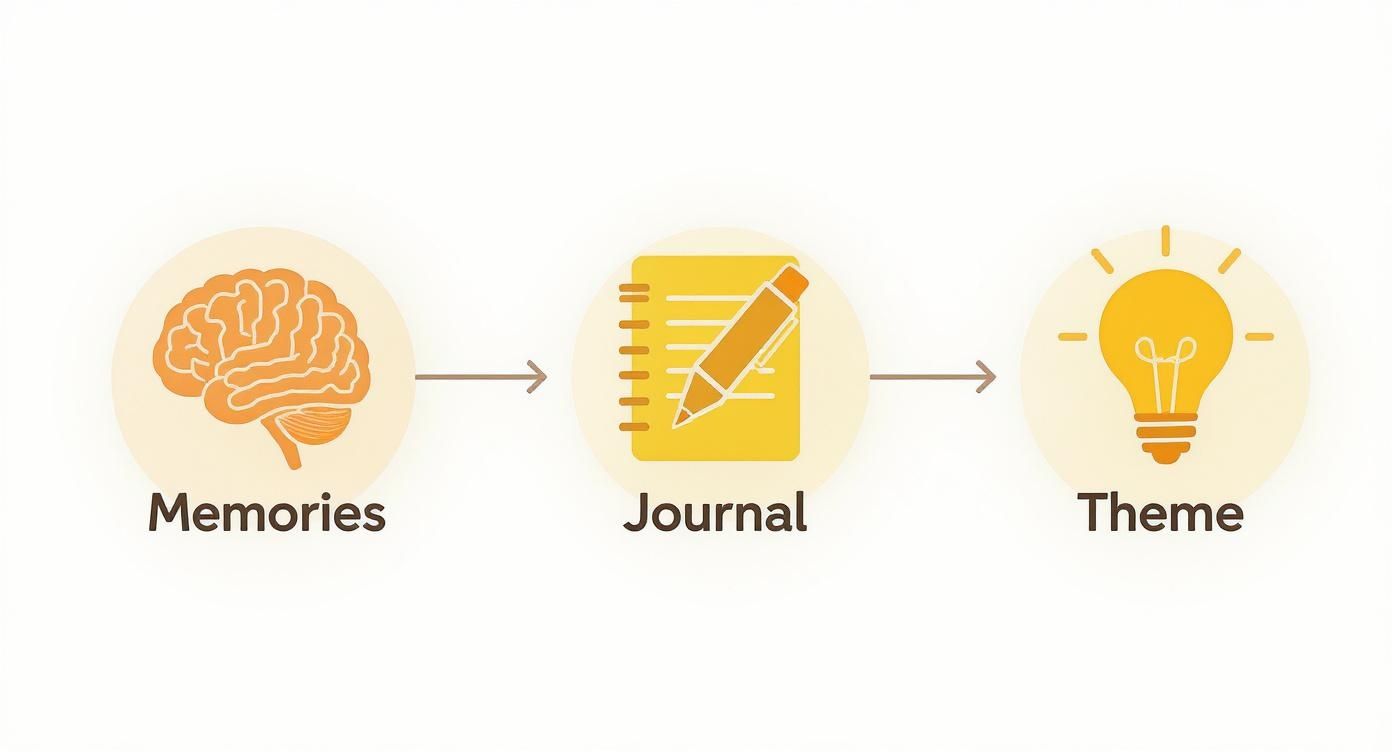
As you can see, it’s not just about chronology. It’s about discovering the deeper meaning that connects your experiences into a story that resonates.
The Three Acts of Your Life Story
A simple but incredibly powerful way to start organizing your memories is to think of your memoir’s time period as having three distinct parts.
- Act One: The Beginning
This is your ‘before’ picture. It sets the stage, showing us your normal world before everything changed. Who were you? What did you believe? What was life like? This part ends with the inciting incident—that moment that knocked you off your path and set you on this new, unexpected journey. It could be a diagnosis, a phone call in the middle of the night, or even a quiet decision to leave a life that no longer fit. - Act Two: The Middle
Here we find the heart of your struggle and your growth. You’re grappling with the new reality kicked off by the inciting incident. This section holds your highest highs and your lowest lows. Somewhere in the middle of all this is the midpoint, a point of no return where you fully commit to your new path, for better or worse. - Act Three: The End
This is where everything comes to a head. It includes the climax, the final confrontation with your central conflict. This doesn’t have to be a big, dramatic showdown; it could be a quiet conversation where you finally speak your truth. After that comes the resolution, where we see the ‘after’ picture. How have you changed? What have you learned? What is your new normal?
Mapping your story this way isn’t just an organizational tool for you; it’s an act of kindness to your reader. It gives them an emotional roadmap, helping them feel every step of your journey right alongside you.
Pinpointing Your Key Story Beats
Alright, let’s get practical. Look at your jumble of memories through the lens of those three acts. Don’t worry about writing full paragraphs yet—just use bullet points to identify these key moments.
- What was your Inciting Incident? Pinpoint the exact moment the game changed. Was it a single event or a slow, dawning realization?
- What was your Midpoint? When did you know you couldn’t go back to the way things were? What choice did you have to make?
- What was your Climax? What was the moment of greatest challenge, where you had to use everything you’d learned to face it head-on?
Taking the time for this structure is a critical step for most successful authors. In fact, a survey of memoir writers found that 83% of authors who used a formal outline reported higher satisfaction with their final manuscript and felt they got more positive feedback from editors. A solid plan really does increase the odds of creating a book that connects. You can read more about how memoir writers keep going and find their own version of success.
Your narrative arc maps what happened. Your emotional arc maps what it felt like. A great memoir outline weaves these two threads together seamlessly.
Building this framework can feel big, and honestly, a little intimidating. That’s totally normal. You’re holding a lifetime of experiences in your hands, and organizing them is an act of deep reflection.
This is often where having a partner, like a professional ghostwriter, can make all the difference. They are experts at seeing the natural arc in a collection of stories. You bring the raw, beautiful material of your life, and they help you shape it into a structure that gives it power. This kind of collaboration allows you to focus on the memories while they handle the architecture—honoring your story in the most profound way.
Building Your Chapters One Scene at a Time
So, we’ve found the heart of your story—your theme—and we’ve sketched out its skeleton with a narrative arc. Now for the fun part: adding the flesh and blood. This is where we start building your chapters and your memoir truly begins to breathe.
Think of a chapter less like a big bucket for a chunk of time and more like a mini-story. A great chapter has its own rhythm, its own small arc of tension and release. The secret to writing one isn’t to think big, but to think small. It’s all about thinking in scenes.

A scene is a single, vivid snapshot in time and space. It’s a moment you can close your eyes and almost relive—you can see, hear, and feel it all over again.
- Maybe it’s a tense, whispered conversation in a car parked under a flickering streetlight.
- Or that life-changing phone call you took while standing barefoot in your kitchen.
- It could even be a rare moment of perfect quiet, just sitting on a front porch as a kid.
These individual moments are the building blocks of your entire memoir. When you focus on outlining one scene at a time, the overwhelming task of “writing a book” suddenly becomes much more manageable and human.
The Rhythm of Scene and Sequel
There’s a simple but incredibly powerful technique for structuring chapters called the “Scene and Sequel” method. It’s a natural rhythm that mimics how we experience life: something happens, and then we have to figure out what it all means.
- The Scene: This is the action. It’s a moment of conflict, a tough decision, or a big discovery. Someone says something important, something happens, a choice is made. This is the event.
- The Sequel: This is the reflection. It’s what happens right after the scene, where you (and your reader) get to process everything. It’s the quiet car ride home, the storm of thoughts in your head, the emotional fallout. This is the meaning.
Pairing these two together creates an amazing narrative flow. The scene pushes the story forward, while the sequel deepens the emotional weight and connects everything back to your central theme.
For instance, a chapter about getting a serious health diagnosis wouldn’t just be a dry report of medical facts.
- Scene: You’re in your kitchen making coffee, the room is filled with morning light, and then the phone rings. You hear the doctor’s heavy tone, and the world stops.
- Sequel: After hanging up, you just sit at the kitchen table in total silence, your coffee now cold. The world outside the window keeps moving on, completely unaware that your own life just tilted on its axis.
See how that works? One flows right into the other, creating a complete emotional experience for the reader.
Thinking in scenes makes the process less about remembering everything and more about capturing the moments that changed everything. This is what makes a memoir feel real and immediate.
Outlining your chapters with this scene-based approach is a game-changer, especially if you plan on working with a ghostwriter. It gives them a crystal-clear map of the moments you want to bring to life, complete with the emotional context that makes them matter so much.
A Simple Template for Your Chapters
Let’s get practical with this. You don’t need fancy software—a simple document or a notebook will do just fine for building out your chapter-by-chapter outline. To help you organize these scenes and sequels, here’s a simple table structure I love using with clients. It’s straightforward and keeps things incredibly clear.
Scene-Based Chapter Outline Template
| Chapter Number & Title | Scene or Event (What Happens?) | Reflection or Sequel (What It Means) |
|---|---|---|
| Chapter 5: The Call | Morning routine, making coffee. The phone rings—it’s the doctor with the biopsy results. I hear the words “I’m sorry.” | I hang up and sit at the table, numb. The world outside feels distant. This is the moment I realize nothing will ever be the same again. |
| Chapter 6: The Long Drive Home | Leaving the specialist’s office after the first treatment plan meeting. My partner and I drive in complete silence. | I watch the city lights blur past and think about all the plans we had. I feel a mix of terror and a strange sense of determination. This is the start of the fight. |
For each major beat in your story, you can use this structure to map out the key moments. It defines the chapter’s purpose, identifies the core action, and explores the emotional impact.
Doing this for each chapter will help you create a rich, detailed, and deeply personal roadmap for your memoir. It’s the final, most granular layer of your outline, bringing your vision into sharp focus and making the path to a finished book feel clear and, dare I say, exciting.
Handing Your Outline Over to a Ghostwriter
Alright, take a deep breath. You’ve done the incredibly hard work of digging through your life, pulling out the defining moments, and giving them a shape. That’s a huge deal. Seriously, pause for a moment and give yourself credit.
This is also, quite often, the perfect time to bring in a partner.
Let’s reframe this next step. Passing your outline to a professional ghostwriter isn’t about giving up control. Think of it like this: you’ve drawn up the architectural blueprints for your dream home, and now you’re hiring a master builder to bring those plans to life. You’ve done the deep thinking; they bring the specialized craft.
Your Outline is Their North Star
A great ghostwriter isn’t there to hijack your story—they’re there to honor it. Your outline is their map, guiding them through the terrain of your life so the final book is your story, told in your voice, just polished with a professional sheen.
They provide that crucial outside perspective and expertise in the things that are nearly impossible to do well on your own, like nailing the pacing, crafting beautiful prose, and writing dialogue that crackles with life. The more detailed your map, the more faithfully they can follow your path.
When you hand over a solid outline, you’re not just giving them a document. You’re showing them you’ve wrestled with your story and know what you want to say. That makes their job of channeling your voice so much easier and more effective.
What to Put in Your “Handoff Packet”
When you’re ready to approach a ghostwriter, don’t just email a single file. Think of it as a “handoff packet” that gives them a complete picture of your vision.
Here’s what I always recommend my clients include:
- Your Core Theme: Just one clear paragraph explaining what the book is really about. Is it a story of resilience? A journey to forgiveness? The search for a place to belong? This becomes the writer’s guiding light.
- The Full Outline: This means everything—your three-act structure, your scene-by-scene chapter breakdowns, all of it. More detail is always better than less.
- A “Cast of Characters”: Create a simple list of the key people in your story. For each person, jot down who they are, their relationship to you, and maybe a key personality quirk. This is a lifesaver for the writer.
- A “Sacred Moments” List: Are there certain phrases, lines of dialogue, or tiny moments you need to be included exactly as you remember them? Maybe it’s the nickname your grandfather had for you or a line from a pivotal fight. Write them down.
- Tone and Voice Notes: How do you want the book to feel? Is it wry and humorous? Raw and unflinching? Gentle and reflective? Listing a few memoirs you admire can be a great shorthand here.
Handing over a detailed outline is an act of trust. It’s you saying, “This is my story, these are my truths. I trust you to help me give them the beautiful shape they deserve.”
Kicking Off a Great Partnership
Putting this packet together does more than just prepare the writer—it prepares you. It forces you to solidify your own vision, giving you a powerful tool to use when you start interviewing potential ghostwriters.
You can watch how they respond to your story, see if they truly grasp your theme, and listen to how they talk about bringing your scenes to life.
Writing a memoir doesn’t have to be a solitary struggle. In fact, it’s almost always a richer, more rewarding experience when it’s collaborative. You’ve done the beautiful, soul-searching work of drawing the map. Now it’s time to find the right partner to walk the road with you, ensuring the journey ends with a book that feels completely, authentically yours.
A Few Common Questions About Memoir Outlining
As you start to put the pieces of your life onto paper, it’s only natural for questions to pop up. This whole process is intensely personal, and trust me, there’s no single “right” way to do it.
Let’s tackle some of the most common questions I hear from people just like you. My goal here is to offer some clarity and, hopefully, give you the confidence to push forward.
How Detailed Should My Memoir Outline Be?
This is the big one, isn’t it? The short answer is: detailed enough to serve as a reliable map, but flexible enough to allow for new discoveries along the way.
Think of it like this: your outline is the road map, not the turn-by-turn GPS. It should show the major highways (your three acts), the key cities you’ll visit (your major life events), and your final destination (the new perspective you’ve gained).
An outline isn’t a contract set in stone; it’s a living document. Its real job is to guide you, not to cage you. As you or your ghostwriter begin to write, new memories and connections will bubble to the surface. That’s not a failure of the plan—that’s the magic of the process.
So, what does that look like in practice? A good target to aim for is:
- One sentence that nails your central theme.
- A short paragraph for each of the three acts (the beginning, middle, and end).
- Several bullet points under each chapter that sketch out the key scenes and emotional shifts.
If you know you’ll be handing this off to a ghostwriter, a little more detail never hurts. It gives them the rich, raw material they need to really sink their teeth into the project and capture your voice.
What If My Memories Are a Jumbled Mess?
First of all, welcome to being human! Our memories almost never arrive in a neat, chronological line. And you know what? That’s a good thing. It can actually make for a far more compelling and powerful memoir.
Some of the most incredible memoirs I’ve ever read play with time. Your outline is the perfect place to experiment with this.
Instead of a straight timeline, you could try a few different things:
- Anchor the story around one pivotal event. Then, you can use flashbacks and flash-forwards to show its ripple effects across your life.
- Organize chapters by theme. Maybe one chapter explores moments of profound loss, while the next one is all about moments of unexpected joy, no matter when they actually happened.
The real goal here is emotional truth, not a perfectly accurate calendar. Ask yourself: what structure best serves the story I’m trying to tell? That’s the only question that truly matters.
Can I Change My Outline After I Start Writing?
Yes! A thousand times, yes. In fact, you absolutely should. An outline that doesn’t evolve as you write is often a sign that you might not be digging deep enough.
The act of writing is an act of discovery. You’ll suddenly remember a conversation you’d long since forgotten. You’ll finally understand the real reason you made a certain choice twenty years ago. These moments are gifts.
When these insights strike, just circle back to your outline and update your map. Maybe that small memory you jotted down now feels like it deserves its own chapter. Perhaps you realize the true climax of your story isn’t what you originally thought it was.
Embrace these changes. They mean you’re getting closer to the heart of your story.
I Finished My Outline… but I’m Not a Writer. Now What?
First off, take a moment and celebrate! Seriously. Creating a comprehensive outline is a massive achievement and the single most important piece of prep work you can do. You’ve already done the heavy lifting of introspection and organization.
If writing just isn’t your thing, this is the perfect time to bring in a professional ghostwriter.
With your detailed outline in hand, you’re not just hiring someone to write a book from scratch. You’re bringing on a skilled collaborator who can take your vision, your structure, and your voice and weave them into beautiful, compelling prose.
You’ve provided the soul and the skeleton; their job is to put on the skin. This kind of partnership lets you stay completely true to your story while ensuring the final book is a work of art you’ll be proud to share with the world.
At My Book Written, we understand that your story is precious. Our resources are designed to help you organize your thoughts and prepare your vision, setting you up for a successful and joyful collaboration with a ghostwriter. Learn more about how to get started on your book journey.