
Writing a book is a massive undertaking. I get it. It’s about more than just stringing words together. It’s about crystallizing your life’s work, your core ideas, and your unique perspective into something tangible and permanent. It’s a beautiful, honorable act. It starts with that one of a kind message only you can share and ends with a legacy that cements your authority and forges a real connection with your audience.
Why Your Book Matters More Than Ever
Let's be honest. The idea of writing a book is probably rattling around in the back of your head. It’s this huge, exciting, and maybe slightly terrifying thought that keeps popping up, feeling both inspiring and completely overwhelming.
That feeling, though? That blend of ambition and "oh my god can I do this?" is exactly why it's a journey worth taking. It’s a sure sign you have something important to say, something that deserves to be more than just a fleeting social media post or a long forgotten blog article.

From Fleeting Content to a Lasting Legacy
We are absolutely drowning in content but starving for wisdom. Every single day, we're blasted with a firehose of tips, tricks, and "hacks" that are gone from our minds by lunchtime. We have content indigestion.
A book is different. It’s an anchor in a sea of noise. It’s a thoughtful, structured, and permanent piece of your legacy.
There's nothing quite like holding a physical book with your name on the spine. It’s a declaration that your ideas have real weight and substance. It's a promise you make to your reader that you’ve poured your best thinking into these pages to genuinely help them. That’s the honor of creating something built to last.
A book is the only medium that allows for a deep, uninterrupted conversation between you and your reader. It's where you can truly share your perspective and guide them toward a new way of thinking.
And here’s the thing: leaders and decision makers are actively looking for this kind of depth. A recent Edelman-LinkedIn report found that a staggering 73% of decision makers find an organization's thought leadership more trustworthy than its marketing materials. People are sick of the fluff; they want the real deal.
Why Now Is the Perfect Time
The world doesn't need another generic business manual. What it desperately needs is your story, your hard won lessons, and your unique framework for solving a real problem. To really get the most out of your book, it helps to understand the fundamentals of effective thought leadership marketing. This isn't just about writing; it's about strategically positioning your wisdom to make a genuine impact.
But let's not ignore the elephant in the room. This is hard. It takes a ton of courage just to get started. The self doubt, the fear of the blank page, the sheer mountain of work ahead, it’s enough to make anyone kick this project down the road to "someday."
That’s where getting the right help can change everything. You don’t have to transform into a full time author overnight. A professional ghostwriter can be your creative partner, expertly capturing your voice and structuring your ideas while you stay focused on being the visionary. It’s your vision, your name, and your legacy, just made a whole lot easier and more fun.
Think of this guide as your roadmap. It's a heart to heart about getting into the right headspace before you even think about chapter one. So let's take a moment and celebrate the courage it takes to even consider this path.
Finding Your Core Idea and Defining Success
Every truly great book starts with a single, powerful idea. But here’s the thing, it can't be just any idea. It has to be the one that lives in your head rent free, the unique perspective that only you, with your specific journey and hard won wisdom, can bring to the world.
This is where we get our hands dirty. It’s about moving past the surface level "I want to write a book about leadership" to something much sharper, something with a real heartbeat. This is the foundation for everything that comes next.
What Is Your Book Really About?
Let's start with a little thought experiment. Imagine your ideal reader is sitting across from you, frustrated with the very problem you know how to solve. What's the one big, game changing idea you would share with them?
Not ten ideas. Not a laundry list of tips. Just one.
This single concept is your North Star. It’s the central theme that every story, every piece of data, and every chapter will serve to support. Without it, a book can feel like a collection of loosely related blog posts. With it, it becomes a powerful, cohesive argument that can genuinely change someone's perspective.
For example, your core idea isn't "how to manage a team." A much stronger angle is something like, "empathetic leadership isn't a soft skill but the single most important driver of team performance and ROI." See the difference? One is a topic; the other is a passionate, defensible point of view. It has some sizzle.
Who Are You Writing For, and Why?
Now, let's talk about that person sitting across from you. Who are they, really? "Business professionals" is way too broad. We need to get specific, almost uncomfortably so.
- Are they a newly promoted manager, terrified of failing their team?
- Are they a seasoned CEO struggling to innovate in a stale industry?
- Are they a founder on the brink of burnout, desperate for a sustainable path forward?
Give this person a name, a job title, and a list of their biggest fears and aspirations. When defining your core idea, it's essential to understand how to find your niche. This process of finding a profitable niche ensures your book connects with an audience that truly needs your message.
The more clearly you can picture your perfect reader, the more powerfully your words will resonate with them. You’re not writing for everyone; you’re writing for someone.
Once you know who they are, ask the most important question: How will their life be different after reading your book? This is the promise you’re making. It’s the transformation you’re offering. A clear vision of this is critical before you dive into outlining. You can get a head start with our guide on how to create a book outline.
To nail this down, grab a coffee and spend some real time with the questions below.
Defining Your Book's Purpose and Audience
Use these prompts to clarify your book's core mission and intended reader before you begin outlining. A clear vision is your most important tool.
| Guiding Question | Your Specific Answer |
|---|---|
| What is the single, core idea of my book? | Example: "The core idea is that small, consistent marketing efforts, not massive campaigns, build enduring brands." |
| Who is my ideal reader? (Be specific!) | Example: "Sarah, a 35-year-old founder of a B2B SaaS startup with a small team and a limited marketing budget." |
| What is their biggest pain point related to my topic? | Example: "She's overwhelmed by marketing advice and feels like she can never compete with larger companies." |
| What is the primary transformation I'm promising them? | Example: "She will feel confident and empowered with a clear, actionable marketing plan that she can execute herself." |
| What secondary benefits will they get? | Example: "More qualified leads, less stress about growth, and a stronger connection with her customers." |
Answering these questions honestly doesn't just give you a marketing plan; it gives you a filter for every single word you'll write.
What Does Success Look Like to You?
Finally, let’s talk about you. Why are you on this incredible, challenging, and beautiful journey? Defining what success means to you is just as important as defining your core idea.
Sure, a book can be a powerful business tool. A study on business book ROI found that while many authors struggle, a dedicated 18% of authors with books out for over six months generate more than $250,000 in related revenue. Those who succeed do so through deep research and a relentless commitment to their audience.
But success isn't just about the money. Be honest with yourself. Is your goal to:
- Book more high profile speaking engagements?
- Generate a steady stream of qualified leads for your consulting business?
- Solidify your legacy within your industry?
- Or simply feel the immense pride of holding your finished book in your hands?
There is no wrong answer. Knowing your personal "why" will be the fuel that keeps you going when the writing gets tough. It’s a beautiful thing to create something that will last, and clarity on your purpose makes the entire process more joyful and, frankly, a lot easier.
Building Your Book's Blueprint, Chapter by Chapter
Okay, let's get into the architecture of your book. You wouldn't build your dream house by just showing up with a pile of lumber and a vague idea, would you? Of course not. You'd start with a detailed plan. Your book, this lasting legacy of your ideas, deserves that same deliberate, thoughtful planning.
This is the point where we shift from the big, soulful "why" to the nitty gritty "how." An outline isn't a cage that stifles creativity; it's a map. It's the structure that gives you the freedom to explore your ideas without getting hopelessly lost in the weeds. Think of it as the difference between a scenic, purposeful hike and just wandering aimlessly until you run out of snacks.
This simple visual is a great reminder of how your core idea, your audience, and your ultimate goal all work together to support the entire project.
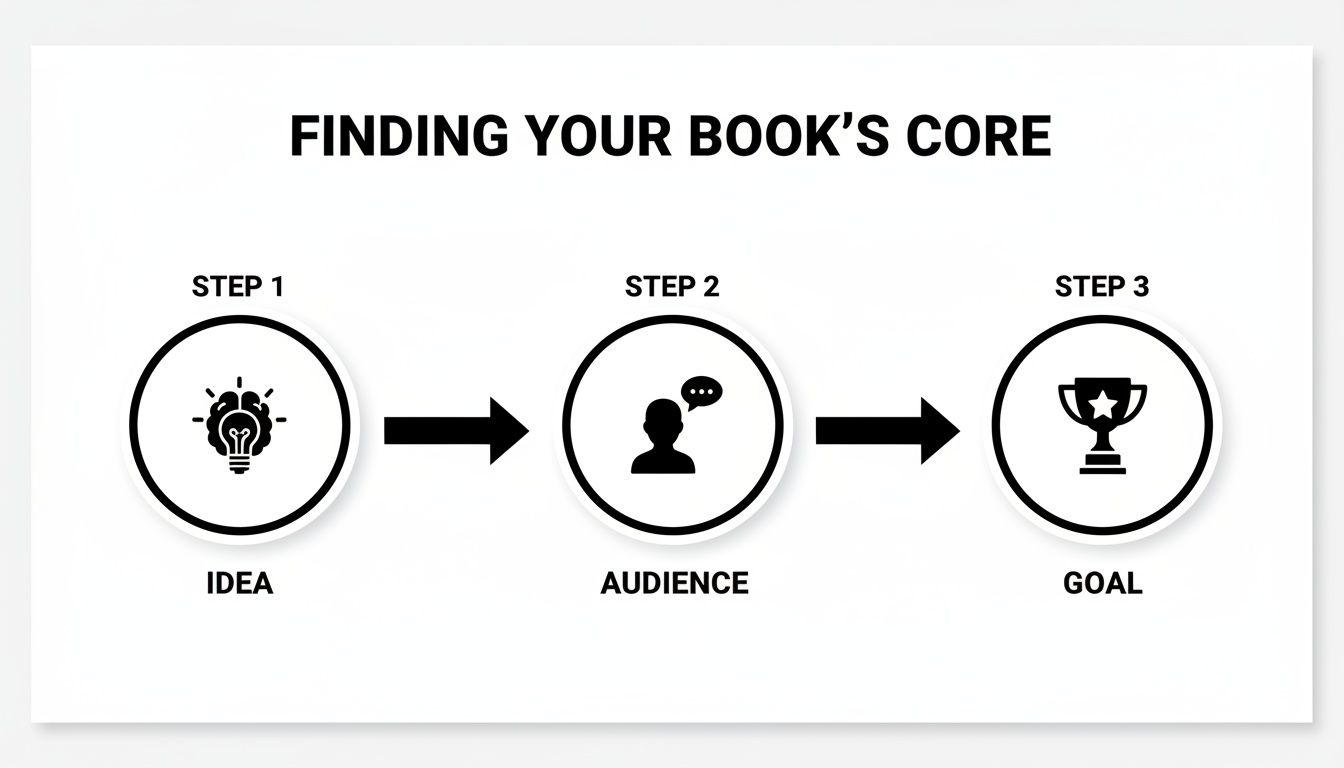
Keep these three pillars, Idea, Audience, and Goal, front and center as you start building your chapter by chapter blueprint.
The Problem, Promise, Path Framework
Over the years, I’ve seen dozens of outlining methods, but the one I always come back to is what I call the “Problem, Promise, Path” framework. It’s incredibly effective because it's simple, it's story driven, and it practically guarantees your book will have a natural narrative arc that keeps people turning the pages.
Here’s how it breaks down:
- The Problem: The first section of your book needs to meet your readers exactly where they are. You have to describe the pain point they're wrestling with so deeply and empathetically that they nod along, thinking, "Yes, that's me!" You're not just listing symptoms; you're showing them you genuinely understand their struggle.
- The Promise: This is the pivot point. After you've established the problem, you introduce your big idea as the solution. You paint a vivid, compelling picture of what their world could look like if they adopted this new perspective or method. This part is all about building hope and excitement for what's possible.
- The Path: This is the heart of your book, the final and largest section. Here, you lay out the practical roadmap. These chapters are the step by step guides, the actionable frameworks, the illustrative stories, and the hard data that show them exactly how to get from the Problem to the Promise.
Following this structure turns your book from a mere collection of essays into a truly compelling journey. It gives it a beginning, a middle, and an end that feels satisfying and complete.
Structuring Individual Chapters
Once that big picture framework is in place, you can zoom in on the individual chapters. Think of each chapter as a mini journey of its own, following a similar pattern to keep your reader engaged and moving forward.
A great chapter doesn't just present information. It creates a small transformation, moving the reader from one level of understanding to the next.
For every single chapter, I recommend this simple but incredibly powerful structure:
- The Hook: Always start with something that grabs them. It could be a compelling personal story, a startling statistic, or a provocative question that immediately introduces the chapter's core idea.
- The Core Argument: This is the meat of the chapter. State your point clearly, then back it up with a rich mix of evidence. Use personal anecdotes, client case studies, academic research, and compelling data to make your argument both persuasive and memorable.
- The Takeaway: Never leave your reader hanging. End each chapter with a clear, actionable summary. What is the one thing you want them to remember or do after reading this section? Make it impossible for them to miss the point.
This isn't about being rigid; it's about being intentional. A solid blueprint gives you the confidence to write freely, knowing that every word you put down is part of a strong, coherent structure. It’s a profound act of service to your reader, making their journey through your ideas as smooth and impactful as it can possibly be.
Finding Your Voice or a Helping Hand
Alright, take a deep breath. We’ve built the blueprint for your book. Now comes the part where the real magic happens, but also, let's be honest, where so many brilliant books go to die. Getting those words out of your head and onto the page is a marathon, not a sprint. It’s an act of incredible vulnerability and endurance.
A lot of leaders I work with get stuck right here. They’re worried the book won’t actually sound like them. They're afraid it'll come out stiff, corporate, or just plain boring. That’s a totally normal fear. The good news? Your unique voice is already there. We just have to uncover it.
What Does Your Voice Sound Like?
Your writing voice isn't some mystical thing you need to invent from scratch. It's simply the way you communicate your ideas when you're at your most natural and passionate. Think about it: how do you explain your core concepts to a new client or an inspired mentee?
That’s your voice.
- Do you use humor and tell funny stories to make a point? Great. Your book should be witty and anecdotal.
- Are you a data driven person who lays out logic step by step? Perfect. Your book should be clear, structured, and packed with evidence.
- Do you speak with deep empathy and connect on an emotional level? Wonderful. Your book should feel like a heartfelt conversation.
Don’t try to sound like a generic "business author." The world has plenty of those. It needs you, with all your quirks and unique ways of seeing things. The goal is to make the reader feel like they're sitting across the table from you, soaking up your wisdom over a cup of coffee.
Your voice is your most powerful tool for building trust. When readers feel like they know the real person behind the words, your ideas don't just land; they stick.
Here’s a quick exercise. Grab your phone and record yourself talking for five minutes about one of your core chapter ideas. Don't script it. Just talk as if you're explaining it to a trusted friend. Then, get it transcribed. I guarantee you, your authentic voice is hiding right there in that transcript.
The Honest Truth About Writing 50,000 Words
Now for some real talk. You are a leader, an innovator, an expert. Your days are already overflowing. The idea of carving out the 200 to 300 hours it typically takes to write a quality first draft can feel completely impossible.
This is the moment where you have to be brutally honest with yourself. Is writing this book yourself the absolute best use of your incredibly valuable time and energy? For some, the answer is a resounding yes. The act of writing is a beautiful process of discovery, and they wouldn't trade it for anything.
But for many, many others, the dream stalls right here. That blinking cursor becomes a source of guilt. The unfinished manuscript gathers digital dust. And a world changing idea never sees the light of day.
If that sounds even remotely familiar, I want you to hear this loud and clear: you do not have to do this alone.
The Smartest Shortcut: A Ghostwriter
Let's bust a common myth right now. Hiring a professional ghostwriter isn't cheating. It’s delegating. It’s like hiring an architect to design your house. You provide the vision, the style, and the core purpose; they bring the technical expertise to build it beautifully and make sure it’s structurally sound.
A great ghostwriter is a master of empathy and a vocal chameleon. Their entire job is to crawl inside your head, understand your ideas so deeply they can articulate them with your unique cadence and passion, and then handle the heavy lifting of writing those 50,000 words.
It’s your vision. Your ideas. Your stories. Your name on the cover. A ghostwriter is simply the dedicated partner who brings it all to life. The results are undeniable; a well crafted book can build immense trust. In fact, one report notes 73% of decision makers trust thought leadership content more than traditional marketing materials.
This partnership allows you to stay in your zone of genius while the book gets written efficiently and expertly. It’s often more fun, less stressful, and the fastest path from a great idea to a finished book in your hands. If you're considering this path, we have an excellent resource on how to find the right ghostwriter for your book.
Turning Your Manuscript into a Masterpiece
First things first: pop the champagne. Seriously. Finishing a first draft is a monumental feat most people only dream of. You’ve wrestled your ideas onto the page, stared down the blinking cursor, and created something from nothing. Take a moment to celebrate that win, because the hardest part is truly behind you.
Now, let's talk about taking that raw manuscript and polishing it into something that shines. This next phase is all about respecting the work you’ve already done. You owe it to your ideas, and your future readers, to make sure the final book is as professional and powerful as the message inside.

Why Fresh Eyes Are Your Secret Weapon
After spending months, maybe even years, living and breathing your book, you're just too close to it. You know what you meant to write, which makes it nearly impossible to spot a clunky sentence or a paragraph that isn’t quite landing. Your brain will automatically fill in the gaps. Trust me, it’s completely normal.
This is precisely where the magic of professional editing comes in. It's not a "nice to have"; it's a non negotiable step for a credible book. This isn’t just about catching typos (though that’s part of it). It’s about getting an objective, expert opinion on your book's structure, flow, clarity, and overall impact.
Think of it this way: you’ve built the engine of a race car. Now you need a specialist mechanic to fine tune it so it can actually win the race.
Understanding the Layers of Editing
Editing isn't a single action; it's a series of distinct, crucial stages. Trying to do them all at once is a recipe for disaster.
Developmental Editing: This is the 30,000 foot view. A developmental editor looks at the big picture: the core argument, the narrative arc, the overall structure. They'll ask the tough questions you need to hear, like, "Is your core premise clear from the start?" or "Does Chapter 7 really belong here, or would it be stronger in Part Three?"
Copy Editing: Once the foundation is solid, the copy editor comes in to work on the sentence level. These are the masters of grammar, style, and consistency. They polish your prose until it’s crisp, clean, and a genuine pleasure to read, making you sound like the absolute best version of yourself.
Proofreading: This is the final pass, the last line of defense. After the book has been designed and formatted, a proofreader meticulously hunts down any stray typos, weird formatting glitches, or punctuation errors that managed to sneak through.
Skipping any of these steps is like building a gorgeous house but forgetting to have the wiring inspected. It might look great on the outside, but problems are lurking just beneath the surface.
Editing is an invisible art. When it's done well, the reader doesn't notice the editor's work, they only experience the author's brilliance, effortlessly.
You Absolutely Judge a Book by Its Cover
Let's be blunt: people do judge a book by its cover. A poorly designed cover can kill your book's chances before a single word is read.
In a sea of other books, your cover has maybe three seconds to grab someone's attention and communicate what your book is all about. This is not the time to ask your nephew who’s "good with Photoshop."
Investing in a professional book cover designer is one of the smartest moves you can make. They’re experts in typography, color psychology, and market trends. They know how to create a cover that signals credibility and perfectly aligns with your message.
The inside of the book, the interior layout, matters just as much. A clean, readable font, plenty of white space, and clear chapter breaks make for a pleasant reading experience. A dense wall of text, on the other hand, is an instant turn off.
Bringing a beautiful, physical book into the world is a final act of respect for your ideas. It deserves to be polished to perfection.
If the thought of finding and managing editors, designers, and formatters sounds like a whole other job… well, it is. This is another area where a good ghostwriting partner can be invaluable. They often manage this entire production process, letting you focus on being the author while they sweat the details and deliver a masterpiece.
Your Lingering Book-Writing Questions, Answered
Okay, we’ve navigated the entire map of creating your thought leadership book, from that first spark of an idea to the final manuscript. I hope you're feeling more energized than overwhelmed at this point. Still, it's totally normal to have a few questions rattling around.
Let's pull up a chair and tackle some of the most common ones I hear from authors just like you.
"How Long Should My Book Actually Be?"
This is probably the number one question I get, and my answer is always the same: it needs to be long enough to make your case powerfully, and not one word longer.
Most solid thought leadership books land in the sweet spot of 40,000 to 60,000 words, which works out to about 150-250 pages. But don't get hung up on hitting a specific number.
Your real mission is to deliver immense value on every page. A tight, potent book that’s full of actionable insight is a thousand times better than a bloated one stuffed with fluff just to seem "bigger." Trust me, your readers will thank you for getting right to the point.
"What’s the Biggest Mistake New Authors Make?"
Oh, this one’s easy. By a long shot, the most common pitfall is trying to pour every single piece of knowledge you've ever acquired into a single book. It’s a noble impulse! You have a lifetime of wisdom and you want to share it all.
But a book that truly leaves a mark is surgically focused. It champions one big idea. Every single story, every piece of data, and every chapter must serve that central argument.
Trying to be everything to everyone is the fastest way to dilute your message. You'll leave readers confused, not empowered. Your goal isn't to be remembered for everything; it's to be remembered for one game changing idea. You can always write another book later.
"How Do I Even Begin to Find a Good Ghostwriter?"
Finding the right person to help tell your story is a huge deal. It’s less like hiring a contractor and more like finding a creative partner. You're not just looking for a talented writer; you're looking for the right collaborator for you.
Start by reviewing their portfolio. Have they written for people in your industry? Does their style click with you? But that's just the first step.
The interview is where you really find out if it's a match. Go beyond their resume and dig into their process:
- How will they work to capture your specific voice and personality?
- What does their interview and collaboration process look like day to day?
- Do they seem genuinely fired up about your project?
The best ghostwriting relationships feel like a true partnership, built on trust and a shared excitement for the project. When you find the right person, the whole process becomes not just easier, but a lot more fun.
"Should I Self-Publish or Go the Traditional Route?"
This is the classic fork in the road, and honestly, there's no single "right" answer, just the right answer for your goals.
Traditional publishing offers the potential for bookstore distribution and a certain kind of prestige. But it's a long, slow, and hyper competitive game. You also hand over a lot of creative control and the vast majority of your royalties.
Self publishing puts you squarely in control. You call all the shots, from the cover art to the launch date. The timeline is exponentially faster, and you keep a much, much larger slice of the revenue.
For most experts I work with, whose primary goal is to use their book as a powerful tool for their business or platform, self publishing is almost always the more strategic path. It lets you get your big idea out into the world on your own terms, and you own the asset you worked so hard to create.
The road from a rough idea to a finished book is one of the most fulfilling professional journeys you can take. At My Book Written, we're here to provide the map and the compass you need to walk it with confidence. Whether you're just sketching out your ideas or ready to find that perfect writing partner, we can help. Dive into our guides at https://mybookwritten.com to get started.