
So, what exactly is a memoir ghostwriter? Think of them as your personal storyteller, a literary partner in crime. They step in to help capture your life story, in your voice, transforming a lifetime of memories into a polished, compelling book. A ghostwriter handles the heavy lifting, the interviews, the outlining, the writing, and the editing, all while making sure the final book is a true reflection of your personality and perspective. And let's be honest, they make it a whole lot more fun.
Your Story Is Ready. Let's Find Its Ghostwriter.

Let's get real for a minute. You have an incredible story inside you, one filled with moments that deserve to be shared. The dream of holding that story, bound in a beautiful book, is a powerful one. It’s a legacy, a tangible piece of you that will last for generations. It’s your story, immortalized. What an amazing thought.
But the actual process of writing it? That can feel like trying to climb Mount Everest in flip flops. It’s a huge task. You have a lifetime of memories swirling around in your head, and just the thought of untangling them into a coherent narrative can be paralyzing. Where on earth do you even start?
This is precisely where a memoir ghostwriter comes in. They don’t replace your voice; they become its biggest champion. Think of them less as a writer for hire and more as a storyteller who specializes in translation. They translate your spoken memories, your unique feelings, and your way of seeing the world directly onto the page.
More Than Just Putting Words on a Page
A great ghostwriter does so much more than just type out your stories. They wear many hats: part investigator, part confidant, and part narrative architect. Their real job is to ask the right questions, the kind that unlock memories you have not revisited in years. I once worked with a client who, after one of our chats, remembered a childhood trip he had completely forgotten. That story ended up being the heart of his first chapter.
They help you find that golden thread connecting all your experiences, weaving them together to create a compelling story. It’s their expertise that transforms a collection of anecdotes into a book people can't put down.
This kind of partnership is built on deep trust and a genuine connection. It is a true honor to be entrusted with someone's life story, and any ghostwriter worth their salt understands the weight and beauty of that responsibility.
The goal isn't just to write a book; it's to create a book that sounds like you wrote it. When your friends and family read it, they should hear your voice, your humor, and your wisdom in every single sentence.
Hiring a professional is not about giving up or admitting you cannot do it. Not at all. It’s about giving your story the expert craftsmanship it deserves. It’s a smart move that acknowledges your time and energy are valuable, turning a potential struggle into a joyful, collaborative journey. It is your vision, brought to life with a little professional magic.
Why Partnering With a Pro Just Makes Sense
Life is busy. You might be running a company, enjoying a well earned retirement, or focusing on your family. The idea of dedicating hundreds of hours to writing, editing, and wrestling with chapter structure is often just not realistic. A ghostwriter simply lifts that burden.
Here’s a breakdown of how the partnership works:
- You are the storyteller. You provide the raw material, the heart and soul of the book. All the memories, the emotions, and the lessons learned come directly from you.
- They are the craftsperson. They take all those beautiful, messy, wonderful pieces and assemble them into a masterpiece. They handle the structure, pacing, and prose.
- It’s still your book, period. Every word is approved by you. The final manuscript is a perfect reflection of your vision, just brought to life with a professional touch.
So, if you’re ready to stop just dreaming about that book and finally start creating it, you're in the right place. Let's dive into how to find that perfect partner who will help you turn your life story into the timeless legacy it's meant to be.
Where to Find Your Perfect Ghostwriting Partner
So, you're ready to find your literary other half, the person who will help turn your memories into a masterpiece. Fantastic. But where do these talented story whisperers actually hang out? You need a ghostwriter, not a ghost.
Finding the right memoir ghostwriter is a lot like dating. You need someone who just gets you, who listens intently, and who you genuinely enjoy spending time with. After all, you're going to be sharing some of your most personal stories with them. Just typing "memoir ghostwriter" into Google can feel like swiping through an endless sea of profiles. It's overwhelming and rarely leads to the right match.
Let's skip the noise and go straight to where the pros are.
Start With Curated Writing Communities
Instead of sifting through the entire internet, begin your search in places where professional writers gather. These are not just random job boards; they are curated platforms and organizations where writers are vetted and take their craft seriously. Think of it as skipping the line and heading straight to the VIP section.
Here are a few excellent starting points:
- Professional Associations: Organizations like the Association of Ghostwriters are gold mines. They often have member directories where you can find specialists in different genres, including memoirs.
- Boutique Agencies: Many smaller, specialized agencies focus exclusively on memoir and nonfiction. They do the initial screening for you, presenting you with a handpicked shortlist of writers who are a good fit for your project.
- Literary Marketplaces: Some platforms connect authors directly with experienced freelance professionals. These are not just ghostwriters but also editors and designers, all of whom have proven track records.
The real benefit here is quality control. These communities have a vested interest in maintaining high standards, which means you're far more likely to find a dedicated, experienced professional rather than someone just trying to make a quick buck.
The Power of a Good Referral
Never underestimate a good old fashioned recommendation. Ask around! Do you know anyone who has published a book? Talk to business coaches, publishing consultants, or even the owner of your favorite local bookstore. You'd be surprised how small the writing world can be.
A personal referral often leads to the best partnerships. When someone comes recommended by a trusted source, they already have a stamp of approval. You know they're reliable, professional, and have successfully helped someone else on a similar journey. It's the coziest, most human way to find your perfect match.
Navigating Freelance Platforms Wisely
Websites like Upwork or Reedsy are vast oceans of talent, but you have to know how to fish. You can absolutely find incredible writers there, but you will also find a lot of "too good to be true" offers. The key is to be incredibly specific and discerning from the get go.
When you post a project brief, be crystal clear about what you need. Do not just say, "I need a memoir ghostwriter." Instead, describe the tone of your story, its core themes, and your ultimate goal for the book. This helps the right people find you.
It’s also crucial to understand the market. Compensation for ghostwriters varies wildly based on experience and the project's scope. While some salary databases might show average figures around $38,680 per year, seasoned professionals working on full length books often earn six figure incomes through project based contracts. You're investing in a highly specialized, deeply personal service.
As you explore, you will also notice the rise of AI tools in the industry, which can affect pricing and timelines. For more on where the industry is headed, you can find some fascinating 2025 industry predictions on the Association of Ghostwriters website.
Ultimately, your goal is to find a partner who values your story as much as you do. Take your time, trust your gut, and focus on finding a genuine connection. You're not just hiring a writer; you're entrusting someone with your legacy.
How to Vet Ghostwriters Like a Pro

So, you’ve waded through the internet and have a shortlist of potential writers. Awesome. But now comes the tricky part: how do you actually pick the one? It can feel like you’re trying to hire a surgeon and a therapist all rolled into one, which, honestly, is not too far from the truth.
The good news? You do not need a literature degree to spot a great match. This process is less about grammatical nitpicking and much more about listening for that human connection. You're looking for someone who can not only write beautifully but also listen with their whole heart.
Let’s walk through how to look at their past work and talk to their previous clients, so you can feel completely confident in your final choice. Think of it as a friendly background check, not a formal interrogation.
Reading Between the Lines of a Portfolio
When a writer sends you their portfolio, it's easy to just scan for typos. And while clean copy is a must, that's just table stakes. What you're really looking for is their storytelling soul.
Your mission is to get a feel for how they capture another person's voice. As you read, do not just ask, "Is this good writing?" Go deeper. Ask yourself these questions:
- Does this feel authentic? Can you imagine a real person actually speaking these words? A great ghostwriter completely disappears, leaving only the author’s personality shining on the page.
- Can they handle emotion? Look for samples that tackle tough subjects or tender moments. Do they handle them with grace and depth, or does the writing feel clinical and detached?
- What's their range? If you have a witty personality, does their portfolio include examples of humor? If your story is more serious and reflective, do they have samples that show emotional gravity?
You're looking for a chameleon, someone who can adapt their style to fit the unique story they’re telling. A portfolio that showcases a variety of different voices is a huge green flag. It tells you they’re a skilled listener and a versatile memoir ghostwriter.
The Art of Checking References
Okay, now for the part that can feel a little awkward: checking references. But this is not about digging for dirt. It's about getting a genuine sense of the collaborative experience. This is where you find out if they are as good a partner as they are a writer.
When you connect with a past client, you're not a detective. You’re simply another person on a similar journey, asking for a bit of advice. Keep the conversation warm and natural.
Here are a few questions that will tell you everything you need to know:
- "How did they make you feel comfortable sharing difficult or personal memories?"
- "What was their communication like? Did you always know where things stood with the project?"
- "Could you give me an example of how they handled feedback or a revision you requested?"
- "What was the most surprising or wonderful part of working with them?"
These kinds of questions get you past a simple "yeah, they were great" and give you real insight into the human side of the process.
Trust is the currency of this relationship. You're looking for someone who made their previous clients feel safe, heard, and respected throughout the entire emotional journey of writing a book.
In the end, vetting a ghostwriter is about trusting your gut. Does their work resonate with you on a personal level? Do their past clients sound genuinely happy and proud of the book they created together? You're looking for a partner to help you build a legacy. Taking the time to find the right one is the most important investment you can make in your story.
Asking the Right Questions to Find Your Ghostwriter
You’ve checked out their portfolio and talked to their references. Now comes the most important part: the interview. This is not about ticking boxes on a resume; it's about seeing if you click on a human level.
Think of this conversation less like a formal interview and more like a first meeting with a creative partner. You’re trying to answer one core question: "Can I trust this person with my most personal stories?" The goal is not to put them on the spot, but to start a real dialogue about how you’ll work together.
So, let's move beyond the obvious, "Have you written a memoir before?" Their portfolio should have already told you that. Instead, here are the questions that will reveal if they're the right ghostwriter to bring your story to life.
Gauging Their Passion and Empathy
First things first, you need to know if they’re genuinely interested in your story. A great ghostwriter is not just looking for another gig; they're looking for a story that resonates with them. You want to see that spark of connection.
Here’s how to find it:
-
"From what you know of my story so far, what part stands out to you the most, and why?" This is a fantastic opener. A thoughtful, specific answer shows they're already engaging with your narrative on an emotional level. It tells you they’re not just seeing a project, but a compelling human story.
-
"My book will touch on some difficult memories. How do you approach sensitive or emotional topics with your clients?" Listen for words like "patience," "respect," and "a safe space." The right partner will make it clear that you are in the driver's seat, and they're there to support you, not push you through painful moments.
-
"What kinds of stories are you most passionate about telling?" This gives you a peek into what truly motivates them as a writer. If their face lights up when they talk about stories of overcoming adversity or creating a family legacy, and that's the heart of your book, you're likely on the right track.
Understanding Their Writing and Collaboration Process
Once you feel that personal connection, it’s time to get practical. How will they actually turn your memories and conversations into a compelling manuscript? These questions pull back the curtain on their craft.
-
"Can you walk me through your process? How do you go from our interview sessions to a finished chapter?" A seasoned pro will have a clear answer. They will likely talk about how they organize interview transcripts, find the central narrative thread, and work to capture your unique voice and way of speaking.
-
"How do you handle feedback and revisions? What happens if I read a chapter and it just does not sound like me?" This is a crucial one. The ideal response is something like, "That's a totally normal and essential part of the process! We'll work on it together until it feels right to you." It shows they view collaboration as a strength, not a problem.
-
"What's your strategy for ensuring the final book truly captures my voice?" Look for answers that involve more than just writing. They should mention things like deep listening, studying your natural speech patterns, and being committed to as many drafts as it takes to get it right.
To help you dig deep during your conversations, I've put together a table of questions. Think of these as conversation starters designed to move beyond the surface and reveal a ghostwriter's true process, empathy, and style.
Interview Questions to Find Your Perfect Match
Use these questions to move beyond surface level answers and truly understand a ghostwriter's process, empathy, and style.
| Question Category | Sample Question | What You're Looking For |
|---|---|---|
| Empathy & Connection | "From the brief summary I sent, what part of my story stood out to you the most, and why?" | A specific, thoughtful answer that shows they've already started connecting with your narrative emotionally. |
| Handling Sensitivity | "My story involves some difficult memories. How do you help clients navigate sensitive or emotional topics?" | Confidence and compassion. They should emphasize creating a "safe space," client control, and patience. |
| Process & Craft | "Can you walk me through your process for turning our interview sessions into a chapter?" | A clear, well defined workflow. They should be able to explain how they find the narrative and capture your voice. |
| Collaboration & Revisions | "How do you handle feedback? What if I feel a chapter does not sound like me?" | An open, collaborative attitude. The best writers welcome feedback as a key part of getting the voice right. |
| Voice & Authenticity | "How will you ensure the book sounds like me and not like a generic writer?" | A focus on deep listening, studying your speech patterns, and a commitment to multiple drafts. |
| Project Management | "How do you keep projects on track and communicate progress?" | A clear system for deadlines, check ins, and communication (e.g., weekly emails, shared documents). |
Ultimately, your gut feeling matters a lot here. The writer who asks thoughtful questions in return, listens more than they talk, and makes you feel genuinely heard is probably the one who will do your story justice.
Remember: you’re not just hiring someone to type for you. You are inviting a creative partner into the most personal parts of your life. The right person will feel privileged to be on this journey with you.
This interview is your chance to find that person. Trust your intuition. It will guide you to the writer who can help you create a book that truly honors your legacy.
Navigating Ghostwriting Contracts and Costs
Okay, let's talk about the part that can make people’s palms sweat a little: money and contracts. I promise this does not have to be scary or complicated. In fact, getting this part right from the get go is what allows you to relax and truly enjoy the creative process, knowing everything is clear and you're protected.
Think of it this way: a good contract is like a GPS for your book project. It maps out the entire journey, shows you all the stops along the way, and makes sure both you and your ghostwriter arrive at the same destination, your finished book, without any wrong turns.
Demystifying the Investment in Your Legacy
First, the numbers. Hiring a memoir ghostwriter is absolutely an investment. There's just no way around that. But what you're investing in is not just a Word document; it's the professional, heartfelt crafting of your life story. It’s a multi billion dollar industry for a reason, driven by people who understand their story is a priceless asset.
The ghostwriting world has different tiers. Industry reports show that fees for a well done memoir typically range from $20,000 to over $120,000.
- At the lower end ($20k to $40k), you will often find collaborative packages.
- Mid career pros with solid track records usually charge between $40k and $80k.
- Top tier writers, especially those with bestseller credits to their name, can easily command fees well north of $80k.
This is why many people budget six figure totals for a book they want to see on shelves. It is also worth noting that the market has split a bit, with premium, human centered services holding their value while cheaper, AI assisted options pop up.
A small tip for managing the budget: using an affordable transcription service to process your interview audio can be a smart, practical way to keep costs down. Those little efficiencies really do add up over the life of a project.
The infographic below highlights a few key qualities to look for that go beyond just the price tag.
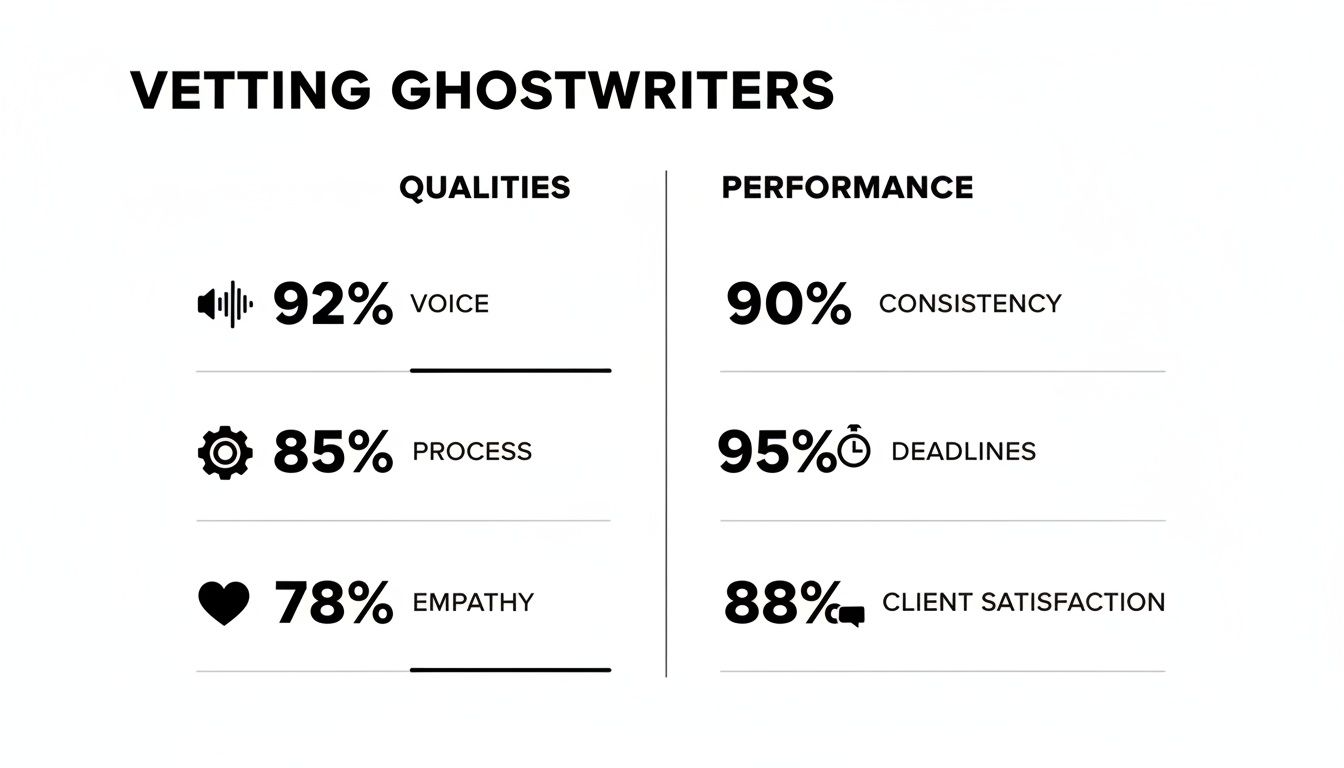
It’s a great reminder that while cost is a factor, the writer's ability to capture your voice, stick to a clear process, and connect with real empathy are the true signs of a great partnership.
What Should Be in Your Ghostwriting Contract
Now for the legal stuff, but in plain English. Your contract is your best friend in this process. It needs to be clear, fair, and leave zero room for misunderstandings. Any professional ghostwriter worth their salt will insist on one.
Here are the non negotiables that absolutely must be in there:
- Confidentiality: This is huge. Your ghostwriter should agree to keep everything you share completely private, forever. You're entrusting them with your life story, and that trust needs to be legally binding.
- Ownership of Rights: Let me be perfectly clear on this one. You own 100% of the rights to your book. The ghostwriter is a service provider. Their name should not appear on the cover (unless that's a separate agreement), and they have no claim to your copyright or future royalties. Period.
- Payment Schedule: The contract must clearly outline the total fee and how it will be paid. This is usually broken into milestones, like an initial deposit, a payment after the first few chapters are approved, a mid project payment, and a final payment on completion.
- The Revision Process: How many rounds of edits are included? A good contract specifies this. It protects you from endless, frustrating back and forth and ensures the writer is committed to getting it right.
- Project Scope and Deliverables: What, exactly, are you getting for your money? The contract should define the estimated word count, the number of interview hours, and what the final deliverable looks like (e.g., a fully edited manuscript in a Word document).
A clear contract is not about a lack of trust; it's the foundation of a great professional relationship. It allows both of you to focus on what really matters: telling your story beautifully.
If all of this feels a bit daunting, you're not alone. The traditional path can be a lot to manage. That’s why services like Opus Eternal have emerged, offering a streamlined approach that is often less than half the cost of traditional options. They provide expert ghostwriting without compromising on the quality your legacy deserves, making the process more accessible without sacrificing the magic.
From Memory to Manuscript: What Working Together Actually Looks Like

You’ve signed on the dotted line and officially have a creative partner for your book. Now, the real work, and the real fun, begins. This is where you get to unpack a lifetime of stories and watch them take shape on the page. I've seen it time and time again; it's a profound experience, full of laughter, deep reflection, and, yes, sometimes a few tears.
This collaboration is the heart of the entire project. It's so much more than a string of interviews. It’s about building a trusting relationship where you feel comfortable sharing memories you have not thought about in years. A good ghostwriter is not just listening to your words; they’re listening for the emotion, the humor, and the meaning tucked between the lines.
Then comes the moment. An email lands in your inbox with a subject line like, "First Chapters." Reading your own life story, told back to you in a compelling narrative, is an emotional rush unlike any other. It’s surreal and validating all at once. This is when your memories officially start their journey into a legacy.
The Art of Giving Great Feedback
Your role now shifts from storyteller to creative director. Providing clear, kind, and constructive feedback is the single most important job you have during the writing phase. Trust me, your memoir ghostwriter wants to get it right, and your insights are the compass they need.
It’s completely normal for the first draft of a chapter not to be perfect. In fact, it is not supposed to be. Think of it as a beautiful lump of clay ready to be molded into its final form.
Here’s how to give feedback that actually helps:
- Get Specific: Instead of a vague, "I do not like this," try something like, "This part does not quite sound like me. I think I would have used a funnier, more sarcastic tone here."
- Focus on the Feeling: Does a chapter feel rushed? Does a piece of dialogue not ring true? Talk about the emotional impact of the writing on you as the reader.
- Balance Praise and Pointers: Always start with what you love. For example: "The way you described my grandmother's kitchen was perfect! I could almost smell her baking. For the next scene, let's work on making the dialogue a bit punchier."
This back and forth is what makes the book truly yours. It's a dance of ideas and refinements that brings you closer to the finished manuscript with every step.
Honoring the Timeline and Trusting the Process
It’s completely natural to feel impatient. You want to hold that finished book in your hands! But creating something truly special takes time. The biggest reason busy professionals, founders, and public figures hire a memoir ghostwriter is precisely because they do not have the months of uninterrupted focus a book demands. For a detailed look at what to expect, you can explore some 2025 publishing trends and insights on Launchmybook.com.
The collaborative journey is an act of discovery for both of you. Be patient with the process, be kind to yourself, and trust that your writer is just as invested in honoring your story as you are.
They will guide you through the outlining, the drafting, and the revisions, keeping the project on track. Your job is simply to show up, be open, and share your stories with honesty and heart.
By the end, you will not just have a manuscript. You’ll have gone on an incredible adventure of self reflection and created a timeless piece of your family's history. And honestly, there is no greater feeling than that.
At My Book Written, we believe every person has a story that deserves to be told with care and professionalism. We provide the resources and guidance to help you navigate this journey with confidence, from organizing your first thoughts to finding the perfect partner to bring your vision to life. Explore our guides at https://mybookwritten.com to start building your legacy today.