
So, you’re thinking about writing a memoir. Let’s start with one simple, powerful truth: your story matters. You've lived something worth remembering, and the idea of turning those memories into a real, physical book is a beautiful, honorable goal. It’s your legacy, after all.
This whole process is about taking a specific theme from your life, building a chapter by chapter roadmap, and then pouring your memories onto the page with all the vivid, emotional detail that makes them real.
Your Story Is Worth Telling, Let’s Get It on Paper

If you're reading this, I'm willing to bet a story is bubbling up inside you. It's that little voice whispering, "Someone should really write this down." That feeling is equal parts exhilarating and absolutely terrifying, isn't it?
On one hand, you’re about to honor a piece of your life that deserves to be remembered forever. On the other, the sheer scale of turning a lifetime of memories into an actual book can feel like trying to bottle a thunderstorm. It's a huge task, and it's okay to feel a little wobbly.
Let’s be honest, the idea of creating something that will last forever is a heavy, beautiful responsibility. It's your legacy in print. But that weight can also be paralyzing, leading to the dreaded "one day I'll write it" syndrome that can drag on for years.
Your Friendly Co-Pilot for This Journey
Think of this guide as your friendly co pilot. We'll skip the stuffy jargon and get straight to what you actually need to know, turning that "one day" into today. You don't need a fancy degree or a secret password to write your memoir. You just need a roadmap and a bit of encouragement.
Believe it or not, your story already has an audience, even if it’s just your family. People are hungry for real, human stories. The global nonfiction book market, which includes memoirs, hit $14.02 billion in 2022, and memoirs are the third most translated genre in the world. That proves just how much people crave authentic, personal narratives. You can dig into more insights on the universal appeal of personal stories over on meminto.com.
Writing a memoir is like sending a letter to the future. It's your chance to explain, to connect, and to leave a piece of yourself behind for others to discover.
Together, we’re going to tackle the big, scary questions:
- What slice of my life should I actually focus on? (Hint: it’s not every haircut you’ve ever had.)
- How do I shape messy memories into a story that people want to read?
- What if writing this all by myself just feels impossible?
This whole journey is about honoring your past and creating a treasure for the future. Let’s get that story out of your head and onto the page where it belongs.
Finding Your Story's Heart, Not Your Whole Life Story
Let’s clear the air on something right away, because this is the single most important hurdle for any aspiring memoirist. You are not writing an autobiography.
Seriously. Let that sink in. The goal here isn't to create a chronological log of your existence from your first breath to this very moment. Thank goodness, right? That’s an overwhelming task, and honestly, it makes for a pretty dull read. No offense to your life, of course.
A great memoir isn't the whole story of your life. It’s about one meaningful, powerful slice of it.
The Power of a Narrow Focus
To get a handle on what to include, think of your life as a collection of powerful, interconnected stories. You’re not trying to tell them all at once. Your job is to choose the one that truly defines a part of you. The heart of your memoir is found in a specific theme, a pivotal era, or a life altering challenge that created a clear "before" and "after."
This central thread is what will hold your entire narrative together. To start tugging at that thread, ask yourself a few questions:
- When did I experience a profound transformation? This could be anything from a career change that upended your identity to recovering from an illness or moving to a new country.
- What relationship fundamentally shaped who I am today? Often, the most powerful memoirs revolve around our connection with a parent, a mentor, a partner, or even a rival.
- What core belief of mine was shattered by a real life experience? The story isn't just about what happened, but about how your entire worldview shifted because of it.
This approach makes the writing process feel manageable. Instead of trying to document every memory, you’re just sharing the one story that needs to be told.
To help clarify this, let’s break down the key differences. Your goal is to write a memoir, not an encyclopedia of your life.
Finding Your Memoir's Focus: Autobiography vs. Memoir
| Feature | Autobiography (What to Avoid) | Memoir (Your Goal) |
|---|---|---|
| Scope | Covers the author's entire life, from birth to present. | Focuses on a specific period, theme, or series of events. |
| Timeline | Strictly chronological and fact based. | Emotionally driven; can jump in time to serve the theme. |
| Core Question | "What happened in my life?" | "What did I learn, and how did it change me?" |
| Reader's Takeaway | A historical account of a person's life. | An emotional connection and a universal truth. |
As you can see, the memoir gives you so much more creative freedom. It's about depth, not breadth.
Trying to write about your entire life is a common beginner's mistake. A memoir shines brightest when it focuses on a specific emotional journey, not just a sequence of events.
If you’re still wrestling with this, don’t panic. It's a huge decision! Sometimes, just talking it through with someone who understands story structure can bring incredible clarity. A good ghostwriter, for instance, is a master at listening to your experiences and helping you pinpoint that golden thread.
Think of them as part story coach, part confidant. Their expertise can save you months of spinning your wheels trying to find your focus. It’s a surprisingly easy and even fun way to get straight to the good stuff. For many people, a service like Opus Eternal can be the perfect partner to help uncover that core story and bring it to life.
Building Your Book's Blueprint, Chapter by Chapter
So, you’ve wrestled with your memories and pinned down your story’s heart. That’s a huge win! Now for what I think is the most exciting part, building the actual blueprint for your book.
Think of it this way: a pile of beautiful bricks is still just a pile of bricks. It only becomes a house when you have a plan. The same goes for your memories. No matter how powerful they are, a random collection of moments doesn’t make a memoir. A solid structure does.
This is the step that separates a private journal from a compelling book. It’s where the abstract dream of writing your story starts to feel real and totally doable.
The Classic Three Act Structure
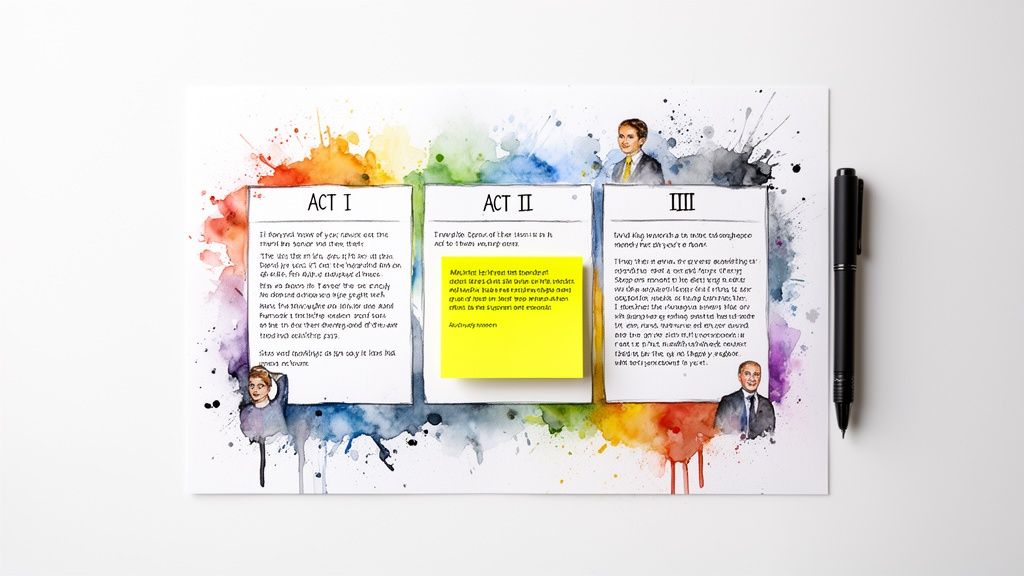
You don't need a degree in literature to structure a great story. Let's borrow a storytelling framework that's worked for thousands of years: the classic three act structure. It’s perfect for a first time memoirist because it gives your personal story a natural, satisfying arc. It's a real story arc-angel.
- Act One: The Before. This is where you introduce your world before everything changed. It sets the scene, establishes the stakes, and shows the reader who you were at the start.
- Act Two: The Messy Middle. This is the heart of your transformation. It’s filled with the challenges, conflicts, and turning points that pushed you to your limits. This is where you learn, grow, and fight your way through.
- Act Three: The After. Here, you reveal your new reality. You show how the events of Act Two reshaped you and your world. It’s the resolution, the new normal, and the hard earned wisdom.
This simple structure provides a strong spine for your narrative, ensuring it has a clear beginning, a compelling middle, and a meaningful end. You can get more hands on guidance in our detailed guide on how to write a memoir outline.
From Acts to Actionable Chapters
Now, let’s get practical and break that big structure down into actual chapters. Try to think of each chapter as a mini story that supports the larger arc.
Grab a stack of index cards or open a blank document and just start brainstorming pivotal moments that fit into each of the three acts.
Don’t worry about perfect prose right now. Just jot down scene ideas.
Some quick chapter ideas might look like this:
- Act One Chapter: The Last Normal Tuesday
- Act Two Chapter: The Phone Call That Changed Everything
- Act Two Chapter: Learning to Breathe Underwater
- Act Three Chapter: The Day I Finally Said No
- Act Three Chapter: Sunrise on the Other Side
Your blueprint doesn’t need to be perfect from the start. Think of it as a living document. Its main job is to give you a roadmap so you don’t get lost in the woods of your own memories.
Mapping this all out can feel overwhelming, especially when you’re so close to the story. This is another one of those moments where a professional partner can be a true gift. A good ghostwriter isn’t just a typist; they are an expert architect of stories.
They can help you sift through your memories, identify the most powerful scenes, and build a blueprint that feels both emotionally true and structurally sound. It makes the whole process feel less daunting and, dare I say, a lot more fun.
Writing Without the Headache: Practical Tips and Pro Help
You’ve got your theme locked in and a chapter by chapter blueprint ready to go. Now for the exciting part, actually bringing those memories to life on the page. This is where the magic happens, but it's also where things can get a little maddening.
The real goal isn't just to report what happened; it's to pull your reader right into the scene with you. Instead of saying, "I was nervous before the big speech," you need to show them. Describe your heart hammering against your ribs. Let them feel the clammy palms, the way your voice cracked on that first word.
This is the art of storytelling. It’s a beautiful thing. But let’s be honest, this is also the exact point where most memoir projects grind to a halt.
The Reality of the Blank Page
Life has a funny way of getting in the way, doesn't it? You power through a few chapters, feeling inspired, and then… nothing. The initial excitement fades, replaced by the glare of a blank screen, a tidal wave of self doubt, and that nagging feeling that you’re just not a "real writer."
Suddenly, finding the time to write feels like a chore. That inner critic gets louder, whispering that your stories aren't interesting enough for anyone to read. You can picture the finished book, that beautiful, tangible piece of your legacy, but the lonely struggle to get there feels overwhelming. If this sounds familiar, you're not alone. Writer's block is a common hurdle, but there are proven ways for anyone to learn How to Overcome Writer's Block and Start Writing.
You want the finished book, but maybe not the solitary struggle of writing it. This is a perfectly normal, human feeling. It doesn't mean your story is any less worthy of being told.
This struggle is very real. The traditional publishing world doesn’t make it any easier, either. Recent data shows that memoir deals are becoming harder to land, making it tough for everyday people to get noticed without a massive platform. In fact, only 23% of memoirs sold in 2022 came from writers whose stories were judged purely on their own merit.
A Smarter, Saner Way to Write Your Book
So, what do you do when the passion is there but the process is just too painful? This is where a professional ghostwriter can be an absolute game changer.
Think of them as your personal storyteller, your structural architect, and your biggest cheerleader, all rolled into one. You bring the memories, the voice, and the vision. They bring the writing expertise and do the heavy lifting, crafting sentences, structuring chapters, and staring down that blank page so you don't have to.
This isn't some out of reach luxury anymore. Services like Opus Eternal have made the process surprisingly accessible, offering a faster, more collaborative path to a finished book, often for less than half the cost of old school ghostwriting agencies. It’s an amazing way to get your story told without having to quit your day job to become a full time author.
Make no mistake, it’s still 100% your book. Your name is on the cover. Your soul is on every page. The only difference is that you didn't have to go through the headache of writing it all by yourself. If you're hitting a wall, we have more tips for you in our guide on tackling writer's block for memoir authors. Think of it as your secret weapon for getting it done.
Writing About Others Without Causing a Family Feud
Writing a memoir inevitably means writing about other people. Let's be honest, that can feel like walking a tightrope over a pit of angry crocodiles.
You need to tell your truth, but you also probably want to be able to show up to Thanksgiving dinner without starting a brawl. So, how do you keep the peace while staying true to your story?
Here are a few practical moves that can make all the difference:
- Use pseudonyms and tweak the details. Your sharp tongued Aunt Carol from Cleveland can become "Charlotte, the florist from Denver." This simple change can offer a surprising amount of legal and emotional protection.
- Create composite characters. Sometimes, three different friends played a similar role in your life. Blending them into one character can protect individual privacy and make your narrative cleaner and more focused.
- Frame it through your own lens. Instead of pointing fingers, focus on how their actions made you feel. "He lied to me" is an accusation. "When I found out the truth, my world shattered" is your emotional experience. The latter keeps the reader on your side.
Even a quick note in your introduction, acknowledging that memory is subjective and this is your version of events, can go a long way in softening the impact.
To Tell or Not to Tell?
Deciding whether to give family members a heads up is a tough call. The thought of your brother asking, "So, what did you say about me in that chapter?" is enough to make anyone sweat.
But a heartfelt chat beforehand can clear up a lot of potential confusion. It gives you a chance to explain why certain memories are so important to your story, and it prevents them from being blindsided when the book is out in the world.
A little honesty upfront can save a lot of drama later.
If you're dealing with sensitive memories, be transparent about why those moments were formative for you. The goal isn't to get their "permission," but to show respect and open a dialogue.
And when you're digging into the past, family documents can be a goldmine. If you're working with old letters or diaries, check out our guide on how to turn family journals into a book.
I once coached a writer who gave his formidable mother the codename "Matriarch M" throughout his manuscript. When she eventually found out, she loved it, she said it made her sound like a superhero. Sometimes, a simple label can turn a privacy tactic into a playful inside joke.
Balancing Truth and Tone
Memoirs have absolutely exploded in popularity, with readership surging over the past 20 years. People are hungry for authentic stories about identity, struggle, and discovery. They want that intimate connection that only a real life story can provide.
Before you even think about sharing your draft, let it sit for a while. A week, a month, whatever it takes to get some distance. Then, come back and read it with fresh eyes.
Even better, read it aloud. You'll instantly hear the sentences that sound more like accusations than observations. This is your chance to add context, adjust the tone, or even trim a scene into a brief vignette to minimize the fallout.
No matter how careful you are, putting your story out there means you might face some criticism. It’s wise to have some strategies for handling criticism and negativity in your back pocket to protect yourself and your work.
If you find yourself tangled in ethical knots, bringing in a professional can be a game changer. A good ghostwriter acts as a neutral third party, helping you navigate sensitive family dynamics while ensuring your voice remains authentic.
This is where a service like Opus Eternal can be incredibly helpful. They provide that expert, premium quality ghostwriting but in a way that’s fast and surprisingly accessible. Their pricing is often less than half of what traditional agencies charge, but you still get a polished, respectful manuscript without the revision headaches.
Crossing the Finish Line: Editing and What’s Next

You did it. You’ve wrestled your memories onto the page, wrangled the words, and now you have a first draft. Go ahead, do a happy dance. I’ll wait.
Now for the most important, and possibly most difficult, next step: walk away. Seriously. Tuck your manuscript into a drawer (a digital one counts!) and try to forget about it for at least a few weeks. Your story needs time to settle, and you need fresh eyes to truly see what you’ve created.
The Three Passes of Editing
When you finally come back to it, don't try to fix everything at once. That path leads to madness and a sudden urge to take up professional cat napping instead. A better approach is to think of editing in three distinct passes.
- The Big Picture Pass: First, read your entire draft without a red pen in sight. Ask yourself: does the story flow? Are there glaring plot holes or confusing jumps in time? This is all about the bones of your story, the overall structure.
- The Scene Level Pass: Now you can zoom in. Go chapter by chapter, scene by scene. Is every moment pulling its weight? Are your descriptions vivid enough to transport the reader? This is where you make each part of the story shine.
- The Polish Pass: Finally, it's time for the final sweep. This is your chance to hunt down typos, grammatical goofs, and any other pesky errors that slipped through. A great trick is to read it aloud, you’ll catch all sorts of awkward sentences that way.
What does "finished" truly mean? It means you have a story that honors your experience and is ready to be shared, whether that's with family, friends, or the wider world. It's a massive achievement.
Your Book, Your Way
So, what happens now? For many, the goal is a beautiful keepsake book to share with loved ones. Others might have their sights set on self publishing. The market is definitely welcoming; 60% of recent memoir authors are choosing to self publish, which gives them complete creative control.
And don't forget audio. The audiobook market is exploding and is on track to hit $19.7 billion by 2028. You can discover more insights about these publishing trends over at Austin Macauley.
If this final stretch from rough draft to finished book feels daunting, remember you don’t have to do it alone. Bringing in a ghostwriter at this stage can be an incredible partnership. They can take your wonderful draft and give it that professional polish, helping you cross the finish line with joy instead of exhaustion.
At Opus Eternal, we often help authors with this very step, it’s one of the best parts of the job, helping a writer bring their vision to life. It’s an accessible way to ensure your story gets the expert touch it deserves.
Answering Your Biggest Memoir Questions
Starting a project this personal is bound to kick up a storm of questions. It's totally normal. Let's walk through a few of the big ones that trip up most first time memoirists. Consider this your friendly Q&A session to clear the path forward.
How Long Does a Memoir Need to Be?
Ah, the million dollar question! If you're aiming for a traditional publishing deal, most memoirs clock in somewhere between 60,000 and 80,000 words.
But please, don't fixate on that number right now. Your first and only job is to get the story out.
Focus on telling a compelling, complete story, one with a clear beginning, a messy middle, and a meaningful end. The story itself will dictate its length. You can always beef up scenes with more detail or trim the excess later on. For now, just write.
What if My Memory Is Hazy on the Details?
Join the club! A memoir isn't a legal deposition; you're not expected to have a perfect, word for word recall of conversations from ten years ago. What you're chasing is emotional truth, not photographic accuracy.
It's absolutely okay to reconstruct dialogue or fill in sensory details from your most honest recollection. Your real goal is to capture the feeling of the moment.
Think about it: Did your stomach clench when you got the news? Did the hospital waiting room smell sterile and faintly of bleach? That's the gold. That's what makes a reader feel like they're right there with you.
Do I Need to Get Permission to Write About Other People?
This is where things get tricky. Legally, you have the right to write about your own life and experiences. But ethically and personally? It's a minefield.
The key is to own your perspective. You’re telling the story of how you felt and what you experienced. It's not about trying to state objective facts about someone else's motivations or character.
Changing names and fudging identifying details is your first line of defense, like we talked about earlier. Sometimes, having a candid conversation with the important people in your story can save a lot of heartache down the road. But at the end of the day, it's your story to tell.
If you're finding it hard to navigate these sensitive relationships, this is exactly where a professional ghostwriter can be a lifesaver. They're masters at handling delicate material with care, helping you tell your truth powerfully but also respectfully.
Writing a memoir is one of the bravest things you can do. Whether you decide to write every word yourself or team up with a pro, the most important thing is that your story sees the light of day. At Opus Eternal, we've helped countless authors navigate this journey, offering everything from coaching to full service ghostwriting. If you’re ready to start, we're ready to help. Explore how we can bring your story to life.