
The boardroom lights have dimmed, the quarterly reports are someone else's problem, and your calendar is gloriously, wonderfully open. After decades spent building, leading, and innovating, the big question shifts from "What have you done?" to "What will you do next?" Retirement isn't an ending. It's the ultimate promotion to Chairman of Your Own Life. For many leaders, this newfound freedom sparks the ambition to tackle one of the most meaningful retirement projects for CEOs: creating a book.
It’s a chance to pour a lifetime of wisdom into something tangible, something that lasts far beyond a single career. But let's be honest. Staring at a blank page can feel more intimidating than any shareholder meeting. The sheer thought of organizing decades of experience, tough lessons, and hard won victories into a coherent story is enough to make anyone suddenly find their sock drawer fascinating.
The good news? You have already done the hardest part. You have lived the story. You have the insights, the anecdotes, and the perspective that others are desperate to learn from. This guide is your blueprint, designed to help you structure that experience into a powerful legacy project. We will skip the fluff and get straight to actionable ideas, from documenting your company’s founding story to crafting a guide for the next generation of leaders. Let's explore some real ways to ensure your legacy is not just remembered, but actively used, studied, and felt for generations to come.
1. Leadership Legacy Memoir
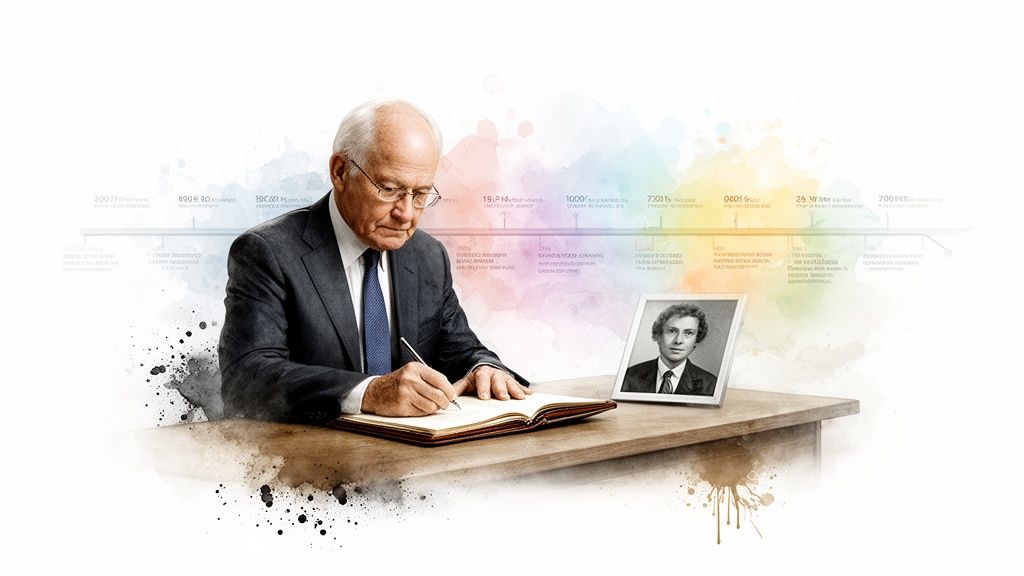
Your career has been a masterclass in strategy, leadership, and resilience. A leadership legacy memoir is your chance to codify that wisdom, creating a permanent record of your journey. This is not just about listing accomplishments. It's about sharing the human story behind the balance sheet, the pivotal decisions that defined your tenure, and the hard won lessons that shaped your philosophy.
Think of books like Indra Nooyi's My Life in Full or Jack Welch's Jack: Straight from the Gut. They don’t just recount history, they provide a blueprint for future generations of leaders. Crafting your own is one of the most impactful retirement projects for CEOs because it transforms a lifetime of experience into an enduring asset for others. Your story could literally change someone else's.
Why It's a Great Project
A memoir solidifies your legacy, ensuring your insights on building teams, navigating crises, and fostering innovation are not lost to time. It's a chance to offer an honest look behind the curtain, connecting with readers by balancing professional triumphs with personal vulnerability. This creates a real, human story that inspires, educates, and entertains.
Key Insight: A powerful memoir isn't just a record of what you did. It's a guide for what others can do. It translates your personal journey into universal lessons on leadership and life.
Getting Started: Actionable Steps
- Map Your Journey: Before a single word is written, create a detailed timeline of your career. Note major promotions, company milestones, market shifts, and key hires. Think of it as your personal highlight reel.
- Identify Pivotal Moments: From that timeline, select 5 to 7 defining events. Was it a high stakes negotiation, a near fatal business mistake, or a breakthrough innovation? These moments are the narrative pillars of your story.
- Find Your Voice: Decide on the tone. Will it be a chronological recounting of your rise, or will each chapter explore a specific leadership theme? Balancing professional insights with personal anecdotes is key to keeping it real.
- Consider the Heavy Lifting: Writing a book is a marathon, not a sprint. To ensure your vision is realized without sacrificing your well earned retirement freedom, working with a professional can be a game changer. For a project this important, a ghostwriter can expertly capture your voice and craft your narrative, allowing you to focus on the story while they handle the structure and prose. It's your vision, just without the typing cramps. To explore this option further, you can learn more about crafting a powerful business memoir.
2. Company History and Founding Story Documentation
Your company is more than a legal entity. It's a living story of vision, risk, and innovation. Documenting its history is a powerful way to preserve the spirit and substance of the organization you built. This project goes beyond financials and org charts to capture the entrepreneurial spark, the strategic pivots, and the collective effort that turned an idea into an institution.
Think of iconic origin stories like Patagonia's or Southwest Airlines'. These narratives are not just corporate lore. They are foundational texts that define the company’s culture, values, and brand identity. Creating an official history is one of the most rewarding retirement projects for CEOs because it ensures the "why" behind the business endures, inspiring employees and connecting with customers for years to come.

Why It's a Great Project
A company history serves as an invaluable internal compass, onboarding new hires into the culture and reminding long time employees of their shared purpose. Externally, it acts as a powerful marketing asset that builds brand authenticity and trust. By documenting the struggles and breakthroughs, you create a compelling story that showcases resilience and deepens stakeholder loyalty.
Key Insight: A well documented company history isn't just a look at the past. It's a strategic asset that shapes the organization's future by grounding its identity in a powerful, authentic story.
Getting Started: Actionable Steps
- Become an Archivist: Begin by gathering foundational materials. Collect founding documents, early business plans, original marketing materials, press clippings, and old photographs. These artifacts are the building blocks of your story.
- Interview the Pioneers: Schedule interviews with co founders, early employees, key investors, and long standing partners. Capture their memories and perspectives while they are still fresh to add depth and human interest to the narrative.
- Create a Master Timeline: Outline every major milestone. Note product launches, funding rounds, key hires, market entries, and significant challenges. This timeline will provide the structural backbone for your history.
- Preserve the Vision: A great business story requires a professional touch to weave disparate facts into a compelling narrative. To avoid getting lost in the weeds of writing, consider partnering with a service that specializes in business storytelling. A professional ghostwriter can help you organize the research, conduct interviews, and craft a book that honors your company's legacy. If you want to dive deeper, you can explore more on how to write a business book and start shaping your company's enduring story.
3. Industry Analysis and Market Evolution Commentary
You have not just led a company. You have had a front row seat to the seismic shifts that have redefined your entire industry. This project allows you to document that transformation, creating a thought leadership book that combines historical analysis with forward looking predictions. You’re not just recounting history. You’re explaining why it happened and what it means for the future.
Consider books like Andy Grove's Only the Paranoid Survive or Bob Iger's The Ride of a Lifetime. These works are not just memoirs. They are deep dives into industry dynamics, offering invaluable context on disruption, competition, and innovation. Crafting your own analysis is one of the most intellectually stimulating retirement projects for CEOs, positioning you as an industry sage whose perspective is crucial for navigating what comes next.
Why It's a Great Project
An industry analysis book cements your status as a visionary thinker. It demonstrates that your expertise transcends your own company's performance and offers a macro view that is invaluable to investors, entrepreneurs, and current leaders. This project transforms your unique vantage point into a strategic guide for an entire sector, ensuring your insights influence its trajectory for years to come.
Key Insight: This book isn’t just about the past. It’s about using decades of firsthand experience to identify the patterns and principles that will shape the future of an entire industry.
Getting Started: Actionable Steps
- Identify Industry Inflection Points: Pinpoint 3 to 4 major shifts you personally navigated. Was it a technological disruption, a landmark regulatory change, or a fundamental shift in consumer behavior? These are your chapters.
- Gather Supporting Evidence: Your anecdotes are powerful, but they are unstoppable when backed by data. Collect historical market analysis, trend reports, and key statistics to validate your observations and provide objective context.
- Find the Transcendent Lessons: Look beyond specific company outcomes. What are the universal principles at play? Focus on lessons about market entry, competitive dynamics, or adapting to disruption that apply to any leader in your field.
- Partner for Precision: Writing a detailed market analysis requires rigorous research and a compelling narrative structure. A professional service can help you organize your decades of insight into a coherent framework. To ensure your book is both authoritative and engaging, a ghostwriter can provide the expertise to structure your analysis and articulate your predictions, freeing you to focus on the big picture ideas. This is a great way to understand how to write a thought leadership book that makes a real impact.
4. Leadership Philosophy and Business Wisdom Collection
While a memoir tells the story of your life, a business wisdom collection distills the principles you lived by. This project moves beyond a chronological narrative to organize your hard won insights around core themes. Instead of recounting your entire journey, you create a focused playbook on decision making, team building, innovation, or navigating crises, with each principle illustrated by powerful stories from your career.
Think of it as the difference between a biography and a masterclass. Books like Peter Drucker's The Effective Executive or Jim Collins' Good to Great offer frameworks built on timeless principles. This is one of the most practical retirement projects for CEOs because it creates an actionable guide that others can immediately apply to their own leadership challenges. It’s less "story time" and more "school time."
Why It's a Great Project
This project codifies your unique leadership philosophy into a replicable model. It allows you to share your most potent insights without the pressure of weaving a single, overarching life story. The thematic structure makes your wisdom highly accessible, enabling readers to jump directly to the topics most relevant to them, whether it's ethics in leadership or strategies for a turnaround.
Key Insight: Your leadership philosophy is a system of repeatable principles. Documenting it transforms your experience from a personal history into a universal toolkit for the next generation of leaders.
Getting Started: Actionable Steps
- Identify Your Core Convictions: What are the 5 to 7 unbreakable rules or principles that guided your leadership? Write each one down as a clear, concise statement. These are the pillars of your book.
- Gather Illustrative Stories: For each principle, find two or three concrete examples from your career that bring it to life. Crucially, include stories of both success and failure to show the principle in action under different circumstances.
- Structure for Clarity: Organize each chapter around a single principle. Start by stating the principle, explain why it matters, illustrate it with your stories, and conclude with actionable advice for the reader. This consistent format makes your wisdom easy to absorb.
- Enlist a Strategic Partner: Translating complex business philosophies into clear, compelling prose is a unique skill. A professional ghostwriter specializes in this exact process. They can help you refine your core principles and craft narratives that make your wisdom unforgettable, ensuring your legacy is not just recorded but truly understood. To see how they transform ideas into impactful books, explore their approach to creating a powerful business book.
5. Succession Planning and Leadership Transition Guide
The final act of a great CEO is not a spectacular quarterly report, but a seamless transition of power. This project involves creating a practical, insightful guide that documents your succession strategy, turning the often opaque process of a leadership handoff into a clear, replicable framework. It's a hybrid of memoir, business manual, and strategic roadmap.
Unlike a traditional memoir focused on the past, this guide is a forward looking tool designed to protect the company’s future. Think of Alan Mulally’s methodical succession at Ford or Satya Nadella’s transition chronicled in Hit Refresh. These are examples of leadership changes that were managed with deliberate care. Creating a guide is one of the most selfless retirement projects for CEOs, as its primary purpose is to ensure the organization thrives long after you’ve left the corner office.
Why It's a Great Project
A leadership transition guide demystifies succession for your board, your successor, and the entire organization. It codifies institutional knowledge, from critical stakeholder relationships to unspoken cultural norms, preventing the loss of vital information. This project provides a structured process for your own departure, making it less an abrupt ending and more a managed, graceful exit.
Key Insight: A successful leadership transition isn't just about picking the right person. It's about building the right process. This guide is the blueprint for that process.
Getting Started: Actionable Steps
- Document the "How": Begin by outlining the practical steps of your transition. Detail how you identified potential successors, what competencies were essential, and the criteria used for the final selection. This becomes the core framework.
- Map Key Relationships: Create a guide to the essential relationships that keep the company running smoothly. This includes key investors, board members, strategic partners, and top talent. Document the history and context of each relationship.
- Define Post CEO Boundaries: Clearly articulate your intended role, if any, after you step down. Will you be on the board, act as an advisor, or make a clean break? Setting these expectations prevents confusion and empowers your successor. As you envision your post leadership life, consider a comprehensive approach to retirement planning for business owners that aligns your personal financial security with your company's future.
- Partner for Clarity and Impact: Transforming your strategic notes and personal reflections into a polished, actionable guide is a significant undertaking. A professional service can help structure your insights into a compelling narrative. For a project of this strategic importance, a ghostwriter can help you articulate your succession philosophy with the clarity and authority it deserves, ensuring your final contribution is both powerful and permanent.
6. Social Impact and ESG Journey Documentary
Your leadership did not just impact the bottom line. It shaped your company’s conscience. A social impact documentary or book chronicles this journey, telling the story of how your organization integrated purpose with profit. This is not a dry report. It's a compelling narrative about the shift from shareholder only focus to a stakeholder driven mission, detailing your Environmental, Social, and Governance (ESG) evolution.
Think of how Yvon Chouinard wove Patagonia's environmentalism into its very fabric or how Marc Benioff embedded philanthropy into Salesforce's DNA with the 1-1-1 model. Documenting your own journey offers a powerful playbook for the next wave of conscious capitalists. This is one of the most forward thinking retirement projects for CEOs because it captures a modern legacy: building a business that does well by doing good.

Why It's a Great Project
This project solidifies your company's commitment to social responsibility and positions you as a thought leader in sustainable business. It’s an authentic way to showcase your values, detailing the challenges, failures, and ultimate successes of your ESG initiatives. This transparency builds trust and provides a practical guide for other leaders aiming to make a similar impact.
Key Insight: A social impact narrative isn't just a record of your company's generosity. It's a strategic blueprint showing how purpose can become a powerful competitive advantage.
Getting Started: Actionable Steps
- Define Your Core Narrative: What was the catalyst for your ESG focus? Was it a personal conviction, a market shift, or an employee led movement? Pinpoint the central story arc of your company's social impact journey.
- Gather the Proof: Collect quantifiable data that brings the story to life. This includes dollars invested, volunteer hours logged, carbon emissions reduced, and testimonials from community partners and beneficiaries.
- Embrace Radical Honesty: The most credible stories include the struggles. Discuss initiatives that did not work, goals you missed, and criticism you faced. This vulnerability makes your successes more meaningful.
- Partner for a Polished Narrative: Compiling data, interviews, and strategic insights into a cohesive and inspiring story is a monumental task. A professional ghostwriter specializes in transforming complex corporate histories into compelling narratives. They can help you structure your impact story, ensuring it resonates with both business leaders and the public, allowing you to focus on the message while they perfect the medium.
7. Personal Transformation and Reinvention Narrative
While a business memoir focuses on your professional ascent, a personal transformation narrative digs deeper into the human story. This project is not about quarterly earnings or market share. It’s about the evolution of you, the person. It explores the failures, health scares, and personal challenges that forged your character long before you ever stepped into the corner office.
Think of Bob Iger's The Ride of a Lifetime or Sheryl Sandberg's Option B. These stories resonate because they reveal the vulnerability behind the success. Crafting your own reinvention narrative is one of the most profound retirement projects for CEOs because it shifts the focus from what you built to who you became, offering a powerful, humanizing account of growth and resilience.
Why It's a Great Project
This type of narrative creates an intensely personal connection with readers. By sharing your struggles and periods of reinvention, you provide a roadmap for others facing their own crossroads. It’s a chance to demonstrate that true leadership is rooted not in perfection, but in the courage to grow through adversity, making your legacy both inspiring and universally relatable.
Key Insight: Your greatest professional breakthroughs were likely preceded by significant personal transformations. Sharing that internal journey is what gives your story its power and purpose.
Getting Started: Actionable Steps
- Identify Your Transformation Arcs: Pinpoint 3 to 4 major periods of personal evolution. This could be overcoming a significant failure, navigating a personal loss, or a fundamental shift in your worldview.
- Journal the Difficult Moments: Dedicate time to writing about these periods with unflinching honesty. What did it feel like? What did you learn about yourself? Don't shy away from depicting yourself as imperfect or uncertain.
- Connect Personal to Professional: Explicitly link your internal growth to your leadership decisions. How did overcoming a personal fear make you a more courageous leader? How did a moment of vulnerability help you build a more empathetic team?
- Embrace the Human Element: This project demands a level of introspection that can be challenging to navigate alone while also trying to write a compelling book. Working with a professional ghostwriter can provide the expert partnership needed to translate raw, personal experiences into a beautifully structured narrative. They help you process and articulate your journey, ensuring your story of transformation is told with the depth and authenticity it deserves. As you define this new narrative, it is also useful to learn more about personal branding for executives to shape how you present your evolved identity.
8. Sector-Specific Strategic Lessons and Case Study Collection
Your career was not a series of abstract theories. It was a sequence of high stakes, real world decisions. This project transforms your experience into a valuable collection of case studies, offering a granular look at the strategic choices that defined your tenure. It’s less about your personal story and more about the decision making process itself: the imperfect information, the stakeholder pressures, and the calculated risks.
Think of Andy Grove's Only the Paranoid Survive or Satya Nadella's Hit Refresh. These works dissect pivotal moments, turning internal business strategy into universal lessons. Creating a collection of your own strategic lessons is one of the most intellectually stimulating retirement projects for CEOs, as it allows you to deconstruct your own history to educate the next generation of leaders.
Why It's a Great Project
This project establishes you as a foremost strategic thinker in your field. By candidly analyzing both successes and failures, you provide a rare, honest glimpse into the realities of C suite decision making. It’s a powerful way to contribute to the business world, creating a practical playbook that goes far beyond what’s taught in business school.
Key Insight: A case study collection's value lies in its honesty. It's not just about showcasing wins. It's about revealing the messy, complex process behind critical decisions and extracting timeless principles from them.
Getting Started: Actionable Steps
- Select Diverse Case Studies: Choose 5 to 7 key decisions from your career. Aim for variety: a successful acquisition, a necessary pivot, a crisis you navigated, a product launch, and even a choice that proved problematic in hindsight.
- Reconstruct the Moment: Gather all available documentation for each case, such as board memos, market research, and internal communications. The goal is to recreate the information environment you had at the time, avoiding the bias of 20/20 hindsight.
- Interview Key Players: Talk to other executives, board members, and team leaders who were involved. Capturing their perspectives will add depth and objectivity to your analysis, showing how consensus was built or how dissent was managed.
- Structure for Impact: A great collection of case studies requires a disciplined, consistent narrative structure. The process of gathering data, interviewing stakeholders, and weaving it all into a compelling analysis is a significant undertaking. A professional ghostwriter can provide the research and writing horsepower needed to turn your strategic history into a polished and impactful book, allowing you to focus on the high level insights. This ensures your hard won lessons are presented with the clarity and authority they deserve.
8-Project Comparison: CEO Retirement Initiatives
| Item | Implementation Complexity 🔄 | Resource Requirements ⚡ | Expected Outcomes 📊⭐ | Ideal Use Cases 💡 | Key Advantages ⭐ |
|---|---|---|---|---|---|
| Leadership Legacy Memoir | High — deep interviews, long narrative (6–12 months) | Moderate–High — ghostwriter, editor, legal review | Durable legacy, thought leadership; scholarly value — ⭐⭐⭐⭐ | Preserve CEO career, inspire future leaders, family legacy | Lasting personal record; strengthens personal brand |
| Company History & Founding Story | Medium–High — multi-perspective research, archival synthesis | High — archives, many interviews, historian/ghostwriter | Preserves org memory; strong marketing/branding asset — ⭐⭐⭐⭐ | Brand heritage, employee engagement, investor relations | Strengthens culture; valuable archival material |
| Industry Analysis & Market Evolution | High — synthesize decades, data analysis, predictions | High — market data, researchers, subject-matter ghostwriter | Positions author as industry authority; strategic influence — ⭐⭐⭐⭐ | Thought leadership, consulting, policymaking | Timeless analysis; influences sector strategy |
| Leadership Philosophy & Wisdom Collection | Medium — curate principles, modular essays | Moderate — speeches, case anecdotes, editor/ghostwriter | Practical, actionable frameworks for readers — ⭐⭐⭐ | Executive education, quick-reference guidance, mentoring | Highly practical; faster to produce and adaptable |
| Succession Planning & Transition Guide | Medium — procedural, sensitive confidentiality | Moderate — internal access, templates, legal input | Immediate organizational stability; institutional reference — ⭐⭐⭐ | Imminent CEO transition, board planning, HR continuity | Prevents costly mistakes; captures transition knowledge |
| Social Impact & ESG Journey Documentary | Medium–High — measure impacts, multiple stakeholders | High — impact data, third-party verification, testimonials | Reputation boost; attracts ESG stakeholders — ⭐⭐⭐ | Companies with social programs, ESG reporting, fund-raising | Builds accountability; guides other organizations |
| Personal Transformation & Reinvention Narrative | High — deep emotional work, careful curation | Moderate — ghostwriter, coaching/therapy, time | Broad emotional resonance; cross-market appeal — ⭐⭐⭐⭐ | Human-centered memoirs, speaking platforms, general readers | High authenticity; strong connection with audiences |
| Sector-Specific Strategic Lessons & Case Studies | High — reconstruct decisions, detailed documentation | High — internal memos, interviews, rigorous research | Strong educational value for MBAs and executives — ⭐⭐⭐⭐ | Business schools, executive education, strategy teams | Real-world decision-making lessons; high credibility |
Your Legacy Is a Book Only You Can Author
The transition from the corner office to a more personal space is not an ending. It is a powerful beginning. After a career spent building companies, guiding teams, and shaping industries, you’ve accumulated a vault of wisdom that is simply too valuable to keep locked away. This next chapter is your opportunity to unpack that vault and share its contents with the world. We’ve explored a variety of powerful retirement projects for CEOs, from crafting a leadership memoir or documenting your company’s founding story to compiling your unique business philosophy or creating a guide for the next generation of leaders.
Each of these avenues offers more than just a way to stay busy. They are frameworks for impact, influence, and introspection. Think of it this way: for decades, your primary output was shareholder value, product innovation, and market share. Now, your primary output can be wisdom, mentorship, and a legacy that transcends quarterly reports. This shift from building a business to building a body of knowledge is one of the most fulfilling pivots a leader can make.
The CEO’s Final, Most Important Project
Choosing the right project is less about what you should do and more about what you need to say. What is the one story, the one lesson, the one piece of advice that burns inside you?
- The Leadership Legacy Memoir is for the leader who wants to connect on a human level, sharing the struggles and triumphs that defined their journey.
- A Company History is for the founder who recognizes their story is intertwined with the story of every employee, client, and partner who helped build their dream.
- A Business Wisdom Collection is for the strategist who sees patterns others miss and can distill complex ideas into actionable principles for future entrepreneurs.
The common thread is generosity. Creating a book is an act of profound giving. It is a way to mentor thousands of people you will never meet. It is a way to give your family, your children, and your grandchildren a tangible piece of your mind and heart that will endure long after memories fade. It’s the ultimate succession plan for your wisdom.
From Vision to Victory: Your Strategic Advantage
Let’s be honest. The journey from a great idea to a polished, published book is a marathon, not a sprint. The very skills that made you an exceptional CEO are the same ones you should apply to this new venture. You excelled at identifying a core mission, building the right team, and delegating tasks to experts so you could focus on the high level vision.
You would not have tried to code your company’s website or personally manage the accounting books, so why would you try to wrestle your life’s work onto the page alone?
This is not a test of your writing prowess. It’s a test of your strategic acumen. Partnering with a professional ghostwriter is not cheating. It is the smartest executive decision you can make for this project. A skilled ghostwriter acts as your project manager, your creative partner, and your quality control specialist all in one. They ensure your authentic voice is captured, your vision is realized beautifully, and the process is efficient and even enjoyable. This allows you to focus on what you do best: providing the wisdom, the stories, and the direction.
Your story deserves to be told with the same excellence and professionalism that you demanded in the boardroom. More importantly, it deserves to be read. Take a look back at the retirement projects for CEOs we’ve outlined. Which one makes your heart beat a little faster? That’s your starting point. Choose it, commit to it, and take the first small step. The world is waiting to learn from you.
Ready to turn your vision into a beautifully crafted book without the headache of writing it yourself? The team at My Book Written specializes in helping leaders like you transform their stories and expertise into powerful legacy projects. Visit My Book Written to learn how we can become your strategic partner in authoring your next chapter.