
So, you’ve decided to write your life story. That's a fantastic, brave decision, a mix of pure excitement and that feeling you get at the very top of a roller coaster. An entire lifetime of memories is swirling around in your head, a beautiful, chaotic universe of moments, people, and places.
The big question is, how do you capture that universe without getting sucked into a black hole of nostalgia? Where do you even begin?
It starts with a simple step: figuring out your scope. Are you telling the whole story, or just one powerful chapter of it? This isn't about remembering every single detail, but about finding the heart of your narrative before you write a single word. It’s an incredible honor to create something that will last forever, and we want to make sure you get it just right.
Starting Your Story Without Getting Lost in Memories
Before you dive headfirst into the writing, let’s clear up one common point of confusion that trips people up. Are you writing an autobiography or a memoir?

Think of it this way: an autobiography is the full feature film of your life, from the opening credits to the final scene. A memoir is one powerful, pivotal scene from that film. One is a life story, the other is a story from your life. See? It's all about focus.
Autobiography vs Memoir Which Is Right for You?
This quick comparison should help you choose the best format for your life story. It breaks down the key differences in scope, focus, and narrative style.
| Feature | Autobiography | Memoir |
|---|---|---|
| Scope | Your entire life, from birth to the present. | A specific period, theme, or series of events. |
| Focus | Factual, chronological progression of events. | Emotional truth, personal reflection, and a central theme. |
| Narrative | Tells the story of a life. | Explores the meaning and impact of a specific experience within a life. |
| Example | The Autobiography of Malcolm X | Wild by Cheryl Strayed |
Choosing the right format is your first big win. It gives you a frame for your story, preventing you from feeling like you have to document every single Tuesday of your life. Honestly, nobody needs to read about that time I tried (and failed) to make sourdough in 2020. Trust me.
Finding Your Story’s Red Thread
Every compelling life story has a “red thread,” a central theme that runs through it, tying everything together. This is what transforms a simple list of events into a narrative that truly resonates with people.
Your theme is the answer to the question, “What is my story really about?”
It could be about resilience, finding belonging, the pursuit of a lifelong passion, or learning to forgive. I once worked with a retired engineer who was convinced his life was "just normal." After we talked, we discovered his red thread was quiet courage, the bravery he showed not in grand battles, but in making tough ethical choices in his career and family life. Suddenly, his "normal" life had a powerful, inspiring core.
Your theme isn't just what happened to you; it's what those happenings mean. It’s the lesson, the insight, the emotional truth that you want to leave with your reader.
Discovering this thread can feel tricky, but it’s often hiding in plain sight. Of course, one of the biggest hurdles when you're starting your story is that blank page paralysis. Fortunately, there are many proven tips and tricks for how to overcome writer's block and get your narrative flowing.
Brainstorming Without the Brain Storm
Ready to find your own red thread? Grab a pen and paper. Don’t worry about perfect sentences or crafting a masterpiece right now. Just jot down answers to these questions:
- What were the 3-5 biggest turning points in your life?
- What is the single biggest lesson you’ve learned?
- If you had to describe your life’s journey in one word, what would it be?
This initial brainstorming is all about discovery, not documentation. You can learn more about crafting a powerful narrative from the very first sentence by exploring our guide on the beginning of a story.
And if you’re wondering if anyone will even want to read your story, remember this: biographies and memoirs are incredibly popular. In fact, between 2004 and 2008, sales of personal memoirs in the U.S. skyrocketed by over 400%. People are hungry for real, authentic stories, just like yours.
Gathering the Clues to Your Own Life
With your core theme locked in, it’s time to play detective. Let’s face it, memory can be a slippery thing. Sometimes it's crystal clear, other times it’s a grainy home video with huge gaps. A truly compelling autobiography is built on the rich, sensory details that make your memories feel real, not just for you, but for someone stepping into your world for the very first time.
Think of this part of the process as a treasure hunt, not a chore. You’re about to unearth the physical pieces of your past that trigger the feelings, the sounds, and even the smells of moments you thought were long gone. This is where the real magic happens.
Digging for Your Story’s Gold
Your memories are the starting point, but they aren't the whole story. The real texture comes from the artifacts you’ve collected along the way, often without even realizing it. Imagine you're an archaeologist, gently brushing the dust off forgotten relics to reveal the story underneath.
So, where do you start digging? Here’s a quick list to get the ball rolling:
- Photo Albums and Shoeboxes: Go beyond the perfectly posed pictures. Look for the candid shots, the goofy faces, the forgotten background details, the questionable fashion choices. What does that blurry photo of your first car really say about your first taste of freedom?
- Journals and Diaries: This is pure gold. Reading your own words from a different time is like having a direct conversation with your younger self. You’ll rediscover forgotten anxieties, secret ambitions, and the raw, unfiltered emotions of the moment.
- Letters and Emails: Sift through that old box of correspondence. The way you wrote to your best friend after a breakup or the excited emails you sent your parents from college hold powerful clues to who you were and what mattered most to you back then.
- Keepsakes and Mementos: Don't overlook the little things! That concert ticket stub from 1988, your grandmother’s handwritten recipe for apple pie, a dusty trophy from a high school debate tournament, each one is a key that can unlock an entire roomful of memories.
Assembling Your Story Spine
As you collect these clues, you need a way to make sense of them all. This isn’t about writing chapters just yet; it’s about building a visual "story spine." A simple timeline is a fantastic tool for this. Grab a big poster board or open a spreadsheet and start plotting out the major events of your life.
But don’t just list dates. Next to each event, jot down the key people involved, the feelings you remember, and any artifacts you’ve found that connect to that moment. For example:
1995 – Moved to Chicago:
- Feeling: Terrified but totally exhilarated.
- People: My first roommate, Sarah.
- Artifact: The worn-out city map I used to navigate the L train.
Seeing your life laid out like this helps you spot connections and patterns you might have missed. You'll start to see the cause and effect, the crucial turning points, and the recurring themes that support the "red thread" you identified earlier. As you gather this vast array of information, building a personal knowledge management system can be an incredible way to organize your thoughts into a coherent structure.
The Interview Process With Your Past
Some of your most valuable resources are still walking and talking. Interviewing family and friends is one of the most powerful things you can do. They hold pieces of your story that you don't. They remember things you’ve completely forgotten, and they saw everything from a totally different angle.
A word of friendly advice: be prepared for their version of events to be… well, different from yours. And that's perfectly okay. Your uncle might remember that infamous family vacation as a hilarious disaster, while you remember it as just a disaster. Both truths can exist.
The goal isn't to prove who's right. It's to gather perspectives. These different accounts add incredible depth and honesty to your narrative. They show that life isn’t a single, objective story but a beautiful, messy collection of experiences. It’s in these messy, human details that your readers will find themselves. This research is the foundation your entire book will stand on, so give it the time and love it truly deserves.
Structuring Your Story for Maximum Impact
You’ve done the detective work, gathered your clues, and found your theme. You have a pile of memories, photos, and maybe even a few half-forgotten journal entries. So… now what? How do you arrange all this wonderful, messy stuff into a book that people actually want to read?
A simple chronological timeline might seem logical, but let's be honest, it can often feel like reading a grocery list. "First this happened, then this happened…" That's a one-way ticket to Snoozeville for your reader. The truth is, the most powerful stories often don’t start at the beginning.
This part of the journey is about becoming an architect. You're taking the raw materials of your life and building a structure with intention, one that creates emotion, suspense, and a deep sense of satisfaction for the reader.
Ditching the Chronological Crutch
Let's get one thing straight: starting your book with "I was born on a Tuesday in…" is almost never the answer. Your birth is, of course, very important to you. But for a reader who doesn't know you yet, it’s not the hook that will pull them into your world.
Instead, think about starting in medias res, a fancy way of saying "in the middle of the action." Drop your reader directly into a pivotal, life changing moment.
- Maybe you start on the day you decided to quit your corporate job to become a beekeeper.
- Or perhaps it's the moment you stood on a stage, heart pounding, about to give the speech that would define your career.
By starting with a moment of high stakes or deep emotion, you create an immediate question in the reader's mind: "How did they get here?" Answering that question is the entire point of your autobiography, and now your reader is hooked, eager to find out. This is a crucial step to write an autobiography that captivates from page one.
Blueprints for Building Your Chapters
Once you have a powerful opening, you need a blueprint for the rest of your book. Think of each chapter not just as a block of time, but as a mini story with its own purpose. Each one should build on the last and leave the reader curious about what’s next.
Here are a few ways you can frame your chapters:
- By Lesson: Each chapter could focus on a single, powerful lesson you learned. One chapter might be about "Learning to Trust Myself," while another could explore "The Art of Letting Go."
- By Relationship: You could structure your story around the key people who shaped you, a chapter for your mentor, your rival, your first love. Each relationship reveals a different facet of who you are.
- By Era: This is a bit more chronological, but with a thematic twist. You could have a chapter on "The College Years" that focuses on your intellectual awakening, followed by "The Wilderness Years" detailing your early career struggles.
To get started on your own blueprint, you can find a ton of helpful guidance in our article on how to write a memoir outline. This process can feel overwhelming, which is why mapping it out is so important.
This diagram shows a simple flow for organizing the memories you've already gathered.
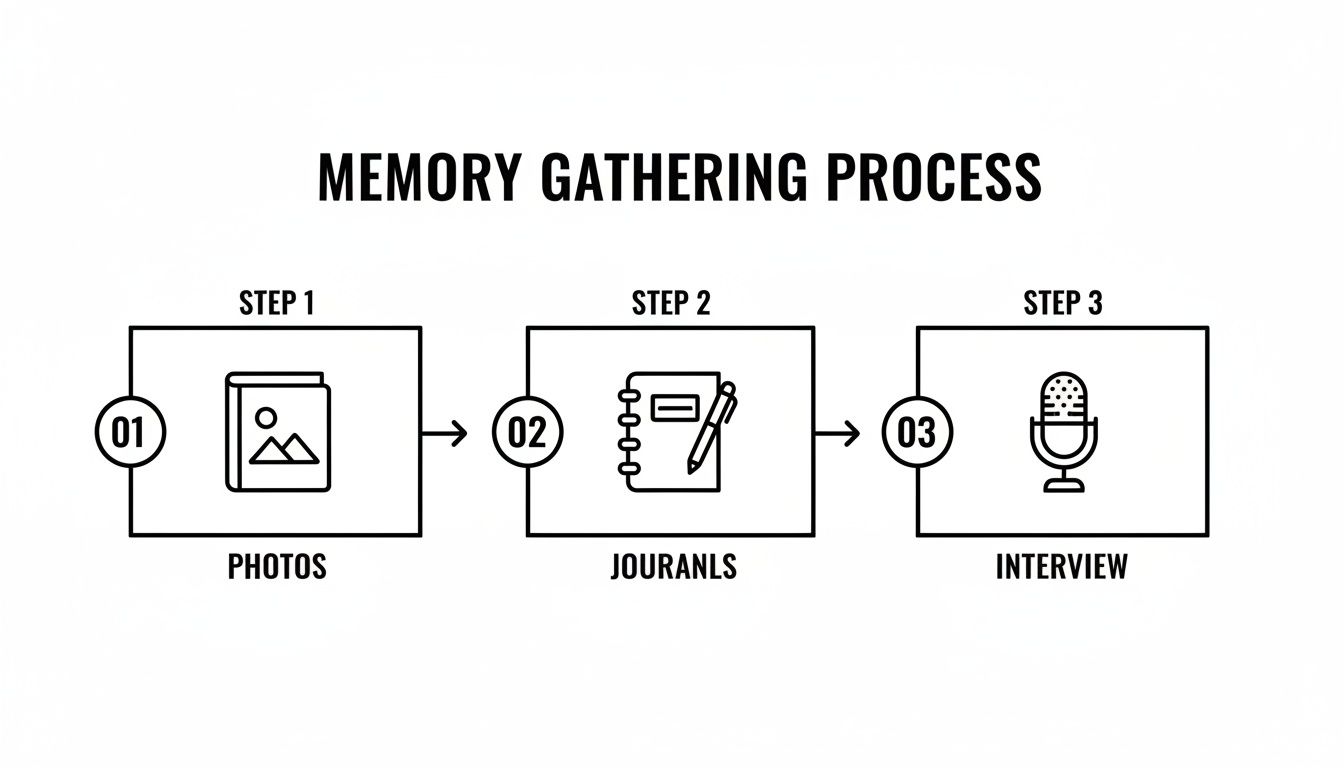
Visualizing your process this way reminds you that each piece of your past can be sorted and placed into your structure with purpose.
The Power of a Framing Device
Another powerful technique is to use a framing device. This is a present day story that "bookends" your past recollections.
For example, your book could open with you packing up your childhood home after your parents have passed away. As you pick up different objects, a baseball glove, a dusty photograph, a chipped teacup, each one triggers a memory that becomes a chapter.
This creates a beautiful, seamless flow between the present and the past. The reader is grounded in a current story while simultaneously journeying through your life's most important moments.
The structure of your autobiography is the silent narrator. It controls the pace, builds the tension, and guides the reader’s emotional journey. It’s the difference between a list of events and a story that lasts forever.
This is often the most creatively challenging part of the process. It's where the heart of your story takes its physical shape. For many, this is the exact moment they realize that having a professional ghostwriter is like hiring a master architect. You bring the vision and the materials; they bring the expertise to build a breathtaking structure that will stand the test of time. It’s still your house, your story, just built with a master's touch.
Navigating the Messy First Draft
Alright, let's talk about the first draft. You’ve dug deep into your memories and mapped out the bones of your story. Now comes the part where the dream of writing a book meets the reality of a blinking cursor on a blank page.
Let’s be honest: this is where it gets tough. Trying to translate a lifetime of vibrant, colorful memories into black and white text can feel like an impossible task. This is the stage where most people get stuck, convinced they aren't a “real writer” or that the story just isn’t coming out right.
I’m here to tell you that feeling is 100% normal. You are exactly where you’re supposed to be.
Embrace the Glorious Mess
Your mission, should you choose to accept it, is to write a truly terrible first draft. I mean it. It should be messy, awkward, and full of sentences you wouldn't show another living soul. Perfectionism is your enemy here, it will freeze you in your tracks before you even get a single word down.
The only goal right now is to get the story out of your head and onto the page. Forget about beautiful prose or finding the perfect word. Just tell the story like you’re sharing it with a close friend over coffee.
The first draft is just you telling yourself the story. It doesn’t need to be good; it just needs to exist. The magic comes later, in the rewriting.
Give yourself permission to be imperfect. Feel free to write scenes out of order. If you get stuck, just pop in a placeholder like “[insert story about that disastrous fishing trip here]” and move on. The key is momentum. Just keep going.
Finding Your True Voice
One of the biggest traps I see aspiring autobiographers fall into is trying to sound “writerly.” They get bogged down in formal language and stiff sentences that make their own life story read like a dusty history textbook.
Your voice is your superpower. It’s that unique blend of your personality, your humor, and the way you see the world. Don’t hide it!
Here are a few tricks I’ve learned to help you find and stick to your authentic voice:
- Talk it Out: Fire up a voice to text app on your phone and just speak a memory out loud. The natural rhythm and words you use when talking are often the most powerful.
- Write Like You Speak: Read your sentences aloud. Do they sound like something you would actually say? If not, rework them until they do.
- Channel a Specific Person: Picture yourself writing a long, detailed letter to one person, your child, a best friend, or even your younger self. This simple trick can help you stay grounded in a genuine, conversational tone.
Remember, readers want to connect with you, not some polished, literary version of you. Your quirks, your slang, and your unique perspective are what will make your story unforgettable. You can find more practical advice on telling your story authentically in our detailed guide on how to write your memoir.
Handling the Hard Parts
Looking back on your life is an emotional ride, and not all of it will be pleasant. Writing about difficult experiences, painful memories, or sensitive topics involving people you love can be incredibly draining. Please, be gentle with yourself.
It is absolutely okay to take breaks. It’s okay to cry. It's okay to write a tough scene and immediately switch to watching a comedy to clear your head. This isn't just a writing project; it’s a deeply personal exploration. Treat it with the care it deserves.
When writing about other people, especially in sensitive situations, the best approach is to anchor the narrative in your own feelings. Instead of writing, “He was wrong,” try something like, “When that happened, I felt betrayed and confused.” This keeps the story focused on your experience, which is the whole point of an autobiography.
This is often the point where the dream of writing a book slams into the reality of a busy life. The emotional weight, combined with the sheer time it takes, can feel overwhelming. Many people realize their time is better spent living their life, not just trying to write about it.
When you hit that wall, partnering with a professional can make all the difference. For instance, services like Opus Eternal deliver expert, high quality ghostwriting remarkably fast, offering an accessible path that's often less than half the cost of traditional options. It’s a smart partnership that turns your vision into reality without the struggle, which makes sense given the rising popularity of the genre.
Ultimately, getting through the first draft is an act of courage. It’s about facing the blank page, honoring your memories, and trusting that your story is worthy of being told, messy, imperfect, and wonderfully, authentically yours.
Polishing Your Story Until It Shines
First off, take a deep breath and a moment to celebrate. You have a first draft. It might be messy, a bit awkward, and parts might even make you wince, but it's done. That's a huge milestone, something most people only ever talk about doing. Now for the really satisfying part: turning that raw clay into a polished sculpture.
This is where the real craft comes in, transforming a good story into one that people will remember. It’s less about a sudden flash of inspiration and more about patient, methodical work. Let's break down the editing process into a few focused passes so it doesn’t feel so overwhelming.
The Big Picture Edit
Before you even think about commas or word choice, you need to zoom out and look at your manuscript from 30,000 feet. This is your structural edit, a check of the book’s very foundation. For now, ignore the small stuff and ask yourself the really big questions.
- Is the theme consistent? Remember that central "red thread" we discussed? Does it pull through clearly from the first chapter to the last, or does it get tangled or dropped along the way?
- How’s the pacing? Read through and pay attention to when your mind starts to wander. Are there sections that drag on? Moments that feel too rushed? Be brutally honest here.
- Are there any glaring gaps? When you're deep in the writing, it's easy to forget to connect the dots for the reader. Does the narrative flow smoothly, or will people feel like they’ve missed a crucial piece of the story?
Think of this first pass like walking through the frame of a newly built house. It’s a lot easier to move a wall now than it will be after the paint and furniture are in.
The Sentence-Level Polish
Once you feel good about the structure, it’s time to zoom in. Way in. This is where you get out the jeweler's loupe and inspect every single sentence. The mission is to make your writing tight, clear, and genuinely enjoyable to read.
This is your chance to hunt down the enemies of good prose: repetitive phrases, worn out clichés, and sentences that meander on forever. Don’t be afraid to be ruthless. If a word isn’t pulling its weight, cut it. You’re a sculptor at this stage, chipping away everything that isn't the essential story.
This part of the process is often the most time consuming and, frankly, the most frustrating. It’s almost impossible to view your own work with fresh eyes. You've lived with these words for months, so the awkward phrasing and typos have become invisible to you.
This is exactly why a second set of eyes is non negotiable. It could be a trusted friend who has a great ear for language or a professional editor. That outside perspective is invaluable.
If this all sounds like a daunting task, remember that this is where a great ghostwriter truly shines. They are experts in this kind of detailed craft, taking your authentic voice and making sure every sentence sings. The story and vision are all yours; it's just been polished to perfection. Options like Opus Eternal can make this level of professional polish accessible, ensuring your story is told as beautifully as it deserves to be.
The Final Comb-Through
At last, we’ve reached the final, most meticulous stage: proofreading. This is where you take a fine toothed comb to the manuscript, searching for those sneaky little errors, typos, grammar mistakes, and misplaced punctuation.
Here's a pro tip: try reading your manuscript backward, one sentence at a time. It’s a strange but effective trick that forces your brain to see each word individually instead of just skimming over familiar text.
This final check gives your book a professional sheen. It signals to the reader that you cared enough to get every last detail right. Completing these editing steps is what truly elevates a first draft into a lasting legacy.
A Few Lingering Questions?
Still have a few questions buzzing around? You’re in good company. Deciding to put your life on paper is a massive undertaking, a true act of courage, and it’s totally normal to have a few last minute jitters.
Let’s tackle some of the most common queries we hear from writers just like you. These are the folks ready to create a book that truly honors their story and builds a lasting legacy.
How Long Should My Autobiography Be?
This is the classic "how long is a piece of string?" question. The honest answer? It depends entirely on your story. While a typical book might land somewhere between 60,000 and 80,000 words, there are no hard and fast rules. Please don't get hung up on word counts.
Your real focus should be on telling your story fully and authentically. Some lives are sprawling epics that need more room to breathe, while others are powerful, concise narratives that get straight to the point. Trust the process; your story will find its own natural length.
Is It Okay to Not Tell the Whole Truth?
There's a big difference between telling your truth and documenting every single fact. Your autobiography is your emotional truth, told from your unique perspective. It’s perfectly fine to compress timelines for the sake of narrative flow or even create composite characters to represent a group of people. Changing names to protect privacy is also a standard and respectful practice.
What matters most is staying faithful to the emotional core of the experience. You're not writing a legal deposition; you're sharing the heart of your journey in a way that feels true to you. Nobody needs to know about that time you "borrowed" your dad's car without asking… unless, of course, it turned into a major life changing event!
The most important part of writing an autobiography is honoring your own perspective. In this book, your memory is the only truth that matters.
What If I Get Sued for What I Write?
This is a valid and very common fear, especially when your story involves other people. The best way to protect yourself is to always write from your own subjective experience. Frame events around how they made you feel and how you perceived them at the time.
Simple shifts in language can make a world of difference. Try using phrases like, "In my memory…" or "The way I experienced it was…" But if you're delving into particularly sensitive topics, it's always a wise investment to consult with a legal professional who specializes in publishing law. It’s worth it for the peace of mind.
Another route is to work with a ghostwriter. An experienced professional knows exactly how to navigate these tricky waters, telling your story with impact while minimizing legal risk. They are experts at walking this tightrope, which can be a huge relief. It frees you up to focus on the memories, not the potential minefields.
Ready to finally bring your story to life without all the struggle? My Book Written is here to guide you. Discover the resources and support you need to turn your vision into a beautiful, finished book at https://mybookwritten.com.