
So you want to write a memoir. You have this incredible story inside you, a life filled with moments that have shaped you, and you feel this deep, persistent pull to get it all down on paper. It’s a beautiful, noble goal. You’re not just writing a book; you’re creating a legacy, a piece of yourself that will last forever.
But let’s be real for a second. The idea of actually doing it? It can feel like standing at the bottom of a mountain, looking up. Overwhelming is an understatement. Where do you even begin to untangle a lifetime of memories?
Your Story Deserves to Be Told. Let's Get It on Paper.

That little voice in your head, the one whispering that your story matters? It’s not going anywhere. It’s that gut feeling that you have wisdom to share, a life filled with lessons and love that deserve to be remembered. And that feeling is absolutely, 100% correct.
But honesty hour: the road from "I have a story" to holding a finished book in your hands can feel massive. It's often overwhelming, a little confusing, and maybe even intimidating. It's a journey, for sure.
Turning Memories into a Masterpiece
Think of this guide as your friendly, slightly witty roadmap. I'm here to walk you through the beautiful, messy, and deeply rewarding process of turning your life into a story that lasts. Together, we’ll figure out how to:
- Find the real heart of your story: It’s not just about what happened, but why it matters to you and, eventually, to your reader.
- Organize messy memories into compelling chapters: We'll take that jumble of thoughts and give it a clear, powerful structure. I promise, no one gets left behind.
- Honor your legacy: Creating something permanent is a profound act of love for yourself and for the people who come after you.
As you start collecting your thoughts, exploring different note-taking methods can be a huge help. Finding a system that clicks with you is a great first step in getting all those ideas out of your head and onto the page.
That blank page can feel like a bully, just staring you down. But you don’t have to face it alone. Remember, your story is not a test; it's a treasure.
You Don't Have to Go It Alone
Sometimes, the best way to do your story justice is to bring in a professional. Think of a ghostwriter not as someone taking over your voice, but as a skilled partner, a "story whisperer" who can help build the house for your memories to live in.
They handle the heavy lifting of sentence structure and chapter flow, freeing you up to focus on what really matters: the memories, the emotions, the truth.
It's a powerful partnership. You bring the soul; they provide the scaffolding. This collaboration makes the whole process easier and, frankly, more fun. It ensures your vision comes to life with the expert care it deserves. So let's get started. Your story is waiting.
Finding the Golden Thread of Your Memoir

Your life isn’t a Wikipedia entry. It’s a rich, complex story filled with turning points, quiet moments, and powerful emotions. A great memoir doesn't just list events; it weaves them together around a central theme. I call this the "golden thread."
It's the soul of your story. Before you even think about outlining a single chapter, finding this thread is your most important job. It’s what separates a random collection of memories from a narrative that truly resonates with readers.
Think of your life as a massive, beautiful tapestry. The golden thread isn’t every single color or shape. It’s that one shimmering strand that runs through the whole thing, giving it form, meaning, and power.
What Is a Golden Thread, Anyway?
In simple terms, your golden thread is the answer to the question, "What is this story really about?" It goes deeper than "what happened" and gets to the heart of the emotional or spiritual journey you took.
Maybe your story is about:
- Overcoming adversity: A journey from a devastating diagnosis to unexpected strength.
- Finding belonging: The search for a family or community that finally felt like home after a lifetime of feeling like an outsider.
- A journey of forgiveness: Learning to forgive someone else, or even harder, yourself.
- The path from loss to hope: Navigating profound grief and rediscovering how to live.
Once you find this central theme, it becomes your compass. Every decision, what to include, what to leave out, suddenly becomes clearer. You'll know which memories serve the thread and which ones, lovely as they are, belong to a different story.
Panning for Your Story's Gold
Finding your theme can feel a bit like panning for gold in the river of your life. You have to sift through a lot of silt and stone to find those shimmering flakes. Here are a few questions I give my clients to help them start the process.
Grab a notebook, and don't censor yourself. Just let the answers flow.
- What were the moments that fundamentally changed you? Pinpoint three to five experiences that split your life into a "before" and an "after."
- What lesson did you learn the hard way? What truth about life, love, or yourself took you years of struggle to finally understand?
- If a reader could only take away one single message from your book, what would you want it to be?
Don't rush this part. This is the foundational work that makes everything else fall into place. It’s also the most critical piece of the puzzle you’ll solve with a ghostwriter, should you choose to partner with one. A good ghostwriter will spend a lot of time here with you, because they know this thread is what makes a memoir unforgettable.
Your story is not just a personal artifact; it's a contribution to a larger human conversation. By sharing your truth, you're tapping into a market that values real, powerful narratives.
And this isn't just some niche hobby. The global book market was projected to generate around $91.98 billion in revenue, with print formats accounting for about 77% of those sales. Memoirs are a huge part of this, participating in a multibillion-dollar industry where readers are hungry for authentic stories. You can discover more about the market for personal stories and get a sense of just how big it is.
Why Your Theme Is Your Best Friend
Nailing down your golden thread early on saves you from the biggest pitfall in memoir writing: trying to include everything. This is so important. Your memoir is not your autobiography. It doesn't need to cover your life from birth to the present day.
Instead, it’s a focused look at a specific "container" of time or experience that illustrates your theme. That's it. This clarity is incredibly liberating. It gives you permission to leave things out and focus only on the scenes that make your central story shine brighter. It’s your creative North Star, guiding you home.
Building Your Story's Skeleton: A No-Fuss Blueprint
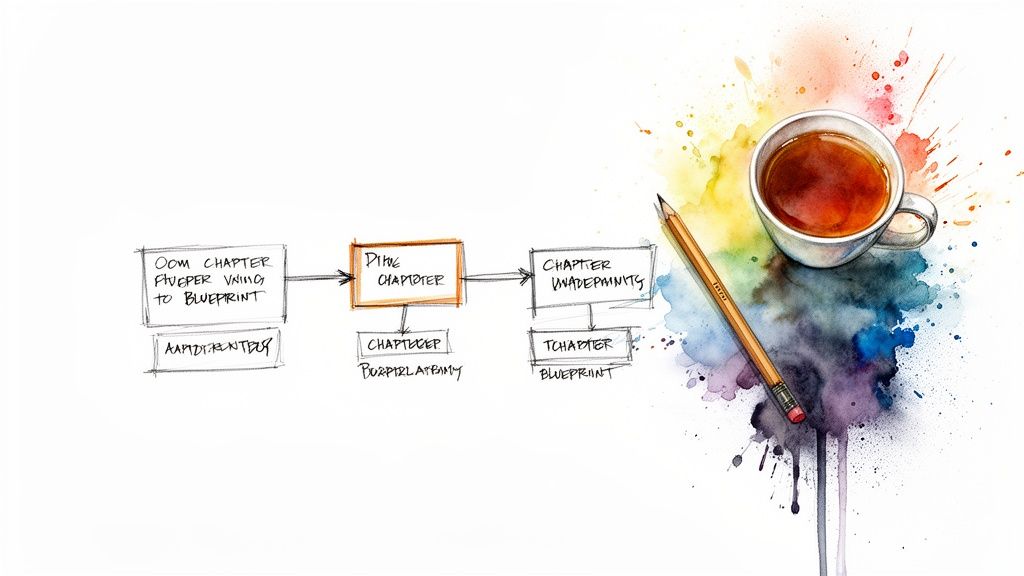
Okay, you’ve found your golden thread. Now it’s time to give your story some bones. A solid outline is what separates a heartfelt story that sings from a jumble of memories that just sits there on the page.
But please, erase that image of a rigid, Roman-numeral nightmare from your high school English class. We're not doing that. This is about creating a simple, flexible "chapter blueprint" that feels more like sketching a map than building a cage.
Think of it as the difference between a connect-the-dots puzzle and a paint-by-numbers canvas. Your blueprint connects the key moments of your life, but it still leaves you all the creative freedom to fill in the colors and textures.
Brainstorming Your Key Scenes
First things first: let’s get those pivotal moments out of your head and onto a page. With your golden thread firmly in mind, start listing every memory, scene, or event that directly supports that theme. Don't worry about the order just yet. This is a brainstorm, not a commitment.
What are the scenes you absolutely can’t imagine the book without?
- The phone call that changed everything.
- The awkward first date that somehow led to a 50-year marriage.
- The devastating mistake that taught you your hardest lesson.
- The quiet moment of forgiveness in a hospital room.
This list is your raw material, the building blocks of your entire memoir. If you’re working with a ghostwriter, this collection of scenes is pure gold. It gives them an immediate and powerful look into the emotional landscape of your story, letting them see the pillars that will hold up the narrative.
Arranging for Emotional Impact
Now for the fun part. A memoir's power often comes from how you tell the story, not just what happened. Going in perfect chronological order can be great, but sometimes it’s the storytelling equivalent of watching paint dry. Instead, we’re going to arrange your scenes for emotional impact.
The goal isn't just to report the events of your life; it’s to take your reader on the same emotional journey you went on. That requires a little bit of storytelling magic.
Let’s think like a movie director for a minute. What’s your opening scene? What’s the one moment that hooks the reader and makes them ask, "What happens next?" From there, you can start to build a narrative arc that has peaks and valleys.
Consider these narrative anchor points:
- The Catalyst: What event kicks everything off? This is your "once upon a time" moment that sets your story in motion.
- The Turning Point: Where did things take a dramatic turn? This could be a moment of crisis or a sudden revelation.
- The Rock Bottom: What was the lowest point in this journey? Showing vulnerability here is what creates a deep connection with your reader.
- The Climax: This is the peak emotional moment where the central conflict comes to a head.
- The Resolution: How did things resolve? What was the "new normal" you arrived at after the dust settled?
By identifying these key posts, you create a structure that has a natural rhythm. It builds tension, offers release, and keeps the reader turning the page. This is the architecture of a good story.
Your Chapter Blueprint: A Simple Framework
To make this practical, let's put it into a simple map. This isn't set in stone; it's a guide to keep you on track. You can use a spreadsheet, a whiteboard, or even a stack of index cards. The tool doesn't matter, but the clarity it brings is priceless.
Here's a simple framework to organize the key scenes of your story for maximum emotional impact. Use this to map the journey your reader will take.
Your Memoir Chapter Blueprint
| Story Phase | What Happens Here? | Key Memory or Scene Example |
|---|---|---|
| The Beginning | The event that introduces the central problem or theme. | The day my doctor gave me the news, which forced me to reevaluate my entire life. |
| The Middle | The struggles, lessons, and small victories on the journey. | The failed treatments, the arguments with family, the first day I felt a glimmer of hope. |
| The Climax | The peak moment of conflict and decision. | Deciding to try the experimental treatment against everyone’s advice. |
| The End | The resolution and the new understanding you gained. | Walking out of the hospital cancer-free, seeing the world with completely new eyes. |
See how this blueprint provides direction without being restrictive? It’s a roadmap, not a railroad. When you write a memoir, having this structure is a lifesaver. And for a ghostwriter, it's the shared map that ensures the book they help create is built exactly to your vision, one powerful scene at a time.
Finding Your Perfect Writing Partner
Let me tell you a little secret, one that the writing world doesn't always advertise. You do not have to write this book alone. In fact, some of the most powerful memoirs you’ve ever read were the result of a beautiful, trusting collaboration.
Hiring a ghostwriter isn't cheating. It’s not admitting defeat. Think of it like hiring an architect to help you build your dream house. You bring the vision, the memories, the blueprint, and they bring the tools, the expertise, and the steady hand to make sure the walls are straight and the roof doesn’t leak. It’s your story, brought to life with expert care.
So, how do you find "the one"? This is a deeply personal partnership, after all. You need someone with the skill to write, but more importantly, the empathy to truly listen. Let's find you a partner who will honor your story and make this whole process feel joyful, not draining.
Vetting a Ghostwriter Like a Pro
Finding the right ghostwriter is less about checking off boxes and more about finding a genuine connection. You’re not just hiring a typist; you’re entrusting someone with the most precious material you have: your life.
When you start looking at portfolios, try to look past the list of famous clients or flashy book covers. What you're really searching for is vocal dexterity. A great ghostwriter is a chameleon. Their portfolio shouldn't have one consistent "author voice"; it should have many.
Can they capture the warm, folksy wisdom of a grandparent in one book and the sharp, direct tone of a CEO in another? That’s the magic you're looking for. It proves they know how to listen and adapt, which is the single most important skill they can possess.
The best ghostwriters don't have a style; they channel a style. Your style. Their job is to disappear, leaving only your voice on the page, just a little sharper and more focused.
And while it might feel intimidating, remember that the demand for well told personal stories is strong. Publishers are still actively seeking out compelling life stories. Traditional publishing’s appetite for memoirs remains significant, with at least 267 memoir deals recorded in a recent year, a level about 85% higher than a decade earlier. The market hasn't vanished, it has just become more selective, which makes finding the right partner even more crucial. You can read more about the current state of memoir publishing and see just how vibrant the landscape is.
The All Important Interview
Once you’ve found a few writers whose work resonates with you, it’s time for a conversation. This is where you’ll really get a feel for whether you can build the trust necessary for this kind of project.
Here are the key questions you should be asking, beyond the basics of cost and timeline.
Key Questions to Ask a Potential Ghostwriter:
- "How do you approach capturing someone's voice?" A good writer will talk about their interview process, about listening for speech patterns, favorite phrases, and the underlying emotion in your stories. A bad one will just say, "Don't worry, I'm good at it."
- "What is your revision process like?" Collaboration is everything. You want a partner who welcomes feedback and sees revisions as part of the creative process, not an insult to their work.
- "Can you tell me about a time a project was challenging and how you handled it?" This question reveals their problem-solving skills and their ability to navigate the inevitable bumps in any creative road.
- "What part of my story excites you the most?" This is the big one. You want to see a genuine spark. The right partner will be personally invested in your story and excited to help you tell it.
Listen to your gut. Seriously. If a writer seems more interested in their own ego than your story, or if they're dismissive of your questions, they are not the one for you. Run, don't walk.
What the Collaborative Process Looks Like
So, what does this partnership actually look like in practice? It’s a beautifully simple, human process.
It typically starts with a series of recorded interviews. This is where you just talk. You’ll share your stories for hours, guided by their gentle questions. You'll laugh, you might cry, and you’ll remember details you thought were long forgotten. Honestly, it's often a deeply therapeutic process in itself.
From those interviews, the writer will create a detailed outline, much like the blueprint we discussed earlier. Once you approve it, they will start crafting chapters. They'll send you drafts, and your job is simply to read them and give feedback. Does this sound like you? Is this how you remember it feeling?
This back and forth is where the magic happens. You’ll see your messy, sprawling memories transformed into a clear, compelling narrative that sounds exactly like you, but on your very best day. It's an incredible feeling. This kind of partnership removes the frustration and leaves the joy, allowing you to create the physical book you’ve always dreamed of holding.
From Messy Drafts to a Finished Book

You’ve done it. The theme is there, you’ve got a structure, and maybe even a fantastic writing partner by your side. You poured your heart onto the page, creating a draft that holds the very essence of your story.
So, what now? This is where the real magic, and the real work, truly begins.
Let's demystify the journey from that chaotic first draft to a beautiful book you can actually hold in your hands. This final leg is all about polishing your story until it shines and bringing that vision to life.
The Two Edits Every Book Absolutely Needs
Think of your first draft as getting all the furniture moved into a new house. It’s messy, things aren't where they belong, but at least it’s all there. Editing is how you arrange that furniture, hang the art, and turn the house into a home.
There are two critical stages to this process, and skipping either one is like trying to build a house on a shaky foundation.
First, the Developmental Edit
This is the big picture edit. A developmental editor looks at the very bones of your book. They're asking the tough questions: Does the story flow logically? Is the emotional arc compelling? Are there plot holes or chapters that just drag the whole thing down?
This edit isn't about commas and spelling; it’s about the story itself.
Then, the Copyedit
Once the structure is solid, a copyeditor comes in with a magnifying glass. They hunt for grammar mistakes, spelling errors, awkward phrasing, and tiny inconsistencies you’d never catch on your own. They are the detail oriented heroes who make your writing clean, professional, and an absolute joy to read.
Every single author, no matter how skilled, needs an editor. Trying to edit your own work is like trying to see the back of your own head. You need that fresh, expert perspective to see what you’re just too close to notice.
This is often the point where bringing in an expert can make all the difference. Investing in professional writing and editing services can be one of the smartest decisions you make for your book, ensuring your manuscript truly shines.
Choosing Your Publishing Path
With a polished manuscript finally in hand, you’ve arrived at a crossroads: traditional publishing or self publishing? There’s no single "right" answer here, only the right answer for you. Both paths can lead to a beautiful book.
-
Traditional Publishing: This is the classic route. You find a literary agent who then shops your book to a publishing house. The publisher handles everything, editing, design, printing, distribution. It comes with a certain prestige, but it’s a long, highly competitive process, and you’ll have to give up some creative control.
-
Self Publishing: This puts you squarely in the driver's seat. You have total control over the content, the cover design, the timeline, and the royalties. It does require more of an upfront investment, both time and money, but the freedom and speed can be incredibly rewarding.
The publishing world has changed dramatically. Self publishing is no longer a vanity project; it's a powerful and popular choice for authors who want to bring their stories to the world on their own terms.
In fact, a recent survey found that 77% of authors identified as self published, with only 5% being fully traditionally published. This just goes to show that an independent route gives you incredible control and speed.
The Unbeatable Joy of a Finished Book
Once your publishing path is chosen, the final pieces start falling into place. You'll work on a cover design that captures the soul of your story and interior formatting that makes the text easy on the eyes. This is the moment your manuscript starts to look like a book.
And then comes the day.
A box arrives on your doorstep. You open it, and inside are your author copies. You pick one up. You feel the weight of it, run your hand over the cover, and smell the fresh ink and paper.
In that moment, all the doubt, the hard work, and the vulnerability become worth it. You are holding your life, your legacy, your story. It’s a physical thing now. It's real.
And there is truly no feeling in the world quite like it.
Common Questions About Writing a Memoir
Alright, let's talk about those nagging questions that creep in when you’re finally alone with your thoughts. The ones that can stop a powerful story from ever seeing the light of day. I hear these fears from authors all the time, so trust me, you’re in good company.
Let’s pull these worries out of the shadows and look them right in the eye. Your story is too important to let them win.
How Do I Know if My Life Is Interesting Enough?
This is the big one, isn't it? That little voice that whispers, "Who would ever want to read about my life?" I totally get it. But here's the thing: a great memoir isn't about being famous or having lived through some crazy, blockbuster worthy drama. It's really not.
A compelling memoir is about sharing an honest, human experience. Readers crave connection. They lean into vulnerability, transformation, and emotions they recognize from their own lives. It’s your unique perspective on universal feelings, love, loss, finding your footing, overcoming a setback, that makes a story impossible to put down. If you've learned something, changed, or simply seen the world in a way that’s all your own, then you have a story that someone out there needs to hear.
It's not the drama of your life that makes a memoir great; it's the depth of your humanity. Your story has value because it’s yours.
What if I Cannot Remember All the Details Perfectly?
Welcome to the club! Unless you have a photographic memory, it’s not going to be a perfect recording. And that’s completely okay. A memoir is about emotional truth, not a court transcript. You're not being cross examined; you're telling a story from your perspective.
Focus on the sensory details you do remember. What did your grandfather's workshop smell like? What song was playing on the radio during that first road trip? You can absolutely reconstruct dialogue based on the emotional core of a conversation. Authenticity comes from capturing the spirit of the moment, not reciting it word for word. A skilled ghostwriter is fantastic at this, they know how to ask the right questions to pull those fuzzy memories into sharp, emotional focus.
How Do I Handle Writing About Other People?
Navigating this is a delicate, but totally manageable, part of the process. The golden rule here is to write your story from your perspective. Keep it grounded in "I" statements. Talk about how events made you feel and the impact they had on your life, rather than trying to state definitive facts about someone else’s intentions or character.
When you're writing about sensitive situations, some authors will change names or even create composite characters to protect people's privacy. If these people are still in your life, sometimes having a direct, respectful conversation beforehand is the right move. Ultimately, you have to tell your truth, but leading with empathy is always the best path forward.
How Long Should My Memoir Even Be?
First off, take a deep breath. You're not trying to write War and Peace (and if you are, that's a whole other conversation!). A standard memoir manuscript typically falls somewhere between 60,000 and 80,000 words. In a normal paperback, that works out to about 250 to 300 pages.
But please, see this as a guideline, not a hard and fast rule. The most important thing is that your story feels complete. It should be just long enough to explore your central theme without padding it with fluff to hit a word count. It’s about finding the natural length your story needs to breathe.
At My Book Written, we know that turning your life into a book is a deeply personal journey. If you’re ready to organize your memories and build the blueprint for your legacy, we’re here to offer the calm, expert guidance you need. Explore our resources and see how we can help you bring your story to life.