

Let’s be honest. When you’re writing your memoir, writer’s block is a totally different animal. You’re not just trying to come up with a plot twist; you’re reliving your life on the page. The block often comes from the sheer emotional weight of your memories and a deep seated fear of not doing your own story justice. It feels less like a creative hiccup and more like a profound, personal wall.
That Blinking Cursor Is Not Judging You
That little blinking line on the blank screen can feel like a personal attack, can't it? A tiny digital judge, tapping its foot, waiting for you to perform. But here’s the truth: if you’re brave enough to write your life story, you’ve more than earned a permission slip to feel stuck.
This isn’t just writing. This is emotional excavation. While writing a novel is a huge achievement, crafting a memoir is a whole different ballgame. You're working with the delicate, complicated, and sometimes painful material of your own life. Creating something that will last forever is an honor, and it’s okay if the process feels a little heavy sometimes.
Why Your Stuck Is Different
For a memoirist, being stuck isn't about a lack of ideas. Your life is the idea. The real struggle is translating a lifetime of messy, beautiful, complicated experiences into clean, linear sentences. It’s about staring your own past in the face and finding the right words.
I've seen this paralyze everyone, from retiring CEOs trying to document their careers to grandparents hoping to leave a legacy for their family. The story is all there, but getting it onto the page can feel like trying to bottle a hurricane. Or trying to get a cat into a carrier. You know, impossible.
The good news is, you can reframe this. The block isn't a sign of failure. It’s a signal from your story telling you it needs a different approach, maybe a little more care, or simply a moment to breathe.
The usual “just write through it” advice often falls flat when the source material is your own heart. That’s like telling someone to “just get over” a powerful memory. It simply doesn’t work that way.
You Are Far From Alone in This
If you feel like you’re the only one wrestling with your story, you couldn't be more wrong. This is an incredibly common part of the journey. We’ve all been there.
In fact, studies show that up to 94% of students working on personal narratives hit a wall occasionally, and a staggering 24% feel blocked almost constantly. This directly mirrors the struggle of memoirists everywhere. The raw honesty required often clashes with our inner perfectionist and the very real fear of dredging up the past. You can explore more about the common causes behind this creative friction to see just how universal this feeling is.
This isn't a sign that your story isn’t worth telling. It’s a sign that it’s so important, your mind is putting up roadblocks to protect you.
When you're staring at the screen, it's easy to feel overwhelmed. Below is a quick look at common emotional triggers for memoirists and a gentle, practical first step for each.
Decoding Your Memoir Writer's Block
| What You Might Be Feeling | What Your Story Might Be Telling You | One Tiny Action to Try Today |
|---|---|---|
| Anxiety & Perfectionism | "I'm scared of getting the details 'wrong' or not making it sound perfect." | Just write one "bad" sentence about a memory. No one has to see it. The goal is to just get words down. |
| Emotional Exhaustion | "Reliving this is draining. I feel raw and exposed." | Step away from the keyboard. Go for a walk, listen to music, or call a friend. Your well being comes first. |
| Self-Doubt | "Who would even want to read my story? It's not that interesting." | Write down one person, even if it's just a family member, who would benefit from hearing your story. Write for them. |
| Feeling Overwhelmed | "My whole life is too much to put into a book. Where do I even start?" | Don't think about the whole book. Just pick one small, vivid memory and describe it in a single paragraph. |
Each of these feelings is valid, and most memoirists I know have felt them all at some point. The trick is to acknowledge them without letting them drive the car.
Sometimes, the most powerful move is realizing you don’t have to do it all by yourself. Teaming up with a professional ghostwriter can be a game changer. It’s not giving up; it’s getting a skilled copilot for the journey. It's still your story, your voice, and your vision, just with an expert helping you navigate the turbulence. Honestly, it makes it easier and a lot more fun.
Pinpointing Your Personal Brand of Stuck
First things first, let’s play detective. Just saying you have "writer's block" is a lot like telling a doctor you feel "unwell." It’s a starting point, but it doesn't get to the heart of the matter. To find the right remedy, we need to diagnose what’s really going on.
Not all blocks are created equal, and this is especially true when you're writing a memoir. Are you just mentally exhausted, or is a deeper emotional barrier holding you back? Let's figure out your particular flavor of stuck.
This little map shows the world every memoirist lives in. Your life story is the center, but it branches out into memory, your search for justice or truth, and the simple, sometimes brutal, mechanics of putting words on a page.
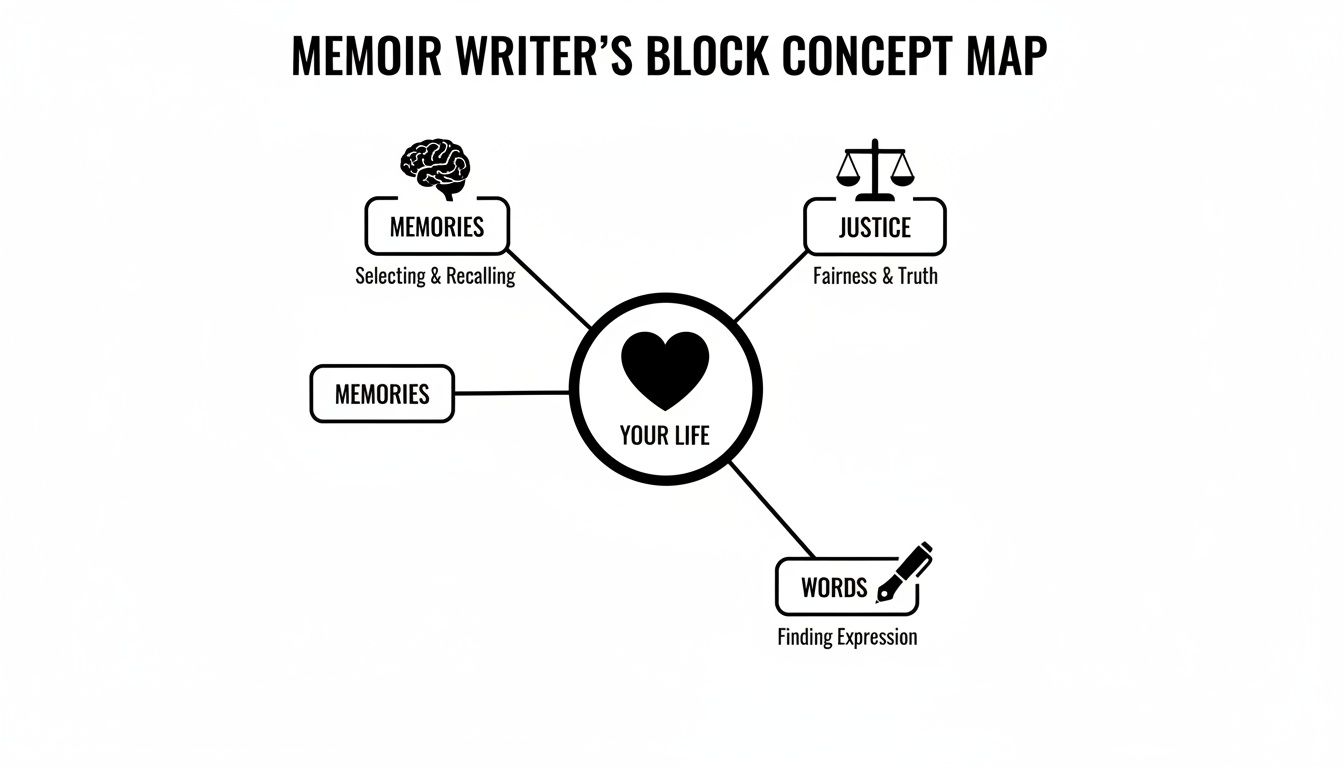
As you can see, your block is rarely just one thing. More often, it’s a tangle of emotional recall, a deep need to set the record straight, and the challenge of finding the right language. Let's start untangling a few of the most common knots I see in my work with authors.
The Emotional Hangover
So, you just finished writing a truly gut wrenching scene. It might have been about losing someone you loved, a traumatic event, or a moment you deeply regret. The next day, you sit down at your keyboard and… nothing. Just silence.
That isn't a block. It’s an emotional hangover.
Your mind and spirit need a moment to breathe and recover. Trying to force yourself back into another heavy memory is like attempting a second marathon the day after finishing your first. This isn't a failure of discipline; it's an act of self preservation.
The "Who Am I To Say This?" Syndrome
Ah, imposter syndrome. That unwelcome guest who always seems to show up right when you’re making progress. You start second guessing yourself, worrying what your family will think or wondering if your story is "important enough." That fear of judgment can be absolutely paralyzing.
You're in good company. When John Steinbeck was stuck writing The Grapes of Wrath, he got around his own fear by writing letters to an imaginary friend. It worked. This lines up with modern research, which found that fear of evaluation was a top trigger for over 40% of writers experiencing a major block.
The secret is realizing this isn’t about ego. It's about honoring your experience. Your story has value because it's yours. Full stop.
The Messy Middle Muddle
Your opening chapter is fantastic and you have a clear vision for the ending, but the space in between is a foggy, tangled mess. Sound familiar? Welcome to the messy middle. It feels like you’ve written yourself into a corner with no obvious way out. You're not lost, you're just in the "muddle."
This is almost always a structural problem, not a creative one. It happens when the initial fire and passion for the project cool down, and the real architectural work of weaving everything together has to begin. If this is you, our guide on how to write a memoir outline might be exactly what you need to find your way through the fog.
The Perfect Sentence Paralysis
You write a sentence. You delete it. You rewrite it, changing a single word. Then you stare at it for twenty minutes, convinced it's the worst sentence ever put on paper. This brand of perfectionism is the enemy of every great book.
Trying to produce a perfect first draft is like trying to sculpt a statue out of a diamond with a spoon. You'll only end up frustrated. Your first draft has one job: to exist. It’s supposed to be messy. The magic comes later, in the editing.
Identifying your particular brand of stuck is the first real step toward breaking free. Once you know what you’re truly up against, you can find the right tool for the job. And sometimes, the best tool isn't a technique, it's a partner. A professional ghostwriter is an expert at navigating these very challenges, helping turn those hangovers, muddles, and paralyses into a finished physical book. It makes the journey smoother and, honestly, a whole lot more rewarding.
5 Fun and Practical Ways to Get Words Flowing
Alright, enough dissecting the problem. Let’s get our hands dirty and make a beautiful, creative mess. The goal right now isn't to write the next perfect chapter of your memoir. It’s the opposite. We’re hunting for momentum, not mastery.
Think of these exercises as a gentle warmup before the main event. They’re all about reconnecting with your story in a playful, low pressure way. We’re tossing out the stuffy, academic writing prompts and trying a few things that are actually fun. Nobody is grading this.
1. Trick Your Brain with Perspective Shifts
Sometimes the weight of telling your truth is the heaviest part. That pressure to get it "right" can be completely immobilizing. So, let's take that pressure off the table for a bit and play with who’s telling the story.
The Unreliable Narrator: Pick a specific memory you’ve been struggling with. Now, retell it from the perspective of someone else who was there. What about your grumpy uncle? Your childhood best friend? A fly on the wall?
The Key Detail: Write it from their point of view, and don't be afraid to include details they might have gotten completely wrong. This frees you from the burden of perfect recall and often shakes loose little things you forgot you knew. It’s a wonderfully sneaky way to approach a scene from a fresh angle.
This isn’t about being dishonest in your final draft; it’s about exploring the emotional landscape of a memory without being the sole, official record keeper. It gives you permission to be messy, which is exactly where creativity thrives.
2. Reconnect Through Your Senses
Memories aren't just a list of facts and events; they're a rich tapestry of sights, sounds, smells, tastes, and textures. When the words won't come, it's often because we’re stuck in our logical brain. Let's get out of our heads and back into our bodies.
The most powerful memories are rarely just visual. They are a full sensory experience. Reconnecting with those details can be the key that unlocks a stuck scene and brings it vividly back to life.
Try this simple but powerful exercise.
The Sensory Snapshot: Choose a single memory. Set a timer for 10 minutes and write about it using only two senses. For instance, describe your grandmother's kitchen using only smells and sounds. Don't mention what anything looked like.
What was the scent of baking bread mixed with cinnamon? What was the sound of her slippers shuffling on the linoleum floor? This focused approach bypasses your inner editor and plugs you directly into the feeling of the moment.
It’s amazing how a specific smell can crack open a memory you thought was locked away for good. You can find more strategies for pushing through these barriers in our guide on how to finish a book when you're stuck.
3. Become Your Own Interview Subject
If writing feels impossible, try talking. We often speak more freely than we write, so let’s use that to our advantage. It’s time to put on your journalist hat and get the scoop on the most interesting subject you know: you.
Interview Yourself: Grab your phone and open the voice memo app. Pretend you're a journalist interviewing yourself about a specific period of your life. Ask yourself questions out loud and then answer them.
What were you most afraid of at that time? What did you hope for? What was the funniest thing that happened? Don't worry about sounding polished. Just talk.
Later, you can transcribe the recording (or even check out how to use AI for writing without losing your voice to help you with the transcription). You'll be amazed at the natural, authentic phrases that emerge when you aren't staring at that blinking cursor. This is a fantastic way to generate raw material that feels real because it is.
4. Jump to the “Good” Part
Who says you have to write your memoir in order? Nobody. That’s a rule we often impose on ourselves, and it can be a real creativity killer. If you’re bogged down in a difficult chapter about your early childhood, give yourself permission to skip ahead.
Jump to that wild story from your twenties. Write about the day you met your spouse or the moment you finally achieved a lifelong dream. Writing a scene that fills you with energy and excitement can refuel your creative tank and give you the motivation to tackle the tougher parts later. Think of your story as a collection of scenes, you can always stitch them together in chronological order during the editing phase. This isn't cheating, it's strategy.
5. Write a Letter You’ll Never Send
Sometimes, the blockage comes from things left unsaid. There might be a person at the center of your story, a parent, an old friend, a former partner, who you have complicated feelings about. The thought of putting those feelings on the page for the world to see can be paralyzing.
So, don't. At least, not yet.
Open a new document and write a letter directly to that person. Pour everything out. The anger, the love, the confusion, the gratitude. Don't hold back, don't self censor, and don't worry about grammar or structure. This is just for you. Getting these raw emotions out of your head and onto a private page can be incredibly cathartic, freeing up the emotional space you need to write the actual scene with more clarity and control.
These exercises aren’t a distraction from your book; they're a direct path back to it. They're about rediscovering the joy in your own story. And if even these feel like too much, remember you don't have to walk this path alone. Partnering with a ghostwriter can turn a frustrating solo project into an exciting collaboration, ensuring your beautiful story finally makes its way into the world.
When Life Gets in the Way of Your Legacy
Let's get real for a minute. Sometimes, writer’s block has absolutely nothing to do with writing. The problem isn’t a lack of words; it’s a lack of time.
You have a story burning inside you, a legacy you’re desperate to capture. But you also have a career, a family, and a life that demands your attention. That blinking cursor on the screen isn’t an invitation, it’s a glaring reminder of another monumental task on an already overflowing to do list.

This kind of "stuck" is different. It’s for the busy professional dictating notes between meetings or the parent trying to sneak in a chapter while the kids are at soccer practice. If this sounds familiar, the old advice to “just chain yourself to the desk” is not only unhelpful, it’s downright laughable.
Redefining Your Writing Practice
We need to completely redefine what “writing” even looks like. When you're juggling a full life, your best work often happens far away from a keyboard.
Your writing practice might look more like this:
- Your Commute Becomes Your Confessional: Use the voice memo app on your phone during your drive. Talk through a memory, tell a story about a former colleague, or just vent about how you felt during a specific moment in your life. Don’t worry about sounding poetic. Just talk.
- The Photo Album Is Your Outline: Pull out those old family photos one evening. Instead of trying to write, just put them in chronological order. As you pick up each picture, jot down a sentence or two about the memory it sparks. You’re not writing a chapter; you’re creating story prompts for later.
- The Interview as an Archive: Ask a friend or family member to “interview” you for an hour. Have them ask questions about your life while you simply answer. If you record it, you create priceless raw material without ever staring at a blank page.
These aren't just clever tricks. They are legitimate, powerful ways to build the foundation of your book without needing a quiet, four hour block of writing time that, let’s be honest, you probably don’t have.
A Heart to Heart About Getting Help
Now, for a dose of tough love, from a friend who wants to see you succeed. Your book is a legacy. It’s an act of courage and a gift to the future. It is far too important to let it die on the vine because of logistics.
If your vision is crystal clear but the actual writing is stalled by the ticking clock, bringing in a partner isn't giving up. It’s one of the smartest, most strategic decisions you can make.
Think of it this way: if you were building your dream house, you’d hire an architect and a builder. You wouldn't feel guilty for not knowing how to pour the foundation yourself. You’d collaborate to bring your vision to life. A ghostwriter is the architect and builder for your book.
Working with a premium ghostwriting service can completely change the game. They can transform your scattered notes, voice memos, and recorded interviews into a polished, powerful manuscript.
It’s still your voice, your story, and your vision, just brought to life with an expert copilot who knows how to navigate the entire process. This isn't just about saving time; it's about honoring your story enough to give it the professional support it deserves, so you can finally hold that physical book in your hands.
Protecting Your Story and Your Sanity
Writing a memoir is a brave, wild, and deeply personal thing to do. You’re not just arranging words on a page; you're excavating your own heart, and that journey requires more than a good outline and a pot of coffee. It requires emotional armor.

This part of the process isn’t just about getting the book finished. It’s about finishing it with your spirit, and your important relationships, still beautifully intact. Your well being has to be the top priority. Always.
Creating Your Writing Sanctuary
Your brain needs clear signals for when it’s time to dig into the past and, just as importantly, when it’s time to stop. Without these boundaries, the emotional residue from a tough writing session can easily bleed into your dinner, your conversations, and even your dreams.
A simple ritual can work wonders here. It doesn't have to be complicated:
- Light a specific candle only when you sit down to write.
- Play the same album to kick off every session.
- Make a cup of tea in a special mug you only use for writing.
Then, when the session is over, blow out the candle or turn off the music. This small action tells your subconscious, "Okay, we're leaving the past for now. We’re back in the present." It’s a way to gently close the door on those powerful memories so you can be fully present in your life.
The Sacred Role of the Safe Reader
Every single memoirist needs a "safe reader." Let me be clear: this is not your brutally honest friend who loves to red pen everything. And it’s definitely not the family member who will have a strong emotional reaction to every scene.
A safe reader is a trusted, nonjudgmental soul whose only job is to listen. They are your emotional sounding board, there to say, "Wow, that must have been so hard to write," not, "You should rephrase this sentence."
Sharing your raw, vulnerable first draft is a huge, terrifying step. Finding that one person who can hold that space for you without criticism is absolutely essential for your sanity. Their feedback isn't about the craft; it’s about acknowledging the courage it took for you to write it down in the first place.
Writing About Others with Grace
Alright, let's talk about the elephant in the room: writing about other people. This is, without a doubt, one of the biggest sources of writer’s block I see in memoir authors. How do you write your truth without causing a full blown family feud? It’s a delicate dance, but it’s not impossible.
The key is to write from a place of compassion, even when the memories are painful. Try to focus on your own feelings and perceptions by using "I" statements. For example, instead of writing, "My father was always angry," you could try, "I often felt scared and small when my father raised his voice." See the difference? It shifts the focus from accusation to your personal experience. It’s your story, and you have every right to tell it from your perspective.
Remember, this whole process is a marathon, not a sprint. If navigating these emotional waters feels overwhelming, please know that you don't have to captain this ship alone. Sometimes, bringing in a professional ghostwriter can provide the support and structure you need. It allows you to tell your story with clarity and confidence while they handle the heavy lifting, an act of self care for both you and your legacy.
Your Story Deserves to Be Told
Let’s bring this all back to you for a moment. You started down this path for a reason, not because it was simple, but because there's a story inside of you that needs to be heard. Turning your life into a book is a huge act of courage. It's a gift you’re creating for the future.
Think of it this way: your memoir is a way to make sure your voice still echoes long after you’ve left the room. It’s a physical thing that will last forever. What an honor.
If you remember just one thing from all this, let it be that writer's block is completely normal for memoirists. It’s not a sign of failure; it’s a sign that you’re doing important, often difficult, work. Figuring out what’s really behind it, whether it’s emotional baggage or a logistical tangle, is the first real step toward getting unstuck.
You've Got So Many Allies
Remember, you have a ton of tools and allies ready to help you on this quest. From sensory writing exercises that reconnect you to the past to simple shifts in perspective, there are so many ways to gently coax the words out.
Most importantly, you don't have to go it alone. The real goal isn't just to write a book; it's to get your story and your legacy out into the world.
Whether you type every single word yourself or bring in a professional ghostwriter to help shape your vision, the victory is exactly the same. The finished book in your hands is what matters.
This whole process is about more than just stringing sentences together. To make sure your story truly connects with people, you have to find your writing voice and let your authentic self shine through on the page.
Ultimately, your memoir isn't just another project. It's a piece of you that will last forever. For a more comprehensive look at the entire journey, from idea to finished book, check out our full guide on how to write your memoir.
Now go on. Honor that one story that only you can tell. The world is waiting to hear it.
Got Questions About Writing Your Memoir?
It’s totally normal to have a million questions swirling around when you’re wrestling with a project this personal. When it comes to writing a memoir, writer's block isn't just a creative problem, it's an emotional one, too. Let's tackle some of the most common questions I hear and get you some straight answers to clear the fog.
Is This Writer’s Block or a Bad Idea?
Ah, the million dollar question. But here’s a little secret from my years of experience: a "bad" memoir idea is incredibly rare. Your life happened. The real question is whether you're facing a creative block or a structural tangle.
True writer's block feels like a deep freeze. You know the story, you can picture the memory perfectly, but the words just won't come out. A structural problem, on the other hand, feels more like being lost in the woods without a map. You find yourself writing in circles, or you get that nagging feeling that the story is missing its "why."
Here’s a great test: try telling a piece of your story out loud to a friend. If it pours out of you with passion and clarity when you speak, but you freeze up at the keyboard, that’s almost certainly writer's block.
To Write or Not to Write Through It?
So, do you chain yourself to the desk or give yourself a break? Honestly, the answer depends entirely on why you're stuck.
If your block is rooted in fear or perfectionism, then yes, a gentle but consistent writing routine can be a powerful antidote. I’m talking just 15 minutes a day of getting something on the page. The goal isn't to write a masterpiece; it's simply to break the cycle of avoidance.
But if you’ve just finished a gut wrenching chapter and feel emotionally wiped out, forcing yourself to write is like trying to run on a sprained ankle. In that case, a planned, intentional break is the kindest and most productive thing you can do. Go for a walk, watch a silly movie, do whatever you need to let your spirit recover.
Can a Ghostwriter Really Capture My Voice?
This is the big one, and it's a completely valid concern. A truly great ghostwriter doesn't slap their own voice onto your story. They act more like a skilled detective, working to find, excavate, and polish yours.
How? Through deep, attentive listening during interviews. They’ll pick up on your unique cadence, your favorite phrases, and the core of how you see the world. It’s a close partnership, with lots of back and forth and feedback to make sure every sentence feels authentic to you. It's 100% your vision and your voice, just brought to life with an expert guide.
The statistics are pretty sobering; research shows that up to 94% of writers working on personal narratives hit a wall with writer's block. Another study found that writers who get stuck often end up deleting 30% more of their work and produce shorter drafts, mostly because perfectionism gets in the way. Given those odds, bringing in a professional isn’t just a luxury; it’s a smart, strategic move to make sure your story actually gets told. You can read the full research about these writer's block findings and see just how common these hurdles are. A ghostwriter helps you leap right over them.
Your story is a legacy. It deserves to be a real, physical book you can hold, share, and preserve forever. If that journey feels overwhelming, My Book Written is here to give you the clarity and resources you need to move forward with confidence. Explore our guides and get your book across the finish line.