
Writing your life story is a profound journey, turning fleeting memories into a timeless legacy. But let’s be real, that first step can feel like trying to climb Everest in flip flops. This guide is here to offer a clear, gentle roadmap to help you find your central theme, organize your thoughts, and finally begin the beautiful process of putting your memories on the page.
So You Want to Write Your Life Story, But Where Do You Start?
The idea of writing your life story can feel a bit like trying to bottle lightning. It’s a brilliant, beautiful, and utterly overwhelming thought. You have a lifetime of memories, moments, and hard won lessons swirling around in your head, and the blank page is just staring back, asking, “So… what’s the plan?”
The good news? You don’t need a perfect plan just yet. You just need to give yourself permission to remember. Before you even think about Chapter 1, the real first step is understanding why you feel this pull to write in the first place.
Finding Your North Star
Every truly great story has a central theme, a single thread that ties everything together. This isn't about trying to summarize your entire existence in one neat sentence. It’s about finding the emotional core of the story you feel compelled to tell right now.
Here's an example from my own experience: a friend of mine wanted to write about his career building a successful company. But as we talked, it became clear the real story wasn’t about spreadsheets and mergers. It was about his complicated relationship with his father, who never believed he’d amount to much. The business was just the stage where that deeply personal drama played out. That discovery became his North Star.
So, what’s yours? It could be one of these, or something else entirely:
- A Legacy Project: Are you creating a beautiful record for your grandchildren, so they’ll always know where they came from?
- A Story of Healing: Is this a way to process a difficult period, find closure, or finally make peace with your past?
- A Collection of Lessons: Do you want to share the wisdom you’ve gained from a life of triumphs and hilarious missteps?
- An Act of Witness: Did you experience something extraordinary, a historical event, a unique challenge, that needs to be shared?
Trust me, there's a massive, hungry audience for these personal tales. Globally, the book publishing industry is huge, and memoirs are a significant slice of that pie. In fact, self published memoirs alone exploded to 1.68 million titles in a single recent year. That’s over 4,500 new stories hitting the shelves every single day. Clearly, people are eager to connect with genuine human experiences.
Brainstorming Without the Storm
Once you have a sense of your "why," it's time to start gathering your ingredients. Don't worry about order, chronology, or importance just yet. Just let the memories flow. Grab a notebook or open a fresh document and start jotting down any moment that comes to mind, big or small.
Think about the "movie scenes" of your life: the day you got married, the moment you landed your dream job, that gut wrenching goodbye. But also make sure to capture the quiet, defining moments: the smell of your grandmother’s kitchen, the feeling of the steering wheel on your first car, the quiet wisdom a mentor shared over a simple cup of coffee.
A great life story isn't just a highlight reel. It’s a tapestry woven from both the bright, bold colors of major events and the subtle, meaningful threads of everyday life. The small details are what make your story uniquely yours.
This process is supposed to be messy, nonlinear, and deeply personal. It's less about "writing" and more about excavating. And if it feels too heavy to lift alone, that’s perfectly normal. Many people find that partnering with a professional ghostwriter at this stage turns a daunting task into a joyful collaboration. They are experts at asking the right questions to unearth those forgotten gems and help you find the story within your stories. This guide offers some great initial steps to write an autobiography, which can help organize your thoughts for that first conversation.
Building the Blueprint for Your Memoir
So, you’ve dug deep and found your "why." You’re probably sitting on a glorious, messy pile of memories, moments, and half forgotten stories. It can feel a bit like you’ve just dumped every box from the attic onto the living room floor. Now what?
You wouldn’t build a house without a blueprint, and the same goes for your book. This is where we create a roadmap, not one of those rigid, soul crushing Roman numeral outlines from high school, but a flexible structure that gives your story shape and direction. It’s the difference between a scenic, purposeful drive and being hopelessly lost in the woods.
This is all about turning that pile of memories into a page turning narrative. A good first step is to get crystal clear on your primary goal.
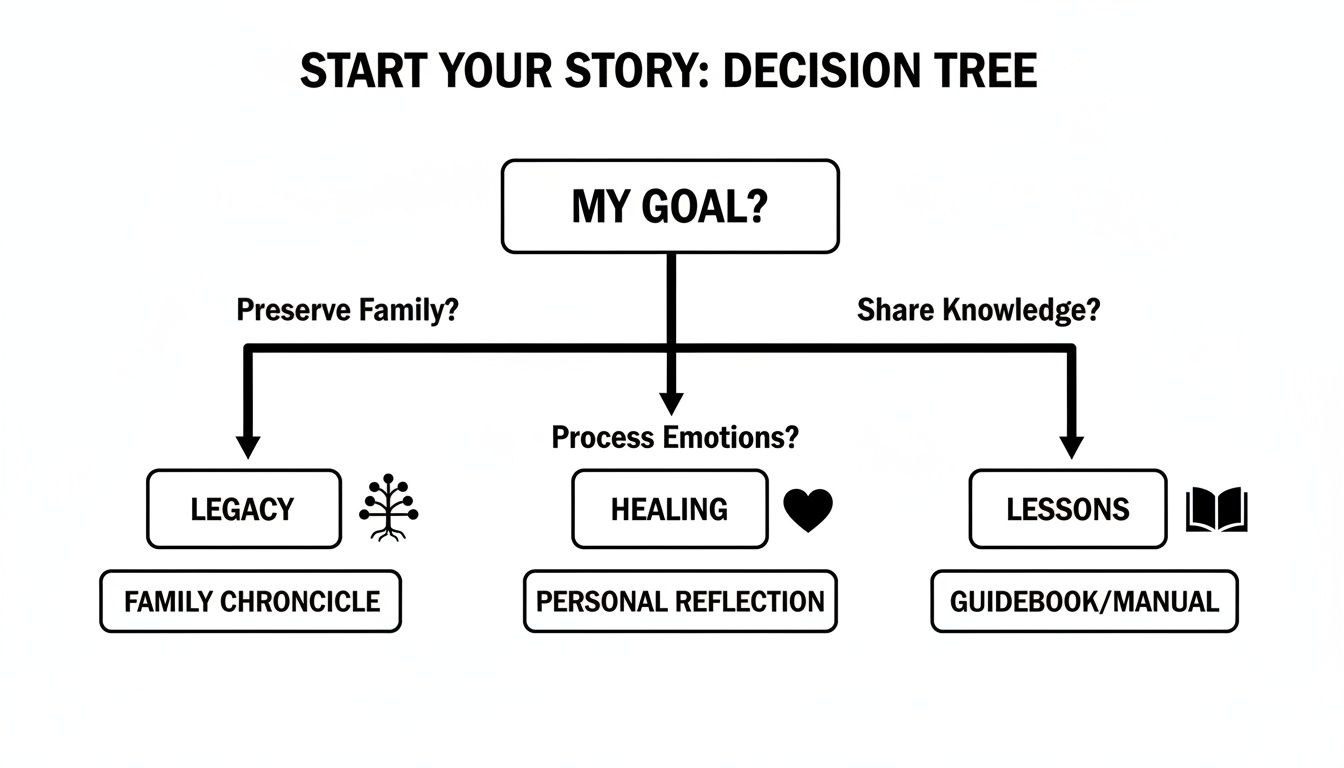
Whether you’re aiming to leave a legacy, find healing, or share hard won lessons, that motivation will shape everything that follows.
Finding a Structure That Fits Your Story
Life rarely happens in a straight line, and your book doesn't have to, either. Some of the most compelling memoirs jump around in time, focusing on powerful themes or pivotal moments. The trick is to pick a structure that serves your story, not the other way around.
I've seen authors succeed with many different approaches, but here are a few simple frameworks that work wonders.
Choose a structure that best fits the natural flow of your story. You can even mix and match elements.
| Structure Type | Best For | Real-World Example |
|---|---|---|
| The Classic Chronological Arc | Stories of transformation, business growth, or a journey with a clear beginning and end. Builds momentum event by event. | A business memoir tracking a company from a garage startup to a successful acquisition. |
| The "String of Pearls" | A collection of powerful, standalone stories connected by a central theme rather than a strict timeline. | A travel memoir where each chapter is a different country, or a doctor's stories of unforgettable patients. |
| The Hero's Journey | Framing stories of overcoming adversity, facing a huge challenge, or a profound personal change. | Someone detailing their battle with an illness, from diagnosis (call to adventure) through treatment (the trials) to recovery (the return). |
The right structure is like the invisible architecture of your book. When it’s strong, the reader can just relax and enjoy the journey you're taking them on, without getting lost or confused.
From Big Ideas to Concrete Chapters
Once you have a general structure in mind, it's time to get your hands dirty. Grab a stack of index cards or open a fresh document. Create one "card" for each major event, memory, or "pearl" you want to include.
Don’t get bogged down in writing beautiful prose here. Just jot down a few bullet points for each card.
For instance, a business memoir might have cards that look like this:
- The awful first pitch meeting (Lesson: Humility)
- Hiring Sarah, our first employee (Best decision ever)
- The year we almost went bankrupt
- Finally landing the big client
Now, arrange those cards according to the structure you chose. Laying it all out visually is a total game changer. Suddenly, you can see the gaps in your story, spot where you need to add a bit of backstory, and make sure the whole thing flows. This is the moment your jumble of memories starts to actually look like a book. It’s incredibly exciting.
Of course, this organizing part can feel a little daunting. You don't have to go it alone. Working with a professional can be a breath of fresh air; a great ghostwriter is part story architect, part collaborator. They’re brilliant at helping you find the perfect blueprint for your story.
If you want to dig deeper into this stage, our guide on how to write a memoir outline breaks it down even further.
Finding Your Voice and Gathering Your Stories

Alright, you’ve got your blueprint. Now comes the part where we put some meat on those bones. This is where the real magic happens, transforming skeletal outlines into living, breathing scenes from your life. It’s time to gather your stories and, just as importantly, find the unique voice that will bring them to life on the page.
Let’s talk about that “voice” for a second. So many people get hung up here, convinced they need to sound like a stuffy, professional “writer.” My advice? Forget that entirely.
Readers don’t want to hear from some formal narrator; they want to hear from you. Are you the person who cracks a dry joke at the perfect moment? Are you warm, reflective, and a little bit sentimental? Your writing voice is simply your personality captured on paper. The best advice is also the simplest: just write the way you talk.
Unearthing the Details by Interviewing Yourself
Our memories are funny things. We remember the big, life altering events, but the tiny, sensory details that make a story truly pop often get tucked away in the brain’s attic. To find them, you need to become a detective of your own past. And your first subject is you.
Set aside some quiet time and start interviewing yourself. Go back to a key moment from your outline and ask specific, evocative questions that dig deeper than just "what happened?" The real goal is to transport yourself back in time.
Try asking questions like these:
- What song was playing on the car radio during that long drive?
- What did the air smell like right after it rained that day?
- What was the texture of that scratchy wool sweater your grandpa always wore?
- What ridiculous posters were hanging on your teenage bedroom walls?
These aren't just trivial details; they're emotional time machines. They are the difference between saying "it was a sad day" and describing the cold drizzle on the windowpane that perfectly mirrored the tears you were holding back. This is the good stuff, the material that makes a reader feel like they’re right there with you.
Becoming a Story Collector
While your own memories are the main event, they aren't the only source. Your life is a rich tapestry woven with threads from all sorts of people and places. Now’s the time to start gathering those threads.
Think of this part of the process as pure treasure hunting. It's a fantastic excuse to reconnect with your past in a tangible, meaningful way.
Here are a few places to start digging:
- The Photo Album Archive: Dust off those old albums and shoeboxes filled with photos. A single photograph can unlock an entire chapter you'd completely forgotten about.
- The Journal Journey: If you were someone who kept diaries or journals, you've hit the jackpot. Your past self is waiting right there to tell you exactly how things felt, in their own words.
- Interview Your Inner Circle: This is my favorite part. Sit down with your siblings, old friends, or even your parents. Ask them about their memories of a shared event. You’ll be floored by the details they remember that you've long since forgotten. A quick audio recording on your phone is perfect for capturing these conversations.
This gathering phase is where many people have a lightbulb moment and realize the sheer scale of their project. It can feel exhilarating and, frankly, a little overwhelming. This is a perfect time to consider bringing in a co pilot.
A professional ghostwriter is an absolute expert at this. They are skilled interviewers who know exactly how to draw out these vibrant details and organize them into a compelling narrative. It turns the pressure of "doing it all" into a fun, collaborative process of discovery.
You get to enjoy the reminiscing while they handle the heavy lifting of weaving it all together. It’s still your story, your voice, and your legacy, just without the headache.
Navigating the Messy Middle and When to Ask for Help
Every creative project has one. It’s that murky, frustrating part of the map where the initial thrill of starting has worn off, but the finish line feels like a distant rumor.
Welcome to the messy middle. It’s where half finished drafts go to collect dust and brilliant ideas lose their sparkle.
This is the point where self doubt loves to throw a party. You might look at your collection of notes and think, "This is just a jumble of disconnected stories." Or you’ll read a chapter you wrote last month and feel a cringe coming on, wondering if your life is even "interesting enough" for a book.
Trust me, this is completely normal. Writing a book, especially your life story, is not a smooth, linear process. It's a rollercoaster, full of breathtaking highs and gut wrenching dips. Recognizing this phase for what it is, just a phase, is the first step to pushing through it.
Common Roadblocks and How to Get Around Them
The messy middle throws a few classic challenges at you that can stop even the most motivated storyteller in their tracks. It’s like hitting creative traffic on the highway to your legacy.
Here are the big ones:
- Motivation Meltdown: The initial excitement has faded, and writing suddenly feels like a chore. The best cure is to reconnect with your "why." Go back to your original inspiration. Was it for your kids? For your own healing? Reminding yourself of the deep, heartfelt reason you started is the best fuel you can find.
- The "It's Not Good Enough" Gremlin: This is that nasty little voice in your head whispering that you’re not a real writer, that your stories are boring, or that no one will care. As you dig into your deepest experiences, it's common to confront this. Learning how to quiet your inner critic can be a huge help during this phase.
- Story Overwhelm: You have so many memories and ideas that you can't see the forest for the trees. This is a sign to step away from writing new material and go back to your blueprint. Reorganize your index cards or outline to find that central thread again.
It's tempting to think that major bestsellers are born from effortless genius, but that's rarely the case. Even hugely successful memoirs face an uphill battle. For example, while Prince Harry's 'Spare' drove a 16% sales spike in biographies in 2023, the number of memoir deals for everyday people actually plummeted.
Publishers are often chasing big media hooks, which can leave beautiful, quiet legacies, like a family preserving a grandparent's tale, on the back burner. This just shows that even the pros face hurdles, so don't be discouraged by your own.
Knowing When to Call for Backup
Let’s be brutally honest for a moment. Writing a book is a monumental undertaking. You are the storyteller, researcher, project manager, editor, and lead motivator, all at once. That's a ton of hats for one person to wear.
Sometimes, the smartest move you can make is to admit you can’t, and shouldn’t have to, do it all alone.
Bringing in help isn't a sign of failure; it's a sign of wisdom. It means you honor your story enough to give it the best possible chance to be told beautifully.
This is where a professional ghostwriter can be a complete game changer. Think of them not as someone who takes over, but as an expert guide, a skilled collaborator who joins your expedition. They are masters of navigating the messy middle because they’ve been through it hundreds of times.
Hiring a ghostwriter means you get to focus on the part you love, the storytelling, while they handle the heavy lifting of structuring, writing, and polishing. It’s still your vision, your voice, and your legacy.
The process simply becomes easier, more joyful, and far more likely to get finished. It’s the secret to transforming your struggle into a finished, physical book you can hold in your hands and proudly share with the world.
Polishing Your Manuscript Until It Shines

You did it. You actually have a first draft. Before you do anything else, take a moment to celebrate this huge milestone. Seriously. Most people only ever talk about writing their book, but you’ve put in the work and have something real to show for it.
Now for a little dose of reality: that first draft is probably a glorious mess. And that's okay! It’s supposed to be. Think of it as a lump of coal just waiting for the right pressure to turn it into a diamond. This next phase, editing, is where the real magic happens. It’s about much more than just fixing typos; it’s about making your story truly sing.
The Big Picture Edit
Before you even think about commas or word choice, you need to look at your manuscript from a 30,000 foot view. This is what we call a developmental or structural edit. It’s where you put on your architect’s hat and check the very foundation of your story.
You have to ask yourself some tough but vital questions:
- Does the story flow logically? Do the chapters connect in a way that feels natural, or are there confusing jumps in time or logic?
- Is the pacing right? Does the story build momentum and keep the reader hooked, or are there long, boring stretches where things just drag?
- Are there any plot holes? Did you introduce a key person in Chapter 2 and then completely forget about them for the rest of the book?
This stage is all about the overall reader experience. You’re making sure your story is a compelling journey, not a confusing ramble. Don’t be afraid to move entire chapters, cut scenes that don’t serve the main theme, or even add new sections to fill in crucial gaps. It can feel like performing surgery on your own creation, but it’s essential for a healthy book.
Zooming In on the Words
Once the structure feels solid, it's time to get out the magnifying glass. This is the "line editing" phase, where you polish the writing sentence by sentence. This is where your unique voice really starts to shine.
Every sentence should be working hard. Are your words powerful? Is your language clear and engaging? This is your chance to replace a bland phrase like “It was a very sad time” with something that shows the emotion, like “A heavy quiet settled over the house for weeks.”
A key takeaway for this stage: Read your manuscript out loud. I can't stress this enough. Your ears will catch awkward phrasing, clunky sentences, and repetitive words that your eyes will just skim over. It’s a simple trick, but it’s pure gold.
As you move through the drafting process, you'll inevitably find sections that need a total overhaul. Having a solid strategy for meticulously revising and rewriting your story is essential to refine your narrative and ensure it truly connects with readers.
The Final Polish
The very last step is the proofread. This is your final defense against those sneaky grammar gremlins, spelling slip ups, and punctuation pitfalls. After spending so much time with your manuscript, your brain starts to see what it thinks should be there, not what actually is. This makes it almost impossible to effectively proofread your own work.
This is where getting fresh eyes on your manuscript becomes non negotiable. It could be a trusted friend with a knack for grammar, but if you're serious about creating a professional quality book, hiring a pro is one of the best investments you can make.
You can learn more about how to find and vet freelance book editors who can give your story the final polish it deserves. It’s that last, crucial step in honoring your story with the care and excellence it’s earned.
Common Questions About Writing Your Life Story
Starting a project like this always kicks up a lot of questions. Honestly, that’s a good sign. It means you’re taking this beautiful, important work seriously. Let’s walk through a few of the most common things people ask, and I’ll give you some straightforward answers to help you move forward with confidence.
How Long Should My Life Story Be?
This is the literary version of "how long is a piece of string?" and the truth is, there's no single magic number. For a traditional memoir aiming for a bookstore shelf, publishers usually like to see something in the 60,000 to 80,000 word range. That length just feels satisfying to a reader.
But what if you're creating a legacy book just for your family and friends? It could be a powerful and heartfelt 30,000 words. The real goal isn't hitting an arbitrary word count; it's telling your story completely. Focus on covering the key moments you outlined, and let the story find its own natural length.
The best measure of your book's length isn't the number of pages, but the impact it has on the reader. Is the story complete? Does it feel satisfying? That's your true north.
If you’re wrestling with this, a good ghostwriter can be your guide. They have an incredible knack for knowing how long a story needs to be to really connect with the audience you have in mind.
What if My Life Isn't Exciting Enough for a Book?
I hear this concern more than any other, and it makes me a little sad every time, because it’s almost never true. We've all seen movies that make us think a worthwhile life story has to involve high speed chases or dramatic betrayals. It just doesn't.
A powerful memoir is built on the foundation of universal human experience. It's about the real stuff.
- Overcoming a quiet, internal struggle that no one else saw.
- The hilarious, beautiful chaos of raising a family.
- Building a small business from nothing but sheer grit and a good idea.
- Learning to finally love yourself after a lifetime of doubt.
Your unique take on these everyday triumphs is exactly what makes your story not just "exciting enough," but deeply, profoundly relatable. The emotional truth of your journey will always be more compelling than any manufactured drama.
How Do I Handle Sensitive Topics or Writing About Other People?
This is the big one. The question that takes both courage and compassion to answer. Writing about real people, especially your own family, is a delicate dance. The key is to honor your truth while being mindful of theirs.
The golden rule here is to tell your story from your perspective. Use "I" statements to own your feelings and experiences. For example, instead of writing, "He was always angry," you could reframe it as, "I felt scared when his voice got loud." It’s a subtle shift, but it’s everything. It keeps you firmly in your truth without pointing fingers.
For particularly sensitive situations or to protect someone's privacy, you always have options:
- Change the names and any identifying details of the people involved.
- Create composite characters, blending the traits of several people into one fictionalized person.
Navigating these ethical waters can be tough, and it’s one of the main reasons people decide to work with a professional. An experienced ghostwriting team has been through this countless times. They can offer that invaluable, objective advice to help you tell your story with both honesty and grace, making sure your book is a testament to your truth, not a source of fresh conflict.
At My Book Written, we provide calm, thoughtful guidance to help you navigate every stage of this journey, from organizing your initial ideas to finding the perfect partner to bring your vision to life.
Ready to take the next step and turn your story into a beautiful, finished book? Explore our resources to get started.