
The beginning of a story isn't about finding some mythical, "perfect" opening. It is about finding the right entry point for your narrative. It's a moment that instantly sets the tone, introduces what is at stake, and makes a promise to the reader about the journey you are about to take them on.
Conquering the Terrifying Blank Page
Let's be real for a moment. Staring at a blank page often feels less like a grand creative adventure and more like an intense staring contest with a blinking cursor. And the cursor is definitely winning. That pressure to nail the perfect opening line, the perfect first paragraph, the perfect first chapter… it is enough to make you want to sprint for the hills (or at least back to the safety of your Netflix queue).
I have been there, and I get it. There is this incredible weight that comes with starting a book. There's this nagging feeling that if you do not get the beginning just right, the whole project is doomed from the start. But I am here to tell you that is a complete myth. It is just a ghost story writers tell themselves around the campfire of procrastination. Get it? Ghost story? I'll be here all week.

Why Your Beginning Matters (But Not for the Reason You Think)
Of course, the beginning of your book is hugely important. It is the handshake, the first impression, the promise of everything to come. A powerful opening hooks your reader, establishes the voice, and lays out the stakes. It is the anchor for the entire story.
This isn't just a literary rule, either. The power of a great beginning is now a core strategy in completely different fields, like the gaming industry. Game developers recently discovered that by weaving their story's lore into social media marketing, they kept players engaged with their games for much, much longer. It just goes to show that a compelling start is not some stuffy old writing device; it speaks to a fundamental human need to be hooked right away. You can actually see more about how storytelling is shaping marketing trends in 2025.
So yes, the start is critical. But its real purpose, especially in the early stages, is not to be a flawless work of art on the first try. Its real job is to get you, the writer, moving. It is about finding a doorway into the world you want to build.
The goal isn't to write the perfect opening. It is to write the right opening for your story, one that gives you the momentum to finally build the incredible thing you have been dreaming of.
Creating a physical book is an act of building a legacy. You are capturing a life, an idea, a piece of your soul and making it permanent. That is a beautiful, honorable, and frankly, enormous task. But you do not have to carry that weight alone. Teaming up with a professional ghostwriter can turn this intimidating first step into an exciting collaboration. It is still your vision, your voice, and your story. It's just without the paralyzing staring contest. Fun, right?
Not sure whether you need a ghostwriter or an editor?
If you already have 30,000+ words drafted, an editor at $3,000–$12,000 will serve you better than a ghostwriter at $40,000. The quiz sorts this out in five questions — honestly, even when the answer is the smaller job.
Finding Your Story's Starting Line
So, where does a story really begin? I will give you a hint: it is almost never, “I was born on a Tuesday in Cleveland.” Deciding on the perfect starting point is less about the literal beginning of a life and more about choosing the most compelling doorway for a reader to walk through. It is like picking the perfect opening track for a road trip playlist. It sets the entire mood.
Picking that entry point can feel like a high-stakes decision, and frankly, it is. But do not let that freeze you up. We are just looking for the right door to your story's grand party, the one that makes a reader desperate to see what is inside.
This choice sets the stage for everything that follows, and it is a crucial first step whether you are writing it yourself or collaborating with a ghostwriter.
Let’s look at the three main strategies for kicking off a narrative. Think of them as the three most popular doors to that party.
The Chronological Start
This is the classic, "once upon a time" approach. You start at the beginning of the key events and move forward in a straight line. It is clean, it is logical, and it invites the reader to grow alongside your characters, building tension and context piece by piece.
For example, a memoir about overcoming a business failure might start on the exhilarating first day of the company's launch, long before any storm clouds gathered. This slow burn lets the reader feel the full, crushing weight of the eventual loss because they were there for the hopeful beginning. It is a fantastic way to build deep emotional investment.
In Medias Res (In the Middle of Things)
Ever walked into a room where your friends are in the middle of a heated argument and you desperately need to know what is going on? That is in medias res. You drop the reader directly into a moment of high drama, confusion, or action, and then you fill in the backstory later.
This is a powerful way to create immediate intrigue. Imagine a memoir that starts with the line, “The third time I was arrested, I finally decided to listen to my mother.” You immediately have a dozen questions. Third time? What for? What did his mother say? It grabs the reader by the collar and refuses to let go.
Choosing your starting point is about making a promise. Are you promising a steady, unfolding journey or a thrilling mystery right from the first page?
The Thematic Opening
Sometimes, the best way to start is not with an event at all, but with an idea. A thematic opening begins with a reflection, a powerful memory, or a central question that defines the entire book. It sets a thoughtful, and often poignant, mood from the very first sentence.
A book about a family's complicated history might not begin with a birth, but with a vivid description of a faded photograph and a meditation on what it means to belong. This approach signals to the reader that they are in for a deep and reflective journey, not just a sequence of events.
Each of these strategies serves a different purpose, and there is no single "right" answer. The key is to find the one that best serves the heart of your story.
To help you decide, here is a quick breakdown of these three approaches and when they work best.
Three Ways to Begin Your Story
| Starting Structure | What It Is | Best For… | Consider This |
|---|---|---|---|
| Chronological | Starting at the "beginning" of the relevant story and moving forward in time. | Stories where context is crucial, tales of personal growth, or narratives that build slowly to a powerful climax. | You need a strong opening scene to avoid a slow start. The early events must be compelling enough on their own. |
| In Medias Res | Dropping the reader directly into a moment of high action, drama, or crisis. | Thrillers, dramatic memoirs, or any story that hinges on a central, explosive event. Perfect for creating immediate suspense. | You will need to skillfully weave in backstory later without disrupting the forward momentum. It can be jarring if not handled well. |
| Thematic | Beginning with a core idea, memory, or philosophical question that defines the book's central theme. | Reflective memoirs, philosophical explorations, or stories where the "why" is more important than the "what." | This approach can feel abstract. You must ground the theme in a concrete image or story quickly to keep the reader engaged. |
Ultimately, choosing your opening is about finding the door that will make readers most excited to come inside and stay for a while. And hey, if you are stuck, this is one of those places where a ghostwriter’s expertise is worth its weight in gold. An outside perspective can help you see which entrance is the most inviting.
Writing a Hook That Actually Catches Readers
So you have picked your starting line. You know where in your life the story kicks off. Now comes the really fun part: writing those first few sentences. This is the moment a reader decides, “Heck yes, I am in,” or, “You know, I should probably go reorganize my sock drawer.”
No pressure, right?
A great hook is way more than just a clever one-liner. It is a promise you make to your reader. It is the firm, confident handshake that says, “Stick with me. This is going to be good.” The first few paragraphs of your book are the most valuable real estate you will ever own, and they have to work hard to earn the reader’s time.
Choosing your approach can feel like a real fork in the road. This little flowchart can help you visualize which path makes the most sense for the story you want to tell.
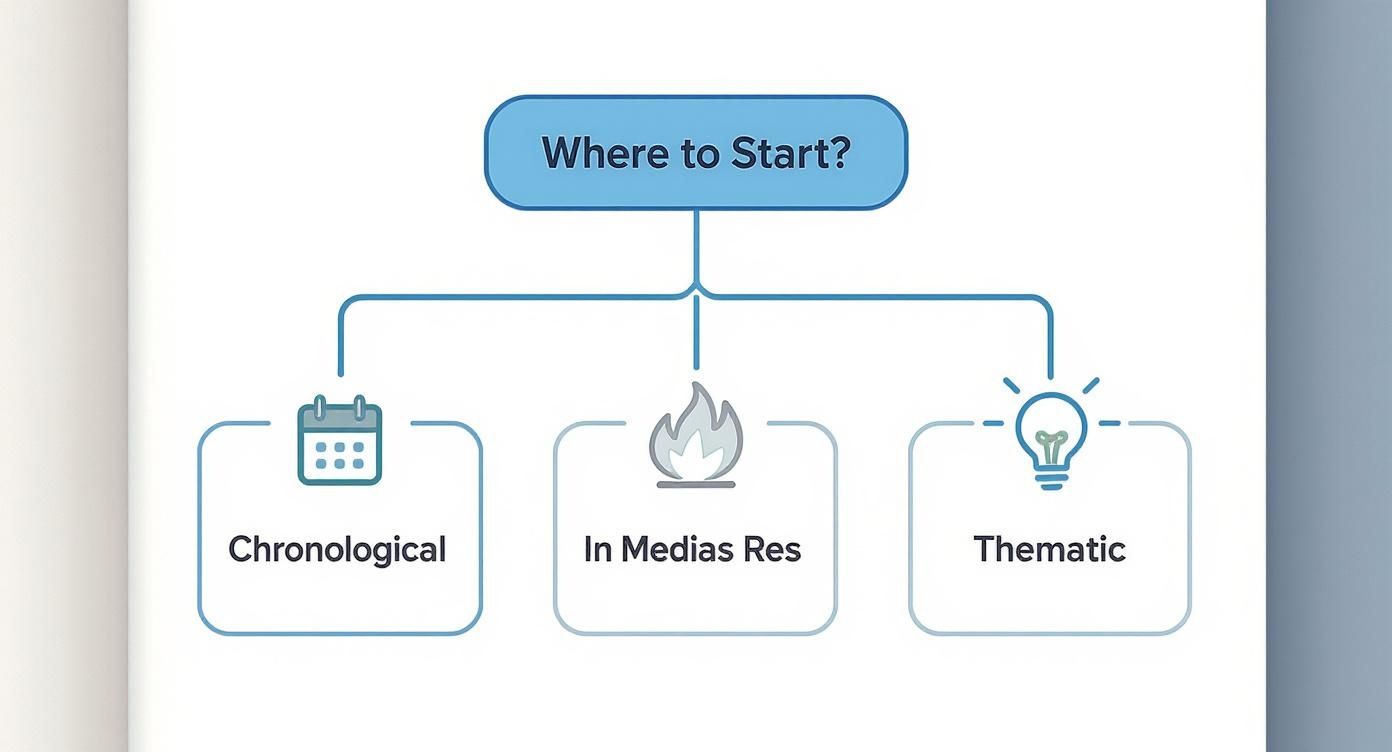
As you can see, the path you choose directly shapes the kind of hook you need to write. Are you building context slowly from the beginning, or are you dropping the reader right into the middle of the action?
The Anatomy of an Irresistible Hook
An amazing hook does more than just sound cool. It has to pull its weight by accomplishing three critical jobs right away, sometimes all in the very first sentence.
- It Establishes Voice: Your voice is the personality of your storytelling. Is it funny and sarcastic? Deeply poetic? No-nonsense and gritty? The hook is your reader's first introduction to the narrator they will be spending the whole book with.
- It Introduces Stakes: The stakes are the "so what?" of your story. Why should anyone care about what happens? A great hook hints at what can be won or, even more powerfully, what is at risk of being lost.
- It Sparks Curiosity: This is the hook's primary mission. It needs to plant a question in the reader's mind that they simply must have answered. It is the ultimate cliffhanger, just planted on page one.
Trying to nail all three at once can feel like trying to pat your head, rub your stomach, and bake a soufflé at the same time. I get it. This is exactly where working with an experienced ghostwriter can be a game changer. They have a knack for finding that core idea and polishing it until it shines so brightly no reader can look away.
From Blah to Brilliant: A Hook Makeover
Let's see this in action. Here are a couple of "before and after" examples to show how a pretty weak opening can be transformed into something magnetic.
Before:
“I had always been interested in mountain climbing. My grandfather was a climber, and he taught me a lot. One day, I decided I wanted to climb Mount Everest.”
Okay, it tells us the facts. But does it make you lean in, desperate to know more? Not really. It is the literary equivalent of lukewarm tap water.
After:
“The air at 29,000 feet is so thin it slices your lungs, but that was not what scared me. What scared me was the photo of my grandfather I had tucked in my glove, the one from his own failed Everest attempt fifty years ago.”
See the difference? We immediately get a sense of voice (determined, a bit haunted). We have high stakes (life and death, family legacy). And we have a burning question: What happened to his grandfather? Suddenly, we are invested.
Your opening line is the first domino. When it falls, it should set off a chain reaction of curiosity that makes it impossible for the reader to stop.
This is not about cheap tricks or gimmicks. It is about digging deep to find the one thing that makes your story unique and powerful, and then having the courage to put that right up front. The beginning of a story is your one shot to make a first impression. Make it count.
Building Reader Trust From Page One
https://www.youtube.com/embed/Vpd9DJLz7hA
Think of your book’s opening like a first date. You are trying to make a good impression, hoping this whole thing leads to a chapter two, and most importantly, you are trying to build a connection. The goal is not just to be flashy; it is to build trust.
That trust is the invisible thread that pulls a reader through your story. It is the feeling that they are in good hands and that you, the storyteller, are a guide they can rely on. It is an unspoken agreement between you and the reader, and it all starts on page one.
Remember, you are asking someone to give you their most valuable resource: their time and attention. That is a huge ask. Earning their trust is how you show respect for that gift.
The Foundation of a Believable World
For those of us writing memoirs, trust is built on a foundation of raw, unflinching honesty. It means showing up on the page with your vulnerabilities, your flaws, and your truth. It is not about being perfect; it is about being real. When you share a difficult memory with genuine courage, the reader feels that and leans in closer.
If you are crafting a novel, this trust is forged in the details. You have to ground the reader in your world by painting it with sensory specifics. Do not just tell me the coffee is hot; show me how the steam fogs the diner window on a chilly morning. That level of detail makes your world feel solid and lived-in.
This is not just a writing concept, either. A recent Deloitte report on marketing trends found that 73% of consumers are more likely to trust brands that are open about their process. People crave authenticity, whether they are buying a product or investing their time in a story. You can find more insights on how data-driven storytelling builds trust on blog.datahut.co.
Trust is the currency of storytelling. Your reader pays with their attention, and you repay them by delivering a story that feels honest, grounded, and worthwhile from the very first page.
Weaving in Facts to Build Authority
Here is another powerful, and often overlooked, way to build trust: weave specific, verifiable details into your narrative.
Did your story take place during a famous blizzard? Mention the actual date and snowfall total. Are you writing a business book? Kick things off with a real, surprising statistic that supports your core argument.
These small anchors of fact give your entire story a feeling of weight and authority. They signal to the reader that you have done your homework and that your story, whether fiction or memoir, is rooted in a reality they can believe in.
I know, this can feel like a lot to juggle. It is tough being the architect, the builder, and the interior designer of your own book. That is why having a professional ghostwriter on your team can be such a relief. They are experts at layering in these trust-building details, making the entire process smoother while ensuring your vision feels solid and real to the reader.
What to Do When Your Opening Just Isn’t Working
So you did it. You stared down that blinking cursor, picked a place to start, and finally wrote the beginning of your story. But now you are re-reading it, and something just feels… off. It is not bad, but it does not have that spark you were aiming for. It does not sing.
Welcome to the club. Honestly, every single writer who has ever tried to create something meaningful has felt this way. This is a totally normal, and necessary, part of the process. Think of me as your friendly story doctor, here to figure out what might be ailing your first chapter.
More often than not, a clunky beginning suffers from a few common, and totally fixable, problems. Let's run through a quick diagnostic checklist to see what is going on.
Diagnosing the Problem
If your opening feels a little flat, it is probably one of these usual suspects:
- Starting Too Early: Are you spending five pages describing your character's breakfast before the interesting stuff happens? A slow windup can bore a reader before the story even gets going. The real beginning is usually right before the first major conflict or change.
- The Infodump: This is what happens when you get so excited about your world or backstory that you unload all of it in the first few pages. It is like meeting someone at a party who immediately launches into their entire life story. It is too much, too soon.
- A Goal-less Protagonist: Does your main character (that is you, in a memoir) have a clear want or need in these opening pages? A character who is just passively watching things happen is not very compelling. We need to know what they are fighting for.
These issues are incredibly common, so do not sweat it. The good news is that just identifying the problem is half the battle. The fix usually involves some smart cutting, tightening, and refocusing on what truly matters: the core conflict.
When You're Too Close to See the Fix
Sometimes, you can stare at a page for so long that the words start to blur. You are just too close to the project to see the solution clearly. It happens to the best of us.
This is especially true with storytelling, a skill that professionals know is crucial but also tricky to master. While a staggering 92% of professionals agree storytelling is a vital business skill, nearly half (49%) feel their organizations lack those skills. You can dig into more of these numbers and what they mean by checking out the storytelling statistics on electroiq.com.
Sometimes the best solution is a fresh pair of expert eyes. A ghostwriter can see the forest when you're lost among the trees, helping you restructure that opening into something spectacular.
This is not about losing control; it is about smart collaboration. A great ghostwriter does not change your story. They help you find its most powerful form. They are the specialist you bring in when you need your book’s beginning to not just survive, but truly thrive. It makes the process easier, more fun, and the end result is still your vision, brought beautifully to life.
Common Questions About Starting Your Story
You have got questions, I have got answers, and I promise, none of them involve reorganizing your sock drawer as a procrastination tactic. Figuring out how to start a story is where all the most interesting “what ifs” and “how tos” seem to gather. Let's tackle a few of the big ones I hear all the time.
It is completely normal to feel a little unsteady here. Honestly, writing a book is a monumental act of courage. Think of these questions less as roadblocks and more as signposts guiding you down the right path.
How Long Should My First Chapter Be?
Ah, the classic "how long is a piece of string" question. The real answer? It needs to be as long as the story demands, and not a single word more. While a typical chapter might fall somewhere between 2,000 and 5,000 words, that is just a guideline, not a rule etched in stone.
My advice is to stop worrying about the word count and focus on the chapter's mission. The first chapter has a very specific job to do: introduce the character, hint at the central conflict, and absolutely hook the reader. If you can pull that off in a punchy 1,500 words, fantastic. If it takes a more detailed 4,000 words to set the scene properly, that is fine too. Just make sure you end it on a moment of tension or a question that makes turning the page feel like a necessity, not a choice.
Do I Need a Prologue?
Let me be blunt: probably not. I say this with the utmost respect, but most prologues are just backstory that got all dressed up for a party it was not actually invited to. Many readers, eager to dive into the "real" story, will just skip right over them.
A prologue is only justified if there is a critical piece of information, something that happens in a different time or from a different character's perspective, that the reader absolutely must know before they even read the first line of Chapter One.
My rule of thumb: When in doubt, leave it out. You can almost always weave that crucial backstory into the main narrative much more naturally. It is a bit more of a challenge, sure, but the result is almost always a stronger, more engaging story.
What If My Opening Isn't Original Enough?
Here is a little secret from someone who has seen it all: no story is 100% original. Every storyteller is standing on the shoulders of the ones who came before. What makes your story unique is not some plot twist the world has never seen before; it is your voice, your unique perspective, and the specific, personal details only you can provide.
Do not get hung up on trying to reinvent the wheel. Just focus on making your wheel roll in the most compelling way possible. Your truth, your sense of humor, your specific pain, that is the magic ingredient that no one else has. This is also where a skilled ghostwriter can be an incredible partner. They are experts at listening for that unique voice and making sure it sings from the very first sentence, turning a familiar idea into something that feels entirely fresh and new.
At My Book Written, we know that turning a personal vision into a beautifully written book is a profound journey. If you are ready to stop asking questions and start finding answers, we have the resources to help you bring your story to life. You can learn more about organizing your ideas and finding the perfect writing partner to build your legacy at https://mybookwritten.com.
Writing something bigger than an assignment?
If this is research for a book you actually want to exist, the match quiz will tell you what it would cost and who could help.
Read next
What will your book cost?
Set the type, length and timeline. Get a real 2026 range in 30 seconds.
Open the calculator