
Got that incredible book idea swirling around in your head? It probably feels like a beautiful, chaotic storm of thoughts, scenes, and bits of wisdom. That's not just normal, it’s the honest to goodness seed of every great book. The trick, and the honor of this whole process, is to give that beautiful storm a solid foundation to build on. That's what structure in writing is all about: creating a blueprint before you even think about laying the first brick.
Your Book Needs a Skeleton, Not a Straitjacket
Let’s be real for a moment. That idea you’re so passionate about feels precious, almost sacred. It's a blend of your unique expertise, your deepest insights, or a story that you know needs to be told. So the thought of forcing it into a rigid structure can feel like you’re caging a wild animal. It sounds restrictive, maybe even a little insulting to your creativity. It’s like being told you can’t finger paint anymore.
Plenty of writers, especially when they're just starting out, get seduced by the romantic idea of just… writing. They imagine sitting down and letting the story pour out of them in a pure, uninhibited stream of consciousness. I totally get the appeal. It sounds so free. But in my experience, that path almost always leads to a messy, tangled manuscript I lovingly call "the blob." The blob might have flashes of genius and some truly brilliant sentences, but they’re all swimming in a confusing, shapeless mess.
Moving From a Mess to a Masterpiece
Trying to revise a "blob" is one of the most soul crushing tasks a writer can face. It’s like trying to unscramble an egg while blindfolded. You’re left with 80,000 words that don’t quite hang together, a plot that loses steam halfway through, or a non-fiction argument that meanders into oblivion. This is the exact point where so many aspiring authors give up, thinking they just don’t have what it takes. It breaks my heart every time I see it.
But it’s not about talent. It’s about your process.
Structure isn't about stifling your creativity, it's about honoring it. It gives your brilliant ideas the strong container they need to truly shine and connect with a reader.
Think of it like this: you can have the most beautiful marble and the finest wood, but without an architectural plan, you just have a pile of expensive firewood. With a plan, you can build something magnificent that lasts for generations. Your book's structure is that plan. It’s what transforms your collection of amazing scenes and ideas into a cohesive, compelling book that people can’t put down.
This is exactly why working with a professional ghostwriter can be so powerful. They're master story architects. A good ghostwriter takes all your incredible raw materials, your anecdotes, data, and vision, and helps you design the perfect blueprint. You're still the creator and it's 100% your book, but you have an expert builder guiding you, making sure the foundation is solid before you start raising the walls. It makes the entire journey less frustrating and, honestly, a lot more fun. You bring the soul, they bring the scaffolding. It's a beautiful partnership.
Not sure whether you need a ghostwriter or an editor?
If you already have 30,000+ words drafted, an editor at $3,000–$12,000 will serve you better than a ghostwriter at $40,000. The quiz sorts this out in five questions — honestly, even when the answer is the smaller job.
Choosing Your Blueprint: Popular Writing Frameworks
So, you’re sold on the idea of a blueprint. Fantastic. But picking the right one can feel like walking into a massive hardware store for the first time. You're surrounded by tools you've never seen before, and it’s easy to feel overwhelmed and just want to go home. My goal is to make this simple and clear so you can grab what you need and get building.
This isn’t about forcing your unique story into a rigid box. It's about finding the right trellis for your creative vine to climb. Let's look at some of the most trusted frameworks that have served as the backbone for timeless stories and influential non-fiction books. These aren't rules, they're recipes for success.
This flowchart shows a simple path forward, whether you have a fully formed idea or are still in the brainstorming phase.
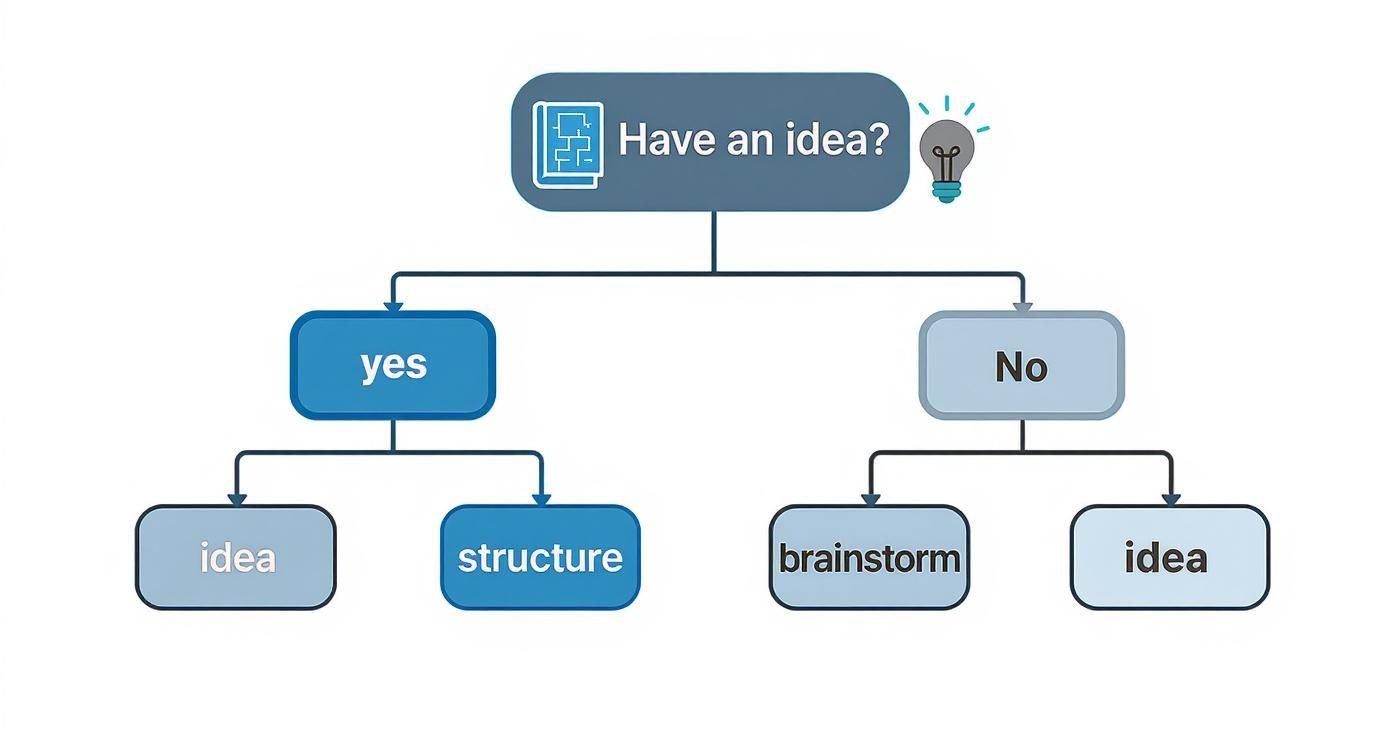
As you can see, the moment an idea takes shape, structure becomes the next critical step in turning it into a real book.
To help you decide, here’s a quick comparison of popular writing structures.
Choosing Your Writing Framework
| Framework | Best For | Key Feature |
|---|---|---|
| Three-Act Structure | Most fiction, especially screenplays and character dramas. | A clear beginning, middle, and end that builds tension toward a climax. |
| The Hero's Journey | Epic adventures, fantasy, and personal transformation stories. | A circular path where the hero leaves home, faces trials, and returns changed. |
| The Fichtean Curve | Thrillers, mysteries, and fast-paced novels. | Drops the reader straight into the action, with rising conflict from page one. |
| Problem-Agitate-Solution | Business, self-help, and persuasive non-fiction. | Identifies a reader's pain point and presents your unique solution. |
| Chronological Approach | Memoirs, histories, and step-by-step guides. | Presents events or instructions in a clear, sequential order. |
Think of this table as a starting point. Your book might even blend elements from a few different frameworks, and that's perfectly fine. Books are complex, just like people.
Frameworks for Fiction Writers
If you're weaving a tale from scratch, these classic structures offer a powerful guide to keep your reader hooked from the first page to the last. They're like guardrails on a winding mountain road, keeping you from driving off a cliff.
-
The Three-Act Structure: This is the bread and butter of storytelling for a reason. It's so good, it's practically baked into our DNA. Think of it as a play with a clear beginning, middle, and end. Act I sets up the world and kicks off the main conflict. Act II is where your protagonist faces escalating challenges. Act III delivers the climax and resolution. It’s simple, effective, and works for everything from blockbuster movies to intimate character dramas.
-
The Hero’s Journey: Made famous by Joseph Campbell, this framework is tailor made for epic adventures or profound personal transformations. It follows a protagonist who leaves their ordinary world, faces a series of trials, achieves a great victory, and returns home changed. Think Star Wars or The Lord of the Rings. It’s a deeply human pattern that resonates with readers on an almost primal level.
-
The Fichtean Curve: Want to grab your reader by the collar and not let go? This is your framework. It drops the audience right into the action, no messing around. The story opens with rising conflict, builds to a climax around the halfway point, and then the second half deals with the fallout and resolution. It's fantastic for thrillers or mysteries.
Choosing the right one often comes down to the kind of story you want to tell. Are you carefully building a world, or are you throwing your hero straight into a crisis? The answer will usually point you toward the right blueprint.
Frameworks for Non-Fiction Authors
For those of you sharing hard earned wisdom or a personal story, structure is just as critical. It’s what transforms a collection of facts or memories into a compelling, persuasive narrative that holds a reader's attention. Without it, you're just yelling facts into the wind.
A great non-fiction structure guides your reader on a journey of understanding. It makes complex ideas feel clear, logical, and inevitable, the ultimate sign of respect for their time.
The demand for well organized writing is massive. The global essay writing service market, for instance, was valued at USD 1.97 billion in 2023 and is projected to more than double by 2032. This trend is driven by a simple truth: clear, logical structure is the key to effective communication. You can find more insights on this market growth over at DataIntelo.
Here are a couple of go to frameworks for non-fiction:
-
Problem-Agitate-Solution: This is a powerhouse for business or self help books. You start by identifying a pain point your reader experiences (Problem). Then you dive into why that problem is so frustrating, costly, or painful (Agitate). Finally, you present your unique method for fixing it (Solution). It’s incredibly persuasive because it mirrors how we naturally make decisions.
-
Chronological Approach: This is the most straightforward framework, perfect for memoirs, histories, or how to guides that need to follow a sequence. You simply tell the story or explain the process from beginning to end. Its power lies in its simplicity and clarity, allowing the reader to follow along without any confusion.
Feeling stuck between options? That’s completely normal. This is often where a ghostwriter becomes an invaluable partner. They have an expert eye for seeing which structure will best serve your unique message, ensuring your book has the strong, elegant bones it needs to stand the test of time. They're like a structural engineer for your soul's work.
From Big Ideas to Organized Chapters
You picked your blueprint. That is a huge, huge win, so please take a moment to celebrate it. Seriously. Get a cookie. This is the moment when that beautiful, chaotic cloud of your idea starts to take on a real, tangible shape. We're moving from architectural dreams to actually framing the rooms of your book. This is where we map out your chapters.

This part of creating structure in writing can feel both thrilling and a little terrifying. It’s the point where you have to start making decisions, corralling all those free roaming ideas into specific paddocks. But I promise, there’s a way to make it feel more like a creative game than a chore.
The Sticky Note Storyboard
Let's get practical. I want you to grab a big pack of colorful sticky notes and a pen. I'm not kidding, go do it. If you’re more of a digital person, open up a new spreadsheet or a mind mapping tool like Miro or Mural. The goal right now isn’t perfection. It’s a brain dump.
On each individual sticky note, write down one single thing that needs to be in your book. Just one. This could be anything:
- A specific scene you’ve imagined for your novel.
- A key argument you need to make in your business book.
- A poignant memory for your memoir.
- A crucial piece of data or a specific tip for your how to guide.
Don't judge them. Don't organize them yet. Just get them all out of your head and onto the notes. Your wall or your screen should look like a beautiful, disorganized mosaic of your brilliance. This is the raw material, the clay you’re about to shape.
This process isn’t about being tidy. It's about externalizing your thoughts so you can see them, touch them, and move them around. You can’t organize a storm when it’s still inside your head.
Once you feel like you've captured everything, step back and just look at it all. It’s messy, right? Good. Now, we play a little game of literary Tetris.
Finding Your Chapter Clusters
Start looking for notes that feel like they belong together. Think of it like sorting laundry. You’re not folding anything yet, just putting all the socks in one pile and all the shirts in another.
Are there a bunch of notes that all relate to your protagonist’s childhood? Group them. Do several notes tackle the financial mistakes people make in their twenties? Cluster them. You’ll start to see natural groupings emerge from the chaos.
These clusters are your proto chapters. They are the foundational themes or chronological blocks that will form the main sections of your book. For a non-fiction book, this might look like grouping all the notes about "Mindset" in one corner and all the notes about "Practical Tools" in another. Don't worry about the exact order just yet. Just focus on creating logical piles.
This visual method is incredibly powerful because it gets you out of the linear, word by word mindset. You’re thinking architecturally, seeing the bigger picture.
As you group your notes, you'll also notice gaps. You might see a cluster about a problem but realize you don't have any notes about the solution. That’s fantastic! This process reveals what’s missing before you’ve written a single paragraph, saving you from a massive headache later on.
I’ll be honest, this can be an intense process. It's deeply creative but also analytical, and holding both of those in your head at once is tough. This is a point where a professional ghostwriter is worth their weight in gold. They are masters at seeing the patterns in your ideas and helping you cluster them into a compelling map that honors your vision. They don't just write; they build. A ghostwriter from a service like My Book Written can be the collaborator who helps you turn that beautiful mess of sticky notes into the elegant structure your book deserves.
The Magic of a Scene-by-Scene Outline
Alright, let's zoom in. We’ve got our big picture chapter map, our beautiful, colorful sticky notes clustered on the wall. If that was the floor plan for your dream home, this next part is deciding exactly where all the furniture goes.
We're about to get granular. And honestly? This is my absolute favorite weapon against the dreaded blinking cursor of doom.

This is the micro level of structure in writing, where we break every single chapter down into its essential parts. For novelists, we call these "scenes." For non-fiction authors, they're more like "sections" or "points." Whatever you label them, they are the individual heartbeats of your book.
I can hear you now: "Isn't this overkill? Can't I just… start writing the chapter?" Sure, you could. But trust me on this. Answering a few simple questions for each scene before you write will save you an unbelievable amount of time and heartache down the road. It's like prepping your ingredients before you start cooking. It makes everything go so much smoother.
Asking the Right Questions
For every scene in your novel or section in your non-fiction book, just grab an index card (or open a new doc) and jot down the answers to these questions. Keep it brief. A sentence or two for each is all you need.
- What's the core purpose? Seriously, why does this scene exist? Is it introducing a character, revealing a clue, or teaching a key concept? If you can't nail its purpose in one sentence, it might be a sign that the scene doesn't belong.
- What's the one key takeaway? What single thing must the reader absolutely know, feel, or understand by the end? In a story, this might be, "Jane now suspects her husband is lying." For a business book, it could be, "Annual budgeting is the first step to financial freedom."
- Who is in the room (and what do they want)? This is literal for fiction. Who’s there, and what is their goal? For non-fiction, think of it as, "What opposing ideas or concepts are in play here?"
- What's the emotional note? How should the reader feel when they finish this part? Tense? Hopeful? Inspired? Confused? This single decision will guide your tone and word choice more than you can imagine.
Answering these turns a vague idea like "Chapter 5: The Big Argument" into a concrete, writeable roadmap. You're no longer staring at a blank page; you’re just connecting the dots you’ve already laid out for yourself.
A Simple Template for Sanity
Let's make this even more practical. Here’s a super simple template you can copy and paste for every single scene or section.
Fiction Scene Template:
- Chapter: 5
- Scene Number: 2
- Purpose: Show the first major crack in John and Sarah’s marriage.
- Key Takeaway: Sarah realizes John has been hiding his financial problems.
- Characters & Goals: Sarah wants to plan a vacation (connection); John wants to avoid talking about money (concealment).
- Ending Emotional Note: Shock and betrayal.
Non-Fiction Section Template:
- Chapter: 3 – The Foundations of Healthy Eating
- Section: Calorie Deficits Explained
- Purpose: To demystify the concept of a calorie deficit for weight loss.
- Key Takeaway: You must burn more calories than you consume to lose weight.
- Concepts in Play: Energy in (food) vs. Energy out (metabolism/exercise).
- Ending Emotional Note: Clarity and empowerment.
See how that transforms things? You’ve given yourself a clear assignment. It’s no longer about writing an entire book; it’s just about writing this one scene.
I cannot overstate this: the scene-by-scene outline is the antidote to writer's block. It breaks an overwhelming project into small, manageable, and achievable chunks. It's an act of kindness to your future self.
Even the pros are using every tool they can to make this easier. The rise of AI, for example, is changing how writers approach structure. As of 2025, a striking 71.7% of professional content marketers use AI tools for outlining and building these exact kinds of frameworks. It just shows how crucial a solid plan really is. You can learn more about the fascinating rise of AI writing assistants and how they support this foundational work.
When the Details Feel Draining
Let me be honest with you. This level of detail work can feel tedious. It’s not as exciting as dreaming up the big idea, and it’s not as immediately rewarding as crafting that perfect sentence. It’s the architectural work, the plumbing and wiring of your book.
This is the exact spot where so many brilliant, passionate people get stuck. The jump from the big picture chapter map to the nitty gritty scene list is where the sheer scale of the project can suddenly feel crushing.
And this, my friend, is where a professional ghostwriter truly shines. They are masters of this process. You can hand them your beautiful collection of sticky notes, and they will meticulously build this detailed, write ready outline. They live for this stuff. They’ll ask you clarifying questions, ensure every scene serves your core message, and deliver a blueprint so perfect that the writing itself feels almost effortless.
It’s still your vision, your story, your name on the cover. You just have an expert architect making sure every single room is perfectly designed before the building begins.
You Don't Have to Build This Alone
Let's just pause for a second. Take a deep breath.
What you're trying to do, create a book that will hold your ideas and your story forever, is an incredible goal. It’s an act of courage and generosity. It is also profoundly difficult. Bringing a book into the world is an act of creation, and like any creation, it’s messy and hard and beautiful.
Juggling that brilliant, expansive vision with the meticulous, architectural work of creating a solid structure in writing is exhausting. I’ve seen it time and time again. This is often where the energy fades and a project stalls out, not because the idea isn't good enough, but because the technical work is just so demanding.
I need you to hear this loud and clear: it is okay to ask for help. You do not have to build this beautiful, complex thing all by yourself.
A Collaborator, Not a Shortcut
Hiring a professional ghostwriter isn't cheating. It's not admitting defeat. It's one of the smartest, most strategic collaborations you can make on your journey to becoming a published author. It's like having a co-pilot on a long flight.
Think of it this way: when you decide to build a dream home, you don’t go out and learn how to pour concrete and frame walls yourself. You hire an expert architect.
You bring them your vision, your scrapbook of ideas, your "must haves," and your heartfelt desires for how the space should feel. They listen, they understand, and then they apply their expertise to create a flawless blueprint. That is exactly what a good ghostwriter does for your book.
They take your stories, your expertise, and your unique voice, and they handle the heavy lifting of structure, outlining, and drafting. They are the expert builders who make sure the foundation is solid, the walls are straight, and the final creation is something that will stand the test of time.
Still Your Book, Still Your Voice
Make no mistake, you are still the author. It’s your name on the cover and your ideas filling every page. A great ghostwriter's job is not to tell their own story, but to bring yours to life with professional skill and precision.
A partnership with a ghostwriter ensures your book gets the expert structural support it deserves, making the journey from idea to finished manuscript easier, more fun, and ultimately, more successful.
The demand for this kind of expert collaboration is growing for a reason. The global content writing services market, which is built on creating well structured content, was valued at USD 22.63 billion in 2025 and is expected to climb to USD 35.63 billion by 2032. North America alone holds over 40% of this market, which shows just how much people and businesses value expert help. You can read more about these insights on the content services market and see the power of professional support.
Your book, your legacy, deserves that same level of expert care. You bring the heart and the vision. Let a professional bring the blueprint and the tools.
Common Questions About Structuring Your Book
Okay, let's get real for a minute. We've talked a lot about blueprints and outlines, but I'm willing to bet you have a few "what if" scenarios rattling around in your head. That's perfectly normal. Writing a book isn't a straight shot down the interstate; it's more like a winding country road with plenty of unexpected detours.
It takes a lot of guts to decide your story is worth telling, and it's an incredible feeling to create something that will outlive you. So let's tackle some of those nagging questions so you can move forward with the confidence your project deserves.
Can My Writing Structure Be Flexible?
Absolutely. One hundred percent. Please, think of your structure as a roadmap, not a straitjacket.
A friend of mine was writing a memoir about his time as a chef. He planned it all out chronologically, from his first disastrous soufflé to his big break. But halfway through, he hit a wall. He realized the real story wasn't the timeline, it was about the lessons each kitchen catastrophe taught him. He called me in a panic, "I've structured myself into a corner!"
He initially panicked, thinking he’d have to scrap everything. But he didn't. Because he had a solid structure, all his "pieces" were laid out clearly. He just rearranged them thematically. The book became ten times more powerful.
That’s the beauty of a good blueprint. It's a living document. As you write, you’ll discover new ideas, or a character might do something that totally surprises you. Having a strong structure in writing actually makes it easier to adapt because you can see exactly how a change in Chapter 3 might ripple out to Chapter 9.
Without a structure, a small change feels like pulling a Jenga block from the bottom of the tower. With one, it just feels like you’re redecorating a room.
So yes, be gloriously flexible. Just remember to come back to your blueprint to make sure your detours are making the whole house stronger.
What if I Realize I Chose the Wrong Structure?
First things first: take a deep breath. This isn't a catastrophe. It's a discovery, and it means you’ve learned something profound about the story you’re trying to tell. This happens way more often than people admit. Think of it as a rite of passage, not a failure.
Let's say you started a business book using a chronological approach, detailing your company's history. But as you get into the writing, you realize the most compelling parts are the failures, the hard earned lessons, and the comeback moments. The real energy isn't in "what happened" but in "what we learned."
This is your cue to step away from the manuscript for a day or two. Go back to your sticky notes, your whiteboard, your big ideas. You’ll probably find you don't need to throw everything out. You just need to re-cluster those stories and insights into a new framework, maybe something like the "Problem-Agitate-Solution" model.
I know it can feel like a major setback, but it’s actually a giant leap toward clarity. This is also where a ghostwriter can be an absolute lifesaver. They bring a calm, expert eye and can help you re break the story into a stronger framework without you losing all your momentum and succumbing to despair. They offer the perspective you need when you're just too close to see the path forward.
How Detailed Should My Outline Be Before I Start Writing?
Ah, the classic "plotter versus pantser" debate. Honestly, the right answer is whatever keeps you writing. Some writers, the "plotters," need a hyper detailed, scene by scene map of every conversation. Others, the "pantsers" (who write by the seat of their pants), just need a few major signposts to guide them.
My advice? Aim for a happy medium. Know enough to get started, but leave enough room for a little magic to happen on the page.
- Start with a clear, one sentence purpose for each chapter.
- Then, for each chapter, jot down 3 to 5 bullet points covering the key events (for fiction) or main arguments (for non-fiction).
This gives you a clear sense of direction for each writing session without being so rigid that it strangles your creativity. It’s enough detail to keep writer's block at bay but leaves plenty of space for you to discover things as you go.
If you’re really unsure, I suggest starting with a more detailed outline. It is always easier to deviate from a plan than it is to create a plan from chaos. And if building that plan feels like the one thing stopping you from actually writing, remember you don't have to do it alone. It's why professionals exist, to take that big, messy, brilliant idea of yours and give it the elegant bones it needs to stand tall.
Bringing a book into the world is a remarkable journey, and you don’t have to navigate it by yourself. At My Book Written, we provide the resources and clarity you need to organize your thoughts and prepare for a successful collaboration with a professional writer. We’re here to help you build the perfect foundation for your legacy. Start exploring your path to becoming an author with our guides at mybookwritten.com.
Writing something bigger than an assignment?
If this is research for a book you actually want to exist, the match quiz will tell you what it would cost and who could help.
Read next
What will your book cost?
Set the type, length and timeline. Get a real 2026 range in 30 seconds.
Open the calculator