
A business memoir is so much more than a simple timeline of your career. It’s a story. One that weaves together your professional journey, the tough personal lessons learned along the way, and the core principles that guided you, all designed to inspire and teach others.
Your Story Deserves More Than a LinkedIn Post
Let’s be honest. The thought of writing a book, a real, hold it in your hands business memoir, feels massive. It’s equal parts thrilling ambition and sheer terror. You’ve spent years, maybe even decades, pouring everything you have into building something from scratch. You’ve stared down payroll, celebrated those impossible, against all odds wins, and learned lessons so hard they’re practically etched into your soul.
That story, your story, is a monumental thing. It deserves far more than a fleeting, 280 character update or a polished LinkedIn post that disappears into the endless scroll. It deserves the permanence and gravity of a book. A legacy. Something you can pass down to your kids.
So, consider this your official permission slip to take that nagging idea seriously. Right now, more than ever, people are craving genuine connection. They don't just want to know what you built; they want to hear the why and the how. They want to see the real human being behind the CEO title.
From Big Idea to Lasting Legacy
Thinking about this isn't just an ego trip. It's about honoring the sweat, the failures, and the triumphs in a way that can genuinely help someone else on their own path. Your story has the power to become a mentor for people you'll never even meet. It’s about turning your hard won experience into wisdom that lasts.
The process itself is a powerful one, taking a fleeting thought and turning it into a permanent piece of your history.
This flow chart really captures that journey from a private idea to a public legacy.
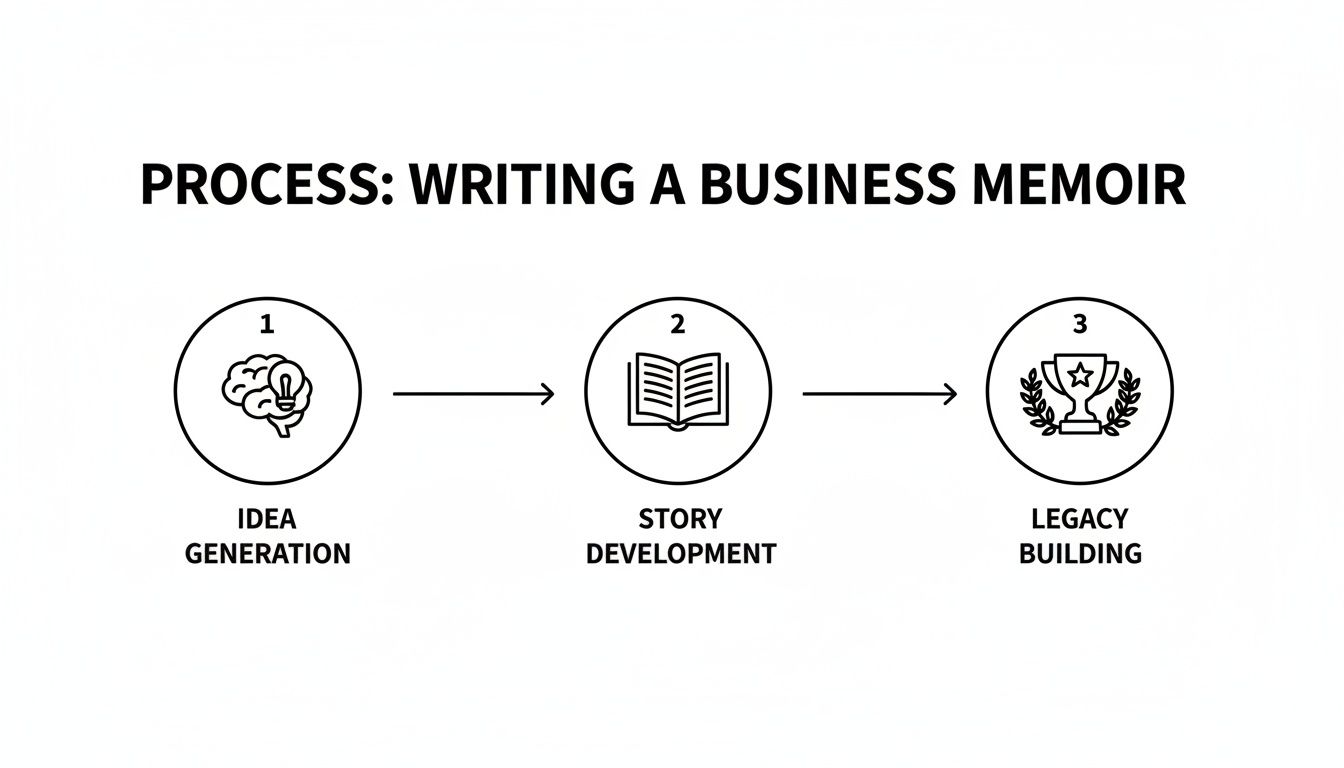
It’s a simple but powerful reminder: every great book begins with that single spark of an idea, which is then carefully crafted into a story that ultimately builds a legacy.
Getting Past the “Who Cares?” Hurdle
Almost every single person who even thinks about writing their story hits the same wall. It’s that quiet, nagging little voice whispering, "Who would possibly want to read about my life?" That fear is universal, and it’s the number one reason so many incredible stories are never told.
Here’s the secret, though. People don't read memoirs just because the author is famous. They read them because the story is relatable. They’re looking to see their own struggles, hopes, and questions reflected in someone else's journey.
Your story about nearly going bankrupt right before landing that one game changing client? That’s not just a business anecdote; it’s a universal lesson in resilience. That time you had to fire your best friend? That’s a gut wrenching lesson in leadership that countless others are facing right this minute.
Your value isn’t in having a flawless, perfect journey. It's in your willingness to share the messy, imperfect, and incredibly human parts of it. That’s where the real connection happens.
You don't have to go on this mission alone, either. The thought of wrestling decades of memories onto a blank page is enough to make anyone want to go take a long nap. That's why so many brilliant leaders bring in a co pilot. Working with a professional ghostwriter isn't cheating, it's just smart. They are experts at pulling that golden thread from your experiences and weaving it into a narrative that sings. It’s still your voice, your vision, and your legacy. You just get to have more fun and way less stress bringing it to life.
Not sure whether you need a ghostwriter or an editor?
If you already have 30,000+ words drafted, an editor at $3,000–$12,000 will serve you better than a ghostwriter at $40,000. The quiz sorts this out in five questions — honestly, even when the answer is the smaller job.
Finding the Golden Thread in Your Business Journey

If you're worried your business story is just a dry chronology of product launches, quarterly reports, and board meetings, I’ve got good news. A powerful business memoir isn't a textbook. Frankly, that would be a world class snooze fest.
The best ones have what I call a “golden thread,” a central theme that weaves through every high and low, tying it all together into a story that feels… well, human. It’s what transforms your career history from a simple timeline into a compelling narrative that people actually want to read.
Think about it. Phil Knight’s Shoe Dog isn’t just about the logistics of selling sneakers. It’s a raw, honest story about the messy, chaotic, and often terrifying reality of building a global brand from the trunk of a car. That’s a golden thread.
Uncovering Your Central Theme
So, what's your golden thread? Is your story a tale of overcoming impossible odds, a classic David versus a Goliath industry? Or maybe it’s a quieter story about the profound loneliness of leadership and the personal sacrifices that nobody ever sees.
It’s easy to get stuck here, so I’ve put together a few prompts to help you dig in and discover the central idea that will make your story resonate with readers.
| Finding Your Memoir's Angle |
| :— | :— | :— |
| Theme Type | Core Question to Ask Yourself | Example Angle |
| The Underdog Story | What massive, established competitor did everyone think would crush you? | How a small startup with $10,000 in funding took on a billion-dollar giant and won. |
| The Redemption Arc | What was your biggest professional failure, and how did it lead to your greatest success? | The story of a failed product launch that taught me everything I needed to know about my customers. |
| The Accidental Innovator | What problem were you trying to solve that led to an unexpected, groundbreaking discovery? | I was just trying to build a better spreadsheet for my team. I had no idea I was creating an industry. |
| The Mission-Driven Leader | What core belief or purpose drove you, even when profits were low and morale was shaky? | Why we turned down a massive buyout to protect our company culture and mission. |
Don't panic if an answer doesn't immediately pop into your head. This isn't a pop quiz. Finding your theme is more like panning for gold in the river of your own experience, it takes a bit of quiet reflection.
Panning for Narrative Gold
Let's get practical. Grab a notebook or open a fresh document and just start brainstorming. Don’t censor yourself. The goal here is to identify the moments that carried the most emotional weight, not the ones that look best on a resume.
Here are a few questions I give my clients to get the ball rolling:
- What was the single moment you felt most alive or most terrified in your career?
- Which decision still keeps you up at night, and what did you learn from it?
- When did you feel like giving up entirely, and what, or who, made you keep going?
These moments, the peaks and the valleys, are where your golden thread is hiding. They are the turning points where your character was forged and your true business philosophy was born. It’s in these authentic stories that readers will see themselves.
The most powerful business memoirs aren't about having all the answers. They're about being honest about the questions, the struggles, and the journey to find clarity.
As you map out these key moments, a pattern will start to emerge. You’ll see that the time you bet the whole company on an unproven idea connects to that early lesson your mentor taught you about trusting your gut. Suddenly, you have a theme. For more detailed guidance, learning how to write a memoir outline can provide a fantastic framework for organizing these thoughts.
The moment you find that thread, everything changes. You’ll know exactly which stories to include and, just as importantly, which ones to leave on the cutting room floor because they don’t serve the central narrative. This process is where a skilled ghostwriter can be an invaluable partner. They have a knack for spotting the patterns you’re too close to see, helping you find that narrative gold a whole lot faster. They are, in a way, your professional prospector.
Structuring Your Story for Maximum Impact

So, you’ve found your golden thread. You’ve sifted through your experiences and pinpointed the core theme that makes your story truly yours. That’s a huge win, and you should take a moment to celebrate it.
Now for the part that trips up so many aspiring authors: How do you actually weave that thread into a book that people can't put down?
This is where the dream of writing a book often gets stuck in the mud. Staring at decades of memories and trying to wrestle them into neat chapters can feel less like a creative act and more like herding cats. But I promise, it doesn't have to be a nightmare. In fact, this can be one of the most rewarding parts of the entire journey.
Think of it less like rigid architecture and more like building with LEGOs. You have all these incredible, colorful pieces from your life. Now, you just need a sturdy base to build upon.
Beyond the Boring Timeline
The first instinct for most people is to start at the beginning. "I was born, then I went to school, then I got my first job…" While that might be technically accurate, it’s often a one way ticket to Snoozeville for your reader.
A truly great business memoir rarely follows a strict chronological path. Why? Because your most powerful lesson might have happened just last year, and burying it in the final chapter is a massive missed opportunity. Instead, let's explore a few more dynamic ways to structure your story. Having a strong structure in writing is what will guide your readers and keep them hooked.
Consider these powerful alternatives:
- The Thematic Approach: Forget chapters like "1998" and "1999." Think in terms of big ideas. You could have a chapter on "Resilience," one on "Leadership," and another on "Innovation." Each chapter then pulls stories from different times in your life to bring that single, powerful theme to life.
- Pivotal Moments: Structure your entire book around the 5-7 most critical turning points in your career. Each chapter unpacks one of these moments, exploring the lead up, the decision itself, and the fallout. It’s like a highlight reel of your most formative experiences.
- Reverse Chronology: This can be incredibly effective. You start with your biggest success, a moment of triumph. Then, you work backward to show the reader the long, winding, and often messy path you took to get there.
The goal of your book's structure isn't just to present facts in order. It's to create an emotional journey for the reader, building momentum and delivering satisfying insights along the way.
Building Your Chapter Arcs
Once you have your big picture structure, you can zoom in on the individual chapters. Think of each chapter as its own mini story, complete with a satisfying beginning, middle, and end. It should grab the reader, present a challenge or a lesson, and then resolve it in a way that feels earned.
A simple way to do this is to ask yourself, "What's the one thing I want the reader to take away from this chapter?" Every story and every anecdote you include should serve that one core message. If it doesn't, it might belong somewhere else, or, as tough as it is to hear, it might not belong in the book at all.
This is another one of those moments where having a co pilot, like a professional ghostwriter, is worth its weight in gold. They are masters of structure. They can look at your collection of stories and instantly see the most powerful way to arrange them. (For more on this, you might find our guide on the essentials of structure in writing really helpful.) They help you build that LEGO masterpiece without you having to read the confusing instruction manual a hundred times. It’s still your vision, just brought to life with an expert's touch.
When Your Story Needs a Co-Pilot
Here’s a little secret nobody likes to say out loud in the hustle and grind world of entrepreneurship: having an incredible story and being a fantastic writer are two completely different skill sets.
It’s like being a world class chef versus being a brilliant food critic. Both are masters of their craft, both live and breathe food, but their talents are totally unique.
So many of the most brilliant leaders I’ve ever met completely freeze when they stare at a blank page. The sheer effort of trying to translate decades of gut feelings, tough calls, and hard earned wisdom into thousands of compelling words is, frankly, paralyzing. You have a business to run, a team to lead, a life to live.
This is the exact point where so many incredible book ideas go to die a quiet death in a forgotten Google Doc. And that's a tragedy, because your story deserves to be told.
The Difference Between Author and Storyteller
You are the storyteller. Simple as that. You hold the memories, the lessons, and the heart of the journey. The writer, or in this case, the ghostwriter, is the skilled artisan who helps you carve that story into its final, beautiful form.
Think of it this way: you wouldn't perform your own root canal just because you have teeth, right? (If you would, we need to have a separate conversation.) Bringing in a professional to handle the complex parts isn't a sign of weakness; it’s a sign of wisdom.
A great ghostwriter doesn't just take over your story. They do something much more magical.
- They become your interviewer, asking the right questions to pull out memories you didn’t even know were still there.
- They act as your architect, helping you structure your narrative for maximum emotional impact and flow.
- They serve as your translator, taking your spoken words, your passion, and your unique voice, and capturing it perfectly on the page.
It's a genuine partnership. The final book is still 100% your vision, your voice, and your legacy. You just get to skip the part where you spend three years wanting to throw your laptop out the window. It’s a true win win.
Making the Dream a Reality
The stakes for a great business memoir are surprisingly high. In the competitive world of publishing, these stories can be powerhouse performers. A book like Rich Dad Poor Dad has sold over 44 million copies by packaging business wisdom in a deeply personal, memoir style format.
But here’s the reality check: only a tiny fraction of books, about 0.01%, ever sell more than 100,000 copies. To stand out, the writing has to be exceptional. You can dig into more publishing statistics and what they mean for authors in this detailed industry overview.
This is where finding the right partner becomes absolutely crucial. For a busy leader, a service that specializes in this exact kind of collaboration can be a game changer.
This screenshot from Opus Eternal’s site gets right to the heart of it. The focus is on turning a vision into a legacy, emphasizing a partnership that honors the author's story efficiently and professionally.
Your job is to live an incredible story. A ghostwriter's job is to help you tell it. Let people do what they do best.
Traditionally, hiring a top tier ghostwriter from an agency could set you back a small fortune. Thankfully, that's changing. Services like Opus Eternal are making expert, premium quality ghostwriting remarkably accessible. They’ve figured out a process that often costs less than half of what traditional agencies charge, all without sacrificing an ounce of quality.
They specialize in helping you bring your book to life, making the entire process easier, more fun, and entirely focused on your legacy.
Finding a Ghostwriter You Actually Trust

Alright, so you're sold on the idea. Having a co pilot for your business memoir is starting to sound like a brilliant move. Fantastic! But now for the million dollar question: How on earth do you find "the one"?
Let's be honest, this step can feel like navigating a minefield. It's a bit like high stakes online dating, except instead of trusting someone with your heart for an evening, you're trusting them with your entire professional legacy. No pressure, right?
You’re not just hiring a contractor; you’re inviting someone into the most personal corners of your life's work. The goal here is to find a partner who feels less like a vendor and more like a trusted confidant.
Where to Look for Your Perfect Match
Finding a truly great ghostwriter isn't as simple as a random Google search. You need to know where the real pros, the ones who understand the subtle art of storytelling, actually hang out.
Here are a few places to start your search:
- Professional Platforms: Sites like Upwork or the Gotham Ghostwriters network are good starting points. They have huge directories of vetted writers, letting you see portfolios, read client reviews, and get a feel for their style right away.
- Good Old Fashioned Referrals: This is the gold standard, period. Ask entrepreneurs or leaders in your circle who have already published books. A warm introduction from someone you trust is invaluable.
- Specialized Ghostwriting Services: Some companies focus specifically on ghostwriting for executives and entrepreneurs. The beauty here is that they've already done the heavy lifting of vetting for you. They can match you with a writer who fits your specific industry, style, and personality. Services like Opus Eternal offer a premium, curated experience that can be surprisingly accessible.
The recent explosion in celebrity business memoirs is proof of concept. Personal stories from high profile leaders are achieving massive commercial success, showing that vulnerability, when tied to triumph, really connects with readers. However, trying to craft that narrative alone is a brutal challenge, where just managing your time and keeping ideas straight can derail the entire project. You can read more about the incredible sales figures of bestselling memoirs.
What to Look for Beyond Good Grammar
Once you've got a shortlist of candidates, it's time to really dig in. A great ghostwriter is so much more than a wordsmith. Honestly, anyone can string together a grammatically correct sentence, you need a true storyteller.
When you review their portfolio, don't just scan for typos. Look deeper for these qualities:
- Voice Matching: Can they adapt their style? Read a few different samples of their work. If every piece sounds exactly the same, that’s a red flag. You want a chameleon who can capture your unique voice, not just stamp their own on it.
- Emotional Depth: Does their writing make you feel something? A good business memoir isn't a dry report; it's driven by emotion. Look for work that shows they can convey tension, joy, frustration, and triumph.
- Narrative Structure: Can they actually tell a compelling story? Pay close attention to how they organize information. The best writers can take a jumble of events and weave them into a gripping narrative with a clear beginning, middle, and end.
Finding the right ghostwriter is an act of trust. You're searching for someone who can not only write well but also listen deeply and honor the soul of your story.
The All Important Interview
This is where you find out if the chemistry is there. The interview is your chance to get past the portfolio and connect with the human being who will be handling your legacy. Don't be shy here, ask the tough questions.
Here’s a quick checklist to get you started:
- "How do you approach capturing a client's unique voice and personality?"
- "Can you walk me through your typical process, from our initial interviews to the final draft?"
- "How have you handled creative differences or disagreements with a client in the past?"
- "What part of my story or project excites you the most?"
Listen carefully to their answers. You’re looking for someone who is curious, empathetic, and seems genuinely invested in your story, not just the paycheck. If you want more in depth advice on finding the perfect collaborator, you can learn a lot by exploring the role of a professional business book ghostwriter.
Remember, you're not just hiring a pair of hands; you're choosing a partner for one of the most important projects of your life. Take your time, trust your gut, and find someone who just gets it.
Common Questions About Writing Your Memoir
Thinking about writing a business memoir is a lot like standing at the base of a mountain you're about to climb. It’s exciting, a little intimidating, and you’ve definitely got questions. That’s not just normal, it’s a great sign. It means you’re taking this seriously.
We talk to founders and leaders every day who are right where you are. Let's tackle some of the most common questions we hear, so you can start your journey with a clear path forward.
How Is a Business Memoir Different From an Autobiography?
This is a fantastic question because the distinction is everything.
An autobiography is the full, sprawling epic of your life. It’s the A to Z story, covering everything from your childhood lemonade stand to last quarter’s board meeting.
A business memoir is much more focused. Think of it as a specific, compelling season of a great TV show, not the entire box set. It uses your life and career as a lens to explore a central theme, a core philosophy, or a set of hard won lessons. While your personal stories are the heart of it, every single one serves that bigger narrative.
It’s less about “everything that ever happened to me” and more about “here’s the story of how my unique experiences built this business, and here’s what you can take away from it.”
Do I Need to Be Famous to Write a Business Memoir?
Let’s clear this up right now: absolutely not. This is probably the single biggest myth that keeps incredible, valuable stories from ever being told.
Some of the most impactful memoirs I’ve seen have come from entrepreneurs who built a small but mighty company, navigated a wild niche industry, or overcame a personal battle that completely redefined their leadership style. The value of your story isn't measured in your follower count or annual revenue. It’s measured in its honesty, its relatability, and the genuine wisdom you're willing to share.
A raw, compelling story about failure and resilience from a small startup founder is often far more useful to a reader than a polished, PR-approved history of a Fortune 500 giant.
What If I’m Worried About Sharing My Failures?
This is a huge, and completely valid, concern. The truth is, vulnerability is what gives a memoir its power. But here’s the most important part: you are always in control of the narrative.
The trick is to frame your failures around the lessons learned. It's not about dwelling on the mistakes themselves, but on how they became non negotiable stepping stones in your growth. You decide where the boundaries are drawn.
The goal isn't to air your dirty laundry; it's to be authentic. A great ghostwriter is a master at helping you find that perfect balance between refreshing candor and professional discretion.
How Long Does It Actually Take to Write a Memoir?
It’s probably faster than you think, especially when you have a partner to guide you.
For a standard length book of about 50,000 to 70,000 words, a professional ghostwriting project typically takes between six and twelve months. That timeline covers everything from the initial interviews and outlining to the full drafting and revision process.
The single biggest variable? Your availability for interviews and providing feedback. And, of course, that old enemy, the blank page, can throw a wrench in things. It’s a common hurdle for authors, and guides on how to overcome writer's block can be a lifesaver.
Working with a pro turns what could be a multi year solo slog into a structured, manageable, and honestly, an enjoyable process with a clear finish line.
Get matched with a business book specialist
Business books need research, interviews and fact-checking, not just writing. We match you with people who have actually done it.
Read next
What will your book cost?
Set the type, length and timeline. Get a real 2026 range in 30 seconds.
Open the calculatorKeep reading
Business & Thought Leadership
11 guides in this section, free to read.
Browse the section