
Writing a memoir isn't just about listing things that happened to you. It's about finding the story within your story, figuring out the key moments that really matter, and then bringing them to life with raw, emotional honesty. This process is how a jumble of memories becomes a book that lasts forever.
Your Story Is Worth Telling, Let's Get It on Paper
That little voice whispering, “My life could be a book,” is absolutely onto something. It’s a valid, exciting, and maybe just a little bit terrifying thought. But you’re here, which means you’re ready to finally listen to it, and I'm genuinely thrilled for you.
Trying to turn a lifetime of experiences into a compelling story can feel like trying to bottle a thunderstorm. Where do you even begin? What do you include? What gets left on the cutting room floor? The sheer scale of it all can be paralyzing, I know.
So, let’s start by giving you permission to be a beginner. This isn't about writing a perfect first draft straight out of the gate. It's about honoring your journey, one memory at a time. It’s a beautiful, honorable thing to create something that will last forever.
Why Your Story Matters, Especially Right Now
The desire to read authentic stories isn’t just a feeling; it’s a massive cultural trend. The memoir boom is backed by hard numbers, showing explosive growth and a real reader hunger for genuine life stories.
Globally, biographies and memoirs are a huge slice of the 2.2 billion books sold each year. And here’s the most telling statistic: while celebrities and established writers get their share of publishing deals, the largest slice, a striking 23%, went to regular people with powerful stories to tell. You can dive deeper into these insights on the memoir market from Meminto.
This proves you don't need to be famous for your story to matter. You just need to tell it well.
Your memoir is more than a chronological list of events. It’s an exploration of what those events meant and how they shaped the person you are today. It’s your unique emotional truth, preserved forever.
Think of this guide as your friendly co-pilot, here to help you navigate the process with clarity and maybe even a few laughs. I remember my first attempt at a family story. It was a chaotic mess of sticky notes and half-remembered conversations that looked more like a detective’s conspiracy board than a book outline. It was a real "memo-war" zone.
But that chaotic process taught me the most important lesson: starting is the hardest part. The good news? You’ve already started just by being here. Together, we'll map out a clear path, turning that overwhelming feeling into a manageable and meaningful creative project. You'll soon see that you have everything you need to bring your book to life.
Finding Your Story's North Star
Before a single word hits the page, we have to find your story’s heartbeat. This is the single most important step. Without a clear, guiding theme, a memoir can quickly devolve into a rambling collection of "and then this happened" anecdotes. It’s a common trap, and it’s the fastest way to lose your reader (and yourself) in a sea of details.
So, what is your story really about? Underneath all the events, what's the universal truth you learned? Is this a tale of overcoming incredible odds? A journey toward forgiveness? Maybe it's about building a legacy from the ground up.
Think of this core idea as the North Star for your entire project. It's the filter you'll use for every decision, from which memories to include to the tone of each chapter.
So, What's a Theme, Really?
Your theme isn't your plot. The plot is what happened; the theme is what it all means.
For instance, a memoir about launching a company isn't just a story about profit margins and product development. The real story might be about resilience in the face of failure. A book about traveling the world after a painful breakup isn’t just a travelogue; it's a story about finding home within yourself.
Nailing this down gives your story an emotional core that connects with people on a much deeper level. It’s what transforms your personal experience into a universal one.
Crafting Your Memoir Mission Statement
Let's get practical. I want you to create what I call a "Memoir Mission Statement." It’s a single, powerful sentence that will act as your anchor throughout this entire process. Trust me, having this makes every choice, what to keep, what to cut, how to frame a scene, infinitely simpler.
Jot down your first thoughts on these prompts. Don't censor yourself.
- When I look back on this period of my life, the biggest lesson I learned was…
- The one feeling that truly defined this experience for me was…
- If a reader could take only one thing away from my story, it would be…
Your answers are breadcrumbs leading straight to your theme. If your biggest lesson was "that I'm stronger than I ever imagined," your theme is probably about inner strength. If the defining feeling was "liberation," then your story is one of freedom.
Now, let's shape that insight into a mission statement using this simple formula:
"This is a story about how [describe your central struggle] taught me that [your core theme]."
Here are a few real-world examples:
- This is a story about how navigating my mother’s final illness taught me that caregiving can be the last, most beautiful gift of love.
- This is a story about how leaving a "successful" career to start over showed me that true wealth is measured in purpose, not paychecks.
- This is a story about how reconnecting with my estranged father taught me that it’s never too late to heal old family wounds.
This mission statement is your foundation. Tape it to your computer. Write it on a sticky note. When you feel lost in the weeds of your memories, this single sentence will pull you back to what truly matters.
This exercise is also pure gold if you decide to work with a ghostwriter. Handing them this sentence is like giving them the keys to the kingdom. It immediately clarifies the project's soul and ensures the final book is a true reflection of your vision, not just a list of events. It makes the process easier and way more fun.
With your theme locked in, we can start building the skeleton of your book. You can dive deeper into how to structure your memories in our guide to creating a memoir outline. This is where your new mission statement really starts to shine.
Building Your Book from Chaos to Chapters
Alright, you’ve done the heavy lifting and found your story's North Star. That mission statement you crafted? That's your compass now. But a compass is only useful if you have a map.
This is the point where most people get completely, utterly stuck. The word "structure" sounds intimidating, like something you'd need a literature degree to understand.
Forget all that. I want you to think about this like building with LEGOs. You have a big, beautiful, chaotic pile of colorful bricks. Those are your memories. The structure is just the blueprint that shows you how to connect them. It turns the daunting task of "writing a memoir" into the much more achievable goal of "writing one scene at a time."
At its core, the journey from your raw life experiences to a compelling story theme follows a simple, powerful path.
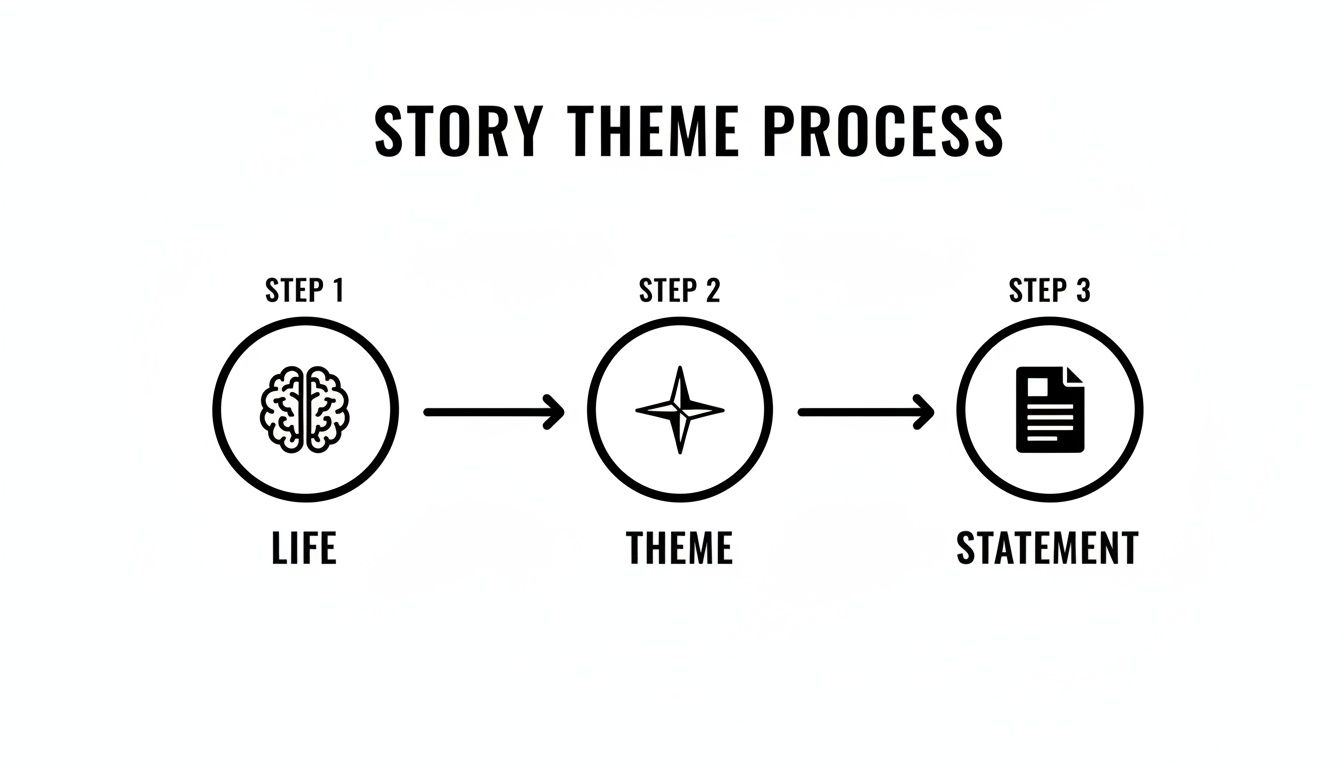
This flow from lived experience to a guiding statement is the foundation for everything that comes next. Now we just need to decide which architectural style suits your story best.
Picking Your Blueprint: Three Ways to Structure Your Story
You don’t have to reinvent the wheel here. Most successful memoirs use one of a few tried-and-true structures. Your job is simply to pick the one that makes your theme shine brightest.
I've seen authors find success with all three of these approaches. It’s all about matching the framework to the story you need to tell.
Here’s a quick breakdown of the most common options to help you choose the best fit for your memoir.
Three Common Memoir Structures
| Structure Type | What It Is | Best For Stories About… |
|---|---|---|
| Chronological Classic | A linear journey from Point A to Point B. You tell your story as it happened, from beginning to end. | Transformation, overcoming adversity, building a business, or any journey where the progression of time is key. |
| Thematic Tapestry | Chapters are organized by theme or idea, not by time. You group related memories together. | A life that spans decades, stories with a strong central message, or when the "why" is more important than the "when." |
| Braided Narrative | Two or more timelines are woven together, often alternating between past and present chapters. | Showing how past events directly shape the present, creating suspense, or revealing information gradually. |
Each of these blueprints offers a different way to guide your reader through your life. Don't stress about picking the "perfect" one right away. Just go with the one that feels the most natural for the story you want to tell. The goal is clarity, not complexity.
If this part feels overwhelming, this is exactly where a professional ghostwriter earns their keep. A good writer can listen to your stories, understand your theme, and immediately see the best way to structure them for maximum emotional impact. It’s like having an architect who can see the finished building from your pile of bricks. You can learn more about how a professional can help you discover the right structure in writing on our blog.
From Blueprint to Chapter Map
Once you've chosen a structure, the next step is to create a simple chapter map. Don't panic! This isn't a detailed, 50-page outline. It’s a high-level roadmap of your book’s journey.
Grab a piece of paper or open a new document and just start brainstorming.
- If you’re going chronological: What are the 10-15 key turning points in your story?
- If you’re going thematic: What are the 5-7 core ideas you want to explore?
For each potential chapter, just jot down these three things:
- The Core Event: What is the main scene or memory this chapter will focus on? (e.g., "The day I got laid off.")
- The Emotional Arc: How do you feel at the beginning of the chapter versus the end? (e.g., "From devastated to determined.")
- The Thematic Connection: How does this chapter serve your Memoir Mission Statement? (e.g., "This shows my first real test of resilience.")
This simple exercise breaks your entire book down into manageable chunks. You’re no longer facing a terrifying blank page. You’re just writing a single, focused story, one chapter at a time. This is how you build a book from chaos. You find your theme, pick a blueprint, and then lay one brick at a time until your masterpiece is standing.
Getting Words on the Page Without the Panic

Okay, this is it. The planning is done, you have a solid structure, and now it’s time to actually get the words out of your head and onto the page. For many people, this is precisely when a cold wave of panic washes over them. That little voice pipes up, whispering, "What if it's not good enough?"
Let’s make a deal: we're going to thank that voice for its concern and then politely show it the door. This first stage isn't about writing well. It’s about writing at all.
Whether you’re drafting this yourself or pulling together memories for a ghostwriter, the goal is exactly the same. You're creating the raw material, the glorious, messy clay that will eventually be sculpted into your book.
Embrace the Glorious Mess
Perfectionism is the single biggest enemy of any writer, full stop. Trying to craft the perfect opening sentence is a surefire recipe for staring at a blinking cursor for three hours and accomplishing nothing.
The solution? Give yourself permission to write what some pros call a "crappy first draft." This isn't just a cute phrase; it's a legitimate professional strategy. No author you admire sits down and produces a flawless manuscript on the first try. It just doesn't happen.
The first draft has one job and one job only: to exist. It's your chance to pour the story out, dig up the details, and discover what you're really trying to say as you say it. For many, the process is tangled up with overthinking and anxiety, which is why treating this draft as a playground for imperfection is so freeing.
"My father, a fine sportswriter, used to say that you should try to write everything like a letter home, a suggestion that’s both graceful and correct… You tend to write about the ideas you are trying on, or the things you’ve tried and failed; how scared you are, or how lonely." – Marion Roach Smith
So, go ahead and write that clunky sentence. Use the wrong word. Chase a tangent down a rabbit hole. You can fix it all later. For now, your only job is to tell yourself the story.
Practical Tools for Capturing Memories
Your most vivid memories rarely arrive on schedule. They’ll ambush you while you're driving, in the shower, or waiting for your coffee. You need a way to catch these sparks before they vanish.
- Your Phone's Voice Memos: This is your secret weapon. The moment a memory surfaces, just open the app and start talking. Don't edit yourself or worry about sounding polished. Capture the raw emotion, the sensory details, the fragment of dialogue you just remembered.
- A Simple Notes App: I tell all my clients to keep a running list of phrases, images, and one-line memory joggers. It can be as simple as "Grandma’s kitchen smell" or "that awful green bridesmaid dress." These fragments are pure gold.
- The 15-Minute Timer: The idea of writing for two hours straight can feel completely overwhelming. But anyone can find 15 minutes. Set a timer and just write, without stopping, until it dings. You will be absolutely stunned by what you can get down in these small, focused bursts.
Getting Unstuck with Prompts
Sometimes, the well just feels dry. When that happens, don't try to force it. Instead, try approaching your story from a different angle with a memoir-specific writing prompt. These are designed to unlock sensory and emotional details, not just plot points.
Next time you feel stuck, give one of these a try:
- The Sensory Room: Describe a room from your childhood using only smells and sounds. What did the old wood of the floorboards smell like after being mopped? What was the specific hum of the refrigerator at night?
- The Imposter Moment: Write about a time you felt like a total fraud, like you were in way over your head and everyone was about to find out.
- A Secret You Kept: Describe the physical feeling of holding a secret. Where did it live in your body? What was the actual, physical weight of it?
- A Meaningful Object: Pick an object from your past that carries a heavy emotional charge. Tell its story. Where did it come from? What events did it witness?
These little exercises can shake loose memories you didn't even know were still there.
And if this whole process still feels like pulling teeth? That might be a sign. Many brilliant people with incredible stories simply aren't wired to be writers, and that is perfectly okay.
That’s precisely why ghostwriting exists. It’s a partnership where you bring the story, the heart, and the soul, and a professional brings the craft of putting it all together. It's still your book and your vision, just without all the frustration. For many, it's the smartest, most enjoyable path to getting their legacy into the world.
Deciding Between DIY and a Ghostwriting Pro
Let's have a completely honest chat. You’ve journeyed this far, wrestled with your theme, and mapped out your chapters. Now you’re staring at the mountain ahead: the actual, page-by-page writing of your book.
If you’re feeling a little overwhelmed, I get it. I really do.
Writing a book is a monumental task. It’s not just about finding the time; it’s about summoning the emotional energy, day after day, and mastering a very specific set of skills. It’s an act of love, but it’s also an act of pure, stubborn grit.
For many busy professionals, entrepreneurs, or anyone who finds the writing process itself exhausting, going it alone can be a recipe for a beautiful dream that ends up as a half-finished manuscript gathering dust. This isn't about giving up. It's about being incredibly smart with your time and energy and choosing the path that actually gets you a finished book.
The Architect and the Dream Home
Hiring a professional ghostwriter is like hiring an architect to build your dream home. You wouldn’t feel like a failure for not knowing how to pour a foundation or frame a wall, would you? Of course not.
You’re the visionary. You know what you want the house to feel like, how the light should hit the kitchen in the morning, where the cozy reading nook should go.
It’s exactly the same with your book. It is still your vision, your story, and your voice. A great ghostwriter is an expert builder. They just handle the heavy lifting, ensuring your story is structurally sound, emotionally resonant, and beautifully written. It's easier, more fun, and you still end up with your book.
The hard truth is that memoirs face a steeper climb in the publishing world. Recent data shows there were only 267 memoir deals announced, compared to 1,828 for fiction. This gap is why memoirs are often called the "hard sell." For aspiring authors without a celebrity platform, the story needs a unique, compelling angle and flawless execution to hook readers.
This is where many get stuck, trying to organize scattered memories into a cohesive structure. You can learn more about the challenges of selling a memoir on Brevitymag.com.
Finding a Partner in Storytelling
The idea of bringing in a pro can feel intimidating, but it's more accessible than you might think. It’s not about handing your story over; it’s about forming a partnership. You are the keeper of the memories, the expert on your life. Your ghostwriter is the expert on turning those memories into a book that people will want to read.
Working with a ghostwriter isn't cheating. It's collaborating. It's honoring your story enough to give it the professional craftsmanship it deserves to truly shine in the world.
This process can actually be incredibly fun and cathartic. Instead of agonizing over a blank page, you get to have deeply engaging conversations, see your story take shape, and provide feedback like a director guiding a film.
Your job is to tell the story; their job is to make it sing. It’s often a faster, more enjoyable, and far more certain path to holding that finished book in your hands.
If you are curious about what this collaboration looks like, it might be helpful to see what's involved when you hire a ghostwriter for your life story. It demystifies the whole process.
Ultimately, whether you write every word yourself or team up with a pro, the goal is the same. You have a story that deserves to be told and preserved forever. Choosing the path that gives your story the greatest chance of reaching that finish line isn't a compromise. It’s a victory.
Tying Up the Loose Ends: Your Memoir Questions, Answered
As you stand at the starting line of this incredible journey, it's totally normal for a few nagging questions to start bubbling up. They have a funny way of showing up at 3 a.m., don't they? Let's tackle those head-on so you can get back to the brilliant work of telling your story.
Think of this as our late-night chat, where we put those common worries to bed for good.
How Do I Write About Other People Without Starting a Family War?
This is the big one. It's the question that keeps so many powerful stories gathering dust in a drawer. You're worried about hurting feelings, burning bridges, or facing a full-blown intervention. I hear you, and it's a valid concern.
The golden rule here is to write your truth from your perspective. A memoir isn't a courtroom transcript; it's a record of your personal, emotional experience.
The key is to focus on how events made you feel, the impact they had on your life, and the lessons you took away. You're telling the story of your journey, not pointing fingers. For example, instead of saying, "My brother was so irresponsible," you could reframe it from your point of view: "Growing up, I often felt like I was carrying the weight of my brother's choices, which left me feeling…" See the difference? One is an accusation; the other is your experience.
Here are a few tools I've seen work wonders:
- Tweak the Details: It's completely fine to change names, blur identifying features, or even merge two minor characters into one to protect someone's privacy. The emotional heart of your story will still beat just as strong.
- Just Talk to Them: Sometimes, a simple, honest conversation is all it takes. Reaching out with a heartfelt, "I'm writing about my life, and our time together was a huge part of it. This is how I remember things, and I want to be as respectful as possible," can prevent a world of hurt down the road.
- Ask Yourself: Is It Essential? Before including a potentially painful detail, ask if it's absolutely vital to the core theme of your book. If it is, then it's worth navigating the complexity. If it's just a bit of juicy but irrelevant gossip, it’s probably better to let it go. Your peace of mind is worth protecting, too.
What If My Memory Is More Like Swiss Cheese Than a Steel Trap?
Welcome to the club! Honestly, if any of us had a perfect, high-definition memory, we’d be completely insufferable. A memoir is about capturing emotional truth, not acing a history exam.
You are absolutely allowed to reconstruct dialogue based on the gist of a conversation. You can even be upfront with the reader, admitting that some of the finer points are a bit fuzzy. That kind of vulnerability actually makes you more relatable, not less credible.
Try using memory joggers to fill in the blanks. Dig out old photo albums, flip through journals, or have a long chat over coffee with a sibling or an old friend. You'll be amazed at the details that come flooding back. The goal isn't a flawless transcript of the past. It's to capture the feeling and the lasting impact of a moment.
So, What's the "Right" Length for a Memoir?
While there's no single magic number, the industry sweet spot for a traditionally published memoir is usually between 60,000 and 80,000 words. That translates to a physical book of around 250 to 300 pages, a length that feels substantial to readers without being too intimidating.
But don't get hung up on that. A shorter, laser-focused memoir of 40,000 words can pack an incredible punch. A sprawling, multi-generational epic might need 90,000 words to do it justice.
Here's my most important piece of advice on this: do not think about word count while you're writing your first draft. Fretting over length while you're trying to get the story out is like trying to frost a cake while it's still in the oven. You're just going to make a mess.
Your only job in the first draft is to tell the story. All of it. It is so much easier to cut a manuscript that’s too long than it is to stretch one that’s too thin.
Get all the clay on the table first. We'll worry about sculpting it into a masterpiece later.
My First Draft Is Done… Now What?
First things first: you need to celebrate. I am not kidding. Pop a bottle of bubbly, do a ridiculous happy dance, buy yourself that thing you’ve been eyeing. Finishing a first draft is a monumental achievement that most people only ever dream of. You actually did it!
Okay, had your moment? Good.
Now, take that manuscript, put it away in a digital (or physical) drawer, and walk away. Do not look at it for at least three weeks. A month is even better. You need to get some real distance from the work to be able to come back and see it with fresh, objective eyes.
When you return, you'll start the editing process, which really happens in layers:
- The Big-Picture Revision: You'll read the whole thing through, looking at the major structure. Does the pacing work? Do the chapters have clear arcs? Is your central theme coming through loud and clear?
- The Line-by-Line Edit: Next, you'll zoom in on the sentences themselves. This is where you polish your prose for clarity and flow, cutting the fluff and making every word count.
- The Final Polish (Proofreading): Lastly, you'll go on a search-and-destroy mission for every last typo, grammatical slip-up, and punctuation error.
This is also the perfect time to bring in a professional. An experienced editor is one of the single best investments you can make in your book. They'll spot the things you're blind to and help elevate your story in ways you can't even imagine. It’s the final, crucial step to getting your story ready for the world.
Turning your life into a legacy is a profound journey. If you need a partner to help organize your thoughts or bring your vision to life, the team at My Book Written is here to guide you every step of the way. Explore our resources to build the book you were meant to create. Learn more at https://mybookwritten.com.