
So, you have a book inside you, just waiting to get out. That’s a beautiful, terrifying, and altogether wonderful thing. It’s an honor to create something that will last forever. But the thought of turning that brilliant idea into the actual sections of a book can feel like trying to build a house without a blueprint.
Let’s fix that. I promise, it’s not as scary as it looks.
Your Book’s Blueprint: The Essential Sections
I get it. You have a story burning inside you, a legacy to leave, or hard-won expertise to share. It takes real courage to decide you’re going to put it all down on paper. But then you sit down, stare at that blinking cursor, and the sheer structure of it all feels… overwhelming.
Don’t panic. A book isn’t some monolithic monster. It’s really just a series of connected rooms, and each one has its own specific job to do. Think of me as your friendly architect, here to walk you through the entire layout. We’ll skip the jargon and just focus on giving your story the strong foundation it deserves. Your idea is worth it.
A Map for Your Journey
Every book, whether it’s a heartfelt memoir or a game-changing business guide, generally follows a familiar three-act structure. It’s like a guided tour for your reader.
- The Front Matter is the welcome mat and foyer. It sets the stage and usually takes up about 5-10% of the book. It’s the first “hello.”
- The Body is the heart of your home, the living room, kitchen, and all the main spaces where the real action happens. This is the bulk of your work, making up 80-90% of the total page count. This is where the magic lives.
- The Back Matter is like a handy workshop, library, or a list of resources. It can range from 5-15% of the book, depending on how much extra material you need to include.
If you’re curious about how these structures relate to the business side of things, the Association of American Publishers offers some interesting insights into industry revenues.
This simple hierarchy shows how the three main parts of a book flow together, from the front matter to the body and finally to the back matter.
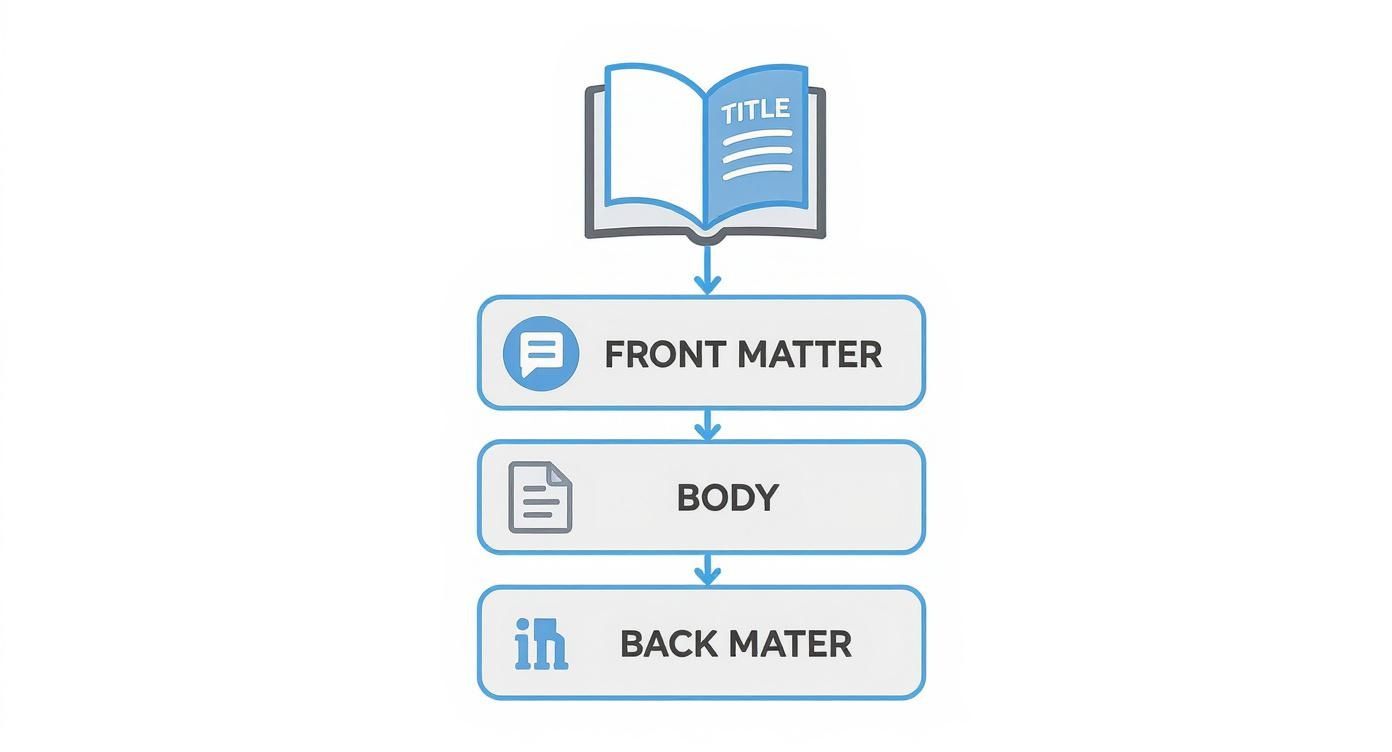
Seeing it laid out visually makes it much clearer, doesn’t it? These aren’t just random pages thrown together; they form a logical sequence designed to guide your reader from start to finish.
To make this even easier to grasp, here’s a quick overview of what goes where.
The Three Main Parts of Your Book at a Glance
| Book Section | Core Purpose | Common Components |
|---|---|---|
| Front Matter | To set the stage, provide context, and establish credibility. | Title Page, Copyright, Dedication, Table of Contents, Foreword, Preface, Introduction |
| The Body | To present the main story, argument, or information in a structured way. | Chapters, Parts/Sections |
| Back Matter | To offer supplementary material, provide closure, and direct the reader to further resources. | Conclusion/Epilogue, Acknowledgments, Appendix, Glossary, Index, About the Author |
Think of this table as your cheat sheet for organizing your manuscript. It helps you see where every piece of the puzzle fits.
Making It Less Scary
My goal here is to demystify this whole process so you can focus on what really matters: your story. Trying to figure this out alone can feel like wrestling an octopus while blindfolded. It’s confusing, messy, and you’re pretty sure you’re losing.
That’s why so many brilliant people partner with a ghostwriter. They are the architects and builders who take your vision and handle the nuts and bolts, making sure every section is perfectly placed and serves its purpose. It’s your vision, just without the headache. It’s still your book, your legacy.
You wouldn’t be expected to build a house by yourself, so why feel pressured to assemble a book all alone? A professional can make the journey smoother and, honestly, a lot more fun. They help you organize your thoughts and transform them into a clear, compelling structure.
Now, let’s start by walking through those three core parts one by one.
The First Handshake: Your Front Matter

Think of your book’s front matter as its first impression. It’s the firm handshake, the warm smile, and the “welcome, come on in!” that happens before the real conversation begins. These first few pages set the tone and give your reader the tools they need to navigate the world you’ve built for them.
It’s easy to dismiss these pages as just administrative fluff, but I promise you they are so much more. This is where you start building a connection with your reader before they even reach the first chapter.
I once worked with a client on a legacy book for his family. His dedication page was so raw and beautiful that it made readers tear up before they even hit page one. It just goes to show this isn’t filler; it’s about creating a true experience from the moment someone cracks open the cover.
The Must-Haves and the Nice-to-Haves
Not every book needs every single piece of front matter. It’s a bit like packing for a trip, you only bring what you need for that specific journey. Let’s break down the most common sections of a book you’ll find up front.
Some of these are absolutely non-negotiable, while others are powerful additions that can add real depth and credibility.
The Essentials (Don’t Skip These):
- Title Page: This one is as simple as it is crucial. It includes your book’s full title, its subtitle, and your name as the author. It’s the book’s official introduction to the world.
- Copyright Page: This is your book’s birth certificate and legal guardian, all rolled into one. It holds the copyright notice, publication information, ISBN, and any necessary legal disclaimers. It might seem a little dry, but it’s what protects your creative work. It’s your book’s legal superhero cape.
The Heartfelt Connections (Use These to Build Rapport):
- Dedication: This is a personal note from you, the author, honoring a specific person or group of people. It’s usually short, sweet, and deeply personal, your chance to say, “This is for you.”
- Epigraph: An epigraph is a short quotation at the very beginning of a book, chosen to hint at its central theme. Think of it as a little appetizer that sets the stage for the main course.
Getting these opening pages just right is an art form. It’s also where having a professional in your corner can make all the difference. A skilled ghostwriter from a top-tier service like My Book Written knows how to make every single word count, turning even the copyright page into a seamless part of the reader’s experience.
Setting Expectations and Building Authority
Beyond the personal touches, your front matter also serves a very practical purpose. It helps readers understand what your book is about and, just as importantly, why they should trust you as their guide.
A well-crafted front matter doesn’t just introduce the book; it builds a bridge between you and your reader. It’s your first opportunity to establish trust and set the stage for the story or wisdom you’re about to share.
Here are a few more powerful sections you might consider including:
- Table of Contents (TOC): This is the roadmap for your book. A truly great TOC doesn’t just list chapter numbers; it uses descriptive titles that spark curiosity and show the reader the journey you’re about to take them on.
- Foreword: Written by someone other than the author, a foreword acts as an endorsement from a respected expert or peer. It essentially tells the reader, “Hey, this person knows their stuff, and their work is absolutely worth your time.”
- Preface: This is your story about the story. In the preface, you get to explain why you wrote the book, what inspired you, and the personal journey that led you to this moment. It’s all about the “why.”
- Introduction: While the preface is about your “why,” the introduction is about the reader’s “what.” It tells them what they’ll learn, what problems the book solves, and how to get the most out of their reading experience.
Deciding which of these to include can feel tricky. You don’t want to overwhelm your reader, but you also want to provide enough context. This is another one of those moments where partnering with a ghostwriter isn’t just helpful; it’s a genuine relief. They’ve done this hundreds of times and can guide you to choose the perfect mix of front matter to make your book shine, making the whole process easier and far more joyful.
The Heart of Your Story: Structuring the Body
This is it. The main event. The reason you started this whole crazy, wonderful journey in the first place. The body of your book is where your story unfolds, your message takes flight, and your wisdom finds a home. It’s the beating heart of your entire project.
Getting here is a huge accomplishment, something to be genuinely proud of. But even the most brilliant idea can fall flat if its structure is confusing. Think of the body as the series of rooms in your house; without hallways connecting them logically, your guests will just wander around in circles, bumping into walls.
You don’t want your reader to feel lost. You want them to feel guided, engaged, and completely captivated by the path you’ve laid out for them.
Finding Your Narrative Flow
How you organize your book’s body depends entirely on what you’re trying to say. There’s no single “right” way to structure your chapters, only the way that best serves your unique story.
The number of sections can vary wildly by genre. In the educational and academic worlds, for instance, books often have more sections to help with learning. A report from Grand View Research highlights that the educational books segment holds the largest market share at 20.65% globally. A typical textbook in this space might have 12-15 sections, while a standard trade book has closer to 7-10.
Let’s look at a few common approaches to structuring the main sections of a book.
- Chronological Order: This is the natural choice for memoirs, legacy projects, or history books. You start at the beginning and move forward through time. Simple, classic, and incredibly effective.
- Thematic Grouping: Perfect for a book that explores different facets of a single big idea. Each chapter or part tackles a different theme, like “Leadership,” “Resilience,” or “Innovation.”
- Problem and Solution: This structure is a powerhouse for business or self-help books. You introduce a common problem your reader faces, explore it deeply, and then present your unique solution. It keeps them hooked because you’re directly addressing their pain points.
The structure of your book is the invisible scaffolding that holds your story up. A great structure is something the reader never notices, but they’d feel its absence immediately. It’s the silent partner to your prose.
Choosing a structure is a huge decision, and frankly, it can be intimidating. This is precisely where a ghostwriter becomes your secret weapon. They are masters of narrative architecture, helping you build a framework that is not only compelling but also perfectly clear for your reader. It’s like having a master builder for your book’s house.
Chapters: The Building Blocks of Your Book
If the body is the house, then the chapters are the individual rooms. Each one should have a clear purpose and feel distinct, yet connected to the whole. A chapter isn’t just a word-count goal; it’s a self-contained unit of your story.
When I work with authors, we often think of each chapter as answering a single, important question or making one major point. This keeps the writing focused and helps the reader process the information without feeling overwhelmed.
Structuring Your Chapters
So, how do you make a chapter feel like a chapter? Here are a few things I always keep in mind:
- A Strong Opening: Hook your reader from the very first sentence. Start with a surprising story, a provocative question, or a bold statement.
- A Clear Focus: Stick to one main idea per chapter. If you find yourself drifting into too many different topics, it might be a sign that you need to break it into two separate chapters.
- A Satisfying Close: End each chapter with a sense of closure, but also with a reason to turn the page. It could be a powerful summary, a cliffhanger, or a question that sets up what’s coming next.
Mapping this all out, the overarching structure, the purpose of each part, the flow of every chapter, is a massive undertaking. It’s also incredibly rewarding when it clicks into place. But you don’t have to do it alone.
This is where the real magic of collaborating with a professional comes in. A ghostwriter doesn’t just write for you; they think with you. They can take your collection of stories, ideas, and notes and see the beautiful, coherent structure hiding within. It makes the entire process easier, more fun, and ensures your vision is brought to life in the most powerful way possible.
The Parting Gift: A Guide to Your Back Matter

Please, whatever you do, don’t think of the back matter as the boring, dusty attic of your book. It’s so much more than that. I like to think of it as the book’s parting gift to the reader, a warm “thank you for coming” with a little goodie bag to take home.
This is where you can provide a ton of extra value, prove your most important points, and give those wonderfully curious readers a path to learn even more. It’s your chance to show off the depth of your research and the care you’ve put into every detail.
Giving Your Readers More
The back matter is entirely optional, but for nonfiction books, it’s often what separates a good book from a great one. It’s a sign of respect for your reader’s intelligence and their desire to dig deeper.
These days, readers simply expect more from the sections of a book, especially in business or academic fields. Publishing has changed a lot over the years. A century ago, books had minimal back matter, but a recent report from WIPO shows that the average number of sections has jumped from about 4-5 to 7-10 in modern books. If you’re a data nerd like me, you can dive into the full research on global publishing trends to learn more.
So, let’s break down the most common pieces of back matter and figure out when you might need them.
The Appendix: Where Extra Details Live
Think of an appendix as the perfect home for all the fascinating stuff that doesn’t quite fit in the main story but is still incredibly valuable. It’s like the “deleted scenes” or a director’s cut of your favorite movie, full of bonus material for the true fans.
When should you add one? Here are a few great reasons:
- You have supplementary documents: This could be anything from full interview transcripts and original letters to detailed case studies that would otherwise bog down a chapter.
- You rely on a lot of data: Instead of cluttering your chapters, you can put raw data tables, charts, or survey results here, keeping the main text clean and readable.
- You’ve created helpful tools: Worksheets, checklists, or extensive resource lists are perfect for an appendix.
An appendix essentially tells your reader, “I have so much more to share with you.” It’s a generous and powerful way to add depth without cluttering your main narrative.
An appendix shows you’ve really done your homework and are giving the reader every possible tool to succeed. It builds immense trust.
Helping Readers with Key Terms and Sources
Some of the most useful parts of a book are the ones that help readers understand your language and trust your information.
- Glossary: If your book is full of technical jargon or industry-specific terms, a glossary is your reader’s best friend. It’s a mini-dictionary just for your book, making sure no one gets left behind.
- Bibliography or Endnotes: This is simply where you list your sources. It’s not just for academic papers; a bibliography shows you respect the work of others and gives your own book huge credibility.
I can’t stress this enough: this is another area where a ghostwriter is an absolute lifesaver. Compiling and formatting these sections is tedious, detail-oriented work. Handing it off to a professional frees you up to focus on the big picture, making the whole process feel less like homework and more like the joyful act of creation it should be.
The Index: The Unsung Hero
An index might seem old-fashioned in a world of digital search, but for a dense nonfiction book, it is a godsend. It’s a meticulously organized map that lets readers quickly find specific topics, names, or concepts they want to revisit.
I once worked on a history book packed with names, dates, and locations. The author was on the fence about including an index. We went for it, and the reviews praised the index almost as much as the content itself. Readers absolutely loved being able to easily jump back to find exactly what they were looking for.
Never underestimate the power of making your book easy to use. A well-crafted index is a sign of ultimate respect for your reader’s time.
Putting It All Together: A Book Structure Checklist
https://www.youtube.com/embed/GGQ_ORob-yI
Okay, let’s bring all this theory down to a practical level. We’ve walked through all the potential rooms you can build into your book’s blueprint, and now it’s time to actually sketch out your own floor plan.
Don’t worry about getting it perfect on the first go. Seriously. Give yourself permission to be a little messy here. Think of this checklist as a conversation starter, a way to get the ideas out of your head and onto paper where you can see them, shape them, and start building.
This is all about creating a solid jumping-off point that you can refine, especially if you plan on teaming up with a ghostwriter. Trust me on this one: showing up to that first meeting with a thoughtful checklist like this will save you a ton of time. It immediately shows a professional that you’ve deeply considered your vision, which is the best possible foundation for bringing your book to life.
The Front Matter: Your First Impression
Let’s start right at the beginning. Your front matter is like the handshake that welcomes your reader in. Answering these questions will help you nail down exactly what your book’s introduction needs to do.
- Dedication: Who is this book really for? Is there a specific person or group you want to honor? What do you want to say to them directly?
- Foreword: Who in your world would be the dream person to introduce your book? Think about whose voice would add instant credibility and get readers buzzing before they even hit page one.
- Preface: What’s the story behind the book? What personal journey, a-ha moment, or nagging question sparked this whole project? This is your “why.”
- Introduction: What’s in it for the reader? Are you solving a specific problem for them, or are you about to take them on a wild ride? This is their “what.”
The Body: Your Core Message
Now we get to the main event. How are you going to organize all your big ideas? The structure you choose for your body chapters is probably the single most important decision you’ll make for your reader’s journey.
Ask yourself these questions:
- Does your story unfold over time? A chronological structure is almost always your best bet.
- Are you teaching a framework or a process with multiple parts? A step-by-step structure will guide your reader from A to B without getting them lost.
- Is your book built around tackling a major challenge? A problem-solution structure can be incredibly satisfying and keep your reader hooked.
I know, figuring this out is tough. It can feel like you’re trying to see the finished sculpture hidden inside a huge block of marble. This is another area where a good ghostwriter can act as your co-pilot. They’re experts at seeing the underlying structure you might miss, helping you arrange scattered ideas into a clear, compelling narrative. It’s still your vision, they just help you draw the map.
A great book structure should feel inevitable to the reader, as if the story could not have been told any other way. Your job isn’t to invent it, but to discover the most natural path for your ideas to follow.
The Back Matter: Your Parting Gift
Finally, what little extras will you leave for your reader? Thoughtful back matter is a sign of respect; it shows you’re committed to giving them everything they need to succeed.
- Appendix: Do you have extra data, case studies, or worksheets that would bog down a chapter but are too valuable to just cut out?
- Glossary: Does your book use industry-specific jargon or new terms? A glossary is a small act of kindness that makes a world of difference.
- Index: Is your book packed with information, names, or places? An index is the ultimate tool for readers who want to circle back and find specific topics later.
This checklist isn’t a test, it’s a tool. Use it to get clear on your vision and take that first tangible step toward holding your finished book in your hands. You’ve got this.
Which Book Sections Do You Need?
Feeling a bit overwhelmed by all the options? That’s completely normal. This simple table is designed to help you quickly decide which front and back matter sections make the most sense for your specific book project.
Go through the list and think honestly about your goals and your reader’s needs.
| Book Section | When to Include It | My Book Needs This (Yes/No/Maybe) |
|---|---|---|
| Dedication | You want to honor a specific person or group who inspired the book. | |
| Foreword | An influential expert can add credibility and reach a wider audience. | |
| Preface | The story of why you wrote the book is important context for the reader. | |
| Introduction | Your book needs to set the stage, make a promise, and tell readers what to expect. | |
| Appendix | You have supplemental material (data, lists, templates) that’s useful but would disrupt the main text. | |
| Glossary | Your book contains specialized terms or jargon that readers might not know. | |
| Index | Your book is a reference guide or is dense with information that readers will want to look up later. | |
| Bibliography | You’ve cited many sources (academic, business, historical) and want to give proper credit. |
Once you’ve filled this out, you’ll have a much clearer picture of your book’s architecture. It’s the first major step from “idea” to “outline,” and a fantastic resource to share with a potential editor or ghostwriter.
A Few Common Questions About Book Sections
It’s completely normal for questions to pop up when you’re mapping out your book. This is a big deal, creating something that will last forever is an honorable goal, and it’s okay to feel a little lost in the weeds sometimes. My hope is to make this whole process as clear and stress-free as possible for you.
Here are a few of the most common questions we hear from aspiring authors who are right where you are now.
Do I Really Need All These Sections in My Book?
Absolutely not. Think of this guide as a restaurant menu, not a mandatory five-course meal. The sections of a book you actually need depend entirely on your genre and what you want your book to achieve.
A heartfelt memoir, for example, might only need a title page, copyright page, and maybe a sweet dedication. A complex business book, on the other hand, would feel incomplete without a detailed table of contents, a strong introduction, and a helpful index. The golden rule is to pick and choose only what serves your reader. It’s about giving them the best possible experience, not just checking off boxes on a list.
What Is the Difference Between a Preface, a Foreword, and an Introduction?
Ah, the “PFI” question. It’s so easy to get these three tangled up, so let’s break it down with a simple analogy. Imagine them as three different people introducing your book at a party.
- The Foreword is written by someone else, usually a well-known expert in your field. They’re the respected guest who stands up and says, “Listen to this person, they’re brilliant.” Their job is to lend your book credibility and social proof.
- The Preface is written by you, the author. This is your chance to tell the story of the book. Why did you write it? What was the personal journey that led you to this topic? It’s all about your “why.”
- The Introduction is also penned by you, but it’s about the book itself. It speaks directly to the reader, laying out what they’re about to learn and how to get the most out of their reading experience. It sets the stage for their “what.”
You almost certainly won’t need all three. It’s all about choosing the one that gives your book the right kind of kickoff.
Can I Change My Book’s Structure While I’m Writing It?
Of course! In fact, please, please give yourself permission to do this. A book is a living, breathing thing during the creation process. Your initial outline is a map, but sometimes you discover a beautiful, unexpected scenic route once you’re on the road.
This is another one of those moments where working with a professional is a lifesaver. A great ghostwriter is like an experienced GPS; they are masters at adapting the structure as the manuscript evolves. They ensure any changes you make only strengthen the book’s flow instead of causing a narrative traffic jam. The goal is to stay flexible while always keeping the reader’s journey front and center.
A book’s structure isn’t set in stone; it’s molded in clay. It needs to be strong enough to hold its shape but flexible enough to be perfected as the vision becomes clearer.
How Important Is the Table of Contents for an Ebook?
For an ebook, the table of contents isn’t just important, it’s critically important. It’s the primary navigation tool your reader will use to get around.
Most ebook platforms automatically generate a clickable TOC that lets readers jump to any chapter with a single tap. This means a clear, well-worded TOC makes your ebook incredibly user-friendly. Vague chapter titles like “Chapter Three” are frustrating for a digital reader, but descriptive ones like “The Five Mistakes Every New Investor Makes” are a gift. This is a key part of their digital experience, so it’s absolutely worth your time to get it right.
At My Book Written, we believe your story deserves a solid foundation. If you’re feeling stuck turning your ideas into a clear structure, we’re here to help. Explore our resources to build your book’s blueprint with confidence. Learn more at My Book Written.